

Extra Eligibility: 11 Ways to Play Longer
Almost every player believes the same thing: you get four seasons, five years to use them, and one redshirt if something goes wrong. That sentence was never true of every level, and as of 2026 it is not even true of the level most people mean when they say “the NCAA.”
Extra eligibility is not a loophole and it is not a favour. It is a set of written provisions in five different rulebooks, and most of them have been sitting there for years while players aged out without ever reading them.
We went through those rulebooks (the NCAA Division III Manual, the NAIA Official Handbook, and the current bylaws of all three junior college associations) and counted every extra eligibility path that can genuinely put you on a college field past year five. There are eleven that we could verify against the actual rule text.
This guide gives you all eleven extra eligibility paths, which division or association each one lives in, whether it buys you time or saves you a season, and the five myths that cost players more eligibility than any injury ever has.
Quick answer: Yes, you can play more than five years of college baseball, and there are eleven verified ways to do it. The biggest is the simplest: the NAIA has no five-year rule and no age limit at all, so a player with terms of attendance left can keep playing into their mid-twenties and beyond. The rest are clock pauses, season-recovery waivers, participation thresholds and enrollment rules that vary sharply by division: extra eligibility is real, but almost none of it works the same way at two different levels.
Key takeaways
- There are 11 verified extra eligibility paths across the NCAA, NAIA and the three JUCO associations.
- The NAIA has no five-year rule and no age limit by its own bylaw → that single fact outranks every waiver on this page.
- Every path does one of two things: it extends your time window, or it saves a season inside it. Confusing the two is the most common mistake in extra eligibility advice.
- Division I and II deleted redshirts and medical hardship waivers in 2026. Division III kept both.
- If your NCAA clock expires with seasons unused, all three JUCO associations are still open to you.
- Nothing here is a loophole. Every one of the 11 is written in a rulebook, and every one is division-specific.
Can you really get extra eligibility past five years?
Yes, but not by arguing with the NCAA. The reliable extra eligibility paths mostly involve playing under a different rulebook, qualifying for a written exception, or never burning the season in the first place.
The five-year figure that makes players assume extra eligibility is impossible comes from one place: the NCAA’s period of eligibility at Divisions I and II. That is one rulebook out of five that govern college baseball, and it is the strictest of them.
The NAIA does not have a five-year rule. None of the three junior college associations has one either. Division III does not run a calendar clock at all, it counts full-time semesters. So “five years” is not a law of college baseball. It is one association’s rule for two of its three divisions, and extra eligibility begins with knowing that.
For the full picture of how the NCAA side now works, start with our NCAA baseball eligibility guide and the NCAA eligibility clock explainer.
The two machines: your time window and your seasons
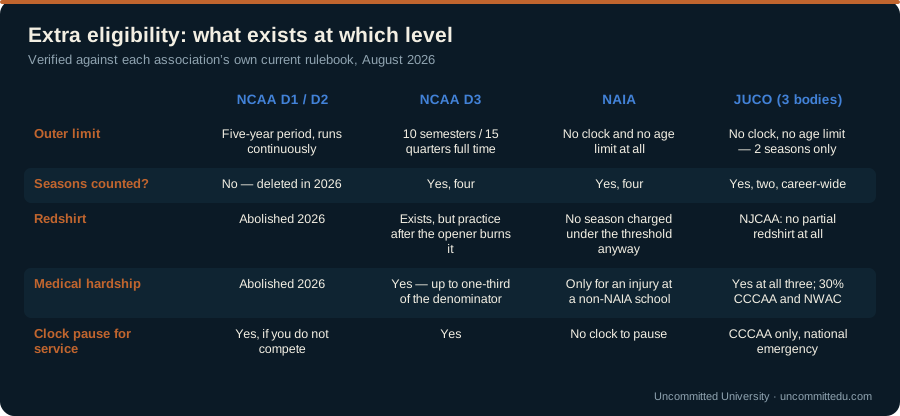
Before the list, one distinction. Get this wrong and every piece of extra eligibility advice you read will seem to contradict every other piece.
There are two separate counters, and a given rule touches one or the other, almost never both.
| Counter | What it measures | Where it lives |
|---|---|---|
| The time window | Calendar time, or full-time terms enrolled | running whether you play or not | NCAA D1/D2 five-year period; D3’s 10 semesters; NAIA’s 10 semesters of attendance |
| Seasons of competition | How many years you actually appeared in games | D3 and NAIA (4 seasons); all three JUCO bodies (2 seasons). Deleted at D1/D2 in 2026 |
A pregnancy pause adds time to the window. Fall ball not counting against you saves a season. Those are different machines, and they do not stack the same way.
The reason this matters for extra eligibility is blunt: if the thing that ran out was your window, saving seasons will not help you, and vice versa. Work out which counter stopped you first, then read only the extra eligibility paths that touch it.
All 11 extra eligibility paths at a glance
| # | Extra eligibility path | Where it applies | Buys time or saves a season |
|---|---|---|---|
| 1 | No clock, no age limit at the NAIA | NAIA | Both | there is no clock to run out |
| 2 | JUCO after your NCAA clock expires | NJCAA, CCCAA, NWAC | Time | they count seasons, not calendar |
| 3 | Military service or an official religious mission | NCAA D1, D2, D3 (CCCAA has its own version) | Time |
| 4 | Pregnancy | NCAA D1, D2, D3; NAIA | Time |
| 5 | Debilitating illness extension | NAIA | Time |
| 6 | Medical hardship, where it still exists | D3, NJCAA, CCCAA, NWAC | Season |
| 7 | Stay under the participation threshold | NAIA, NWAC | Season |
| 8 | Club baseball where there is no varsity team | D3, CCCAA | Season |
| 9 | Play through a graduate or second degree | D3, NAIA | Unlocks what you already have |
| 10 | Summer and inter-terms never burn a term | NAIA | Time |
| 11 | Part-time and reduced enrollment | NAIA, NWAC | Time |
Extra eligibility by switching rulebooks
1. Play NAIA, where no clock and no age limit exist
This is the single most under-used piece of extra eligibility in college baseball, and it is one sentence in the NAIA handbook.
The NAIA states outright that for eligibility purposes it does not recognise the NCAA five-year rule or age-limitation regulations. What it counts instead is four seasons of competition inside ten semesters of attendance, and its own bylaw adds that those ten semesters need not be consecutive.
Read that carefully. A term is only charged while you are enrolled and identified at a school. A gap year charges nothing. A gap decade charges nothing. Working a job for three years charges nothing, because there is no calendar counter running in the background at all.
The practical result: a 26-year-old with four semesters of attendance left and two seasons unused has no NAIA rule standing in his way. Our NAIA eligibility rules guide covers the two-counter structure in detail, and NAIA baseball explained covers what the level actually looks like.
You can read the rule yourself in the NAIA Official and Policy Handbook, Article V.
2. Play JUCO after your NCAA clock expires
Here is a genuine extra eligibility consequence of the 2026 NCAA reform that almost nobody has written about: the NCAA now counts time, and the junior colleges count seasons. Those two systems can disagree, and when they do, a door opens.
None of the three JUCO associations imposes its own clock or its own age limit. Each asks one question: how many seasons of collegiate competition have you already used, anywhere? If your NCAA five-year period expired while you still have JUCO seasons left, the junior colleges have no rule that closes on you.
All three cap you at two seasons and all three count seasons played at other colleges, so this does not mint new seasons: you cannot drop down a level for a fresh start. But a player whose window closed with one or two seasons unused is a real category, and the 2026 reform created more of them.
The three associations are the NJCAA across most of the country, the CCCAA in California, and the NWAC in Washington, Oregon and Idaho. Our JUCO eligibility clock guide explains how the two systems interact, and JUCO baseball explained covers the level itself.
Extra eligibility from pausing the clock
3. Active-duty military service or an official religious mission
This extra eligibility path gets dismissed as a rumour constantly. It is not a rumour. It has been NCAA bylaw for decades, and it survived the 2026 rewrite intact.
Time spent in active-duty military service, on an official religious mission, or in a similar recognised service commitment can be excluded from the five-year period at Divisions I and II, provided you do not compete during that service. Compete, and the exception does not apply at all. Division III handles the same situations under its own unchanged rule.
Scope it carefully, because this is where extra eligibility advice usually goes wrong. At the junior colleges the same words mean much less: the NJCAA and NWAC provisions relieve academic and enrollment requirements for returning veterans but do not hand back a season. Only the CCCAA grants an outright extra season for active duty, and only when a national emergency has been declared. The NAIA has no clock to pause in the first place, so describing its military provisions as a “stop-clock” is simply the wrong frame.
4. Pregnancy
Pregnancy is the one extra eligibility provision that exists at every NCAA division and at the NAIA, and the versions differ enough to matter.
At Divisions I and II under the 2026 model, the pause runs for the actual period during which the athlete cannot compete, with medical documentation, it is open-ended rather than capped. Division III grants a fixed two-semester or three-quarter extension. The NAIA grants a one-time two-semester or three-quarter extension to its terms-of-attendance cap.
The honest gap: none of the three junior college associations names pregnancy anywhere in the bylaws we read. That is an absence in their rulebooks, not a denial, and it is the one item on this page most worth asking a compliance officer about directly.
5. NAIA’s debilitating-illness extension
Separate from pregnancy and separate from any sports injury, this NAIA extra eligibility route grants a one-time extension of two semesters or three quarters to the ten-semester cap for a debilitating illness: its bylaw names cancer, chemical dependency, and sufficiently intrusive psychological or mental illness as examples.
It requires documentation from someone licensed to diagnose and treat that specific condition, and it is not automatic: the request goes to the National Eligibility Committee as an exceptional ruling, decided case by case.
Extra eligibility from saving a season
6. Medical hardship, where it still exists
The medical hardship waiver is the extra eligibility path everyone has heard of, and it is also the one whose map changed most in 2026.
Divisions I and II deleted it. Medical hardship waivers appear by name on the NCAA’s own list of waiver categories eliminated by the age-based model. If you are a D1 or D2 athlete, this route no longer exists for you.
It survives everywhere else, with different thresholds:
- Division III: a season-ending injury or illness before the halfway point of the season, with participation no greater than one-third of the standard denominator. Mental health conditions qualify on equal footing with physical injury as of a 2025 revision. Note the number: a lot of secondary sites still quote 20%, which is stale.
- CCCAA: 30% of completed contests, and before the second half of the season.
- NWAC: 30% of maximum permissible contests, which for baseball is capped at 15, with the injury in the first half of the schedule.
- NJCAA: the bylaw explicitly contemplates a third season of participation once a hardship is approved. We could not confirm the current participation threshold: the pamphlet we could reach lists 20%, and njcaa.org has moved to a format that served no readable rulebook when we checked in August 2026. Treat it as somewhere in the 20–30% range and confirm with the school.
The NAIA is the odd one out and it is good news. Because of its participation threshold below, a player hurt early is never charged a season to begin with, so no waiver is needed. The one hardship provision left in the NAIA handbook covers a season-ending injury suffered at a non-NAIA school before transferring in.
7. Stay under the participation threshold
Most players assume any appearance burns a year, and give up on extra eligibility because of it. At two associations, that is flatly untrue, and the numbers are generous.
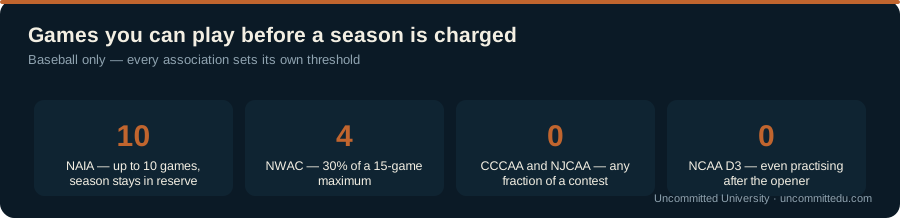
The NAIA charges a season only past 20% of the maximum allowable contests. For baseball, the published threshold is 11 contests, meaning a player can appear in up to 10 games and the season stays in reserve. Scrimmages never count at all, with no cap on how many.
The NWAC charges a season only past 30% of its maximum, which for baseball is 15 contests. Appear in four or fewer and never reach the postseason, and no NWAC season is used. Any postseason appearance charges the season regardless of percentage.
The contrast is stark and it is worth knowing before you choose a level: the CCCAA and the NJCAA charge a full season for any fraction of any contest, and the NJCAA says in its own text that it does not use a partial-season redshirt under any circumstance.
8. Club baseball where there is no varsity team
A narrow extra eligibility route, but a free one. At Division III, participation on a college club team is exempt from counting as intercollegiate competition provided the institution does not sponsor that sport at varsity level. The CCCAA has the same carve-out. Division I mirrored it before 2026.
Flip it around and the rule bites: club baseball at a school that does field a varsity team burns a season exactly as if you had played varsity. And the NJCAA charges a season for any fraction of a club season regardless of the host school’s varsity status, so this path does not exist there at all.
Extra eligibility from stretching the calendar
9. Play through a graduate or second degree
This is the most realistic extra eligibility route at Division III, and it has nothing to do with injury or hardship. Graduate early, keep your grades up, and enrol in a graduate or second bachelor’s programme: a D3 athlete may keep competing at the same or a new D3 school with eligibility remaining, provided time is left in the ten-semester window.
The NAIA has its own version: a post-baccalaureate student pursuing a second degree, a second major, or graduate work of any kind may keep competing on remaining seasons and terms. Combined with the NAIA having no clock at all, this is the mechanism behind players legitimately on rosters into their mid-twenties.
The transfer side of this is its own subject: see our grad transfer rules guide.
10. Summer sessions and inter-terms never burn an NAIA term
The NAIA defines a term of attendance as any quarter, semester or trimester excluding summer sessions. Inter-terms (the short sessions between two regular terms) are separately defined as not being terms of attendance at all.
That means you can take a full summer load, earn real credit toward your degree, and spend none of your ten terms doing it. Stack that across three summers and you have effectively bought yourself an extra year of campus time without touching the counter that limits you. It is the quietest extra eligibility gain on this page.
11. Part-time and reduced enrollment
Two different extra eligibility rules here, both real.
At the NAIA, a term only counts once you are “identified”, which means enrolling in 12 or more credit hours, or competing in a contest. Enrol below that line and do not compete, and the term is not charged. It is narrow by design: play in one game and you are identified regardless of hours, so this only helps a term you were sitting out anyway.
At the NWAC, there is an explicit reduced-enrollment path for athletes who have banked 90-plus credits or an associate degree: they may enrol less than full-time and still compete, provided they stay in at least one degree-seeking class. The bylaw itself flags the trade-off: doing this may cost you a term or year of participation at the four-year level even though the NWAC does not charge it that way.
Can you play college baseball at 24 or 25? Age limits by association
Yes, at Division III, in the NAIA and at a junior college, none of which has an age limit. At NCAA Division I and II the answer is arithmetic: your five-year period starts the academic year after your 19th birthday whether you enrolled or not, so it runs out around your 25th birthday no matter what you did in between. That is the single biggest change the 2026 model made for the late starter, the gap-year player and the returning missionary who did not file the exclusion.
| Association | Age limit | What actually limits you | A 25 year old who never enrolled |
|---|---|---|---|
| NCAA Division I and II | None by name, but the clock starts the year after you turn 19 | The five-year period, paused only by military service, a religious mission or pregnancy | Clock started at 20 and expired at 25. No time left. |
| NCAA Division III | None | 10 semesters of full-time enrollment and four seasons of participation, counted from first full-time enrollment anywhere | A full four seasons, as a freshman. |
| NAIA | None, and the handbook says it does not recognise NCAA age rules | 10 semesters and four seasons, and a season only when you pass the participation threshold | A full four seasons. |
| NJCAA, CCCAA, NWAC | None | Two seasons of competition in the sport | Two seasons, then transfer with the four-year clock still to be read by the next association. |
Former professionals are a separate question. A player who signed a professional baseball contract has ended his NCAA baseball eligibility; the NAIA and the junior colleges can take a former professional in some circumstances, usually charging seasons for the professional seasons played, and each reads its own rule, so ask the eligibility office before assuming either answer. The age limit guide works through the 19th-birthday trigger with dates.
Five extra eligibility myths that cost players seasons
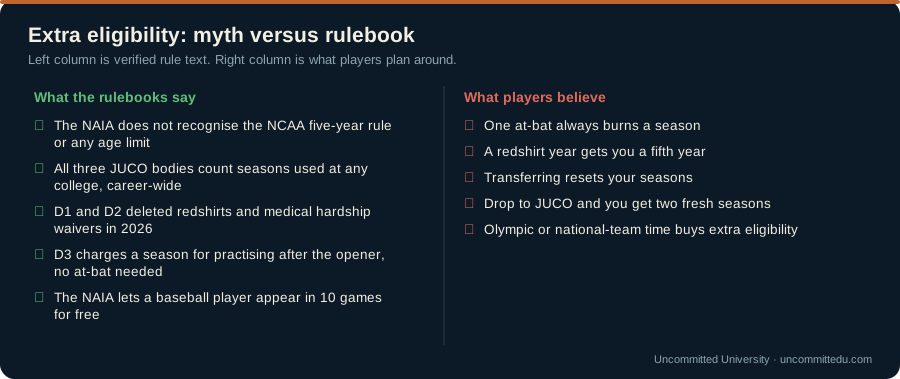
These come up in every conversation about extra eligibility, and each one is either wrong or wrong at the level the player cares about.
| The myth | What the rulebooks say |
|---|---|
| “One at-bat burns a season” | Was exactly right at D1/D2 before 2026: the bylaw said any competition, regardless of time. Now moot there, since seasons of competition were deleted. Understates D3, where merely practising after the opener burns it. Wrong at the NAIA and NWAC, which have thresholds |
| “A redshirt gets you a fifth year” | Athletics redshirt rules were eliminated at D1 and D2 in 2026. D3 still permits one, but only if you avoid practice as well as games, and its own bylaw lists a redshirt year as a circumstance within your control that earns no extra time |
| “Transferring resets your seasons” | False everywhere we looked. The NAIA counts seasons charged by other associations at face value; all three JUCO bodies count seasons used at any post-secondary institution |
| “Drop to JUCO for two fresh seasons” | False. All three JUCO associations count prior collegiate seasons career-wide. Path 2 above works because your clock expired, not because seasons reset |
| “Olympic or national-team time buys eligibility” | It did before 2026, through a one-time athletics activity waiver capped at one year. That waiver category is named on the NCAA’s own eliminated list, so the clock-extension version of this looks gone at D1/D2, though the NCAA has not addressed Olympians by name |
The redshirt myth is the most expensive extra eligibility mistake, because players still plan around it. Our NCAA redshirt rules guide covers what replaced it, and the NCAA age limit guide explains the model that deleted it.
What we could not verify
Publishing what we could not confirm is part of honest extra eligibility reporting, because a confident answer built on a stale rulebook is worse than no answer.
- The NJCAA’s current medical hardship threshold. The reachable NJCAA rules document dates from 2018-19; njcaa.org now serves a format that returned no readable rulebook in August 2026. The mechanism is clear, the exact percentage is not.
- Pregnancy provisions at the junior colleges. Genuinely absent from every JUCO rulebook we read, not merely unresearched.
- Study-abroad and internship clock exceptions at D1. These existed before 2026. They are not named on the NCAA’s eliminated lists, but those lists may not be exhaustive. Status unknown.
- Whether club baseball still means anything at D1/D2. The season-of-competition concept those rules were built on no longer exists there.
One more caveat that applies to every NCAA line on this page: parts of the 2026 age-based model are under active litigation. A July 2026 preliminary injunction in Wisne v. NCAA restored fifth-season eligibility for the Division I class of 2022, and on August 21, 2026 the Tenth Circuit stayed that injunction, 2 to 1, pending an expedited appeal. The NCAA told its schools the same day that the age-based rules were back in force and that class members who had returned under the injunction were no longer eligible, unless a state court had ordered otherwise for them individually. The appeal itself is undecided. The rules described here are the rules in force as of September 2026. If you are inside a season that depends on the outcome, check the current position before you commit.
How to work out your own extra eligibility
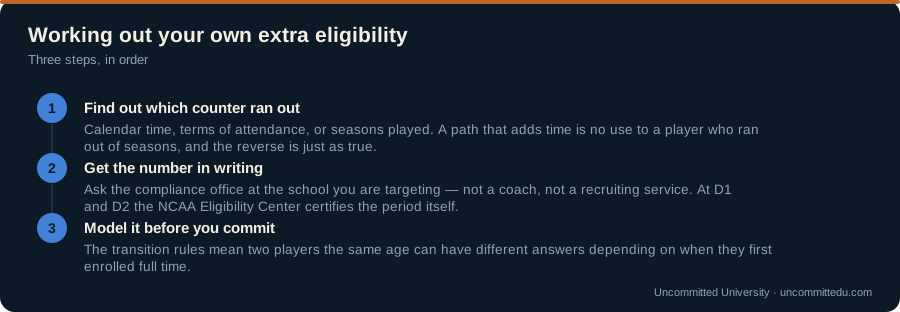
Three steps, in this order, and they apply to every extra eligibility path above.
First, find out which counter ran out. Was it calendar time, terms of attendance, or seasons played? The answer decides which of the eleven extra eligibility paths above can even apply to you.
Second, get the number in writing. Ask the compliance office at the school you are targeting (not your coach, not a recruiting service) how many seasons and how much window they believe you have. At Divisions I and II the NCAA Eligibility Center certifies the period itself.
Third, model it before you decide anything. Most of these paths interact, and the transition rules at D1 and D2 mean two players the same age can have different answers depending on when they first enrolled.
Check your eligibility, free
Answer a few questions and see how many seasons you have left across NCAA D1, D2 and D3, the NAIA and all three JUCO associations.
Frequently asked questions about extra eligibility
How do you get a 5th year of eligibility? At NCAA Division I and II you no longer have to. Since 2026 the model is five years to play five, so a fifth season is the default for any player whose clock still has time, and no redshirt or waiver is needed to reach it. The question that remains is the sixth year, and the only routes to it are the clock pauses: military service, a religious mission or pregnancy. At Division III and in the NAIA the fifth year still comes from a saved season: a year of full-time enrollment in which you stayed under the participation threshold.
Does redshirting give you an extra year of eligibility? Not at Division I or II any more. The 2026 age-based model deleted seasons of competition, so sitting out a year saves nothing; the five-year period runs whether you play or not. At Division III and in the NAIA a genuine redshirt year, full-time enrolled and under the games threshold, still saves one of your four seasons, but it never saves a semester: the 10-semester count keeps running.
Can you play college baseball at 25? Yes. Division III, the NAIA and the junior colleges have no age limit, and a 25 year old who has never enrolled full time starts with a full set of seasons at any of them. NCAA Division I and II are closed to that player, not by an age rule but by the clock, which started the academic year after his 19th birthday and has already run out.
How many ways are there to get extra eligibility in college baseball? Eleven that can be verified against the actual rule text of the NCAA, NAIA and the three junior college associations. They divide into paths that extend your time window, paths that save a season inside it, and one path (the NAIA) where no clock exists to run out.
Can you play college baseball after your NCAA five-year clock expires? Yes. The NAIA does not recognise the NCAA five-year rule or any age limit, and none of the three JUCO associations runs its own clock. If your NCAA window closed with seasons unused, those levels have no rule that closes on you for that reason alone.
Is there still a medical hardship waiver for extra eligibility? Not at Division I or Division II: it was eliminated by name in the 2026 age-based reform. It survives at Division III and at all three JUCO associations, with different participation thresholds at each.
Does a religious mission really pause your eligibility clock? At the NCAA, yes. Time on an official religious mission can be excluded from the five-year period provided you do not compete during it. At the junior colleges it does not add a season: the CCCAA explicitly limits its extra-season provision to military service.
How many games can you play without using a season? It depends entirely on the association. The NAIA allows up to 10 baseball games before a season is charged, and the NWAC allows up to four. The CCCAA and NJCAA charge a full season for any appearance at all, and Division III charges one for merely practising after the opener.
Does the NAIA have an age limit for baseball? No. The NAIA states in its own handbook that it does not recognise NCAA age-limitation regulations, and it counts terms of attendance rather than calendar years. Its ten semesters need not be consecutive, so time away from school costs nothing.
The short version
Extra eligibility is real, there are eleven verified ways to get it, and the biggest one is that the NAIA has no clock and no age limit at all. Every other extra eligibility route is a written exception in a specific rulebook.
Work out which counter stopped you (your time window or your seasons) because that decides which paths are even open. Then check the level, not the sport: a rule that is true at Division III may be deleted at Division I and irrelevant at the NAIA.
And treat the 2026 changes as the dividing line. Redshirts and medical hardship waivers are gone at Divisions I and II. Division III kept both. The NAIA and the junior colleges were never part of that legislation and did not change at all.
Your next step
Find out what extra eligibility you actually have before you plan around what you think you have.
Check your eligibility, free
See how many seasons and how much window you have left across every level: NCAA, NAIA and JUCO.
Then go to the source. The NCAA’s Division II announcement covers the 2026 model, and each association publishes its own rulebook. If an extra eligibility path on this page matters to your season, read the bylaw and then ask compliance, in writing.
For the division-by-division picture, our D2 eligibility rules guide covers the newest ruleset in the group.
Written by Wayne Keeton, founder of Uncommitted University.