

USCAA Baseball: All 42 Teams, Real Rules, How to Get In
Updated September 2026. Team list checked against the USCAA 2025-26 baseball standings. Eligibility from the USCAA eligibility rules. Champions from the association’s own archive.
You searched “USCAA baseball” and Google gave you the association’s website, a championship site, a FieldLevel list of team names behind a login, and an AI summary that named five schools. Nothing explained what the USCAA is, whether its teams give scholarships, or how a player ends up on one of those rosters.
This page is the missing explainer, with every USCAA baseball program listed by state, the division rules that decide your money, the Small College World Series, and a step-by-step path to a coach’s inbox.
Here is what you get, in order:
- What the USCAA is, and how it differs from the NCAA, NAIA and NJCAA
- Division I vs Division II in the USCAA, and who can give athletic aid
- Every USCAA baseball team, by state
- The Small College World Series and the recent champions
- The eligibility rules, in plain words
- How to get recruited by a USCAA program
- Whether the level is good, honestly
Key takeaways
- The USCAA is the United States Collegiate Athletic Association, based in Pittsburgh, a national association for small colleges with enrollments mostly between 500 and 2,000 students.
- Forty-two teams played in the 2025-26 USCAA baseball standings. Many are branch campuses of big universities, such as the Penn State commonwealth campuses and the Miami University regional campuses, plus community colleges and small private schools.
- Divisions are set per sport. Division I schools may give athletic scholarships or hold a dual membership with the NCAA or NAIA. Division II schools give no athletic aid by rule.
- The Apprentice School in Newport News, Virginia won the 2026 Small College World Series, its fourth baseball national title.
- Eligibility is simpler than the NCAA: a high school diploma or GED, 12 credits a term, progress toward a degree, and four seasons to play. A two-year graduate is eligible immediately.
Not sure this is your level? Read what college baseball level am I first. For a lot of players who started late, or who need to stay close to home and keep costs down, the USCAA is exactly the level.
What USCAA baseball is
USCAA baseball is the baseball championship structure of the United States Collegiate Athletic Association. The association governs intercollegiate sports for roughly 80 small colleges and universities across the country. Its members offer associate degrees, bachelor degrees or certificates, and most enroll somewhere between 500 and 2,000 students.
The tagline on its own social pages is “leveling the playing field for America’s small colleges”, and that is the whole idea. A branch campus with 900 students cannot field a program that competes in the NCAA. In the USCAA it can, with a real schedule, a national poll, player of the week awards, All-American teams and a national championship called the Small College World Series.
Membership stacks. A school can be USCAA and also NCAA Division II, NAIA or NCCAA. When it holds two memberships, its scholarship rules and eligibility come from the primary association. That single fact answers most of the questions people search, so keep it in mind through the rest of this page.

Compared with the NCAA, NAIA and NJCAA
“Is the USCAA the same as NCAA” is the top question Google shows under this search. No, and here is where each association sits.
| Question | NCAA | NAIA | NJCAA | USCAA |
|---|---|---|---|---|
| Who plays | Four-year colleges, large and small | Four-year colleges, mostly small private | Two-year colleges | Small two-year and four-year colleges, branch campuses, trade schools |
| Typical enrollment | 2,000 to 50,000 | 1,000 to 5,000 | 1,000 to 20,000 | 500 to 2,000 |
| Athletic scholarships | D1 and D2 yes, D3 no | Yes | D1 and D2 yes, D3 no | Division I yes or dual, Division II none |
| Eligibility clearinghouse | NCAA Eligibility Center | NAIA Eligibility Center | None, school certifies | None, school certifies to the eligibility chair |
| Baseball championship | College World Series | NAIA World Series | JUCO World Series by division | Small College World Series |
| Dual membership | Rare | Common with NCCAA | Some with USCAA | Common with NCAA D2, NAIA, NCCAA |
One thing the table cannot show is culture. A USCAA program at a Penn State branch campus feels like a club with a real schedule and a coach who teaches or works on campus. A program at The Apprentice School is a shipbuilding trade school where every player is a paid apprentice.
There is no single experience at this level. Visit.
The full landscape is laid out in college baseball divisions explained, and the two-year path in JUCO baseball explained, since several USCAA teams are community colleges.
Division I vs Division II, and who can give athletic scholarships
“Can USCAA offer athletic scholarships” is a top ten search on this topic and nobody answers it directly. Here is the rule.
Divisions are per sport, not per school. A college can be Division I in basketball and Division II in soccer. Baseball currently runs as a single bracket for standings and the World Series, so ask each program which division it declares for baseball.
Division I is for colleges that give athletic grants or scholarships, or that hold a dual affiliation with the NCAA or NAIA, or that simply choose Division I. Athletes there can receive aid based on athletic merit.
Division II colleges grant no athletic scholarship to any student-athlete, and no special aid unless it is offered equally to the whole student body. Academic, need-based and institutional aid still apply.
For a dual member like Salem University, an NCAA Division II school that also plays in the USCAA, athletic aid follows NCAA Division II rules. For a Penn State commonwealth campus, expect no athletic money and a very low in-state tuition, which for many families is the better deal. The math behind stacking aid is in college baseball scholarships explained.

Every USCAA baseball team, by state
Forty-two teams played in the 2025-26 baseball standings. The table below is every program in the Uncommitted University coach directory under the USCAA level, where coach names and questionnaires open with a free account. Programs listed on the standings that hold a dual NCAA or NAIA membership, such as Salem University and Virginia State, appear in the directory under their primary association.
| School | City | State |
|---|---|---|
| United States Sports University | Daphne | Alabama |
| Grace University | Pomona | California |
| Atlantis University | Miami | Florida |
| John Melvin Christian College, Central Florida | Winter Park | Florida |
| John Melvin Christian College, Northwest Florida | Pace | Florida |
| Lighthouse Christian College | Pensacola | Florida |
| Trinity College of Florida | Trinity | Florida |
| United International College | Dania Beach | Florida |
| John Melvin University | Crowley | Louisiana |
| Central Maine Community College | Auburn | Maine |
| Southern Maine Community College | South Portland | Maine |
| University of Maine at Augusta | Augusta | Maine |
| University of Maine at Fort Kent | Fort Kent | Maine |
| York County Community College | Wells | Maine |
| Great Bay Community College | Portsmouth | New Hampshire |
| NHTI, Concord’s Community College | Concord | New Hampshire |
| Albany College of Pharmacy and Health Sciences | Albany | New York |
| Bryant and Stratton College, Albany | Albany | New York |
| Bryant and Stratton College, Syracuse | Syracuse | New York |
| Mid-Atlantic Christian University | Elizabeth City | North Carolina |
| Kent State University at Tuscarawas | New Philadelphia | Ohio |
| Miami University Hamilton | Hamilton | Ohio |
| Miami University Middletown | Middletown | Ohio |
| University of Cincinnati Clermont College | Batavia | Ohio |
| Wright State University, Lake Campus | Celina | Ohio |
| Central Penn College | Summerdale | Pennsylvania |
| Manor College | Jenkintown | Pennsylvania |
| Penn State Beaver | Monaca | Pennsylvania |
| Penn State DuBois | DuBois | Pennsylvania |
| Penn State Fayette, The Eberly Campus | Lemont Furnace | Pennsylvania |
| Penn State Greater Allegheny | McKeesport | Pennsylvania |
| Penn State Hazleton | Hazleton | Pennsylvania |
| Penn State Mont Alto | Mont Alto | Pennsylvania |
| Penn State New Kensington | New Kensington | Pennsylvania |
| Penn State Scranton | Dunmore | Pennsylvania |
| Penn State Shenango | Sharon | Pennsylvania |
| Penn State York | York | Pennsylvania |
| Williamson College of the Trades | Media | Pennsylvania |
| Denmark Technical College | Denmark | South Carolina |
| Paul Quinn College | Dallas | Texas |
| Vermont State University Randolph | Randolph Center | Vermont |
| Christendom College | Front Royal | Virginia |
| The Apprentice School | Newport News | Virginia |
Pennsylvania is the center of gravity, with 13 programs and nine of them Penn State commonwealth campuses. Ohio, Maine and Florida follow. If you live in the Northeast or the Mid-Atlantic, there is almost certainly a program within a two-hour drive that you have never heard of. West of Texas there is one, Grace University in Pomona, California.
Lists change every summer. The association announced its new members for 2026-27 in July, and our crawler reads the standings and the membership pages every two weeks, so the directory is the live version of this table.

The Small College World Series
The USCAA baseball season ends with the Small College World Series, a national championship tournament run through the association’s championships site. Selection comes from the national poll and the standings, and the selection show is streamed on the USCAA network each spring.
| Year | Champion |
|---|---|
| 2026 | The Apprentice School, its fourth title |
| 2025 | Salem University |
| 2024 | University of Cincinnati Clermont |
| 2023 | Penn State DuBois |
| 2022 | The Apprentice School |
| 2021 | Penn State DuBois |
Three things jump out of that list. A trade school has won four national titles. A Penn State branch campus has won two of the last six. And the champion in 2025 was a dual member that also plays NCAA Division II.
The level at the top is real, and the schools at the top are not the ones with the biggest names.
In January 2025 the association signed a two-year extension for the Small College World Series, so the event is locked in through the 2027 season. Search interest in the tournament peaks every May and the ramp starts in December, which is when coaches are finalising spring rosters. If you want to be on one of those rosters, December is late but not too late.

The two-year path inside the USCAA
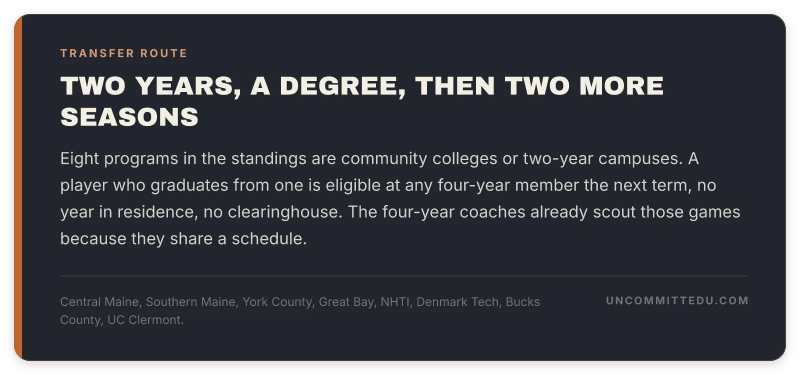
Eight of the programs in the table are community colleges or two-year campuses: Central Maine, Southern Maine, York County, Great Bay, NHTI, Denmark Technical, Bucks County and the University of Cincinnati Clermont. They play the same standings as the four-year schools, and a player who graduates from one of them is eligible at any four-year member the very next term.
That makes this level a quiet transfer route. Two years at a community college in Maine or New Hampshire, an associate degree, then two more seasons at a four-year program without sitting out. The four-year schools in the same standings already know the coaches and already watch the games.
Compare it to the NJCAA route, where the receiving school is usually NCAA or NAIA and the eligibility paperwork is heavier. Here the whole path can stay inside one association with one rulebook. If the two-year start is your plan, how the baseball transfer portal works explains what changes when the receiving school is NCAA instead.
USCAA eligibility rules, in plain words
“USCAA baseball rules” is one of the most typed searches on this topic, and the association’s own rules page is dated 2017, so here they are in one place. Each member school is responsible for knowing and enforcing these rules for its own athletes, and it certifies eligibility to the association’s eligibility chair.
- Getting in: a diploma from an accredited high school or a GED. Enrolled in a recognised academic program and making progress toward a two-year or four-year degree.
- Full time: at least 12 credits at the time you play. Fewer than 12 makes you part time and ineligible. Second-term students must have passed 12 credits in the first term with a 1.6 GPA.
- The 12/24 rule: summer and inter-term credits count toward the 12-credit and 24-credit requirements and toward the GPA line.
- Seasons: four seasons of competition in each sport, total, across all colleges.
- Transfers from two-year schools: a player who graduated from a two-year college the previous term is eligible right away.
- Coming back: a player who has not been enrolled full time for 12 straight months can return to a member college and play immediately.
- Seniors: can drop under 12 credits in the final term if that is all they need to graduate.
- Graduates: ineligible, with one exception. A player can use a fourth season as a full-time student at the school that awarded the bachelor degree.
- Military: service that interrupts a career earns an exemption.
- Dual members: a school that is also NCAA or NAIA uses that association’s eligibility rules and forwards the form to the association.
Compare that to the NCAA baseball eligibility rules and you will see why this level matters for late starters, GED holders and players who left school and want to come back. There is no core-course audit, no sliding scale and no clearinghouse fee.

How to get recruited by a USCAA program
The advantage at this level is attention. Coaching staffs are one to three people, rosters are 20 to 30 players, and an email from a player who has done ten minutes of homework gets read the same day. This is the method.
- Start with geography. Pick every program in the table within your driving range. Most players at this level live close to campus, and the branch campuses recruit their own county first.
- Find the coach. Every program is in the coach directory under the USCAA level. Fill the recruiting questionnaire where one exists, then email.
- Keep the email short and attach video. The template is in how to email a college baseball coach. Sixty seconds of game footage, your graduation year, your position and your GPA.
- Ask the division question. Which division does your baseball program declare, and is any athletic aid available. Then ask what a player on the roster actually pays after all aid.
- Ask about the academic side. Branch campuses often let you finish a degree at the main campus. Community colleges feed four-year programs. Know the path before you sign.
Timing runs late. A USCAA roster is still taking players in the spring of your senior year, and some fill from open tryouts in the fall. The recruiting timeline tells you what to do this month, and Build My List sorts every program, including this level, by the numbers that fit you.

Is USCAA baseball good?
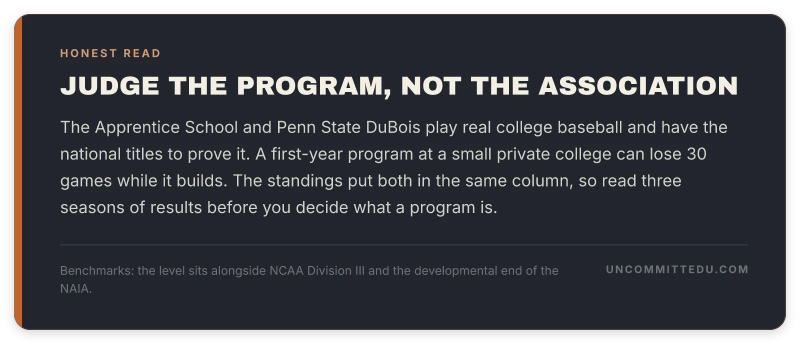
Honest answer: the top is real college baseball, the bottom is a step above a strong high school program, and the gap between them is wide.
The Apprentice School, Penn State DuBois, UC Clermont and Salem play tight, well-coached games, and their players include former NCAA and JUCO rosters. A new program at a small private college can go 2-30 in its first year. The standings table on the association site shows both in the same column, so look at a program’s record over three seasons, not one.
Measure yourself the same way you would for any level. The exit velocity benchmarks by level and the pitching velocity benchmarks by level put the USCAA alongside NCAA Division III and the developmental end of the NAIA. If your numbers sit there, you can start as a freshman at most of these programs.
The players this level fits best are easy to describe. You want four more years of baseball. You need to stay close to home, or keep the cost low, or both. You started late, or your grades kept the NCAA route closed, or you left school and want back in.
For that player, 42 programs and something like 1,000 roster spots a year are sitting there with almost nobody explaining how to reach them.
What to do next
Open the level filter in the coach directory, pick the programs inside your driving range, and send the first email this week. The college baseball recruiting guide covers everything else, and the NCCAA guide covers the other association nobody explains, which overlaps this one at several schools.
This page updates every time the standings or the membership list changes.
Frequently asked questions
Is the USCAA the same as the NCAA?
No. The USCAA is a separate national association for small colleges, mostly with 500 to 2,000 students. Some schools belong to both, and those schools follow NCAA rules for scholarships and eligibility.
What is USCAA baseball?
The baseball championship structure of the United States Collegiate Athletic Association. Forty-two teams played in the 2025-26 standings, from Penn State branch campuses to community colleges and a shipbuilding trade school, and the season ends with the Small College World Series.
Can USCAA schools offer athletic scholarships?
Division I schools can, or they hold a dual NCAA or NAIA membership that allows it. Division II schools give no athletic aid by rule. Divisions are declared per sport, so ask the baseball coach which one the program uses.
What is the USCAA division for baseball?
Baseball runs as one national bracket for standings and the Small College World Series. Each school still declares Division I or Division II for the sport, which controls athletic aid.
Who won the USCAA baseball national championship?
The Apprentice School won the 2026 Small College World Series, its fourth title. Salem University won in 2025, UC Clermont in 2024, and Penn State DuBois in 2023 and 2021.