

How to Enter the Transfer Portal
Knowing how to enter the transfer portal matters, because it is a formal process, not just a decision you make quietly. Get the steps wrong and you can lose time, eligibility, or both.
This covers exactly how it works. For the full picture, see the baseball transfer portal guide.
Quick answer: How to enter the transfer portal starts with notifying your current school, which triggers your name being entered into the NCAA’s database. This opens a contact window with other programs, governed by specific rules and timing that vary by situation.
Key takeaways
- How to enter the transfer portal, in short: tell your staff, then compliance enters your name.
- You cannot enter yourself: the compliance office does it.
- How to enter the transfer portal differs by level; the NAIA and NJCAA do not use the NCAA portal.
- Other programs generally cannot contact you before your name is in, and doing so is tampering.
- Confirm what happens to your current aid before learning how to enter the transfer portal in practice.
- Withdrawing is possible in some cases, so how to enter the transfer portal is not always a one-way door.
How to enter the transfer portal, step 1: talk to your coaching staff
The diagram below summarises how to enter the transfer portal from first conversation to commitment.
The five steps below are how to enter the transfer portal, in the order they must happen.
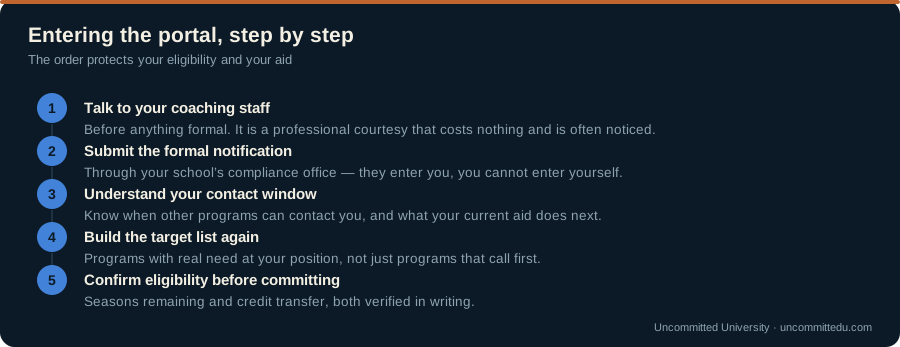
Most programs require or strongly expect a conversation before you enter the portal. This isn’t always comfortable, but it’s the normal first step and keeps the process professional.
Some players worry this conversation burns a bridge. In practice, coaches see transfers constantly and usually handle it professionally too.
Before that conversation, get clear on your own reasons: playing time, fit, a coaching change, or a development need somewhere else. A coach can help you more (with an honest reference, a direct introduction) if you’re straight with him about why you’re leaving.
- Ask what a good landing spot looks like, in his opinion. Coaches often know programs and staffs personally, and can point you toward a real fit.
- Ask whether he’ll speak to other coaches on your behalf. A coach-to-coach reference carries more weight than almost anything else in this process.
- Ask about the actual process at your school. Some compliance offices move fast, others take longer: knowing this up front sets realistic expectations.
How to enter the transfer portal, step 2: submit the formal notification
Your school’s compliance office handles the formal step of entering your name into the transfer portal. This is an official NCAA process, not something you can do informally on your own.
When can a baseball player enter the transfer portal? The 2026 dates
A Division I baseball undergraduate can enter the portal only during the sport’s window, which in 2026 ran June 1 to June 30. Outside it, the door opens only for a head coaching change, the end of a postseason run, a scholarship cut, or a player who will be a graduate student next year. Divisions II and III have no sport-specific window calendar, and the NAIA and junior colleges do not use the portal at all. The window is when you notify; the recruiting that follows can run into August.
| Who | When you can notify | How fast your name appears |
|---|---|---|
| D1 undergraduate | June 1 to June 30, 2026, one window a year, no fall window in baseball | The school has two business days after your written notification |
| D1 player whose team is still playing on June 30 | Five days starting the day after the final game | Two business days |
| D1 player whose head coach leaves | A 30-day window opening shortly after the change is announced | Two business days |
| D1 player who will enroll as a graduate student | Any time in the academic year, but before the June window closes | Two business days |
| D2 or D3 player | No sport window calendar; notification of transfer through compliance at any point | Ask the school; D2 has its own entry timeline |
| NAIA or NJCAA player | No NCAA portal; a release and eligibility paperwork through your school | On the school’s schedule |
Dates are the NCAA’s Division I notification of transfer windows for 2025-26 and the June 2026 coverage of the window, read 2026-09-12. Baseball coaches have asked the NCAA to move the window and it was on the ABCA agenda in January 2026, so check the next year’s list before you plan around June. The transfer portal guide covers what the window means for the JUCO and grad transfer paths.
How to enter the transfer portal, step 3: understand your contact window
Once entered, other programs can begin contacting you, within rules set by the NCAA. Specific windows and rules can vary by situation: confirm current details directly with a compliance office rather than relying on outdated information.
Before your name is in the portal, other schools generally can’t contact you directly: that’s considered tampering, and it’s taken seriously. Once you’re entered, that restriction lifts, and coaches or their staff can reach out.
Entering doesn’t happen instantly at the moment you ask. Your compliance office processes the paperwork, then your name appears in the database, typically within a short window, often a few business days, though this varies by school and time of year. Ask your compliance office for a specific timeline rather than guessing.
How the transfer process differs by level
The table below shows how to enter the transfer portal at each level, including the two that do not use it.
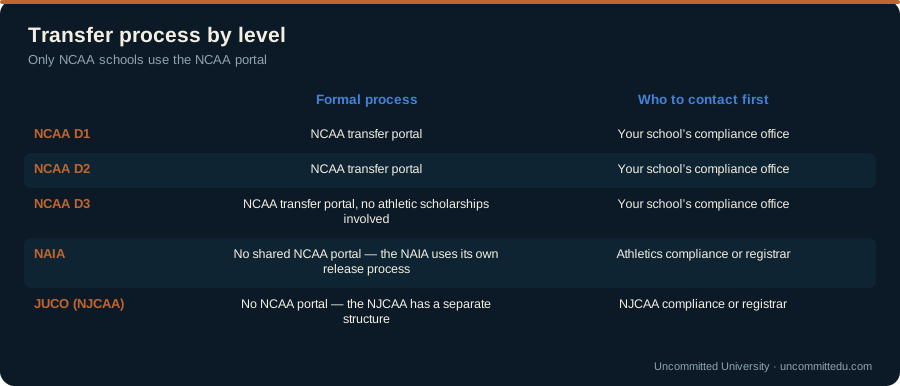
“The transfer portal” specifically refers to the NCAA’s database, which covers D1, D2, and D3. NAIA and JUCO programs handle transfers differently.
| Level | Formal process | Immediate eligibility norm | Who to contact first |
|---|---|---|---|
| NCAA D1 | NCAA transfer portal | Common via the one-time transfer exception | Your school’s compliance office |
| NCAA D2 | NCAA transfer portal | Common via the one-time transfer exception | Your school’s compliance office |
| NCAA D3 | NCAA transfer portal (no athletic scholarships involved) | Common, with no scholarship funds to negotiate | Your school’s compliance office |
| NAIA | No shared NCAA portal: NAIA schools use their own release and eligibility process | Rules differ from the NCAA: confirm directly with the NAIA school | Athletics compliance or registrar |
| JUCO (NJCAA) | No NCAA portal: NJCAA has a separate transfer and eligibility structure | Governed by NJCAA rules, on a distinct eligibility clock | NJCAA compliance or registrar |
If you’re moving between levels (JUCO to NCAA, or NCAA to NAIA) you’re dealing with two different systems, not one. Confirm both sides directly rather than assuming the NCAA portal process applies everywhere.
This matters most for players considering a JUCO-to-D1 move or a shift toward NAIA for more scholarship flexibility: the paperwork, timing, and even the vocabulary (“release” versus “portal entry”) differ enough that assuming your first experience applies the second time around is a common, avoidable mistake.
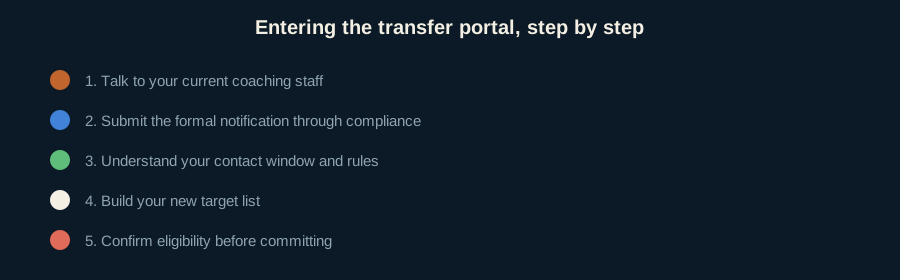
How to enter the transfer portal, step 4: build your target list again
Treat this like recruiting the first time: build a real target list, not just a handful of dream schools. Use your current college stats and film, which now carry real weight.
- Research programs with an actual roster need at your position
- Confirm academic transfer credit before assuming a smooth transition
- Reach out directly with your updated profile and film
What to actually say when you reach out to a coach
The same direct-outreach approach that worked in high school recruiting works here, with a few portal-specific adjustments:
- Lead with your status. Say clearly that you’re in the transfer portal and eligible to be contacted: coaches get a lot of outreach and need this upfront.
- Lead with current-level stats, not high school numbers. A coach evaluating a transfer wants to know how you performed against college pitching or hitters, not what you did at 17.
- Name the specific need you’d fill. “I saw your program lost a starting middle infielder” reads very differently than a generic “I’m interested in your program.”
- Keep it short. One clear paragraph with stats, position, and a link to video and your profile beats a long story about why you’re leaving.
- Follow up once, professionally. Coaches are busy during the portal window. A single, polite follow-up after a week or two is normal, repeated messages aren’t.
What a new coach will actually want to know
Beyond stats and film, coaches recruiting a transfer are evaluating things a highlight reel doesn’t show:
- Why you’re actually leaving. Be honest and specific. “I wasn’t getting consistent innings” is a fair answer. Vague or negative answers about a previous program raise questions.
- How you’ll fit the current roster and culture. A coach is thinking about chemistry, not just talent, especially adding a player mid-career.
- Your academic standing. Grades and credits matter for a transfer just as much as for a freshman recruit, sometimes more, since credit transfer can be complicated.
- Whether you’ll actually commit if offered. Coaches recruiting transfers are often filling one specific need fast, and want a realistic read on your interest level, not a player weighing five offers indefinitely.
Update your profile before you enter the portal
Make it easy for a new coach to evaluate you fast with current stats and film.
Can you withdraw from the transfer portal?
Yes. Entering the portal isn’t a one-way door. A player can withdraw and return to their original team, though the exact process and deadlines depend on the school and the specific circumstances.
Withdrawing doesn’t always mean a smooth landing back on the same roster: scholarship money and roster spots can already be committed elsewhere in the meantime. Talk to your current coaching staff directly and as early as possible if withdrawal becomes a real option, rather than assuming your old spot is guaranteed to still be there.
What happens to your scholarship when you enter the portal
Entering the portal by itself doesn’t automatically cancel a current athletic scholarship, but the details depend heavily on your specific school’s policy and the timing relative to the academic year.
- Ask directly, before you enter, what your current school’s policy is on scholarships for players who enter the portal.
- Get any agreement in writing. A verbal assurance from a coach isn’t the same as a signed document from the financial aid or compliance office.
- Confirm the timing. Some scholarship decisions are tied to specific dates in the academic calendar, not just the moment you enter the portal.
How to enter the transfer portal, step 5: confirm your eligibility
Before accepting anywhere new, confirm exactly what eligibility you have left and how your credits transfer academically. Both your current and new school’s compliance offices should confirm this in writing.
In Divisions I and II that is no longer a count of seasons. It is a date. The NCAA adopted an age-based eligibility model in 2026 (Division I in June, Division II in August), replacing seasons of competition with a single five-year period. It starts at the earlier of your first full-time enrollment at any college, junior colleges included, or the start of the regular academic year after your 19th birthday.
That matters to a transfer more than to anyone else, because the clock does not stop while you move. The NCAA is explicit: the five-year period runs continuously and does not pause because a student-athlete does not compete, transfers, sits out, changes teams or takes time away from participation. A sit-out year is not free any more, and there is no redshirt left to spend: athletics redshirt rules and medical hardship waivers went with the same legislation. That one fact should shape how to enter the transfer portal and, more importantly, when.
So plan how to enter the transfer portal around a calendar rather than a seasons tally. Division III, the NAIA and the NJCAA were not part of the change and still count seasons their own way, which is exactly the mismatch a cross-level move creates.
Academic credit transfer: what to actually check
Eligibility and academic credit are related but separate questions, and it’s easy to confirm one and assume the other is fine.
- Which specific credits transfer. Not every course transfers one-to-one between schools, especially between different degree programs.
- How transferred credits affect your graduation timeline. Losing credits in a transfer can add a semester or more you didn’t plan for.
- Whether your new major is even offered. A transfer that doesn’t support your intended major creates problems well beyond baseball.
- Who at the new school owns this conversation. Ask for a specific academic advisor or registrar contact, not just a general assurance from the coaching staff.
None of this is a reason to avoid transferring. It’s a reason to get it confirmed by the people who actually handle it, before you commit.
Common mistakes with how to enter the transfer portal
The checklist below covers what players get wrong about how to enter the transfer portal.
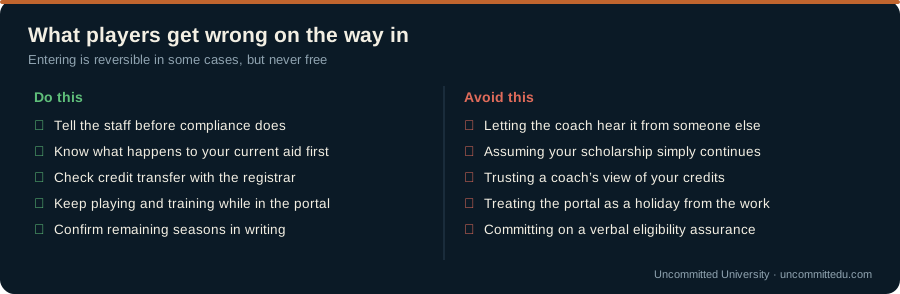
- Entering without a plan. Have a realistic target list ready, not just an exit strategy.
- Assuming interest equals an offer. Contact from a program doesn’t guarantee a roster spot or scholarship.
- Skipping the eligibility check. Confirm your remaining seasons before committing anywhere.
- Burning a bridge unnecessarily. An unprofessional exit follows you: college baseball is a small world, and coaches talk to each other.
- Going public before it’s official. Posting about a transfer before your name is actually entered can create confusion and put your current coach in an awkward spot.
What your school can and cannot do when you enter the portal
The fear that stops most players is the same one: what if my school blocks me, or punishes me for asking?
Here is the reassuring half. Your school cannot refuse to enter you. Once you submit a written notification of transfer, the institution is required to enter your name into the database within two business days. There is no approval step, and a coach does not get a veto.
That was the entire point of the portal replacing the old permission-to-contact system. Learning how to enter the transfer portal is now an administrative process, not a negotiation.
Now the half that people do not tell you. Your school is not required to keep holding your roster spot or your athletic aid beyond the current term.
That is the actual risk, and it is why how to enter the transfer portal is a decision to make with information rather than in frustration after a bad weekend.
Entering does not oblige you to leave. Players withdraw and stay every year. But the relationship rarely returns to exactly what it was, and you should assume your spot is genuinely in play.
Entering also does not mean anybody will call. The portal is a list, not a marketplace with buyers waiting. Hundreds of names appear at once, and coaches work it with the same limited time they give everything else.
The players who land well almost always did the work before entering, not after. They had conversations, they knew of real interest, and the portal entry was the formality that unlocked it.
There is also a timing dimension. Transfer windows are specific periods rather than a year-round option, and they are set by sport. Missing your window can cost you a year, so confirm the current dates for baseball with your compliance office before you plan anything.
Practical sequence, then. Talk to people you trust. Find out whether real interest exists. Understand what happens to your aid at the end of the term. Confirm the window. Then submit the written notification.
Doing it in that order is the whole difference between a transfer and a gap year.
Frequently asked questions about how to enter the transfer portal
Is there a transfer portal login for athletes? No. The NCAA Transfer Portal is a compliance database that only member-school staff can log in to. You do not create an account or enter yourself; you give your compliance office written notification of transfer and the school enters your name, after which you receive a confirmation. If you are searching for a portal login, what you actually need is your compliance office’s email address.
How do you enter the transfer portal at D2, D3, the NAIA or a JUCO? At Division II and III the mechanism is the same as Division I, a written notification of transfer to your compliance office, but there is no sport-specific window calendar, so the timing is yours. The NAIA and the NJCAA do not use the NCAA portal: you ask your athletics department for a release and the new school’s eligibility office reads your record under its own rules. A JUCO player moving to an NCAA school never enters the portal at all; the NCAA school recruits him directly.
Can anyone enter the transfer portal? Any NCAA student-athlete on a roster can notify, at any division, and the school cannot refuse to enter you. What the school can do is decline to renew your athletic aid at the end of the term and give your roster spot away, so entering is free but not without cost. In Division I baseball the notification also has to land inside the sport’s window unless one of the exceptions applies.
Do I need my coach’s permission to enter the transfer portal? No formal permission is required to enter, but most programs expect a conversation first, and skipping it can create unnecessary friction with a coach whose reference you may still want.
How long does it take to actually enter the portal? The compliance paperwork itself is usually quick, but processing time varies by school. Ask your compliance office for a specific timeline rather than assuming it happens the same day.
Can I talk to other coaches before I officially enter the portal? Generally no: contact from other schools before your name is entered is treated as tampering under NCAA rules. Confirm the exact boundaries with your compliance office.
Does entering the portal cancel my scholarship? Not automatically. Scholarship policy for players who enter the portal varies by school: get your specific school’s policy confirmed in writing before you enter.
Can I change my mind after entering the portal? Yes, withdrawing is possible, though your original roster spot and scholarship aren’t guaranteed to still be available depending on timing and what’s already been committed elsewhere.
What’s the most common mistake players make entering the portal? Entering without a real target list ready. Having a plan for where you actually want to land matters as much as the decision to leave.
Does entering the transfer portal pause my eligibility clock? No. In Divisions I and II the five-year period runs continuously and does not pause because you transfer, sit out, change teams or stop competing. Only pregnancy, active-duty military service and official religious missions can pause it. Plan how to enter the transfer portal around that calendar: a year spent moving is a year spent.
The short version: how to enter the transfer portal is five steps, and the order protects both your eligibility and your aid. Talk to your staff first, let compliance submit the notification, understand your contact window, rebuild your target list properly, and confirm eligibility and credit transfer in writing before committing anywhere. Done in that sequence, how to enter the transfer portal stops being the risky part of a transfer and becomes the administrative part.
The short version
How to enter the transfer portal: submit written notification to your compliance office, and the school must enter you within two business days. It cannot block you, but it can stop holding your roster spot and your aid after the current term.
Entering does not guarantee interest. The portal is a list, not a recruiting service.
Uncommitted University advises establishing real interest before you learn how to enter the transfer portal in practice, because the players who land well had those conversations first.
Confirm the current baseball transfer window with your compliance office before anything else. Knowing how to enter the transfer portal is of no use in a month when the window is shut.
And keep playing well while you wait. The most common mistake after deciding how to enter the transfer portal is mentally leaving before the season ends, which costs you exactly the film a new school wants to see.
Your next step
Confirm your eligibility first, see the NCAA baseball eligibility guide, then build your list using the D1 vs. D2 vs. D3 vs. NAIA vs. JUCO breakdown.
Written by Wayne Keeton, founder of Uncommitted University.