

NAIA Eligibility Rules (2026)
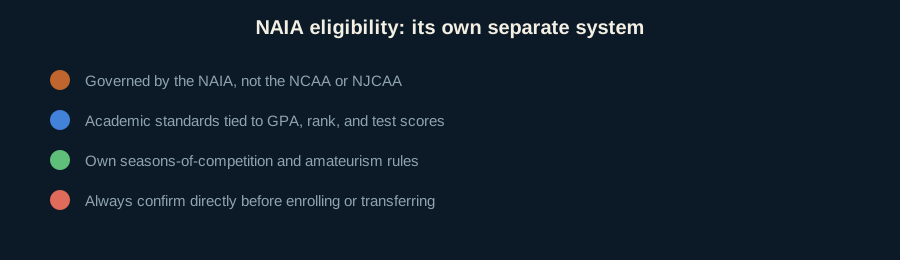
NAIA eligibility rules run on a separate system from both the NCAA and NJCAA. Assuming one set of rules applies across all three is one of the most common recruiting mistakes.
This explains exactly how NAIA eligibility rules work. For the full picture, see the NCAA baseball eligibility guide.
Quick answer: NAIA eligibility rules are governed entirely by the NAIA, with its own academic standards, amateurism rules, and seasons-of-competition system, separate from both the NCAA and NJCAA.
Key takeaways
- NAIA eligibility rules use a two-of-three standard: GPA, class rank or test score.
- NAIA eligibility rules are administered by the NAIA, not the NCAA Eligibility Center.
- NCAA certification does nothing for you under NAIA eligibility rules. Register separately.
- NAIA eligibility rules allow earlier, more direct coach contact than the NCAA.
- NAIA eligibility rules include their own redshirt and amateurism provisions.
NAIA eligibility requirements 2026: the exact numbers
A high school graduate with a final GPA of 2.30 or better is eligible on GPA alone. Below 2.30, meet two of three: a 2.0 GPA, a class rank in the top half, or an 18 ACT or 970 SAT. That is the whole freshman academic standard, and it is why the NAIA is the route for a strong player whose transcript would not clear the NCAA’s 16 core courses: the NAIA reads the GPA your school printed, not a course-by-course audit.
| Requirement | NAIA standard | Note |
|---|---|---|
| Diploma | Graduate of an accredited high school, or accepted as a regular student in good standing | Credit recovery counts. The NAIA looks at the transcript’s GPA and rank, not individual courses. |
| Direct path | Final high school GPA of 2.30 or higher | Eligible immediately, no test, no rank. |
| Two-of-three path | Any two: 2.0 GPA · top half of the graduating class · 18 ACT or 970 SAT (reading and math, one sitting) | No class rank on the transcript? Nine college credit hours before you are identified can stand in for it. |
| Registration | PlayNAIA Eligibility Center, final senior transcript uploaded | Mid-year senior transcripts stopped being accepted May 1; the final one is required. |
| Time | 10 semesters or 15 quarters of full-time attendance, 4 seasons of competition | Terms need not be consecutive. No five-year clock. No maximum age. |
| Staying eligible | 12 credit hours a term, 24 hours across the previous two terms, progress toward a degree | The 24/36 hour rule, checked every term. |
The numbers come from the NAIA’s freshman eligibility bylaws and its published interpretations, read 2026-09-12. The NAIA handbook, Article V is the source of record and the number to quote to a coach.
NAIA eligibility rules: how they are structured
The NAIA sets its own academic eligibility requirements, generally tied to a combination of high school GPA, class rank, and test scores, evaluated somewhat differently than the NCAA’s core-course system.
Confirm current specific requirements directly with the NAIA, since exact thresholds can shift and vary by circumstance.
The NAIA’s two-of-three eligibility rule, explained
NAIA freshman eligibility is commonly built around meeting at least two of three specific standards, rather than the NCAA’s core-course GPA floor (2.3 at Division I, 2.2 at Division II, no test score since 2023).
- A minimum GPA: commonly a 2.0 or higher on a 4.0 scale
- A minimum class rank: commonly finishing in the top half of your graduating class
- A minimum standardized test score: an ACT or SAT score at or above a set threshold
Meeting two of these three generally satisfies the initial academic eligibility standard. Exact thresholds are set and updated by the NAIA: confirm the current numbers directly rather than relying on an older chart.
Seasons of competition under NAIA eligibility rules
NAIA athletes have a set number of seasons of competition available within a defined window after enrolling, and that window is counted in terms of attendance, not in years. Those are two separate counters running at the same time, and they are pulled apart in full further down this page. The specifics (including redshirt-style provisions) are set by the NAIA, not the NCAA, and should be confirmed directly with a program’s compliance staff.
This is the point where NAIA eligibility rules and the NCAA stopped working the same way. NCAA Divisions I and II adopted an age-based eligibility model in 2026 (Division I in June, Division II in August) and that legislation deleted seasons of competition outright, replacing them with one continuous five-year period. Division III was not part of it. The NAIA still counts seasons and terms, so a remaining-seasons answer from a D1 or D2 compliance office no longer converts into an NAIA number.
The overview below shows how NAIA eligibility rules are structured.
Amateurism under NAIA eligibility rules
NAIA amateurism standards cover similar ground to the NCAA’s (professional contracts, prize money, and agent relationships can all affect eligibility) but the specific NAIA rules aren’t identical. Confirm your status through official NAIA channels rather than assuming NCAA rules transfer over.
NAIA redshirt rules: the redshirt provisions in detail
The NAIA allows redshirt-style development years, similar in concept to the NCAA version but governed by its own separate rules.
A player can typically practice and train with a team for a year without using a season of competition, as long as they don’t appear in official contests that count under NAIA rules. Medical hardship provisions also exist separately, following their own approval process.
Confirm the specific redshirt process directly with your program’s compliance office: the concept is familiar, but the NAIA’s specific rules aren’t identical to the NCAA’s.
The practical differences between NAIA redshirt rules and the NCAA version come down to three things.
- What counts as using a season. Appearing in an official contest is what spends a season of competition. A year of practising, training and travelling with the team does not, and that is the whole mechanic behind NAIA redshirt rules.
- What is actually being counted. NCAA Divisions I and II now run a single five-year calendar clock and count no seasons at all: the 2026 age-based model deleted seasons of competition, athletics redshirt rules and medical hardship waivers together. The NAIA still counts terms of attendance, so a redshirt year and a year away from school do not land the same way, covered in full further down this page.
- Who approves it. In the NAIA, a medical hardship year has its own application and its own evidence requirements, a route D1 and D2 no longer offer at all. A standard development year is a roster decision. Do not assume an injury automatically converts into a preserved season.
The question worth asking a coach is not “will I redshirt?” It is “what would have to be true for me to compete as a freshman?” A staff with a real answer to the second question has a plan for you. A staff with only the first is managing a roster.
Then get the season count in writing each year. Under NAIA eligibility rules the record that matters is the school’s, not a recollection of what was said in the fall.
NAIA eligibility rules at a glance vs. NCAA
The table below sets NAIA eligibility rules against the NCAA equivalents.
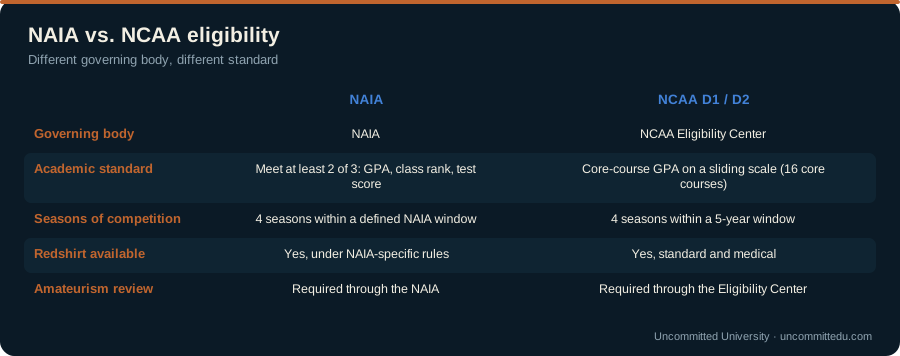
| Feature | NAIA | NCAA D1 / D2 |
|---|---|---|
| Governing body | NAIA | NCAA Eligibility Center |
| Academic standard | Meet at least 2 of 3: GPA, class rank, test score | 16 core courses, core GPA 2.3 (D1) or 2.2 (D2), no test score |
| Seasons of competition | 4 seasons of competition, plus a separate cap on terms of attendance (10 semesters, 12 trimesters or 15 quarters) | two counters, neither of them a calendar clock | No seasons counted in D1/D2 | one continuous five-year period of eligibility under the age-based model (D1 June 2026, D2 August 2026). D3 was not part of that change. |
| Redshirt available | Yes, under NAIA-specific rules | No | the 2026 age-based model eliminated athletics redshirt rules and medical hardship waivers in D1 and D2 |
| Amateurism review | Required through the NAIA | Required through the Eligibility Center |
The two systems overlap in spirit but run entirely separately. Confirm your status directly with each governing body if you’re keeping both paths open.
Check your eligibility across every level
Confirm your standing under NCAA, NAIA, or JUCO rules in minutes.
Transferring between NAIA and NCAA programs
Transfers between NAIA and NCAA schools are common, but eligibility doesn’t automatically transfer cleanly. Both the sending and receiving school’s compliance offices need to confirm exactly how seasons and academic standing carry over.
NAIA eligibility rules: transfer checklist
Confirm these directly with both the sending and receiving school’s compliance offices before transferring into or out of an NAIA program:
- How many seasons of competition you have remaining under NAIA rules
- Whether academic credits from your previous school transfer as eligible credit
- Whether a redshirt year at your previous school affects your window under NAIA eligibility rules
- Any NAIA-specific transfer waiting period that might apply to your situation
None of this carries over automatically just because you’re moving between two athletic programs. Confirm every point directly before assuming your eligibility transfers cleanly.
NAIA and JUCO: how the two interact
Players moving between JUCO and NAIA programs need to confirm eligibility both directions: seasons used at a JUCO generally count against total NAIA eligibility, the same way they count against NCAA eligibility.
See the JUCO eligibility clock rules guide for how that system’s shorter window works, and confirm directly with an NAIA program’s compliance office exactly how JUCO seasons transfer into their system.
NAIA scholarships and NAIA eligibility rules
Scholarship money at NAIA programs isn’t automatically tied to eligibility status the way some families assume: a redshirt year or a still-pending amateurism review doesn’t necessarily threaten aid already offered.
NAIA scholarship rules and limits vary by sport and by conference more than some families expect. Confirm directly with your specific program how aid is structured, and whether anything about your eligibility timeline affects it.
Common misconceptions about NAIA eligibility rules
- “NAIA eligibility is easier than NCAA.” It’s different, not necessarily easier, the two-of-three standard has its own real thresholds.
- “My NCAA core-course GPA automatically satisfies NAIA requirements.” The two systems evaluate academics differently: confirm both separately if you’re keeping multiple paths open.
- “NAIA doesn’t have amateurism rules.” It does, administered separately from the NCAA’s.
- “Redshirting works exactly the same as in the NCAA.” The concept is similar, but NAIA redshirt rules are its own.
Most of these misconceptions come from assuming NCAA rules simply apply everywhere. They don’t. Confirm NAIA-specific requirements directly.
How coaches at NAIA programs evaluate recruits and transfers
NAIA coaches, like coaches at any level, look past the two-of-three academic standard to build a full eligibility picture before recruiting seriously.
- Whether a recruit’s academic record clearly satisfies at least two of the three NAIA standards, not just one
- How many seasons of competition a transfer has remaining, and from which level
- Whether amateurism status has already been confirmed, or is still pending review
A recruit or transfer who can answer these questions immediately moves faster through a program’s recruiting process than one who needs to check.
This applies whether you’re a fresh high school recruit or a transfer coming from JUCO, NCAA, or another NAIA program, the specifics differ, but the expectation of a clear, confirmed answer doesn’t.
Building your timeline around NAIA eligibility rules
The steps below sequence NAIA eligibility rules across a recruiting year.
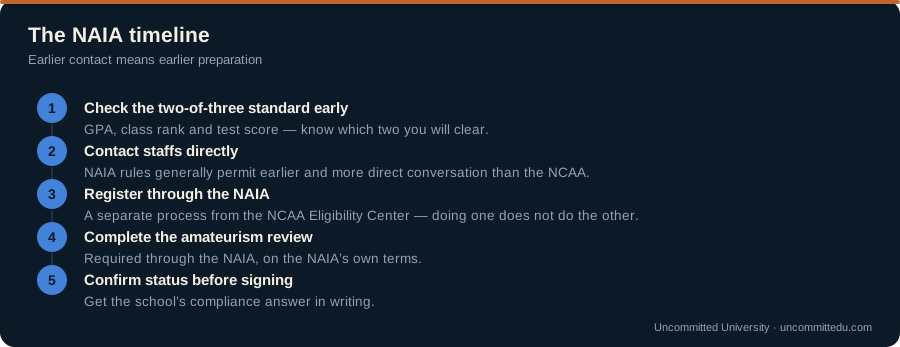
- Freshman/sophomore year: Track GPA and class rank alongside any standard high school academic planning: no NAIA-specific registration is required this early.
- Junior year: Take standardized tests if you haven’t already, since test scores are one of the three eligibility standards.
- Senior year: Confirm your final GPA, class rank, and test score picture directly against NAIA standards with any program recruiting you.
- Before enrolling: Complete the NAIA’s own eligibility and amateurism paperwork through the school you’re committing to.
Because NAIA eligibility rules run through the school rather than a single national account you register for years in advance, the process is generally lighter, but it still needs to be confirmed, not assumed.
Deciding between NAIA and NCAA: what actually matters
Families sometimes treat NAIA as a fallback rather than a legitimate first choice, which isn’t accurate for every situation.
- Roster size and playing time can be more favorable at some NAIA programs than at a bench role in a larger NCAA program
- Scholarship distribution works differently: NAIA programs sometimes have more flexibility in how aid is divided across a roster
- Competition level varies widely within NAIA, just as it does within NCAA divisions: research the specific conference, not just the level
The right level is the one that matches a player’s actual development needs and playing-time goals, not just the name recognition of the governing body.
Common mistakes with NAIA eligibility rules
The checklist below covers where NAIA eligibility rules go wrong most often.
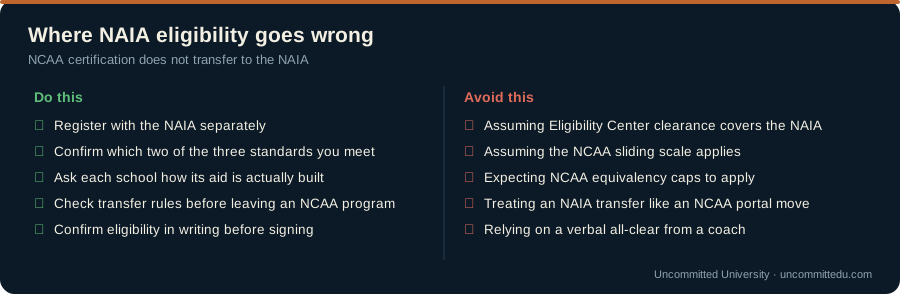
- Assuming NCAA eligibility rules apply. NAIA runs its own separate system entirely.
- Not confirming academic requirements early with the specific NAIA school, since standards can vary.
- Skipping compliance confirmation when transferring in or out of an NAIA program.
Questions to ask an NAIA program directly
- What academic standards does this specific school use for eligibility?
- How many seasons of competition would I have remaining here?
- Does a redshirt-style option exist, and how has it worked for past players?
- What does the amateurism review process look like for incoming recruits?
Getting clear answers directly from the school avoids surprises after you’ve already committed.
What to confirm before signing with an NAIA program
Before signing, confirm these directly with the program’s compliance office, not just the coaching staff:
- Your specific academic eligibility status under the two-of-three standard
- Your amateurism status, fully cleared rather than pending
- Exactly how many seasons of competition you’ll have remaining once enrolled
- Whether any prior JUCO, NCAA, or international competition affects your standing
A program that answers these clearly and specifically is also showing you how organized its compliance operation is, which matters well beyond signing day.
International student-athletes and NAIA eligibility rules
International players pursuing NAIA eligibility go through additional transcript and coursework evaluation to confirm their academic record satisfies the two-of-three standard.
Standardized test requirements and class rank documentation can look different outside the U.S. school system, so confirm directly with the NAIA and the specific school how your academic record will be evaluated. Don’t assume it maps over automatically.
Starting this evaluation early matters even more for international players, since document translation and verification steps generally take longer than a standard domestic review.
How NAIA eligibility rules count time differently
The single most useful thing to understand about NAIA eligibility rules is that they measure your career in terms of attendance, not in a five-year clock.
NAIA eligibility rules run two counters at once, and you have to clear both. Earlier on this page you read that an NAIA athlete gets four seasons of competition within a defined window. Here you are reading that the NAIA counts terms of attendance rather than years. Both are correct, because they are not the same counter:
- Counter one: seasons of competition. Four of them. A season is spent by appearing in an official contest, and eligibility for each one is gated by the NAIA’s progress rule, which checks that you are still moving toward a degree.
- Counter two: terms of attendance. The “defined window” is not a calendar. It is a cap on how many full-time terms you may attend: 10 semesters, 12 trimesters or 15 quarters, per the NAIA interpretations repository. A term is spent by enrolling full time, whether or not you play.
So the two can run out at different times. You can have seasons left and no terms, or terms left and no seasons, and only one of those is the answer to “how much eligibility do I have”. What consumes a season is competing. What consumes a term is enrolling full time. Neither of them is the calendar running in the background, which is the real difference from the NCAA: Divisions I and II now run a single counter and it is a calendar.
That difference matters enormously to a specific kind of player: one who took time away, started late, or had a year that went badly. Under NAIA eligibility rules, time you were not enrolled generally does not count against you the same way.
The 2026 rule change made that contrast sharper, not smaller. In NCAA Divisions I and II one five-year period now starts at the earlier of two events (your first full-time enrollment at any college, junior colleges and international schools included, or the start of the regular academic year after your 19th birthday) and then runs continuously.
It does not pause because you did not compete, transferred, sat out or stepped away from the sport. Only pregnancy, active-duty military service and official religious missions can delay or pause it, and the Eligibility Center administers all three. NAIA eligibility rules were not part of that legislation and neither was NCAA Division III, which is why the same player can now get two very different answers from two compliance offices.
The continuing-eligibility requirements are built around credit hours rather than a single admissions gate. In broad terms you must be enrolled full time to compete, accumulate a required number of credit hours before each subsequent season, and hold a minimum cumulative GPA.
Those requirements tighten as you progress, which is deliberate: the NAIA is checking that you are moving toward a degree rather than simply staying enrolled.
The entry standards are generally more flexible than the NCAA equivalents. That is the practical reason NAIA eligibility rules matter so much to players whose high school offered few NCAA-approved core courses, or whose academic record improved late.
Transfers are the other area where the NAIA is markedly less restrictive. Moving into the NAIA from an NCAA or junior college programme is typically far simpler than moving between NCAA institutions, which is why NAIA rosters absorb so many transfers each year.
One process point that families miss completely: you register with the NAIA Eligibility Center, which is a separate organisation from the NCAA Eligibility Center. An NCAA registration does nothing for you here. Different account, different fee, different determination.
And because the NAIA is a smaller association, the compliance officer at the individual school is genuinely the right person to ask. NAIA eligibility rules leave real discretion at institutional level, and the answer for your situation may not be the answer on a forum.
Get it in writing before you enrol, not after.
Frequently asked questions about NAIA eligibility
Is there an NAIA age limit? No. The NAIA has no maximum age. Eligibility is 10 semesters of full-time attendance and four seasons of competition, counted from your first full-time term at any college. A 25 year old who has never enrolled full time is a freshman under NAIA rules. The NCAA’s 19th birthday trigger does not exist here.
Does NAIA count against NCAA eligibility? Yes, as time. Your first full-time semester at an NAIA school starts the NCAA Division I and II five-year period, exactly as a JUCO semester does, and that period runs whether you play or not. Seasons no longer count at D1 or D2 since 2026, so an NAIA season spends NCAA time but not an NCAA season. The clock guide has the two triggers.
Does the NAIA have a five-year eligibility rule? No, and nothing changed in 2026. The NAIA counts terms of attendance, 10 semesters or 15 quarters, not calendar years, and a semester you are not enrolled full time does not count. The five-year rule people search for is the NCAA’s new age-based model, which the NAIA is not part of.
How do NAIA redshirt rules differ from NCAA redshirt rules? As of 2026 there is no NCAA redshirt left to compare against in Divisions I and II. The age-based model deleted athletics redshirt rules and replaced seasons of competition with one five-year clock that runs continuously. The NAIA kept its redshirt-style provisions and still counts terms of attendance. Confirm the specifics with the NAIA program compliance office rather than carrying an NCAA assumption across.
Does a redshirt year still count as a term of attendance? Those are two separate counters. A redshirt year preserves a season of competition, but you are enrolled full time during it, and NAIA eligibility rules track enrollment as well as competition. Ask the compliance office how a redshirt year lands on both counters before you plan around it.
What is the NAIA’s two-of-three eligibility rule? Freshman academic eligibility is generally based on meeting at least two of three standards: a minimum GPA, a minimum class rank, and a minimum standardized test score.
How many seasons of competition does an NAIA athlete get? Generally four seasons of competition, within a window defined by the NAIA. That used to mirror the NCAA. It no longer does: Divisions I and II moved to an age-based five-year clock in 2026 and count no seasons at all, so carry no NCAA assumption across.
Can an NAIA athlete redshirt? Yes. The NAIA allows redshirt-style development years under its own rules, distinct from NCAA redshirt provisions.
Does NAIA eligibility transfer automatically to an NCAA program? No. Both the sending and receiving school’s compliance offices need to confirm how seasons and academic standing carry over.
Are NAIA academic standards the same as NCAA core-course requirements? No. The NAIA uses its own GPA, class rank, and test score standards rather than the NCAA’s 16 core courses and core GPA floor.
Does the NAIA have its own amateurism rules? Yes. NAIA amateurism standards cover similar ground to the NCAA’s but are administered entirely separately: confirm your status through official NAIA channels.
The short version: almost every problem with NAIA eligibility rules starts with an assumption carried over from the NCAA rulebook. Register through the NAIA separately, confirm which two of the three academic standards you clear, and get your status in writing from the school before signing. Treated on their own terms, NAIA eligibility rules are generally lighter than the NCAA process, not harder.
Because the NAIA counts terms of attendance rather than calendar years, it is the single biggest of the 11 extra eligibility paths we verified across every association.
The short version
NAIA eligibility rules run two counters (four seasons of competition and a separate cap on terms of attendance) rather than a five-year calendar clock, and they are generally more flexible than the NCAA equivalents on entry, transfer and academic history.
You must register with the NAIA Eligibility Center separately. An NCAA registration does not carry across.
Uncommitted University advises confirming NAIA eligibility rules with the compliance officer at the specific school, because the association leaves genuine discretion at institutional level.
A closing point that is easy to miss. Because NAIA eligibility rules are more forgiving on entry, players sometimes treat the continuing requirements casually, and those are not lenient at all.
Credit-hour thresholds and GPA minimums have to be met before each season, every season. More players lose NAIA eligibility in their second and third years than ever fail to gain it in the first.
Your next step
See how NAIA fits into your overall picture in NAIA baseball explained, and build your target list using the D1 vs. D2 vs. D3 vs. NAIA vs. JUCO breakdown.
Written by Wayne Keeton, founder of Uncommitted University.