

NAIA Baseball Explained: 194 Programs
NAIA baseball gets overlooked constantly, mostly because families are less familiar with it than the NCAA divisions. That’s a mistake for a lot of players.
This explains exactly how NAIA works and where it fits. For the full picture, see the college baseball level guide.
Quick answer: NAIA schools follow their own rules, separate from the NCAA, and typically offer more scholarship flexibility than D2 or D3 since NAIA isn’t bound by NCAA equivalency limits. Competition at the top NAIA baseball programs rivals D2.
Key takeaways
- NAIA baseball is governed by the NAIA, not the NCAA, with its own rulebook throughout.
- NAIA baseball scholarships are not bound by NCAA equivalency caps, so they vary school to school.
- NAIA baseball recruiting contact is generally earlier and more direct than the NCAA allows.
- Competition at the top of NAIA baseball rivals NCAA D2.
- NAIA baseball schools are typically smaller and often private, so judge cost after aid, not on sticker price.
NAIA baseball explained: what it actually is
The NAIA is a separate governing body from the NCAA, with its own rules on scholarships, eligibility, and recruiting contact. NAIA schools are typically smaller, often private institutions.
NAIA vs. NCAA divisions at a glance
The table below sets NAIA baseball against its closest NCAA comparison, D2.
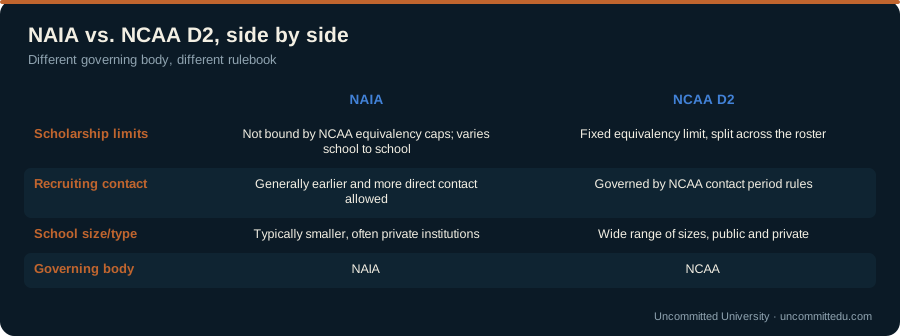
| Feature | NAIA | NCAA D2 (for comparison) |
|---|---|---|
| Scholarship limits | Not bound by NCAA equivalency caps; more school-to-school variation | Fixed equivalency limit per sport, split across the roster |
| Recruiting contact timing | Generally allows earlier and more direct contact | Governed by NCAA contact period rules |
| School size/type | Typically smaller, often private institutions | Wide range of sizes, public and private |
| Governing body | NAIA | NCAA |
This isn’t a ranking of one over the other: it’s a different rulebook entirely, and that difference is exactly why NAIA programs can sometimes move faster and offer more flexible aid than a comparable NCAA D2 or D3 program.
Why NAIA baseball scholarships are often more flexible
NCAA D1 and D2 programs are capped by strict equivalency limits: a fixed scholarship budget split across the roster. NAIA isn’t bound by those same limits.
That flexibility means NAIA programs can sometimes offer more total scholarship money, spread more generously, than an NCAA D2 or D3 program with similar competition level.
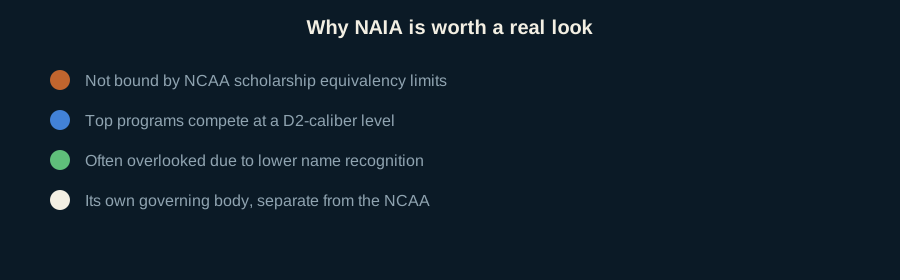
The overview below covers how NAIA baseball is structured and where it sits against the NCAA divisions.
NAIA eligibility rules
NAIA eligibility runs on its own set of rules, separate from the NCAA’s structure. Broadly, NAIA student-athletes generally have four seasons of competition to use within a defined period of full-time enrollment, governed entirely by NAIA rules.
That used to resemble the NCAA. As of 2026 it does not. NCAA Divisions I and II adopted an age-based eligibility model (Division I in June 2026, Division II in August), which deleted seasons of competition, athletics redshirt rules and medical hardship waivers, and replaced them with one five-year period that runs continuously. NAIA baseball was not part of that legislation, and neither was NCAA Division III.
So the two systems now answer the same question differently. The NAIA still asks what you have played and attended. D1 and D2 ask only when your clock started. Carrying an answer from one to the other is how NAIA baseball recruits end up planning around a rule that does not apply to them.
Transfer rules, redshirt provisions, and international student eligibility all have their own NAIA-specific requirements. A program’s compliance office, not general assumptions carried over from NCAA rules, is the reliable source for a player’s exact eligibility picture.
This distinction trips up plenty of families mid-recruiting process, especially when a player is weighing an NAIA offer alongside an NCAA one. Assuming the two systems work identically, or that an NCAA rule automatically applies at an NAIA school, is one of the more common and avoidable mistakes in the process: always confirm directly with the specific school rather than carrying over an assumption from a different governing body.
Go deeper: the NAIA eligibility rules, season by season.
How NAIA baseball recruiting contact differs from the NCAA
One practical advantage families often miss: NAIA recruiting contact rules tend to be less restrictive than the NCAA’s contact-period system. Coaches at NAIA programs can often start direct conversations with recruits earlier and more consistently than NCAA D1 or D2 coaches, who operate under strict NCAA-defined contact windows.
In practice, this means a player interested in NAIA programs can often expect earlier, more direct communication with coaching staffs than the same player would experience navigating NCAA recruiting rules.
How many NAIA baseball programs are there?
194 NAIA baseball programs in 34 states, on the 2026 rosters we track. That is roughly two thirds the size of NCAA Division I and about the same as Division II, spread thinner: the Midwest and the South carry most of it, and a dozen states have one program or none. Forty-six of the 194 make the national tournament each May, so a quarter of the association plays postseason baseball, a higher share than any NCAA division.
| State | NAIA baseball programs |
|---|---|
| Missouri, Indiana, Kansas | 14 each |
| Iowa | 11 |
| Georgia, Florida, Kentucky, Texas | 10 each |
| Michigan | 9 |
| Ohio, Tennessee | 8 each |
| Nebraska | 7 |
| Everywhere else | 69 programs across 22 states |
The season ends the same place every year. The 46-team national tournament opens with double-elimination brackets at ten campus sites in the second week of May, and the ten survivors play the Avista NAIA World Series at Harris Field in Lewiston, Idaho, home of Lewis-Clark State, where it has been held since 2000. In 2026 that ran May 22 to 30 and Tennessee Wesleyan won its third title. Every one of the 194 programs, with its coaching staff and contact details, is in the Uncommitted University directory.
Is NAIA baseball D1, D2 or something else?
Neither. NAIA baseball is not an NCAA division at all. The NAIA is a separate governing body with its own rulebook, its own eligibility standards and its own national championship, so labelling a program “D1” or “D2” is a category error rather than a ranking.
The comparison that actually helps is scholarship structure and fit, level by level.
| Level | Governing body | Athletic scholarships | Who it fits |
|---|---|---|---|
| NCAA D1 | NCAA | Funded roster spots at schools that opted into the House settlement; equivalency limits elsewhere | Elite recruits who can handle heavy travel |
| NCAA D2 | NCAA | 9 equivalencies, split across the roster | Strong recruits, often underrated |
| NCAA D3 | NCAA | None: academic and need-based aid only | Academics-first players |
| NAIA | NAIA | 12 equivalencies, set by the NAIA rather than the NCAA | Players who want real scholarship money and earlier coach contact |
| JUCO | NJCAA | Varies by school and NJCAA division | Late bloomers and players building a transfer path |
Read that table sideways, not top to bottom. NAIA baseball sits alongside the NCAA levels rather than underneath them, and the top of the NAIA competes with solid D2 while the bottom of any level looks much like the bottom of any other.
Competition level: what to actually expect
NAIA competition varies, same as any level. Top NAIA programs rival D2 talent and sometimes produce professional players. Others are more developmental.
Research a specific program’s conference and recent results rather than assuming based on the NAIA label alone.
Why NAIA baseball gets overlooked
- Name recognition. Families know the NCAA divisions; NAIA is less familiar.
- Fewer televised games and less general media coverage than NCAA programs.
- Assumptions about quality that don’t hold up once you look at actual rosters and results.
That gap in awareness is exactly why NAIA can be a strong, less-competitive-to-land recruiting opportunity for the right player.
See if NAIA fits your numbers
Check your real stats against every level, NAIA included.
What day-to-day life looks like on an NAIA baseball roster
Because many NAIA schools are smaller, the athletic experience often feels different from a large NCAA program, in ways that can cut both directions:
- Roster sizes tend to be smaller, which can mean more realistic playing time for a player who might sit deep on the depth chart at a bigger program.
- Coaching staffs are often smaller too, which can mean more direct, personal coaching attention but fewer dedicated position-specific coaches than a large D1 program.
- Facilities vary widely. Some NAIA programs have invested heavily in modern training facilities; others are more modest. This is worth evaluating in person rather than assuming from the level alone.
- Travel and scheduling can be lighter than a power-conference NCAA program, which matters for a player balancing academics and athletics closely.
NAIA baseball as an option for two-sport athletes
NAIA programs are often more accommodating of multi-sport athletes than NCAA D1 programs, where the demands of a single sport frequently make a second sport impractical. A player weighing whether to keep playing two sports into college may find NAIA programs more willing to work around a shared schedule, though this still varies significantly by school and coaching staff.
Cost of attendance at NAIA schools
Cost at NAIA schools varies as widely as the schools themselves, since many are private institutions with higher sticker-price tuition than public NCAA D2 or D3 options. That headline number can be misleading on its own:
- The scholarship flexibility described above often narrows the real gap between a private NAIA school’s sticker price and a public NCAA school’s in-state tuition
- Academic scholarships frequently stack with athletic aid at NAIA schools in ways that can make the final cost competitive with, or lower than, a state school
- A direct conversation with the financial aid office, not just the coaching staff, is the only reliable way to know a real number for a specific family’s situation
Comparing offers purely on the headline scholarship percentage, without asking what that percentage applies to after other aid is factored in, is one of the more common ways families misjudge the real cost difference between an NAIA offer and an NCAA one.
How to research NAIA baseball programs
The steps below turn a general interest in NAIA baseball into a real target list.
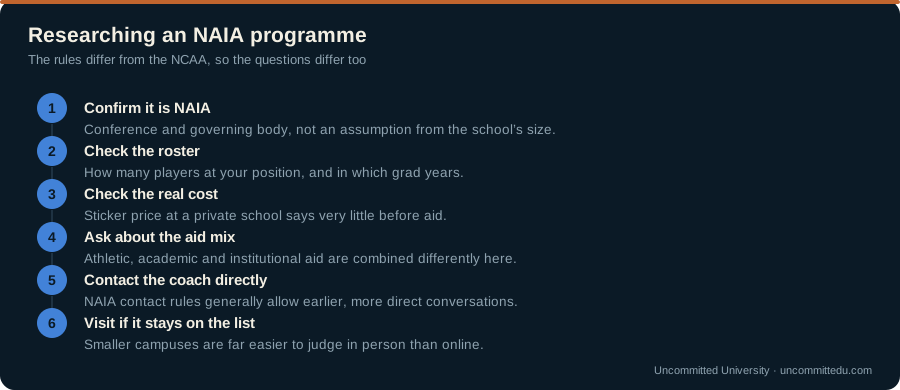
- Check the school’s conference and recent standings, not just its name
- Look at roster size and typical playing time for your position
- Ask directly about scholarship structure: it varies more school to school than in the NCAA
- Visit if possible: academics and campus fit matter as much as baseball here
Questions to ask when researching an NAIA baseball program
- What conference does the program compete in, and how competitive is that conference nationally?
- What does the total cost look like after both athletic and academic aid are applied?
- How does the coaching staff’s contact and recruiting timeline typically work?
- What percentage of roster spots at my position are currently filled by underclassmen versus upperclassmen?
Common mistakes families make evaluating NAIA baseball programs
The checklist below covers the mistakes families make when judging NAIA baseball programmes.
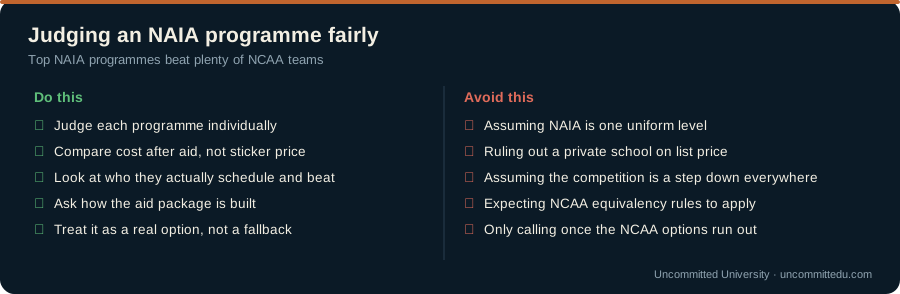
- Ranking every NAIA program below every NCAA program by default. Competition level should be judged program by program, not by governing body alone: a strong NAIA program can outcompete a weak D2 or D3 roster.
- Assuming the sticker price is the real price. NAIA scholarship flexibility means the actual cost after aid can look very different from the published tuition figure.
- Skipping NAIA schools in a search entirely simply because they’re less familiar, which removes real options, including some with strong athletic and academic combinations, before ever evaluating them directly.
- Not asking directly about roster depth at a specific position. A program’s overall reputation says little about whether there’s realistic playing time at one specific spot.
Common misconceptions about NAIA baseball
- “NAIA is a lower level than D3.” There’s no strict hierarchy: the governing bodies are simply separate, and competition level depends entirely on the specific program, not the letters in front of it.
- “NAIA schools don’t offer real athletic scholarships.” Many offer more scholarship flexibility than NCAA D2 or D3 programs, not less.
- “Pro scouts don’t look at NAIA rosters.” Top NAIA programs have a track record of producing drafted and professional players, and scouts cover them accordingly.
Academics at NAIA schools
Many NAIA schools are smaller, private institutions with a strong academic focus alongside athletics. That combination can be a real advantage.
- Smaller class sizes and more individual attention than large NCAA programs
- Academic scholarships that stack with athletic aid, often generously
- A campus culture where athletes are known personally by faculty, not just coaches
NAIA baseball runs on its own rulebook, not the NCAA one
This is the most common and most expensive misunderstanding about NAIA baseball: families apply NCAA rules to it and get the answers wrong.
The NAIA is a separate governing body. It has its own eligibility centre, its own academic standards, its own transfer rules and its own scholarship limits. Registering with the NCAA Eligibility Center does nothing for NAIA baseball eligibility.
You register with the NAIA Eligibility Center instead, and it is a different account, a different fee and a different process.
The academic entry standards are generally more flexible than the NCAA equivalents, which matters enormously to late-blooming students and to players whose high school did not have many NCAA-approved core courses.
Eligibility is counted differently too. The NAIA works in semesters of attendance rather than a five-year clock, which gives many players more usable time than the NCAA model does.
Transfer rules are the other big divergence, and they are the reason NAIA baseball absorbs so many NCAA transfers. Moving into the NAIA is typically far less restrictive than moving between NCAA institutions.
On money: NAIA baseball programs work with 12 equivalencies, more than NCAA Division II, and the NAIA does not restrict stacking athletic aid with academic and institutional money the way some NCAA rules do. Well-run NAIA programs use that combination aggressively.
What about the standard of play? At the top it is strong. Leading NAIA baseball programs compete with, and beat, mid-tier NCAA Division II teams, and the NAIA World Series is a serious tournament.
The spread is wide, though. There is more distance between the best and worst NAIA baseball programs than in most NCAA divisions, so evaluate the specific program rather than the letters.
The honest summary: NAIA baseball is the most consistently underrated route in the sport, largely because families never learn it operates as a genuine parallel system.
NAIA baseball rules: the numbers families ask about
NAIA baseball is played under the NCAA rulebook with a short list of NAIA modifications, so the game on the field looks the same. The differences are in the season, the money and the eligibility math.
| Question | NAIA answer |
|---|---|
| Whose playing rules? | The NCAA baseball rulebook, with modifications passed by the NAIA Baseball Coaches Association. Nine innings, with seven by agreement of both coaches. |
| Is there a run rule? | Yes. Ten runs after seven innings, by conference rule or mutual agreement in the regular season, and in every national tournament game except the championship. |
| Pitch clock? | Yes, the NCAA 20-second action clock, with the 2025-26 timers for mound visits and offensive timeouts. |
| How many games? | 55 contests a year, plus two scrimmages in season and three in the off-season. All-star games do not count. |
| Roster limit? | No NAIA bylaw caps the regular-season roster. Rosters tend to be smaller than NCAA D1 because the aid is smaller; ask the program for its number. |
| Scholarships? | 12 full-grant equivalencies per program, split any way the coach likes. Aid to strong students can be exempt from the 12 entirely, which is how a good transcript stretches an NAIA offer. |
| When does a season get used? | Play in more than 20 percent of the schedule, 11 games in baseball, and that year counts as one of your four seasons. |
| Drug testing? | At national championship events, unannounced, for performance-enhancing drugs. Every player signs a consent form each year. |
Read from the NAIA handbook, its interpretations repository and its financial aid page on 2026-09-12. The NAIA eligibility guide carries the academic side: the 2.30 GPA direct path, the two-of-three rule and the 10-semester count.
Frequently asked questions about NAIA baseball
How many NAIA baseball teams are there? 194 programs in 34 states on the 2026 rosters we track, against 309 in NCAA Division I, 253 in Division II and 382 in Division III. Missouri, Indiana and Kansas lead with 14 each. Forty-six of them reach the national tournament and ten reach the World Series in Lewiston, Idaho.
Can you get a full ride scholarship to an NAIA school? Yes, and it is more possible than at an NCAA school. A program has 12 full-grant equivalencies to split however it likes, so one player can hold a full grant while teammates hold quarters. Academic aid to a strong student can also sit outside the 12, so a player with a 3.75 GPA can stack athletic and academic money to a full cost of attendance. Most offers are still partial. The question to ask is the total out-of-pocket number, not the label on the award.
Is NAIA baseball better than D3? At the top, usually yes: the programs that reach the NAIA World Series play at a level comparable to strong NCAA Division II, and they can offer athletic money, which Division III cannot. Across the middle the two overlap, and a selective D3 with a deep roster will beat many NAIA programs. Judge the program, the conference and the roster, then compare the real cost of attendance at each.
Does NAIA baseball have its own national championship? Yes. The NAIA runs its own postseason and crowns its own national champion: NAIA programs do not feed into the NCAA tournament. That is the clearest sign NAIA baseball is a parallel system rather than a lower rung of the NCAA ladder.
Can you play NAIA baseball after JUCO? Yes, and it is a well-worn route. A JUCO player moving to an NAIA program follows NAIA transfer and eligibility rules rather than NCAA ones, so confirm the season count with the NAIA school directly before committing to the move.
Is NAIA baseball considered a step down from NCAA D2 or D3? Not accurately. NAIA is a separate governing body, not a lower rung on the NCAA ladder, and the best NAIA programs compete at a level comparable to solid D2 competition.
Do NAIA baseball players get drafted into professional baseball? Yes. NAIA programs have a real, ongoing track record of producing drafted and professional players, particularly from their top conferences.
Can international students play NAIA baseball? Yes, though eligibility requirements for international students have their own specific NAIA rules, separate from NCAA international eligibility requirements.
Is NAIA recruiting contact easier to navigate than NCAA contact? Generally, yes. NAIA doesn’t operate under the same strict contact-period system as the NCAA, which often means earlier and more direct conversations with coaching staffs.
How do I know if an NAIA program is a good academic fit, not just an athletic one? Treat the school search the same as any college decision: research the specific academic programs, visit if possible, and talk to current students, not just the coaching staff.
Can a player transfer between an NAIA school and an NCAA school? Yes, transfers happen in both directions, though each governing body has its own transfer and eligibility rules to navigate, so a compliance office conversation on both ends is the reliable way to confirm specifics before committing to a move.
The short version: NAIA baseball gets written off for two reasons that are both wrong: that the competition is a step down everywhere, and that a private school is automatically expensive. Judge each programme on who it actually schedules and beats, and on cost after aid. For a lot of players NAIA baseball delivers a bigger role, more scholarship flexibility and an earlier conversation than the NCAA route.
The short version
NAIA baseball is a separate association with its own eligibility centre, its own academic rules and 12 scholarship equivalencies that can be stacked with academic aid. It is not a lower tier of the NCAA and it does not follow NCAA rules.
If your NCAA core-course situation is difficult, or you need eligibility counted in semesters rather than a five-year clock, NAIA baseball is often the better structural fit rather than the fallback.
Uncommitted University advises registering with the NAIA Eligibility Center separately and early, because it is the step families forget entirely.
A practical warning about scale. NAIA schools are typically small, often between one and three thousand students, and that shapes the experience as much as the baseball does.
For some players that is the appeal: smaller classes, professors who know your name, a coach who has real influence across campus. For others it is claustrophobic after a large public high school.
Visit before deciding, and visit on an ordinary weekday rather than a showcase weekend. The version of a small campus you see on a recruiting visit is not the version you live in during February.
Also check the conference travel map. Some NAIA baseball conferences are geographically tight and forgiving; others send teams on long bus trips that eat far more of the academic week than the brochure suggests.
Finally, look at roster size before you commit. Without an NCAA-style cap, some NAIA baseball programs carry very large rosters, and a large roster at a small school means the competition for innings is fiercer than the level suggests.
Ask directly how many players are on the roster, how many are at your position, and how many of last year’s group are returning. Those three numbers predict your freshman year better than any facility tour.
Your next step
Add NAIA programs to your target list: see the < href="https://uncommittedu.com/college-baseball-divisions/">D1 vs. D2 vs. D3 vs. NAIA vs. JUCO breakdown for how to build a realistic, multi-level list.
Written by Wayne Keeton, founder of Uncommitted University.