

NCAA Age Limit: The Honest Truth
The NCAA age limit question comes up the moment a player considers a gap year, a post-grad season, or a junior college detour, and almost every answer still online was written for a rulebook that no longer exists.
Division I adopted an age-based eligibility model in June 2026. Division II followed on August 5, 2026. Together they replaced four seasons of competition with one continuous five-year period, and that rewrote what the NCAA age limit means for every recruit on a nontraditional path.
Here’s the deal: the honest answer is not a number of years old. It’s a date.
This guide covers how the NCAA age limit works under the 2026 rules: what starts your clock, the Sept. 1 birthday split most write-ups miss, the three exceptions that can pause it, the waiver categories that were deleted outright, and what all of it means for a baseball player.
Quick answer: There is no hard NCAA age limit. Under the age-based eligibility model adopted by Divisions I and II in 2026, your five-year period of eligibility begins at the start of the academic year after you turn 19, or at your first full-time college enrollment at any college anywhere, whichever comes first. It then runs continuously until it expires.
Key takeaways
- There is no hard NCAA age limit: there is a five-year clock, and a birthday can start it.
- The NCAA age limit clock starts at the earlier of full-time college enrollment anywhere or the academic year after your 19th birthday.
- Turn 19 on or after Sept. 1 and the age trigger waits a full extra year.
- The clock runs continuously: transfers, sit-out years and injuries do not pause it.
- Athletics redshirts and medical hardship waivers were deleted, not modified.
- The NCAA age limit rules cover Divisions I and II only. D3, NAIA and NJCAA are not part of this legislation.
Is there an NCAA age limit?
There is no hard NCAA age limit, but under the 2026 rules your five-year clock starts at the academic year after you turn 19, or at full-time college enrollment anywhere, whichever comes first.
That distinction is the whole article. No NCAA bylaw bars a 24-year-old from a Division I roster.
What the age-based rules do is start a countdown on a birthday. Being older is only a problem because the countdown has been running the entire time.
The old system asked how many seasons you had used. The NCAA age limit system asks what date your clock started and whether today is still inside five years of it.
Go deeper on the whole certification process: how NCAA baseball eligibility works, end to end.
How the NCAA age-based eligibility model starts your clock
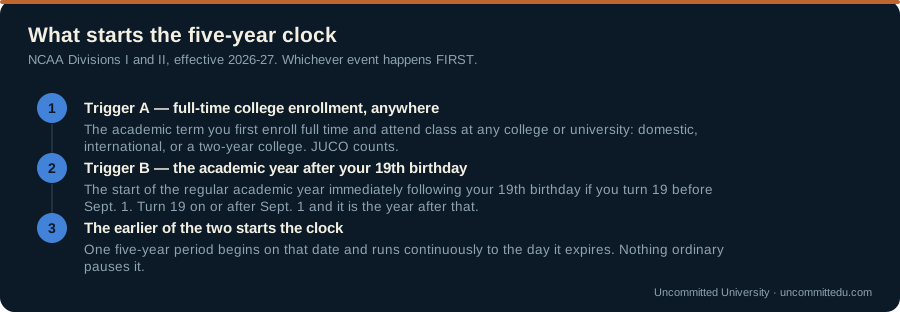
The NCAA age-based eligibility model starts a single five-year period at whichever of two events happens first, and there is no third trigger.
The NCAA states it plainly in its Division II announcement:
“The NCAA Division II age-based eligibility rules mirror the legislation adopted by Division I and establish a five-year period of eligibility. Under this model, a student-athlete’s period of eligibility begins at the earlier of these two events: full-time enrollment at any college or university, domestic or international, including junior colleges; or the beginning of the regular academic year immediately after the student’s 19th birthday.”
The diagram below shows how the two NCAA age limit triggers race each other.
The NCAA Eligibility Center‘s own Division I age-based eligibility rules page defines each trigger more precisely:
- Initial full-time college enrollment: “The academic term when the student-athlete first enrolls full time and attends class at any college or university, including a domestic institution, international institution or two-year college.”
- Age-based trigger: “The start of the regular academic year immediately following the student-athlete’s 19th birthday, if the student-athlete turns 19 before Sept. 1.”
Read the enrollment trigger twice. Any college, anywhere, including a two-year college, a junior college semester is a full-time enrollment, and it starts the NCAA age limit clock exactly the way a four-year enrollment does.
What is the Sept. 1 birthday split in the NCAA age limit rules?
A player who turns 19 on or after Sept. 1 does not start the clock that academic year, the age trigger waits until the following one, which is worth a full extra year of eligibility.
Here is the Eligibility Center’s exact wording, and it is the sentence most NCAA age limit explainers leave out:
“For an individual who turns 19 on or after Sept. 1, the period of eligibility begins at the start of the subsequent academic year, unless the individual enrolls full time in college earlier.”
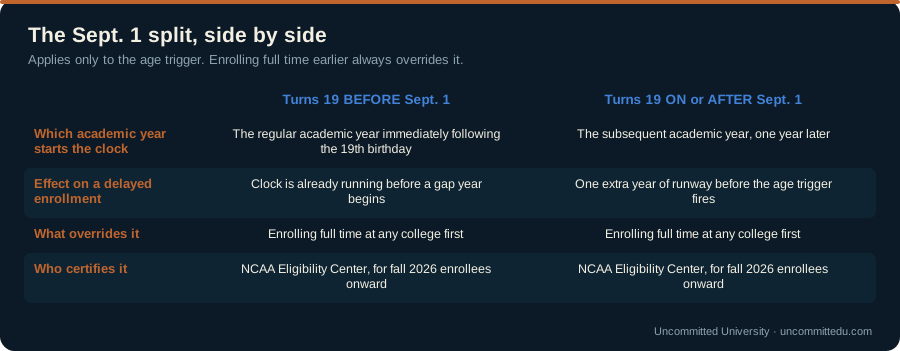
Two players, born eight weeks apart, get different answers:
- An August 19th birthday. He turns 19 before Sept. 1, so the age trigger fires at the start of that same academic year. If he sits out to play travel ball instead of enrolling, the NCAA age limit clock is already burning.
- An October 19th birthday. He turns 19 after Sept. 1, so the age trigger waits until the start of the next academic year. A gap year costs him nothing, provided he does not enroll full time anywhere in the meantime.
Now: the birthday only ever delays the age trigger. It never delays the enrollment trigger. Enrolling full time in college always overrides the split and starts the clock immediately.
Does the NCAA five-year rule clock ever pause?
No, under the NCAA five-year rule the period runs continuously from the day it starts, and nothing about your participation stops it.
The Eligibility Center is unambiguous about this:
“Once the five-year period starts, it runs continuously. It does not pause because a student-athlete does not compete, transfers, sits out, changes teams or takes time away from participation, meaning student-athletes, coaches and athletics departments no longer have to track athletic ‘redshirts.'”
That single sentence deletes four familiar assumptions at once:
- A transfer does not pause it. Entering the portal, sitting a year, and re-enrolling somewhere else spends clock the entire time.
- A redshirt year does not preserve anything. There is no season count left to preserve.
- An injury does not pause it. A lost season under the NCAA five-year rule is simply a lost year.
- Not competing does not pause it. The clock measures elapsed time, not games played.
What’s the bottom line? The NCAA age limit rules trade flexibility for predictability. The Eligibility Center says so itself: “The new age-based rules are more predictable but less flexible.”
Go deeper: how the NCAA eligibility clock works, start to expiry.
Why the NCAA rejects the “5 for 5” label
The NCAA explicitly rejects “5 for 5” because the age-based model does not guarantee five seasons to everybody, and a delayed enrollee can end up with fewer.
The Eligibility Center names and dismisses the phrase directly:
“While some have referred to this as the NCAA ‘5 for 5’ rule, that is not accurate. The age-based rules actually centers on a student-athlete’s age and when the student initially enrolls full time in college, and it does not guarantee five years for all student-athletes, particularly those who delay enrollment.”
The arithmetic is simple. If your NCAA age limit clock started at 19 and you did not enroll until you were 21, two of your five years are already gone.
Five years of clock is not the same thing as five years of college baseball. That gap is exactly where families get surprised.
Who gets a choice between the old rules and the NCAA age limit?
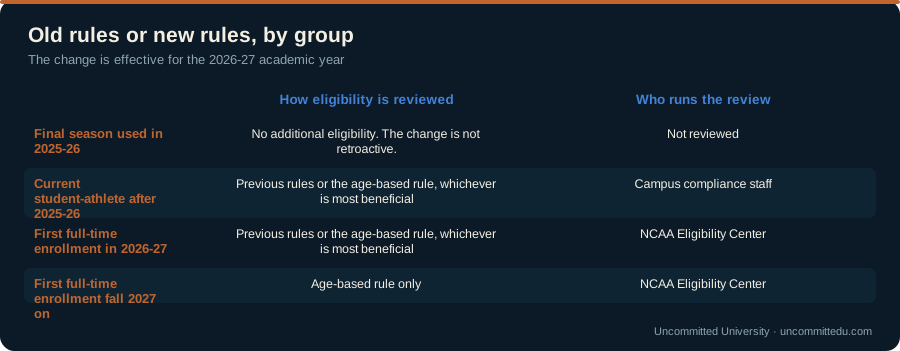
Whether you get the old rules, the new NCAA age limit rules, or the more favorable of the two depends entirely on when you first enrolled full time in college.
The rule change is effective immediately for the 2026-27 academic year. Four groups are treated differently:
| Your situation | How your eligibility is reviewed |
|---|---|
| Used your final season of competition under the previous rules during 2025-26 | No additional eligibility. The change is not retroactive. |
| Current student-athlete with eligibility remaining after 2025-26 | Previous rules or the age-based rule, whichever is most beneficial |
| Prospect first enrolling full time at any college during 2026-27, including those who have already turned 19 | Previous rules or the age-based rule, whichever is most beneficial |
| Prospect first enrolling full time in fall 2027 or later | Age-based rule only |
Two different offices run that comparison, and this trips people up. Campus compliance staff do it for current student-athletes. The NCAA Eligibility Center does it for incoming 2026-27 enrollees.
There is also a cost to staying on the old rules that is easy to miss:
“However, student-athletes who continue under the previous rules will not have future waiver opportunities to gain additional eligibility through eliminated waiver categories.”
On why nobody whose eligibility already expired gets a season back, the Division II Executive Board and Management Council said this jointly:
“Giving student-athletes another season would disrupt expected roster spots and playing time ahead of the upcoming seasons and alter financial aid packages for countless student-athletes, including incoming freshmen who are beginning (or have begun) their college athletics experience.”
What are the three exceptions to the NCAA age limit clock?
Three things can delay or pause the five-year period: pregnancy, active-duty military service and official religious missions, and all three are administered by the NCAA Eligibility Center.
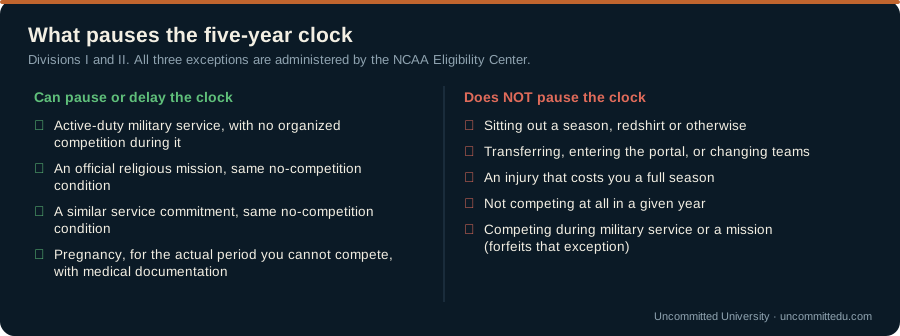
The conditions on each one matter more than the categories:
- Military service, religious missions and similar service commitments. That time “may be excluded from the five-year period if the student-athlete does not participate in organized competition during that service.” Compete during the service period and, in the Eligibility Center’s words, “the exception does not apply.”
- Pregnancy. A pregnant student-athlete “may pause the eligibility period for the duration of the actual period during which the individual cannot compete.” Supporting medical documentation is required.
Notice the asymmetry. The service exception is forfeited by competing; the pregnancy exception is bounded by the actual period of inability to compete. They are not the same shape of relief, and neither is a general-purpose pause button on the NCAA age limit clock.
What the NCAA age limit model deleted
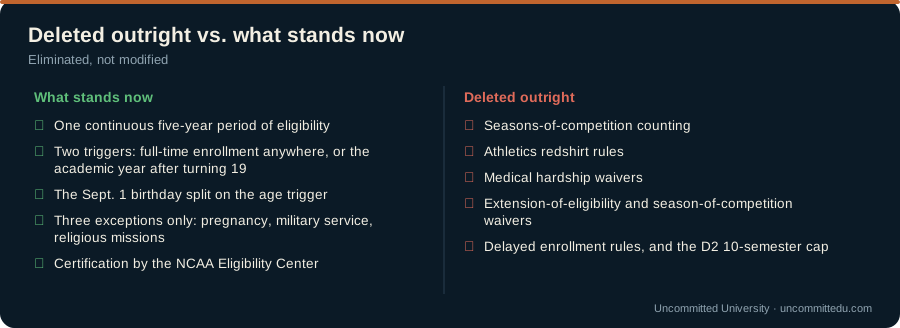
The age-based model did not modify redshirt rules, medical hardship waivers or the 10-semester rule: it deleted them.
These rules were eliminated outright:
- Seasons of competition: the count itself is gone
- Athletics redshirt rules
- Delayed enrollment and organized competition rules
- Sport-specific enrollment timelines
- Academic nonqualifier season limitations (Division I only)
- 10 semesters / 15 quarters of full-time eligibility (Division II only)
And these waiver categories were eliminated with them:
- Medical hardship waivers
- Extension-of-eligibility waivers
- Season-of-competition waivers
- Athletics activity waivers
- Delayed enrollment and organized competition waivers
Here’s the kicker: the medical redshirt was the safety net families relied on most, and under the NCAA age limit rules there is nothing behind it. A season lost to a torn UCL is a year of clock, and no waiver exists to buy it back.
Go deeper on what changed and what survives: redshirt rules for baseball after the age-based model.
Is there an NCAA age limit for baseball?
There is no NCAA age limit baseball rule separate from the general one, baseball players simply run into the clock more often, because the sport’s normal development paths involve delay.
A note on sourcing: the NCAA has published no baseball-specific guidance on the age-based model. Everything in this section is Uncommitted University’s analysis of the published rule, not NCAA instruction.
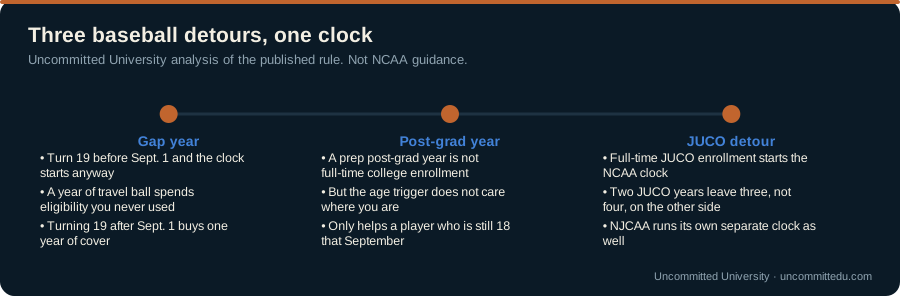
Three baseball detours read differently now:
- The gap year. A year of travel ball or independent training after high school does not enroll you anywhere, but it does not stop the age trigger either. For a player who turned 19 before Sept. 1, that year is spent clock with no season to show for it.
- The post-grad year. A prep post-grad season is not full-time college enrollment, so the enrollment trigger stays dormant. It only preserves anything for a player who is still 18 that September.
- The JUCO detour. Full-time junior college enrollment starts the NCAA clock. Two JUCO years leave three on the other side, not four, and the NJCAA still runs its own separate clock alongside it.
Our read, stated as an opinion rather than a rule: the NCAA age limit baseball consequence is that late bloomers pay for their patience. The player who needed an extra year to add velocity now spends eligibility to buy it.
Go deeper: JUCO eligibility clock rules and how they interact with the NCAA clock.
What is the NCAA Division 2 age limit?
The NCAA Division 2 age limit works identically to Division I’s, because the Division II Executive Board adopted emergency legislation on August 5, 2026 that mirrors the Division I model.
The NCAA’s own wording is that the Division II rules “mirror the legislation adopted by Division I.” Same two triggers, same five-year period, same three exceptions, same Eligibility Center administration.
One thing genuinely differs, and it is what was replaced. Division I dropped four seasons within five years. Division II dropped four seasons of competition within 10 semesters or 15 quarters, a rule that had no Division I equivalent.
Go deeper: Division 2 eligibility rules under the age-based model.
Which levels the NCAA age limit does not touch
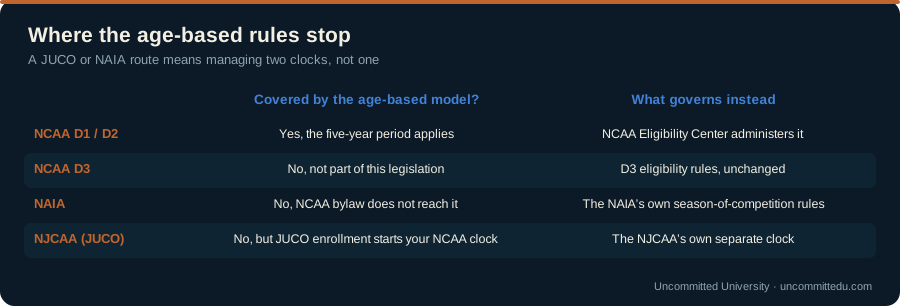
The age-based legislation covers Divisions I and II only, so a player evaluating other levels is looking at different rulebooks entirely.
- Division III. Both NCAA sources describe this model as a Divisions I and II change. No D3 age-based model has been announced, and nothing here should be read as describing D3 eligibility.
- The NAIA. This is NCAA bylaw, so it does not reach the NAIA. NAIA eligibility continues to run on the NAIA’s own standards and its own season-of-competition rules.
- The NJCAA. Junior college eligibility is likewise governed by the NJCAA’s own clock. Full-time JUCO enrollment starts your NCAA clock, but the NJCAA’s rules for JUCO competition are unchanged by this legislation.
The practical version: registering or competing under one governing body’s rules tells you nothing about another’s. A player weighing a JUCO or NAIA route is now managing two clocks, not one.
Inside the five years is not the same as eligible
Being inside your five-year period does not make you eligible to compete. It only means the clock has not expired.
The Eligibility Center is explicit about it:
“Other eligibility rules – including academic and other athletics-related rules – will still apply, meaning a student-athlete may be inside the five-year eligibility period and still be ineligible for other reasons.”
Core courses, GPA, progress toward degree and amateurism all still stand. The NCAA age limit clock is one gate of several, and it is the only one this legislation touched.
Go deeper: academic eligibility, core courses and the GPA sliding scale.
What to do about the NCAA age limit right now
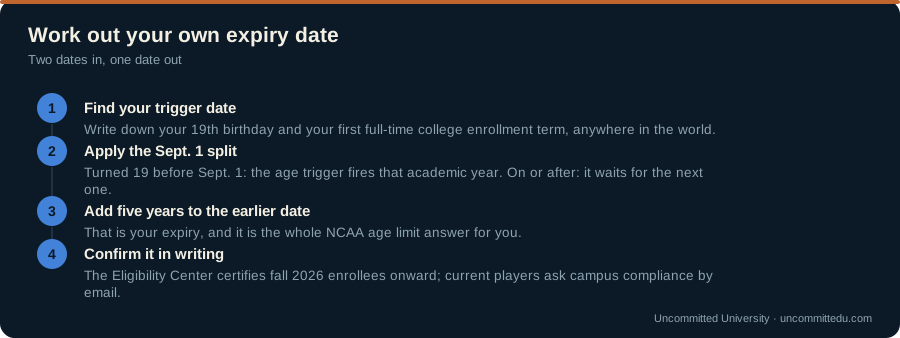
The NCAA age limit is now a date-arithmetic problem, and four steps settle it for almost everybody.
- Find your trigger date. Write down your 19th birthday and your first full-time college enrollment term, whether that was a four-year school, a junior college, or an institution outside the United States.
- Apply the Sept. 1 split. Before Sept. 1, the age trigger fires that academic year. On or after Sept. 1, it waits for the next one.
- Add five years to the earlier date. That is your expiry, and it is the whole NCAA age limit answer for you.
- Confirm it in writing. The Eligibility Center certifies the period for students initially enrolling in fall 2026 and beyond, and planned to surface this information in student accounts in early August 2026. Current student-athletes should ask campus compliance for the most-beneficial comparison in an email, not after practice.
The clock question is now a birthday question
Uncommitted University’s eligibility calculator takes your birthday and your first full-time enrollment term and returns the date your five-year period expires.
How old is too old for college baseball, football or basketball?
The bylaw never names a sport. The same five-year period governs a baseball player, a kicker and a point guard, so “too old for college baseball” and “too old for college football” have one answer, and it is a date, not an age.
Run the two triggers. A player who never enrolls full time anywhere starts the clock in the academic year after turning 19, so the Division I and II window closes at roughly 24 or 25. A player who enrolled at 18 started it then, and it closes at about 23. That is why 23 is not too old by itself: the question is when your clock started, and the eligibility calculator gives you the exact expiry date from your birthday and enrollment history.
At 30 or 40 the Division I and II answer is no, unless one of the three exceptions above paused the period: active-duty military service, an official religious mission or pregnancy, each with its own conditions. Everywhere else the answer changes. Division III, the NAIA and the NJCAA run their own rules with no age-based clock, which is how a 61 year old kicked off for Division III Austin College in 2009, another 61 year old kicked an extra point for NAIA Faulkner in 2011, and a 55 year old carried the ball for South Carolina State under the old Division I rules in 2016. Older players are still on fields every fall. They are on the levels this legislation never touched.
One rule that is not the NCAA’s: “students who turn 19 before June 15 are only eligible the following fall” is a California high school rule (CIF), not a college one. If you found this page searching that sentence, your high school season is governed by CIF and your college clock by the two triggers above.
Frequently asked questions about the NCAA age limit
Can a 30 year old play college football or basketball? Not in Division I or II unless active-duty military service, a religious mission or pregnancy paused the five-year period, because the clock started in the academic year after that player turned 19 and expired years ago. Division III, the NAIA and the NJCAA have no age-based clock, and players in their 30s, 40s and beyond compete there every season.
Who is the oldest athlete to play NCAA college football? Tom Thompson kicked off for Division III Austin College in 2009 at 61. Alan Moore, also 61, kicked an extra point for Faulkner in 2011, but Faulkner is NAIA, so Thompson holds the NCAA mark. In Division I, Joe Thomas Sr. rushed for South Carolina State in 2016 at 55, under the rules the 2026 age-based model replaced.
Is the “turn 19 before June 15” rule an NCAA rule? No. That is a California Interscholastic Federation high school rule about the coming school year. The NCAA’s age trigger is the academic year after your 19th birthday, with a Sept. 1 split, and it has nothing to do with June 15.
Is there an NCAA age limit for playing college sports? No. There is no maximum age in NCAA bylaws. What exists is a five-year period of eligibility that starts at the earlier of full-time college enrollment or the academic year after your 19th birthday, and expires five years later regardless of how much you competed.
When exactly does the NCAA age limit clock start if I turn 19 in October? At the start of the academic year after the next one. Turning 19 on or after Sept. 1 pushes the age trigger to the subsequent academic year, unless you enroll full time in college before then, which starts the clock immediately.
Does a redshirt year still protect a season under the NCAA age limit rules? No. Athletics redshirt rules were eliminated in Divisions I and II, along with medical hardship, extension-of-eligibility, season-of-competition, athletics activity, and delayed enrollment waivers. The five-year period runs continuously whether you compete or not.
Does junior college enrollment start the NCAA five-year rule clock? Yes. The rule names two-year colleges explicitly. Full-time enrollment at any college or university, domestic, international or junior college, starts the period.
What is the NCAA Division 2 age limit compared with Division I? They are the same. Division II adopted emergency legislation on August 5, 2026 that mirrors the Division I model, with the same two triggers, the same five-year period and the same three exceptions.
Do the NCAA age limit rules apply to Division III, NAIA or JUCO? No. The age-based model was adopted by Divisions I and II. Division III is not part of this legislation, and the NAIA and NJCAA govern their own eligibility under their own rules.
An expired clock is not always the end of it. Our guide to extra eligibility lists the 11 verified ways players still get on a field past year five, including the levels this rule never touched.
The short version
The NCAA age limit is not an age at all: it is a five-year period that starts at the earlier of your first full-time college enrollment anywhere or the academic year after your 19th birthday. Turn 19 on or after Sept. 1 and that second trigger waits a year.
Once it starts it does not stop. Transfers, sit-outs, injuries and unused seasons all spend clock, and the redshirt and medical hardship waivers that used to fix that are gone.
Only pregnancy, active-duty military service and official religious missions can pause it, and the service exceptions are forfeited by competing. Divisions I and II only. D3, the NAIA and the NJCAA are not part of this rule.
Your next step
Work out your own expiry date before you make a decision that depends on it.
Check your eligibility, free
Answer a few questions and see the exact date your five-year NCAA period expires.
Then read the primary sources yourself: the NCAA’s Division II age-based eligibility announcement and the NCAA Eligibility Center, which administers all three exceptions and certifies the period for fall 2026 enrollees onward.
Written by Wayne Keeton, founder of Uncommitted University.