

NCAA Eligibility Center Registration
NCAA Eligibility Center registration is the first real paperwork step in the recruiting process. Miss it, or wait too long, and it can hold up a scholarship offer even for a talented player.
This walks through exactly how to register, step by step. For the full picture, see the NCAA baseball eligibility guide.
Quick answer: Create a free account at the NCAA Eligibility Center as early as sophomore year, have your school send official transcripts, submit test scores if required, and complete the amateurism questionnaire before your final year of high school.
Key takeaways
- NCAA Eligibility Center registration is five steps, and the free account is the easy one.
- Transcripts must come from the school directly: a copy you upload does not count.
- Start NCAA Eligibility Center registration in sophomore year, before you know your level.
- NCAA Eligibility Center registration is tied to one sport and one high school on file.
- Spreading NCAA Eligibility Center registration across four years is what prevents a senior-year scramble.
What you need before NCAA Eligibility Center registration
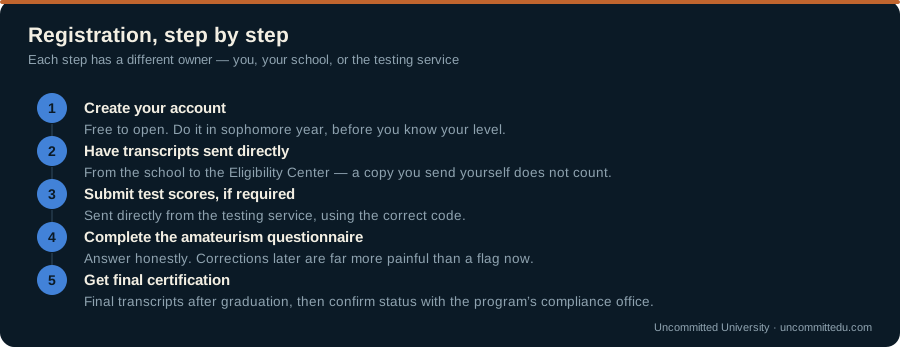
The five steps below are the whole of NCAA Eligibility Center registration, in the order they have to happen.
NCAA Eligibility Center registration itself is quick, but having the right information ready first makes it faster and avoids logging back in mid-process to look something up.
- Full legal name, exactly as it appears on official records
- Date of birth and current contact information
- Your high school’s exact name and location
- Your expected graduation year and the sport you plan to compete in
- A parent or guardian’s information if you’re not yet 13, since a separate account setup applies
None of this is complicated: it just goes faster with a few minutes of prep instead of stopping mid-registration.
What the NCAA Eligibility Center costs in 2026
The Academic and Athletics Certification Account costs $120 for domestic students and $180 for international students, paid once, and the Profile Page is free. The fee is non-refundable after 30 days and is not refunded because you never played at an NCAA school. Those are the figures printed on the NCAA’s registration page on 2026-09-12; older guides still quote $100 and $160.
| Account | Who needs it | Fee | What it produces |
|---|---|---|---|
| Academic and Athletics Certification Account | Anyone who may compete at Division I or II | $120 domestic, $180 international | The academic and amateurism certification a D1 or D2 school needs before you practice, compete or receive athletic aid |
| Athletics Certification Account | International students headed to Division III, and two-year transfers to D1 or D2 who were never certified | Set at registration; the same fee schedule | Amateurism certification only |
| Profile Page | Domestic Division III recruits, players not yet recruited, players unsure of level | Free | An NCAA ID and a place in the system, no certification. Upgrade later from the dashboard. |
Fee waivers exist for the certification account. The Eligibility Center grants them to students who received an SAT or ACT fee waiver, and school counselors submit the request during registration, so ask the counselor before paying. A wrong account type can be refunded if the form is filed within 30 calendar days of payment. Walk-ons and preferred walk-ons must register and meet the same standards as scholarship recruits.
Step 1: Create your account
Go to the NCAA Eligibility Center and register for a free account. You’ll need basic personal information and your high school details.
Do this as early as sophomore year: it costs nothing and starts the process of tracking your core courses officially.
Step 2: Have your transcripts sent directly
Your high school counselor needs to send official transcripts directly to the Eligibility Center, not a copy you submit yourself. Ask your counselor early, and confirm it’s actually been sent.
Do this after every semester that adds new core courses, not just once at the end.
Coordinating with your high school counselor
Your counselor is the one person who can actually get transcripts moving, confirm your core-course list, and flag problems early. A short conversation early in the process saves real time later.
- Ask directly whether your school has a designated NCAA liaison or if it’s handled through general counseling
- Confirm your school’s approved core-course list matches what you’re actually enrolled in
- Set a standing reminder to check in each semester, rather than waiting for a problem to surface
Counselors handle dozens of these requests every year. Being specific and organized when you ask makes it far more likely things move quickly.
Step 3: Submit test scores, if required
For anyone first enrolling full time on or after August 1, 2023, no SAT or ACT score is required for NCAA certification at Division I or II; the sliding scale that once paired GPA with a test score is gone. The step still exists on the form because a school may require a score for admission, and because international students can be asked for one. If you have a score, enter it. If you do not, certification does not wait for it.
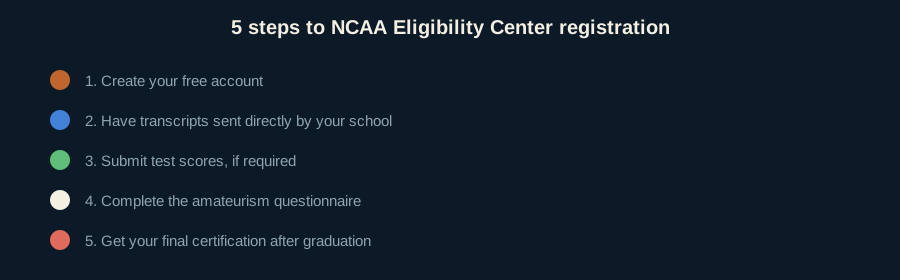
The diagram below walks through NCAA Eligibility Center registration from account to certification.
Step 4: Complete the amateurism questionnaire
This confirms you haven’t violated NCAA amateurism rules: things like accepting prize money or signing with an agent. Most high school players clear this easily, but it still needs to be completed, typically junior year.
How the amateurism questionnaire actually works, in more detail
The amateurism questionnaire asks about your athletic history in detail: organized teams you played for, any prize money received, and any contact with agents or professional teams.
A few specifics worth knowing:
- Answer based on your actual history, not what you think the “right” answer is: inconsistencies get flagged and take longer to resolve than an honest disclosure would have.
- Travel ball, showcase events, and typical high school competition don’t trigger amateurism concerns on their own.
- If you’re unsure whether something needs to be disclosed (a camp, an award, a signed form from years ago), disclose it. Eligibility Center staff can evaluate it; you can’t undo leaving it out.
Most players complete this questionnaire in under fifteen minutes. It only becomes complicated when someone tries to guess what to leave out.
What if you switch sports or schools mid-process
NCAA Eligibility Center registration is tied to a specific sport and a specific high school on file: both need to be updated if either changes.
Switching the sport you’re being certified for is usually a simple account update, but do it as soon as the change is real, not after a coach has already started recruiting you for the new sport.
Switching high schools mid-process means the new school needs to pick up sending transcripts, and any core courses already completed need to transfer over correctly. Confirm this directly with both schools’ counseling offices. Don’t assume it happens automatically.
Step 5: Get your final certification
Once your core courses, GPA, and amateurism status are all confirmed, the Eligibility Center issues your final certification, usually after graduation, once your final transcript is in.
This certification is what allows you to practice, compete, and receive athletic aid as a college freshman.
Since 2026 there is a second thing the Eligibility Center certifies: your period of eligibility. NCAA Divisions I and II replaced seasons of competition with an age-based five-year model (Division I in June 2026, Division II in August), and the Eligibility Center administers and certifies that period for anyone first enrolling full time in fall 2026 or later. It sits alongside the academic and amateurism certifications, not instead of them.
Two jobs in particular now belong to the Eligibility Center rather than a campus compliance office. It administers the three exceptions that can delay or pause a five-year period: pregnancy, active-duty military service and official religious missions. And for a prospect first enrolling in 2026-27, it runs the comparison between the previous rules and the age-based rule and applies whichever is more beneficial.
The distinction is worth holding onto, because two different offices do the same arithmetic for two different people. A current student-athlete with eligibility left after 2025-26 gets that comparison from campus compliance staff. An incoming enrollee gets it from the Eligibility Center, which is one more reason NCAA Eligibility Center registration is not a formality you finish and forget.
NCAA Eligibility Center registration fees and fee waivers
Creating a basic Eligibility Center account is free. There’s a separate one-time registration fee once you move into the certification process, with a higher fee for international students.
Fee waivers are available for students who qualify for a reduced-price or free school lunch program, or who received an SAT/ACT testing fee waiver. Ask your counselor whether you qualify before assuming you need to pay out of pocket.
Confirm the current fee amount and waiver requirements directly on the Eligibility Center site. Both are updated periodically.
Check your eligibility timeline
See how many seasons you have left and confirm you’re on track.
Common NCAA Eligibility Center registration mistakes
The checklist below covers what actually delays NCAA Eligibility Center registration, and it is almost always process rather than eligibility.
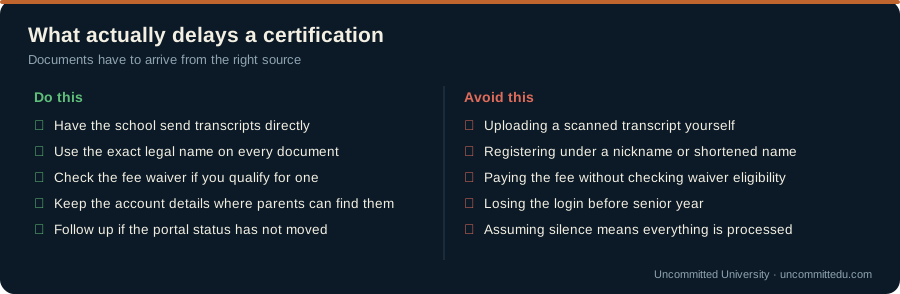
- Waiting until senior year to register. This leaves no time to fix an academic issue if one surfaces.
- Assuming your counselor sent transcripts automatically. Always confirm directly.
- Forgetting to update your account after transferring schools or retaking a course.
- Skipping the amateurism questionnaire until the deadline is already close.
- Not updating the account after a mid-high-school change in primary sport, which can leave the wrong certification in progress.
What happens if something gets flagged
Sometimes the Eligibility Center flags a discrepancy: a missing transcript, a course that doesn’t match the approved list, or a gap in academic records.
- Respond to any request for information quickly: delays here can hold up your certification
- Loop in your high school counselor immediately if a course or transcript issue comes up
- Keep copies of everything you submit, in case something needs to be resent
Most flags are simple paperwork issues, not disqualifying problems, but they need to be resolved promptly.
NCAA Eligibility Center registration timeline by grade year
The table below shows what NCAA Eligibility Center registration asks of you in each grade year.
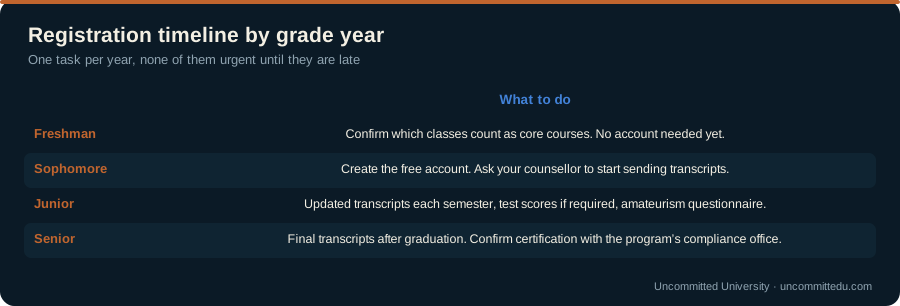
Spreading NCAA Eligibility Center registration steps across four years, instead of cramming them into senior year, is the single biggest difference between families who breeze through certification and families who scramble.
| Grade | What to do |
|---|---|
| Freshman year | Confirm which classes count as core courses with your counselor. No Eligibility Center account needed yet. |
| Sophomore year | Create your free Eligibility Center account. Ask your counselor to start sending transcripts. |
| Junior year | Send updated transcripts each semester. Submit test scores if required. Complete the amateurism questionnaire. |
| Senior year | Send final transcripts after graduation. Confirm final certification with your target program’s compliance office. |
Homeschool, transfer and international NCAA Eligibility Center registration
Most of the NCAA Eligibility Center registration process above applies the same way to every player, but three situations add extra steps:
- Homeschooled players go through a separate review process to confirm their curriculum meets NCAA core-course standards, since there’s no standard high school transcript to submit.
- Students who transferred high schools need to confirm which courses transferred as approved core credit: this sometimes requires extra documentation from the previous school.
- International students need their transcripts evaluated for NCAA-equivalent core courses, which typically takes longer than a standard domestic review.
If any of these apply to you, start the NCAA Eligibility Center registration and transcript process earlier than the standard timeline above: the extra review step takes real time.
Reach out to the Eligibility Center directly if you’re not sure which category applies to you, a quick question early is much easier to resolve than a certification delay discovered senior year.
Confirming your certification status before you commit
Before signing with any program, confirm your actual certification status directly on your Eligibility Center account, don’t rely on a coach’s assumption or an old status check.
- Log in and check your status directly rather than asking someone else to confirm it for you
- Confirm all required transcripts show as received, not just submitted
- Confirm your amateurism questionnaire shows as complete, not pending
- If anything shows as outstanding, resolve it before your signing date, not after
A clean status check takes minutes and removes any doubt heading into a commitment that matters.
Why registering early matters even if you’re undecided on your level
Some players hold off on registering because they don’t yet know if they’ll end up D1, D2, NAIA, or JUCO. That hesitation costs time for no real benefit.
A basic Eligibility Center account doesn’t commit you to anything. It simply starts the transcript-tracking process that every D1 or D2 path eventually requires anyway. If you end up choosing NAIA or JUCO instead, you’ve lost nothing by having registered early, but if you end up needing D1 or D2 certification and haven’t started, you’re behind.
Register as if D1/D2 is on the table, even if you’re not sure yet. It costs nothing and keeps every option open.
Certification Account or Profile Page: choosing the right NCAA Eligibility Center registration
There are two different accounts, they cost different amounts, and picking the wrong one is the most common NCAA Eligibility Center registration mistake.
The Certification Account is the paid one, and it is the only one that produces an actual eligibility decision. If there is any chance you will compete at Division I or Division II, this is the account you need.
The Profile Page is free. It gets you into the system and lets Division III programs and coaches find you, but it does not certify anything.
The rule of thumb is simple: if D1 or D2 is realistically on your list, open a Certification Account. You can upgrade a Profile Page later, but doing it late is how players end up ineligible in August.
What happens after your NCAA Eligibility Center registration is where families get surprised, because the account alone finishes nothing.
Your high school has to send an official transcript directly: a copy you upload yourself does not count. Most schools send it after your sixth semester, and then a final one after graduation.
You complete the amateurism questionnaire, which asks about pro contracts, agents, prize money, benefits and playing with professionals. Answer it honestly; the NCAA verifies, and an inconsistency is far worse than an awkward true answer.
Then amateurism certification opens on a fixed date depending on when you enrol, and you request final certification. Nothing is final until a school on your list requests your information and the Eligibility Center places you on its institutional request list.
That last step catches people out. Completing NCAA Eligibility Center registration does not mean you have been certified → it means you are ready to be.
Two practical notes. Use a permanent email address, not a school one that gets shut off at graduation. And check your account after every semester, because a course your school lists differently from the NCAA-approved list is a problem you want to find early.
Frequently asked questions about NCAA Eligibility Center registration
Do I need to register with the NCAA Eligibility Center? Yes if there is any chance you will play at a Division I or Division II school, including as a walk-on; a D1 or D2 program cannot let you practice, compete or receive athletic aid until the Eligibility Center has certified you. Division III players do not need certification, though a free Profile Page gets you an NCAA ID that D3 coaches ask for. The NAIA runs its own PlayNAIA Eligibility Center and junior colleges use neither.
How do you get your NCAA Eligibility Center ID? It is assigned the moment you create any account, including the free Profile Page: a ten-digit NCAA ID shown on your dashboard and in the confirmation email. Coaches and camp forms ask for it, and your high school uses it to send transcripts. Put it on your recruiting profile once you have it, and if you lose it, sign in and it is on the dashboard rather than in a new registration.
When should you register for NCAA eligibility? Open the account at the start of sophomore year, so your high school can send transcripts after your sixth semester and you find out about a missing core course while there is still time to fix it. The certification itself is not final until the final transcript arrives after graduation. Registering as a senior is allowed and common, but a problem found in July of senior year is a problem with no semester left to solve it.
How much does it cost to register with the NCAA Eligibility Center? The Profile Page is free. The Academic and Athletics Certification Account, the one Division I and II require, is $120 for domestic students and $180 for international students as printed on the NCAA registration page in September 2026, paid once, with fee waivers for students who qualified for an SAT or ACT fee waiver.
When should I create my Eligibility Center account? As early as sophomore year, so transcripts and core-course tracking start well before any certification deadline.
Do I need to resend transcripts every time I take a new class? Send updated transcripts after every semester that adds a new core course, not just once at the end of high school.
What happens if my school doesn’t send transcripts directly? The Eligibility Center generally requires transcripts sent directly from your school, not submitted by the student: confirm with your counselor that this has actually happened.
Is the amateurism questionnaire required for every sport? Yes. It’s required regardless of which sport you’re being certified for, though the specific situations it flags can vary.
Can I still register if I already graduated high school? The process is designed to happen while you’re still enrolled, so your school can send transcripts directly. If you’ve already graduated, contact the Eligibility Center directly to find out what’s still possible for your situation.
Does the Eligibility Center decide my five-year eligibility period now? Yes, if you first enroll full time in fall 2026 or later. Divisions I and II moved to an age-based model in 2026, and the Eligibility Center administers and certifies the five-year period as well as your academic and amateurism status. It also administers the only three exceptions that can pause it: pregnancy, active-duty military service and official religious missions.
The short version: NCAA Eligibility Center registration is free to begin and costs nothing but time until certification. Open the account, get your counsellor sending transcripts each semester, use your exact legal name everywhere, and check whether you qualify for a fee waiver. Then confirm your certification status with the program’s compliance office before signing anything.
The short version
NCAA Eligibility Center registration needs a paid Certification Account for Division I or II; the free Profile Page only serves Division III and general interest. Register early, send official transcripts through your school, and complete the amateurism questionnaire honestly.
Uncommitted University advises completing NCAA Eligibility Center registration in your sophomore year. It costs nothing to be early, and every problem it uncovers takes months to fix.
There is a fee waiver available if you already qualify for a testing or lunch fee waiver at school. Ask your counsellor rather than assuming: it is routinely unclaimed.
Keep your own copy of everything you submit, and note the date you submitted it. Disputes about missing transcripts are far easier to settle when you can point at a date.
If you change high schools at any point, every school you attended has to send a transcript. A missing transcript from a single semester at a previous school is one of the most common reasons certification stalls.
Your next step
Once you’re registered, track your academic progress against the core course and GPA requirements, and check your redshirt eligibility rules, the 2026 age-based model changed what they mean in Divisions I and II.
Written by Wayne Keeton, founder of Uncommitted University.