

NCAA Academic Eligibility: Core Courses
NCAA academic eligibility trips up more players than a lack of talent ever does. Core courses and the core GPA floor sound complicated. They’re actually pretty simple once you break them down.
This explains exactly what’s required. For the full picture, see the NCAA baseball eligibility guide.
Quick answer: The NCAA requires a set number of approved core courses across English, math, science, and social studies, completed with a core GPA of at least 2.3 for Division I or 2.2 for Division II. No test score has been required since January 2023. Fall short, and a player can be ruled an academic redshirt, a partial qualifier or a non-qualifier as a freshman.
Key takeaways
- NCAA academic eligibility needs 16 core courses at both D1 and D2: the subject split differs, not the total.
- Your core GPA is not your report-card GPA, and NCAA academic eligibility only counts the core.
- Only courses on your school’s approved list count toward NCAA academic eligibility.
- NCAA academic eligibility runs on a core GPA floor, 2.3 at Division I and 2.2 at Division II, with no test score since 2023.
- Ten of the sixteen should be finished before senior year starts.
What counts as a core course for NCAA academic eligibility
Core courses are specific, NCAA-approved classes in four main areas:
- English
- Mathematics
- Natural or physical science
- Social science
Not every class automatically counts. Your high school submits an official list of approved core courses to the Eligibility Center. Check that list directly rather than assuming.
NCAA academic eligibility core courses: Division I vs. Division II
The table below breaks the 16 core courses for NCAA academic eligibility across D1 and D2.
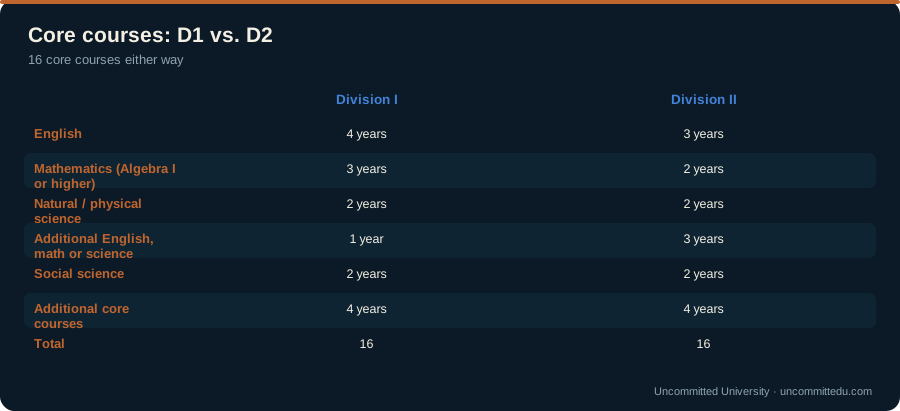
Both divisions require 16 total core courses, but the required split by subject area differs slightly.
| Subject area | Division I | Division II |
|---|---|---|
| English | 4 years | 3 years |
| Mathematics (Algebra I or higher) | 3 years | 2 years |
| Natural / physical science | 2 years | 2 years |
| Additional English, math, or science | 1 year | 3 years |
| Social science | 2 years | 2 years |
| Additional core courses (any area above, or foreign language, comparative religion, philosophy) | 4 years | 4 years |
| Total core courses | 16 | 16 |
This breakdown reflects the standard structure both divisions have used for years. Confirm current requirements directly with the Eligibility Center, since specific rules are reviewed periodically and can change.
The NCAA academic eligibility GPA requirement: 2.3, 2.2 and what sits below them
Division I needs a 2.3 core-course GPA across the 16 approved courses, Division II needs a 2.2, and neither division has asked for an SAT or ACT score since January 2023. The old sliding scale, where a higher GPA could offset a lower test score, is gone. The number is the number.
The bands below the floor still matter, because they decide whether you can play as a freshman. The NCAA Eligibility Center publishes the current standard; a chart that pairs GPA with a test score is a pre-2023 chart, whoever is handing it out.
The table below is the whole standard as it stands in 2026.
| Status | Core GPA (16 approved courses) | Test score | First year of college |
|---|---|---|---|
| Division I full qualifier | 2.3 or higher, with 10 of the 16 courses done before the seventh semester | Not required | Practice, compete, athletic aid |
| Division I academic redshirt | 2.0 to 2.299 | Not required | Practice and athletic aid, no competition |
| Division II full qualifier | 2.2 or higher | Not required | Practice, compete, athletic aid |
| Division II partial qualifier | 2.0 to 2.199 | Not required | Practice and athletic aid, no competition |
| Non-qualifier, either division | Below 2.0, or fewer than 16 approved courses | Not required | No practice, no competition, no athletic aid in year one |
Read from the NCAA Eligibility Center’s Division I and Division II initial-eligibility pages on 2026-09-12. Division III has no Eligibility Center standard at all: admission to the school is the academic bar.
How your core-course GPA is actually calculated
Core-course GPA isn’t the same number as the GPA that shows up on a standard report card, which is exactly why it catches families off guard.
- Only approved core courses count: electives, PE, and non-approved classes are excluded entirely, even if they raise your overall GPA.
- The scale is generally unweighted for core-course GPA purposes, regardless of how your high school weights honors or AP classes on its own transcript.
- Repeated courses are typically handled under specific rules about which attempt counts. Confirm directly rather than assuming the better grade automatically applies.
- Grades from every core course that counts toward the 16-course requirement factor in, not just your most recent semester.
Because of these differences, a player’s core-course GPA and overall GPA can genuinely diverge, sometimes significantly. Track the core-course number specifically, not just the number that shows up on report cards.
How AP, honors and dual-enrollment courses count toward NCAA academic eligibility
Advanced classes generally do count as core courses, as long as they’re on your high school’s approved core-course list submitted to the Eligibility Center: the advanced label alone doesn’t automatically qualify a class.
A few specifics to confirm directly with your counselor:
- Dual-enrollment and community-college courses taken while still in high school sometimes need separate documentation to count as core credit
- Online courses and credit-recovery programs often need separate approval, even if they cover the same material as an in-person class
- A class that qualifies as a core course at one high school isn’t automatically approved if you transfer to a different school
None of this is complicated to resolve, it just requires asking directly instead of assuming a class counts because it looks like it should.
Why NCAA academic eligibility catches families off guard
- A class doesn’t count because it wasn’t on the approved core course list, even though it looked academic.
- Grades from 9th grade don’t count at all levels. Confirm exactly which years factor in.
- A transfer between high schools complicates which courses transfer as core credit.
- Online or credit-recovery courses sometimes need separate approval.
Check your full eligibility picture
Confirm your seasons and academic standing together.
How to stay ahead of NCAA academic eligibility
- Register with the Eligibility Center by sophomore year
- Review your school’s approved core course list with a counselor early
- Send transcripts after every semester with new core courses
- Ask your counselor directly if you’re on track, don’t assume
What happens if you fall short of NCAA academic eligibility
A player ruled a partial qualifier or non-qualifier can still enroll and often still practice, but the academic standard decides whether you can compete or receive first-year athletic aid.
What falling short costs has changed in Division I. The 2026 age-based eligibility model eliminated seasons of competition, and with them the academic non-qualifier season limitations that used to apply in Division I. There is no longer a season to lose. What you lose now is time: the five-year period of eligibility starts at your first full-time college enrollment and runs continuously whether or not you are cleared to play.
That is the trap worth naming. The NCAA says plainly that a student-athlete can be inside the five-year period and still be ineligible for other reasons, and NCAA academic eligibility is the most common of those reasons. The clock does not wait while you fix a transcript. This is exactly why catching issues early matters. There’s often still time to fix a shortfall before senior year.
What to do if you’re behind on core courses
Finding out midway through high school that you’re behind on a core-course requirement isn’t unusual, and it’s rarely unfixable if it’s caught with enough time left.
- Summer school can add core-course credit outside the regular school year, if the specific course is on your school’s approved list.
- Retaking a course to replace a low grade is often possible, under rules about which attempt counts toward your core-course GPA.
- Adjusting your senior-year schedule to add a needed core course is usually the most direct fix if the shortfall is caught early enough.
The earlier a shortfall is caught, the more of these options are realistically available. A gap discovered in the first semester of senior year has far fewer paths than one caught sophomore or junior year.
Core-course requirements for NAIA and JUCO-bound players
If NAIA or JUCO is realistically part of your plan, it’s worth knowing the academic picture looks different there too.
NAIA academic eligibility is generally based on a combination of GPA, class rank, and test scores, evaluated under the NAIA’s own standards rather than an NCAA-style core-course list. See the NAIA eligibility rules guide for the specifics.
JUCO academic standards are set by the NJCAA and the enrolling college directly, rather than through core-course certification. See the JUCO eligibility clock rules guide for how that system works.
Keeping every path open (NCAA, NAIA, and JUCO) usually means keeping your core-course GPA as strong as possible regardless of which level ends up being the best fit.
It also means not assuming a shortfall at one level rules out every level. A player who falls short of a Division I sliding-scale standard can often still qualify for Division II, NAIA, or JUCO, the systems aren’t stacked in strict difficulty order, they’re simply different.
Building a semester-by-semester NCAA academic eligibility plan
The steps below turn NCAA academic eligibility into a plan you build once and check each semester.
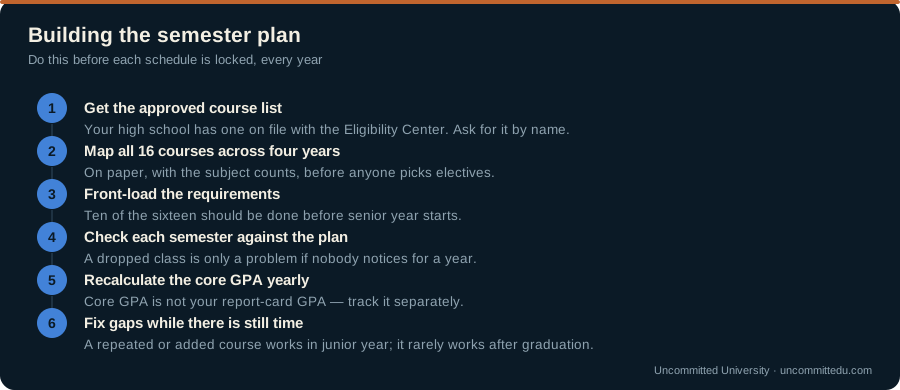
Don’t leave core courses to chance. Map them out early:
- List every required core course area and how many credits you still need
- Plan your schedule each semester with a counselor, confirming each class counts
- Track your running core GPA, not just your overall GPA, they can differ
- Revisit the plan every semester, especially after any schedule change
A clear plan two years out is worth far more than scrambling senior year.
What if you switch high schools mid-year
Transferring high schools complicates core-course tracking more than families expect, mainly because the new school needs to confirm which previously completed courses transfer as approved core credit.
Steps worth taking as soon as a transfer happens:
- Request an official transcript from the previous school immediately. Don’t wait until the new school asks
- Ask the new school’s counselor to review the transcript specifically for core-course equivalency, not just general credit
- Confirm any GPA recalculation directly: a switch in grading scale between schools can shift your core-course GPA
- Update your Eligibility Center account with the new school’s information right away
A mid-year transfer isn’t a problem by itself. An unconfirmed one, discovered senior year, can be.
The same logic applies to any gap in your academic record: a missed semester, a schedule change, an incomplete grade. Flag it with your counselor and the Eligibility Center as soon as it happens, rather than hoping it resolves itself by graduation.
Why strong students still fail NCAA academic eligibility
The checklist below shows why a high GPA and an NCAA academic eligibility problem are entirely compatible.
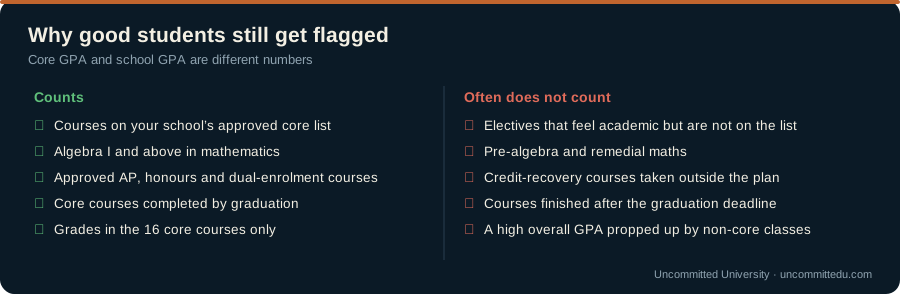
It’s a common surprise: a player with a strong overall GPA and a full course load still gets flagged for a core-course shortfall. That usually comes down to one of a few specific gaps.
- A required subject area (often social science or an additional core course) got overlooked while focusing on other classes
- A class assumed to be core-approved wasn’t actually on the school’s submitted list
- Credits earned before core-course tracking started weren’t properly accounted for
None of these are academic failures. They’re tracking gaps, which is exactly why a semester-by-semester plan, reviewed with a counselor, matters more than raw GPA alone.
Questions to ask your counselor about NCAA academic eligibility
A short, direct conversation with your counselor once a year avoids most core-course surprises. Worth asking specifically:
- Which of my current classes are on the school’s NCAA-approved core-course list?
- Am I on pace to complete all required core courses by graduation?
- What’s my current core-course GPA, calculated the way the Eligibility Center calculates it?
- Has our school’s approved core-course list changed recently?
Counselors review these questions constantly for other students. Asking directly, with specific questions, gets a far more useful answer than a general “am I on track?”
The deadline inside NCAA academic eligibility that closes early
Most families think of eligibility as something settled in senior year. For Division I it is largely settled before senior year starts, and that surprises people every single spring.
The rule is this: of the 16 required core courses, 10 must be completed before your seventh semester of high school (in practice, before the start of senior year). Seven of those 10 must be in English, maths or natural/physical science.
Here is the part that does the damage. Those 10 courses lock. Once your seventh semester begins, you cannot retake them to raise your core GPA for Division I purposes.
So a player who plans to fix a weak transcript with a strong senior year is, for NCAA academic eligibility purposes, often too late. The senior year can still add the remaining courses. It cannot repair the locked ones.
Division II does not apply that lock, which is one of several reasons a player can be short for D1 and comfortable at D2.
The second thing to understand is that your core GPA is not your school GPA. Only NCAA-approved core courses count, and electives your high school weights heavily may contribute nothing.
Every high school has a published list of NCAA-approved courses. Check your schedule against your own school’s list every single year, because a course that looks academic and is not approved is wasted time for NCAA academic eligibility.
On testing: the NCAA has been test-optional since 2023, so no ACT or SAT score is required. That removes a lever players used to use, and puts all the weight on core-course GPA.
The division standards themselves are straightforward. Division I asks for a 2.3 core GPA. Division II asks for 2.2. Division III sets no national academic standard and defers to each institution.
The practical routine is simple and almost nobody does it: meet your counsellor once a year with the approved-course list in hand, and confirm both the count and the GPA. NCAA academic eligibility problems are nearly always discovered late and fixable early.
Frequently asked questions about NCAA academic eligibility
Is there still an NCAA sliding scale? No. The sliding scale that matched a core GPA to a minimum SAT or ACT score ended in January 2023, when the NCAA made initial eligibility test-optional for good. Any sliding scale PDF or calculator dated 2023 or 2024 is describing a rule that no longer exists. The standard now is a flat floor: 2.3 core GPA at Division I, 2.2 at Division II, across 16 approved courses, with no test score at all.
What is the 40-60-80 rule? The progress-toward-degree standard that keeps you eligible once you are in college. At Division I you must have completed 40 percent of your degree by the start of your third year, 60 percent by the start of your fourth and 80 percent by the start of your fifth, alongside a rising GPA floor of 90, 95 and 100 percent of the school’s minimum. It has nothing to do with high school core courses, but it is the next gate after them, and it is the one that catches players who change majors in year three.
How do I find the NCAA-approved core courses at my high school? Search your school by name or its CEEB code in the Eligibility Center’s High School Portal and open its list of approved courses. Only courses on that list count, exactly as titled there. A class that looks like a core course but is missing from the list is not one until the school submits it and the NCAA approves it, which is the single most common way a strong student ends up short.
How many core courses does the NCAA require? 16 total core courses for both Division I and Division II, split across English, math, science, social science, and additional academic areas.
Does my overall GPA matter for NCAA eligibility? Not directly. Only your core-course GPA counts against the 2.3 or 2.2 floor, though a strong overall GPA usually correlates with a strong core-course GPA.
Do AP and honors classes count differently than standard classes? Not automatically: they count as core courses if they’re on your school’s approved list, generally evaluated on an unweighted scale for eligibility purposes.
What happens to core courses if I switch high schools? Your new school needs to confirm which previous courses transfer as approved core credit. Request transcripts immediately and don’t assume it happens automatically.
Are online or credit-recovery courses accepted as core courses? Sometimes, but they often require separate approval. Confirm directly with the Eligibility Center rather than assuming.
Can I retake a class to improve my core-course GPA? Generally yes, but specific rules govern which attempt counts toward your core-course GPA. Confirm directly rather than assuming the higher grade automatically applies.
The short version: NCAA academic eligibility is decided in the room where next year’s schedule gets built. Ask for your school’s approved core-course list by name, map all sixteen across four years on paper, and recalculate your core GPA yearly. A strong student can still fail NCAA academic eligibility on a technicality, and the fix is almost always available a year earlier than it is needed.
The short version
NCAA academic eligibility at Division I needs 16 core courses and a 2.3 core GPA, with 10 courses finished (and locked) before senior year begins. Division II needs 2.2 and does not lock them. Division III sets its own standards.
Only NCAA-approved core courses count, and the NCAA has been test-optional since 2023.
Uncommitted University tells every sophomore the same thing: audit your NCAA academic eligibility now, because the most important deadline in it passes before your senior year starts.
If you are already past that point and short, do not assume the whole thing is over. Division II, the NAIA and junior college all run different standards, and a transcript that fails one of them frequently clears another.
The players who lose years are the ones who find out in July. The ones who adapt are the ones who checked in sophomore year and adjusted the plan while there was still a plan to adjust.
Your next step
Register with the NCAA Eligibility Center if you haven’t already, and review your redshirt options in the redshirt rules guide: the 2026 age-based model changed what redshirting means in Divisions I and II.
Written by Wayne Keeton, founder of Uncommitted University.