

JUCO to D1: Transfer Requirements
The JUCO to D1 transfer path, built on a foundation of NJCAA competition, is one of the most reliable ways for a late bloomer to reach the highest level of college baseball. It’s a real strategy, not a backup plan.
This covers exactly how it works. For the full picture, see the baseball transfer portal guide.
Quick answer: Players use JUCO to add strength, refine mechanics, and post real college-level stats and film, all of which make them a stronger recruiting target than they were out of high school. D1 coaches actively scout JUCO rosters, especially in-season.
Key takeaways
- JUCO to D1 works because you arrive with college stats against college pitching.
- D1 staffs scout JUCO rosters actively in-season, so JUCO to D1 is a recruited path, not a hopeful one.
- A JUCO to D1 move is recruited a full year before it happens.
- Transferable credits decide more JUCO to D1 moves than talent does.
- JUCO to D1 is one of four destinations: D2, NAIA and a second JUCO year are all real options.
Why JUCO to D1 works so well
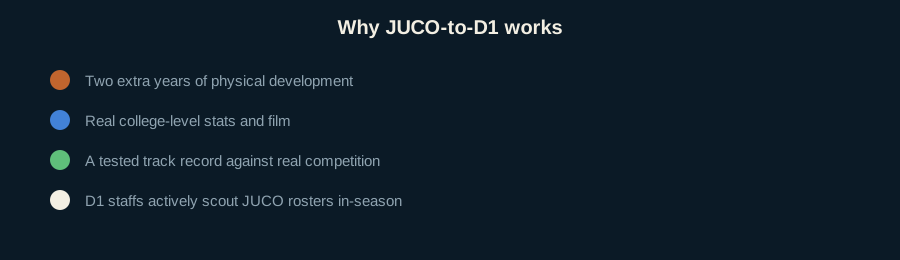
- Two extra years of physical development: strength, velocity, and body control all typically improve significantly.
- Real college stats and film: coaches trust current performance data more than high school numbers.
- A tested track record: succeeding against college-level pitching or hitters proves something a showcase number can’t.
There’s also a numbers reality worth naming directly: many more players play JUCO baseball than get recruited directly to D1 out of high school. That means the JUCO ranks are full of players who are genuinely D1-caliber but were missed the first time around, not a lesser tier of talent, just a less-scouted one.
JUCO transfer paths: a quick comparison
The table below compares JUCO to D1 against the three other realistic destinations.
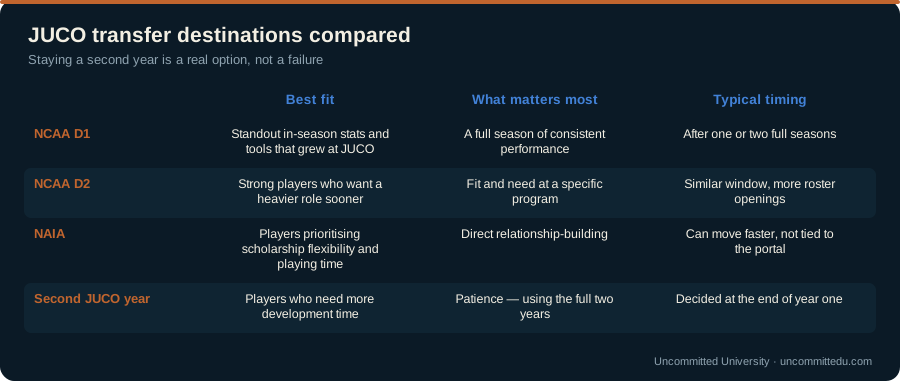
Not every JUCO transfer is aiming for D1. The same development happens across several destinations, and it’s worth knowing how they typically differ.
| Destination | Best fit | What matters most | Typical timing |
|---|---|---|---|
| NCAA D1 | Players with standout in-season stats and physical tools that grew during JUCO | A full season of consistent performance against strong competition | After one or two full JUCO seasons |
| NCAA D2 | Strong JUCO players who want a heavier role sooner | Fit and need at a specific program, not just raw tools | Similar window to D1, often with more roster openings |
| NAIA | Players prioritizing scholarship flexibility and playing time | Direct relationship-building, since NAIA recruiting is less centralized | Can move faster, since NAIA isn’t tied to the NCAA portal timeline |
| Staying at the JUCO for a second year | Players who need more development time before any transfer | Patience: using the full two years before deciding | End of first JUCO season, as a deliberate choice |
What D1 coaches look for in a JUCO to D1 transfer
Beyond raw tools, D1 coaches want to see consistent in-season performance, not just a hot stretch. A full season of stats tells them far more than a handful of standout games.
Academic transfer credit and remaining eligibility both matter too: confirm both directly before assuming a smooth move.
Coaches are also watching for specific, position-relevant signals, not just overall numbers:
- Pitchers: velocity trends across a full season, strike-throwing consistency, and how stuff holds up against the toughest lineups on the schedule, not just the weakest.
- Hitters: performance against the best pitching faced, not just aggregate season stats: a coach wants to know how you handle the top of an opposing rotation.
- Defenders: reliability over a full season matters more than a handful of highlight-reel plays. Coaches ask JUCO staff directly about routine-play consistency.
JUCO coaches are also a real reference point here. A D1 assistant will frequently call a JUCO coach directly to ask about makeup, coachability, and effort, not just what the stat line says.
The timeline below shows how a JUCO to D1 move is sequenced across two years.
Building your recruiting profile for a JUCO to D1 move
Treat this like recruiting the first time, with updated tools:
- Lead with your current college stats and video, not high school numbers
- Build a real target list of D1 and D2 programs with an actual roster need
- Email coaches directly: the same outreach approach that works in high school still works here
- Ask your JUCO coach for direct introductions where he has relationships
Where showcases fit in a JUCO to D1 move
Showcases matter differently at the JUCO level than they did in high school. A handful are worth the investment; most aren’t necessary if your in-season stats are strong and visible.
- Check who’s actually scouting. A JUCO-specific showcase with real D1 and D2 assistants in attendance is worth far more than a general event.
- Don’t skip your season to chase an event. A full, healthy JUCO season is the strongest recruiting asset you have. Protect it.
- Use events to supplement outreach, not replace it. Direct emails with your stats and film still do most of the work.
Financial realities of a JUCO to D1 move
Scholarship money can change significantly with a transfer, in either direction. Confirm this early rather than assuming it mirrors your JUCO situation.
- D1 scholarships are equivalency-based, meaning the total scholarship budget is split across a roster: a spot on the team doesn’t always mean full funding.
- Ask directly what’s actually being offered (full ride, partial scholarship, or preferred walk-on) before you commit emotionally to a program.
- Compare total cost, not just scholarship percentage. A partial scholarship at a lower-cost school can be a better financial outcome than a similar percentage at an expensive one.
Questions to ask a D1 coach recruiting you for a JUCO to D1 move
A JUCO transfer should be asking as many questions as he’s answering. Before committing, get direct answers on:
- What’s the specific roster need at your position? “We like your tools” is different from “our starter graduated and we need a replacement.”
- What does the coach’s JUCO track record actually look like? Ask for names of past JUCO transfers and how their time there went.
- How does the staff plan to use you in year one? Get specifics, not just general encouragement.
- What happens academically if your JUCO credits don’t fully transfer? Get this answer from an academic advisor, not just the coaching staff.
Keep your profile current through your JUCO season
Update your stats and video as your season goes, so it’s always ready for a coach to check.
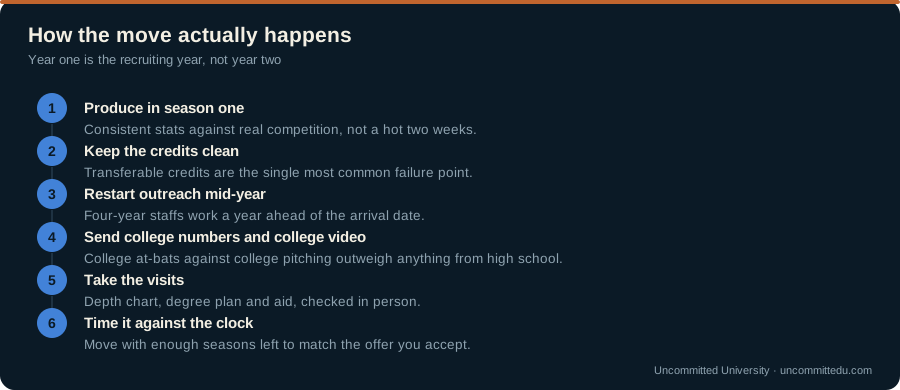
How a JUCO to D1 move actually plays out
The steps below are how a JUCO to D1 move actually happens, in order.
This isn’t a real player: it’s a composite scenario reflecting the pattern that shows up across programs.
A player goes unrecruited out of high school, or gets a single low-level offer he turns down to develop further. He enrolls at a JUCO, redshirts or plays limited innings as a freshman while adding strength, then has a full sophomore season with real, consistent stats. His JUCO coach makes a few direct calls to D1 assistants he knows. Combined with the player’s own outreach (email, stats, and film sent directly to programs with an actual roster need), he lands a D1 opportunity that never existed for him at 18.
The pattern holds across most successful JUCO-to-D1 moves: physical development, a full season of proof, a coach’s direct relationships, and the player’s own outreach, all working together, not any single one alone.
What to confirm with a JUCO program before you even enroll
If you’re choosing a JUCO with an eventual D1 move in mind, not every program offers the same path. Ask directly, before committing:
- What’s the program’s actual transfer track record? Ask for real names and destinations, not a general claim of “we send guys up.”
- Does the coaching staff have real D1 and D2 relationships? A coach who’s worked the phones for past players is worth more than facility upgrades.
- What does the schedule look like? Playing a schedule with strong competition gives your stats more credibility with a D1 evaluator.
- How does the program handle academics? Confirm which four-year schools have a track record of accepting this JUCO’s credits smoothly.
JUCO to D1 transfer requirements: the exact numbers
To compete at a Division I school the year you arrive from a junior college, you need a 2.5 GPA in transferable credit, an average of 12 transferable hours for every full-time term you attended, and, if you were not a qualifier out of high school, an associate degree or 48 transferable hours over at least three full-time semesters with 6 hours of English, 3 of math and 3 of science inside them. Those are the NCAA’s 2-4 transfer rules as published in its two-year transfer guide, read 2026-09-12. Baseball adds one line of its own: a midyear transfer cannot play until the following academic year.
| Requirement | Qualifier out of high school | Non-qualifier or academic redshirt out of high school |
|---|---|---|
| Time at the junior college | At least one full-time semester or quarter | At least three full-time semesters or four quarters. Summer does not count. |
| Credits | An average of 12 transferable hours per full-time term | An associate degree, or 48 transferable semester hours (72 quarter), with 25 percent earned at the school awarding the degree |
| Core subjects | None beyond the transferable-hours rule | 6 semester hours of transferable English, 3 of math, 3 of natural or physical science |
| GPA | 2.5 in transferable coursework | 2.5 in transferable coursework |
| What does not count | Remedial English and math; more than 2 hours of physical education activity courses unless your major requires them; anything the four-year school will not accept toward your degree | |
| Progress toward degree | A player entering his fifth semester must be 40 percent of the way to the four-year degree on arrival, which means roughly 48 hours that apply to that major, not just transfer | |
| Baseball midyear rule | A baseball player who transfers midyear is not eligible to compete that same academic year | |
The percentage row is the one that catches good students. Credits can transfer and still not apply to the degree you declare, and the four-year compliance office certifies applicability, not the junior college. Ask the receiving school’s compliance office to read your transcript before you commit, and read the JUCO eligibility clock guide for how the NJCAA seasons and the NCAA five-year period run side by side.
Timing the transfer right
Most JUCO-to-D1 moves happen after a full season of stats are available, giving coaches real data to evaluate. Enter the transfer conversation with updated numbers in hand, not projections.
The JUCO eligibility clock, in practical terms
There are two clocks running, they are set by different rulebooks, and mixing them up causes real problems on a JUCO to D1 move.
- NJCAA eligibility is typically limited to two seasons of competition at the JUCO level, though redshirt and hardship situations can affect this. NJCAA rules are its own and were not part of the 2026 NCAA change.
- Your NCAA clock starts at the JUCO, not at the four-year school. This is the biggest change to a JUCO to D1 move in years. NCAA Divisions I and II adopted an age-based eligibility model in 2026 (Division I in June, Division II in August) under which a five-year period of eligibility begins at your first full-time enrollment at any college. Both NCAA sources name junior colleges explicitly.
- And that clock never pauses. It does not stop because you did not compete, transferred, sat out or took time away from the sport. Two years at a JUCO therefore spends two of the five, so a player arriving at a four-year school usually has about three calendar years left rather than four.
- Credits matter as much as seasons. An NCAA school will evaluate your JUCO transcript directly; not every course transfers the way you expect.
Go deeper: JUCO eligibility clock rules, in full.
Redshirting at the JUCO level is worth a direct conversation with your coach too. Sitting out a year to add strength and refine mechanics can turn a marginal prospect into a real D1 target, but it also uses up part of your limited JUCO eligibility window, so it’s a decision worth making deliberately, not by default.
Since 2026 it costs you twice. A redshirt year still exists under NJCAA rules, but it also spends a year of the NCAA five-year period that started the day you enrolled full time, and there is no NCAA redshirt left to recover it with. Divisions I and II eliminated athletics redshirt rules and medical hardship waivers along with seasons of competition. Only pregnancy, active-duty military service and official religious missions can pause that period now.
Common mistakes in a JUCO to D1 move
The checklist below covers what derails a JUCO to D1 move, and it is rarely the talent.
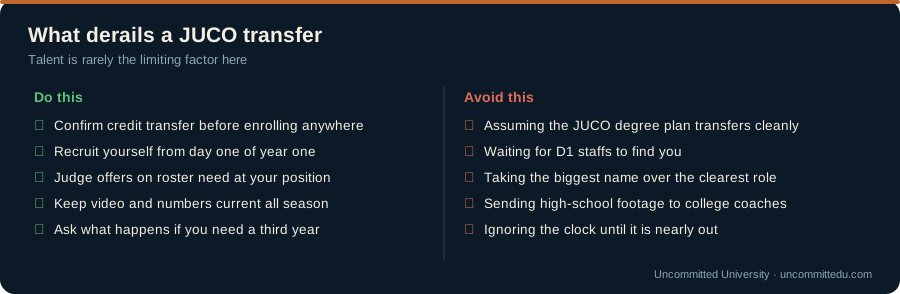
- Assuming one good stretch is enough. A full, consistent season matters more than a hot month.
- Not confirming academic credit transfer early. This can affect both eligibility and your actual graduation timeline.
- Waiting for coaches to find you. Direct outreach still matters as much as it did in high school.
- Ignoring fit for the sake of a bigger name. A D1 program with no real need at your position leaves you buried on the depth chart. A D2 or NAIA program with a genuine need and real playing time is often the better move.
- Underselling the JUCO coach’s role. His direct relationships and willingness to make calls can matter more than another highlight video.
The academic requirements that decide a JUCO to D1 move
Almost every conversation about going JUCO to D1 is about baseball. Almost every failure is about credits.
The move is governed by NCAA transfer requirements, and they turn on what you completed, not what you hit. A player putting up numbers with a transcript that will not transfer is not a Division I recruit, however he is playing.
The cleanest route is finishing your associate degree. A completed AA or AS at the junior college satisfies the most demanding version of the requirements and removes most of the argument.
Without the degree, you are into partial-qualifier and credit-count territory, where the specifics depend on your own status coming out of high school. That is exactly the situation where you need the compliance officer, not a forum thread.
The credits also have to be the right credits. Courses have to transfer into the receiving institution and count toward a degree there. A full transcript of courses that do not apply to any major at your target school is worth very little for a JUCO to D1 move.
This is why the advice to meet an academic adviser in your first month at junior college is not filler. By the time a Division I coach is genuinely interested, your transcript is largely written.
The recruiting timeline runs earlier than players expect too. Division I staffs are typically evaluating junior college players well before their sophomore season concludes, which means your first-year performance and your first-year transcript are both doing work.
A blunt point on level. The JUCO to D1 path is real and it is well travelled, but not every junior college player is a Division I player, and a good NJCAA Division I programme will tell you honestly where you sit.
Ask your junior college staff directly which level they see for you and which schools have actually called. A coach who has moved players before will answer specifically, with names.
And keep the four-year conversation going during the season rather than after it. The JUCO to D1 window is short, and the players who land well were already talking in the autumn.
Frequently asked questions about the JUCO to D1 transfer path
Can you transfer to a D1 after 1 year of JUCO? Yes, if you were a qualifier out of high school and you finished one full-time semester with an average of 12 transferable hours and a 2.5 GPA. A non-qualifier cannot; he needs three full-time semesters or the associate degree. One year is also early for the baseball side: most Division I staffs want a full JUCO season of statistics, and the June portal window is when they shop.
Do JUCO players enter the transfer portal? No. The NCAA portal is for players already at NCAA schools. A junior college player is recruited directly: the four-year coach contacts you or your JUCO coach, and the NJCAA has its own release paperwork. That is an advantage, because a D1 staff can talk to a JUCO player at any time of year without waiting for a window.
Can a JUCO be D1? Yes, in the NJCAA’s own sense. The NJCAA runs three divisions, and NJCAA Division I programs can offer full athletic scholarships, which is why the best junior college baseball is played there. It is not NCAA Division I. A player at an NJCAA Division I school still transfers into the NCAA under the 2-4 rules above; the JUCO’s division changes the money and the competition, not the transfer requirements.
How long does a JUCO-to-D1 transfer usually take? Most moves happen after one or two full JUCO seasons, once a player has a real, current sample of stats and film for a D1 coach to evaluate.
Do D1 coaches actually watch JUCO games? Yes, especially in-season. Many D1 programs actively track JUCO rosters and stats, particularly at positions where they anticipate a roster need.
Does JUCO eligibility count against NCAA eligibility? Seasons no, time yes. Your NJCAA seasons are counted by the NJCAA and do not reduce anything at the NCAA. But your first full-time semester at the junior college starts the NCAA Division I and II five-year period under the 2026 age-based model, and it runs whether you play or not, so two JUCO years leave about three at the four-year school. Division III and the NAIA count semesters of attendance instead, and your JUCO semesters count there too. Confirm your own dates with both compliance offices.
Is it better to transfer after one JUCO season or two? It depends on development and opportunity. A full season of strong, consistent stats is generally more valuable than transferring early on a partial or unproven sample.
Can a JUCO player transfer directly to a D2 or NAIA program instead of D1? Yes. The same JUCO development path leads to D2 and NAIA opportunities as often as D1, the right level depends on fit, not just ambition.
What’s the biggest mistake in a JUCO-to-D1 transfer? Waiting for coaches to find you. Direct outreach with current stats and film, backed by your JUCO coach’s relationships, matters as much here as it did in high school recruiting.
The short version: JUCO to D1 is a two-year plan with a hard deadline. Produce across a full season rather than a hot fortnight, keep every credit on a four-year degree track, and restart your own recruiting in year one. Time the move so the seasons you have left match the offer you take, and JUCO to D1 becomes a straightforward transfer rather than a scramble.
The short version
A JUCO to D1 move is decided by transferable credits and degree progress at least as much as by performance. Completing the associate degree is the cleanest route; without it, the requirements depend on your status out of high school.
Division I staffs evaluate junior college players earlier than most expect, so the first year counts on both the field and the transcript.
Uncommitted University tells JUCO players to meet the academic adviser in month one, because the JUCO to D1 path closes on paperwork far more often than on ability.
Your next step
Confirm your eligibility clock in the JUCO eligibility clock rules guide, then build your target list using the D1 vs. D2 vs. D3 vs. NAIA vs. JUCO breakdown.
Written by Wayne Keeton, founder of Uncommitted University.