

Unsigned Senior in September? The Complete 10-Day Plan
Updated September 2026. NCAA rule facts from the NCAA rulebook and the 2025 House settlement terms, program counts from the Uncommitted University coach directory.
It is September, you are a senior, and your name is not on any list. Every group chat has someone with an offer, and you are refreshing your phone wondering if you missed the window. You are not the only unsigned senior scrolling that feed tonight.
You did not miss it. Unsigned senior baseball recruiting runs later than most players think, and this page is the playbook: why rosters stay open, what coaches are doing right now, and the next ten days that actually move the needle. Every unsigned senior who reads to the end will have that playbook by the last section.
If you want the full picture of how recruiting works end to end, our college baseball recruiting guide covers every stage. This page is the late-cycle chapter, for the unsigned senior standing in September with no offer yet. Nothing here assumes an unsigned senior started early or already has a highlight reel built.
Here is what you get, in order:
- What “unsigned senior” means today, now that the old signing system is gone
- The four real reasons seniors go unsigned, and which ones you control
- What coaches are doing with their rosters in September through December
- A ten-day plan, plus outreach that gets a reply this late
- JUCO, NAIA and D3 as fast paths, not consolation prizes
- Walk-on and preferred walk-on, and the fine print nobody explains
Key takeaways
- The NCAA ended the National Letter of Intent in October 2024, so there is no single national signing day left to have missed.
- D1 baseball is equivalency, not headcount, with a 34-player roster cap after the 2025 House settlement, so partial spots open every fall.
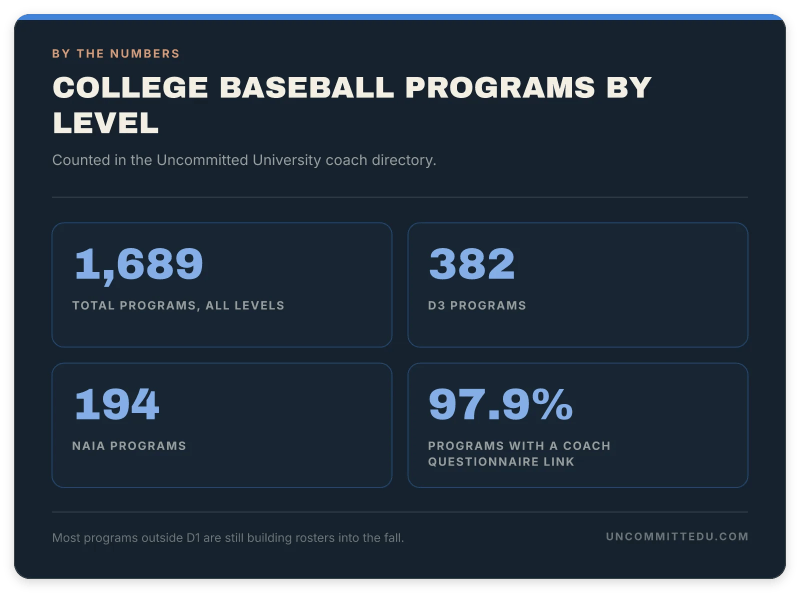
- 1,689 college baseball programs exist across every level, including 382 D3 programs and 194 NAIA programs, and many still have open spots in September.
- The Uncommitted University coach directory carries questionnaire links on 97.9 percent of programs, so most coaches take a form before a call.
- JUCO and preferred walk-on spots both move in November and December, after the players who talked to nobody in September already gave up.
What unsigned senior baseball recruiting actually means now
Unsigned senior baseball recruiting used to mean one thing: you had not signed a National Letter of Intent by the November date everyone talked about. That system is gone.
The NCAA ended the National Letter of Intent in October 2024. Schools now send a written offer of athletic aid instead, on their own timeline, with no single national signing day to miss. That single change is why an unsigned senior in September is not actually behind schedule.
That change works in your favor. A coach can offer you real money in January of your senior year, and it counts exactly the same as an offer sent in November. Being unsigned in September is not a red flag. It is just where most players actually are.
Under the old system, a player who had not signed by the fall date felt like they had already lost. That pressure sold a lot of expensive recruiting packages to families who were never actually behind. The new system removes the artificial deadline, but it does not remove the need to act. Coaches still fill rosters on their own schedule, and the players who reach out early in that schedule still get first look.
It also changes what “committed” means. A verbal commitment is a spoken agreement with no paperwork behind it, and either side can back out. A written offer of athletic aid is the real document, and it does not exist until a coach sends it. Plenty of players call themselves committed on social media in the spring of junior year and are still waiting on the actual offer a year later.

The players who panic are the ones still measuring themselves against a calendar that does not exist anymore. The players who move are the ones who understand why rosters are still open, which is the next question. An unsigned senior who moves this week beats one who waits for a sign.
Parents feel this pressure just as hard as players do. Every social media feed in August and September fills with commitment graphics, and it is easy to read that as a countdown clock. Neither the parent nor the unsigned senior is actually running out of time.
It is not. Those posts are a small, loud slice of recruiting, mostly early commitments from players who caught a coach’s eye a year or more ago. The far larger group, the players who sign in November, December, January and even February, almost never posts about the wait.
That group is not failing. That group is simply on the normal, later part of the same calendar, and most of this page is written for them. The unsigned senior reading this in September is squarely inside that normal group.
The four real reasons seniors go unsigned
Coaches are not ignoring you for one single reason. It is almost always one of four, and only one of them is about your skill.
- The roster math has not settled. D1 baseball is an equivalency sport with a 34-player roster cap after the 2025 House settlement. Coaches hold spots until transfer portal decisions land, often into December.
- Nobody has actually seen you. A great year on a small schedule, with no verified numbers anywhere, looks identical to a mediocre year from outside the state.
- You have contacted nobody, or contacted everybody with the same generic message. Coaches read outreach volume as interest level. Zero emails reads as zero interest.
- You are aiming at the wrong level. Chasing D1 offers with numbers that fit D3 or NAIA rosters burns the exact months when those rosters are still building.
Only the first reason is out of your hands. The other three are outreach, evidence, and targeting, and all three are fixable in the next two weeks. An unsigned senior who fixes all three usually sees a reply within days.
Look at each of those three honestly before you touch outreach. If your evidence is a phone video from the bleachers, that is a problem you can fix this week with a tripod and a bright field. If you have sent zero emails, that is not a talent gap, it is a to-do list. If your list is fifteen schools that all recruit at a level above your numbers, that is a targeting error, not a rejection.
Coaches also weigh timing against need. A program that lost three outfielders to the transfer portal in November suddenly needs an outfielder more than it needed one in June. That is out of your control too, which is exactly why casting a wider net matters more than picking five dream schools and waiting. That is exactly the kind of opening an unsigned senior with a wide list gets to catch.
Before you fix anything, it helps to know what a coach’s own September actually looks like, because it explains why your first email landed in silence.
What coaches are actually doing in September through December
A college coach in September is running practice, finishing a transfer portal board, and reading recruiting emails in five-minute gaps between meetings. Your one email is competing with a hundred others that day. That is true whether the sender is a five-star recruit or an unsigned senior nobody has heard of yet.
Here is the pattern across a normal fall, based on how programs build a class:
| Month | What the coaching staff is doing | What that means for you |
|---|---|---|
| September | Fall practice, evaluating returners, light recruiting between drills | Short emails get read. Long ones get skipped. |
| October | Fall scrimmages, first look at transfer portal names | Video and stats matter more than a cold introduction. |
| November | Portal decisions firm up, roster math becomes real | Coaches suddenly know exactly how many spots are open. |
| December | Filling the last roster gaps fast, often at lower cost levels | This is when unsigned seniors with real evidence get calls. |
Notice what is missing: nowhere on that list does a coach stop looking. The idea that recruiting ends after junior year is a myth built for a system the NCAA already retired. That myth is what talks an otherwise fine unsigned senior out of sending the email that would have worked.

The roster cap itself is new. Before the 2025 House settlement, D1 baseball had no roster limit at all, just a 11.7 scholarship cap split across as many players as a coach wanted to carry. Now the roster is capped at 34, and every scholarship dollar still gets split across whoever is on it. That makes every open seat, even a partial one, worth fighting for.
So the real question is not whether it is too late. It is whether your next ten days are spent on outreach that a busy coach can actually act on. That is the only question that actually decides where an unsigned senior lands.
There is a reason this pattern repeats every single year. D1 rosters are capped at 34 total under the House settlement, a hard limit that includes walk-ons, while D2, D3, NAIA, and JUCO carry no House cap at all. Injuries, academic issues, and portal exits all move that number during the season. A coach in December is not filling a wish list, they are patching real holes, which is why the unsigned senior who kept showing up in their inbox is often the easiest yes on the board.
Your ten-day plan, starting today
This is not a five-month plan. You do not have five months. You have ten days to get in front of the right coaches before rosters lock for the fall. Ten days is enough time for an unsigned senior to change the outcome.
- Day 1 to 2: Build one page that holds your numbers, schedule, and highlight video in one link. A coach will not click three separate links.
- Day 3 to 4: Build a list of 25 programs at your realistic level, using our level guide to set the range honestly.
- Day 5 to 7: Send a short, specific email to each coach on that list, one at a time, never a mass blast.
- Day 8 to 9: Follow up with anyone who opened but did not reply, once, with one new piece of information.
- Day 10: Widen the list to a second tier of programs and repeat, because volume compounds.

The plan only works if the outreach itself is good, and most unsigned seniors are sending the wrong kind of email without knowing it.
Outreach that gets a reply this late in the process
A coach in September skims. Your email has about eight seconds to prove you are worth a real look, and most player emails fail in the first sentence. That eight-second window is the same for every unsigned senior in the inbox that morning.
What works: your name, your position, your grad year, one verified number, and a direct link to video, all in the first three lines. No essay about your love of the game.
What fails: “I am interested in your program” with no number, no video link, and no sign you know anything about the roster you are asking to join.
Our own directory data shows why this matters at scale: coach questionnaire links exist on 97.9 percent of the programs we track, which means most coaches already built a funnel for exactly this. Skipping their form and cold-emailing instead is often the slower path. An unsigned senior who skips the questionnaire is often choosing the slower path without knowing it.

Send through both channels when you can. The coach directory holds the questionnaire link for each program, and a short direct email backs it up. Either channel alone can work, but an unsigned senior who uses both gets seen faster.
Timing matters inside the week too. Emails sent Tuesday through Thursday morning, before practice, get read more often than weekend messages that sit in an inbox until Monday. None of this replaces having real numbers to show. It just makes sure the numbers get seen.
JUCO, NAIA and D3 as fast paths, not backup plans
Here is the number most unsigned seniors never hear: there are 1,689 college baseball programs across every level, and D1 is a small slice of that. 382 of them are D3 programs and 194 are NAIA, and both groups build rosters later than D1 does.
Read our JUCO explainer before you rule it out. A strong JUCO year is one of the fastest ways back into a four-year program, and JUCO coaches are still building rosters into December. The NJCAA confirms JUCO coaches keep building rosters well past December, which is exactly the window an unsigned senior can still use.
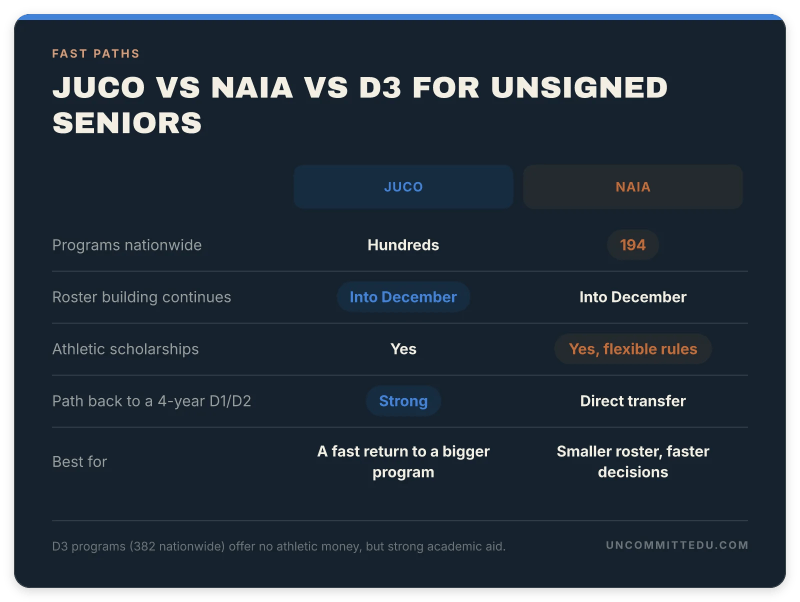
NAIA programs run smaller rosters, faster decisions, and often more scholarship flexibility than D2. D3 programs cannot offer athletic scholarships at all, but many carry strong academic aid, and their coaches read September email far more closely than D1 staffs do.
None of these are a downgrade if the roster spot is real and the coach wants you there. A signed spot on a program that plays you beats an unsigned wish list at a program that never calls back. For the unsigned senior weighing options, a real spot beats a bigger name every time.
NAIA eligibility rules also work differently than NCAA rules, with more flexibility around transfers and a shorter, faster recruiting cycle. A player who strikes out on D1 in September can have a real NAIA conversation going within two weeks, because NAIA coaches are used to building a class late. The same is true for many JUCO programs, where a coach short two arms in November will move fast on anyone who can show up and pitch.
Geography also works differently at these levels than most players expect. A D1 program recruits nationally and sometimes internationally, so a coach can afford to wait for exactly the right fit. A JUCO or small NAIA program usually recruits regionally, within driving distance of campus, because travel budgets are smaller and in-person visits matter more in the decision. That means a player who broadens the search radius by even two states at these levels often finds two or three times as many realistic options as staying local does.
This is also where the coach directory earns its keep. Searching by level and by state, rather than by name recognition, surfaces programs a player has never heard of but that fit their numbers exactly. Most of the players who end up thrilled with where they landed found that program in exactly this way, not from a highlight reel going viral. That search-by-level approach is exactly how an unsigned senior finds a program worth signing with.
Walk-on and preferred walk-on, and the fine print
A walk-on tries out for a roster with no scholarship promise attached, and might not make the team. A preferred walk-on is invited onto the roster ahead of time, with no athletic money attached, which is a real spot with real playing opportunity.
The two get confused constantly, and the difference matters. A preferred walk-on offer is a coach telling you, in writing, that they want you on the field. It is not a lesser offer. It is an offer without a scholarship line, and scholarship money can follow later as the roster’s equivalency math allows.

Ask the coach directly which one is on the table. “Am I invited onto the roster, or trying out for a spot?” is a fair question, and any coach worth playing for will answer it straight.

Before you accept anything, ask about the depth chart at your position, not just the roster spot. A preferred walk-on behind four scholarship players at the same position is a very different opportunity than one behind zero. An unsigned senior who skips that question can end up buried on the depth chart by spring.
What not to do while you are unsigned
Panic produces bad decisions, and a few show up every fall among unsigned seniors chasing a fast fix.
- Do not mass-email fifty coaches the identical letter. Coaches compare notes, and a form letter reads as one immediately.
- Do not go silent because one program said no. One no is one program, not a verdict on your ability.
- Do not chase only the biggest names. A realistic list at the right level outperforms a wish list at the wrong one.
- Do not skip the follow-up. Most replies come after the second message, not the first.

One more habit worth breaking: refreshing recruiting forums and social media for hours a day. That time is better spent on the ten-day plan above. Outreach volume, not anxiety, is what actually changes a coach’s list.
It also helps to keep a simple log of every program you contact, the date, and whether you heard back. Two weeks in, that log tells you exactly where to spend your next round of energy, on the coaches who opened your email but stayed quiet, rather than starting from zero every time. That log is the single habit that separates an organized unsigned senior from one still guessing in November.
We never promise a roster spot or a scholarship. What we can promise is the tool and the next step, which is the whole point of building your free player profile before the fall gets any further along.
A profile takes less time than one of the panic-scrolling sessions above, and it gives every coach you email a single link to your numbers, schedule and video, instead of three separate attachments they have to hunt for. That alone changes how many of your emails get a real look instead of a skim. An unsigned senior with one clean link simply gets more replies than one sending scattered attachments.
None of this requires waiting for a magic sign that you are ready. The players who land somewhere good this fall are, almost without exception, the ones who started the ten-day plan the same week they read a page exactly like this one.
Every email on that list is one of the seven touches the system tracks, from touch 1 through touch 7. The course walks the full sequence if you want it mapped out.
Frequently asked questions
Is it too late to be recruited as a senior?
No. The NCAA ended the National Letter of Intent in October 2024, so there is no fixed signing day left to have missed. Programs at every level keep filling rosters into December, and JUCO programs later than that. That means an unsigned senior in September still has real months of runway left.
Is it possible to get a D1 offer as an unsigned senior?
Yes, though it gets harder as roster caps fill. D1 baseball is equivalency, not headcount, with a 34-player cap after the 2025 House settlement, so partial spots do open in November and December as transfer portal decisions settle.
How do I get recruited for college baseball as a senior?
Build one page with your numbers, schedule and highlight video, target a realistic list of 25 programs, and send short, specific emails one at a time. Follow up once, then widen the list.
What is the difference between a walk-on and a preferred walk-on?
A walk-on tries out with no roster promise. A preferred walk-on is invited onto the roster in writing, with no scholarship attached yet. Ask the coach directly which one is being offered.
Should I lower my target level if I am unsigned in September?
Only if your numbers do not match your current list. Use a level guide to set a realistic range first, then aim there, since a realistic offer beats a wish-list silence.