

College Baseball Scholarships: How Many, How Much
How college baseball scholarships actually work is the most misunderstood part of recruiting. Most families expect a full ride. Almost nobody gets one.
This breaks down exactly how the money works. For the full recruiting process, see the college baseball recruiting guide.
Quick answer: NCAA baseball is an “equivalency” sport: a program gets a fixed scholarship budget (11.7 at D1) and splits it across the roster however the coach chooses. That was true of every D1 program until 1 July 2025, and it is now true of only some of them. True full rides are rare. Most offers are partial, and academic scholarships often matter as much as athletic ones.
Key takeaways
- College baseball scholarships are equivalency awards, not full rides: D1 programs that opted out of the House settlement still split 11.7 across an entire roster, while those that opted in can fund all 34 spots.
- Most college baseball scholarships are partial, and a bigger percentage does not mean more money.
- Compare college baseball scholarships on final out-of-pocket cost, never on percentage.
- Academic aid sits outside college baseball scholarships, and is often the larger number.
- Many college baseball scholarships renew year to year rather than being locked in for four.
How many scholarships does D1 baseball have? Every level, one table
Division I baseball at a school that opted into the House settlement can fund all 34 roster spots. A school that opted out still splits 11.7 equivalencies. That is the 2026 answer to the most typed question about college baseball money, and every other level has its own number. A “scholarship” at most of these levels is a share of a pool, not a full ride, so the second column is the one to read.
| Level | Maximum athletic aid per team | What that means for one player |
|---|---|---|
| NCAA D1, opted in (about 310 schools) | Up to 34, one per roster spot | Full rides are possible and power conference programs fund many. Mid-majors report funding 18 to 20 of the 34. Partial offers are still the norm below the top. |
| NCAA D1, opted out | 11.7 equivalencies, no roster cap | Quarters and halves across 30 to 40 players. A 25 percent offer is ordinary. |
| NCAA D2 | 9 equivalencies | Partial offers, often stacked with academic money. Many programs fund fewer than 9. |
| NCAA D3 | 0 athletic | Academic and need-based aid only, and it can beat a D2 partial. |
| NAIA | 12 equivalencies | Partial offers with more freedom to stack institutional aid than the NCAA allows. |
| NJCAA Division I | 24 full scholarships | Tuition, fees, books, room and board are all allowed. The cheapest full ride in college baseball. |
| NJCAA Division II | 24, tuition, fees and books only | No room and board in the award. |
| NJCAA Division III, CCCAA (California), NWAC | 0 athletic | Community college tuition is the aid. California JUCOs award nothing athletic by rule. |
How many baseball players get full scholarships? Under the old 11.7 system, almost none: a full ride meant taking a tenth of the whole budget. Under the 34 model it depends entirely on the school’s opt-in status and its athletic department budget, which is why the question to ask a coach in 2026 is not “is it a full ride” but “how many of your 34 are funded, and to what percentage.”
How to get a college baseball scholarship: the six steps that actually move money
- Know your level before you ask for money. Scholarship budgets follow talent bands. Find Your Level reads your 60, exit velocity and arm against real rosters so you are asking the schools that pay players like you.
- Get certified early. Register with the Eligibility Center by sophomore year. A coach cannot commit aid to a player who may not clear.
- Make the grades a weapon. Academic money is not capped by any of the numbers above. A 3.5 unlocks institutional aid the coach can stack on top of his budget.
- Build the video and the profile once, send it many times. Coaches decide whom to watch from a two-minute video and a one-page profile. The video guide has the shape.
- Email the coach yourself, with the numbers in the first line. Not a parent, not a service. The templates are built for it.
- Compare offers in dollars against cost of attendance, never in percentages, using the worked example below. Then ask the year-to-year questions in the coach section before you sign anything.
College baseball scholarships and what “equivalency sport” means
Some college sports, like football, offer a fixed number of full scholarships. Baseball doesn’t work that way.
Instead, a program gets a total scholarship budget under NCAA rules (11.7 scholarships at D1) and the coach splits that budget across the entire roster however he wants, unless the program opted into the House settlement and funds all 34 roster spots instead. One player might get 70%. Another might get 15%.
How the House settlement changed college baseball scholarships
Here is the single most important thing to know in 2026: college baseball scholarships no longer work the same way at every Division I school.
The House v. NCAA settlement received final approval on 6 June 2025 and took effect on 1 July 2025. It let Division I programs opt into a new model, and most of the money programs did.
Opting in replaces the 11.7 equivalency budget with a hard 34-player roster cap and removes the scholarship ceiling underneath it. Those schools can fund every roster spot.
Opting out keeps the old system: 11.7 equivalencies spread across a roster with no cap on its size.
So two D1 offers can now come from completely different economies. One school may be able to offer a full ride. Another, in the same conference, may still be splitting quarters and halves.
One precision point worth carrying: 11.7 is no longer an NCAA bylaw at all. The sport-by-sport aid limits were struck from the Division I Manual, so 11.7 now works as the trigger line that pulls a school into the settlement. The bylaw citations, and the limits at every other level, are in our baseball recruiting statistics page.
There is a cost to the new model. A 34-man cap is smaller than the 40-man rosters many programs carried, so the developmental walk-on spot that used to exist at the bottom of the roster has largely gone.
One wrinkle is worth knowing. Players who would have lost a spot purely because of the new cap could be flagged by their school as exempt from it, so some rosters legitimately ran past 34 during the changeover.
Ask whether a program is still carrying any of those exempt players before you read its roster number as the real number of college baseball scholarships available to you.
Below Division I, college baseball scholarships did not change at all. NCAA D2 still has 9 equivalencies. The NAIA still has 12. The NJCAA limit for baseball is 30 Letters of Intent or scholarships for 2026-27, not the 24 that circulates widely, which is softball on the same NJCAA chart. NCAA D3 still offers no athletic aid, only academic and need-based money.
Whats the bottom line? Ask two questions of every D1 program: did you opt in, and what is your roster number. Those answers tell you more about your real college baseball scholarships odds than any ranking will.
College baseball scholarships by level
The chart below breaks college baseball scholarships down by level, because the structure changes completely between the NCAA, the NAIA and the NJCAA.
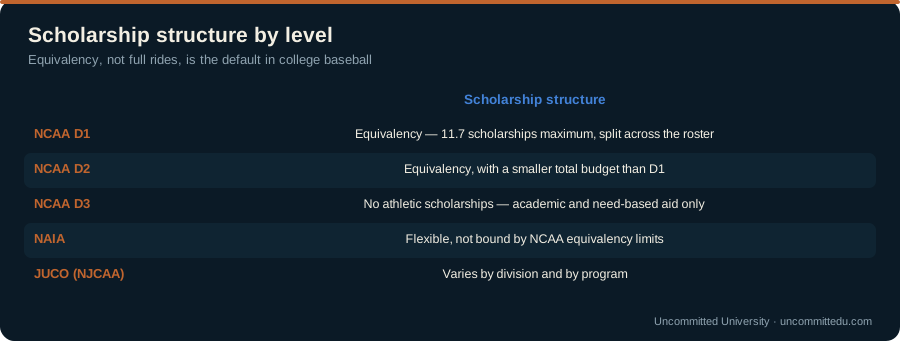
| Level | Scholarship structure |
|---|---|
| NCAA D1 | Opted in: up to 34 funded spots. Opted out: 11.7 equivalency, split across roster |
| NCAA D2 | Equivalency, smaller total budget than D1 |
| NCAA D3 | No athletic scholarships | academic/need-based aid only |
| NAIA | Flexible, not bound by NCAA equivalency limits |
| JUCO (NJCAA) | Varies by division and program |
Why “full” vs. “partial” isn’t the right way to compare
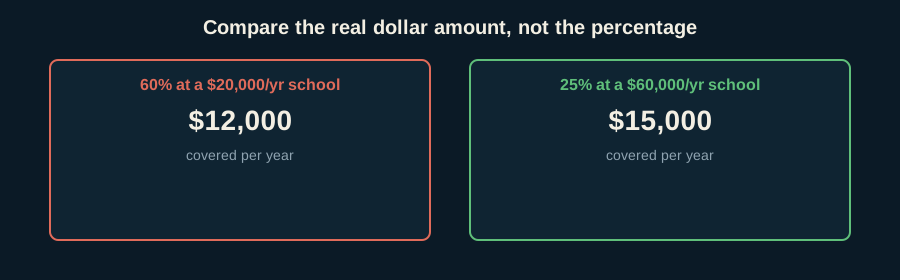
Don’t judge an offer purely by the percentage. Compare the actual dollar amount against the school’s total cost of attendance.
A 25% offer at a $60,000-a-year school can be worth more than a 60% offer at a $20,000-a-year school. Do the math on the real number, not the headline percentage.
The diagram below shows how one equivalency budget gets divided, which is why college baseball scholarships so rarely arrive as a full ride.
What is the average D2 baseball scholarship?
There is no published average, and any site quoting one to the dollar is guessing. What can be said honestly about college baseball scholarships at D2 is the arithmetic that sets the ceiling.
NCAA D2 baseball is an equivalency sport with 9 scholarships to split across an entire roster. Divide 9 by a roster that usually runs past 30 and the average share sits under a third of a scholarship, and it is never divided evenly.
- The 9 is a maximum, not a promise. Every D2 program is allowed 9 equivalencies. Not every D2 program funds all 9, so a partially funded roster has fewer college baseball scholarships to hand out than the rule implies.
- The money concentrates. A staff spends most of its budget on the few positions it cannot afford to get wrong, which pushes the typical D2 offer below the average and the top D2 offer well above it.
- Percentages hide dollars. Thirty percent of a $22,000 in-state cost and thirty percent of a $45,000 private-school cost are the same headline and completely different money.
- Academic aid usually does more work. At D2 the academic and need-based piece is often larger than the athletic piece, and it does not come out of the coach’s 9: it stacks on top of whatever college baseball scholarships money you are offered.
So the useful question is not what the average D2 baseball scholarship is worth. It is what this program is offering you, in dollars, after every other form of aid: the only honest way to compare college baseball scholarships across schools that cost different amounts to attend.
A worked example: comparing two offers side by side
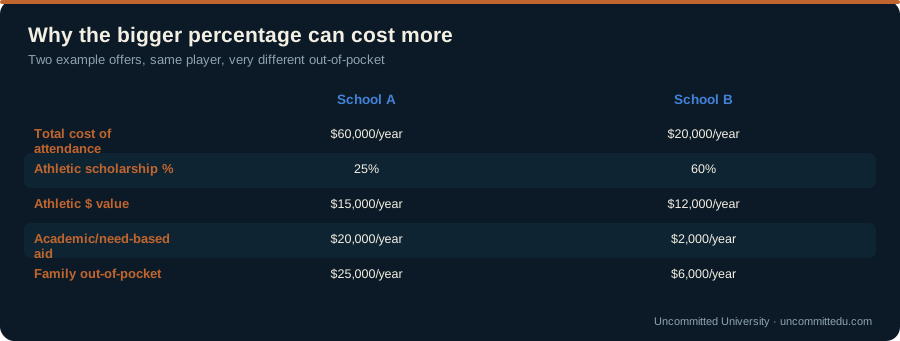
Illustrative numbers only: every school’s real cost of attendance is different, so always request the actual figures in writing. But the math pattern below is exactly how to compare any two real offers:
| School A (example) | School B (example) | |
|---|---|---|
| Total cost of attendance | $60,000/year | $20,000/year |
| Athletic scholarship % | 25% | 60% |
| Athletic $ value | $15,000/year | $12,000/year |
| Academic/need-based aid | $20,000/year | $2,000/year |
| Family out-of-pocket | $25,000/year | $6,000/year |
The 25% offer sounds smaller on paper. Once academic aid stacks on top, the real out-of-pocket comparison flips: School B actually costs less per year in this example. Always ask for the full award letter before comparing offers by percentage alone.
Academic scholarships often matter more
The comparison below is the one that changes decisions fastest: two college baseball scholarships offers where the larger percentage costs a family $19,000 more per year.
Academic scholarships sit outside the college baseball scholarships budget, and are often larger. A strong GPA and test scores can add real money on top of an athletic offer, sometimes more than the athletic money itself.
Always ask a coach what percentage of an offer is athletic money versus what your family would need to cover through academic aid, need-based aid, or out of pocket.
Know where you fit before you talk numbers
A realistic level match makes scholarship conversations easier. Check yours free.
How an offer actually moves from conversation to signature
A scholarship doesn’t arrive all at once. It typically moves through stages, and knowing them helps you understand where you actually stand:
- Verbal offer: A coach tells you directly what he’s prepared to offer. Real and worth taking seriously, but not binding: coaches and players both sometimes change their minds before paperwork is signed.
- Financial aid award letter: The school’s financial aid office sends a written breakdown of athletic, academic, and need-based aid combined. This is the first document that shows the real total picture, not just the athletic piece.
- National Letter of Intent (NLI) or institutional aid agreement: The binding paperwork. Signing this (for NCAA programs that participate in the NLI program) commits you to the school and the school to the scholarship terms for the period specified.
- Annual renewal (if applicable): Many college baseball scholarships are renewed year to year rather than guaranteed for all four years upfront. Confirm which type you’re being offered before you sign anything.
Treat a verbal offer as a strong, genuine signal, but don’t consider a decision final, or stop talking to other schools, until there’s something in writing.
What happens to college baseball scholarships if you get injured
This is one of the most common worries families raise, and the honest answer is that it depends on the specific agreement:
- NCAA rules provide some protections around scholarship non-renewal, but the details vary by situation and by school policy.
- Ask directly, before signing: what happens to my scholarship if I’m injured and can’t play for a season?
- Get the answer in writing rather than relying on a verbal reassurance: a program’s actual policy matters more than a general “we take care of our guys” answer.
- A program that has a clear, specific answer to this question (rather than a vague one) is usually a program that handles these situations fairly in practice.
Questions to ask a coach about college baseball scholarships
- What percentage of this offer is guaranteed for all four years?
- Does it change based on performance, injury, or roster spot?
- What’s the total cost of attendance, so I can see the real dollar gap?
- Are there academic scholarships I’d also qualify for?
- What happens to the scholarship if I get injured, or if I transfer?
- If I lose a year to injury, does my aid continue while my five-year eligibility clock keeps running?
Roster spots vs. scholarship spots
Not every player on a roster is on scholarship. Programs often carry walk-ons: players who make the team without athletic aid, at least at first.
- Walk-on spots are real opportunities, especially at D1 and D2, where roster sizes exceed scholarship counts.
- Scholarship money often opens up as players graduate, transfer, or get injured.
- A strong walk-on season is one of the more reliable ways to earn a scholarship later.
How college baseball scholarships can change year to year
College baseball scholarships aren’t always locked in at the same number for four years. Coaches can adjust it, within NCAA rules, based on performance, roster needs, or budget changes.
- Ask directly whether your offer is guaranteed for four years or renewed annually.
- Get the renewal terms in writing when you can.
- Understand what circumstances (injury, a coaching change, a bad season) could affect it.
A clear answer here tells you a lot about how the program treats its players long-term.
How to actually negotiate, without souring the relationship
“Negotiate” makes some families uncomfortable, but a respectful, informed conversation about numbers is normal and expected: coaches have these conversations constantly.
- Lead with information, not demands. “We received a written offer from [Program] with a real dollar gap of [X], is there any flexibility on your end?” is a fair, common question.
- Loop in the financial aid office, not just the coach. Some of the biggest gaps get closed through academic or need-based aid the coach doesn’t control directly.
- Ask, don’t demand. A coach who feels pressured rarely responds well, but a coach who understands your real constraints often finds a way to help if one exists.
- Know your walk-away point before the conversation, so you’re not deciding under pressure in the moment.
- Get any adjusted offer back in writing before treating it as final: a verbal adjustment during a negotiation is still just a verbal offer.
In-state vs. out-of-state cost, a factor worth asking about early
At public D1 and D2 schools, in-state and out-of-state tuition can differ substantially, and this changes what a given scholarship percentage is actually worth:
- The same 30% athletic scholarship covers a much bigger real dollar amount at out-of-state tuition than in-state tuition: ask which rate applies to your award.
- Some programs use academic scholarships specifically to help out-of-state athletes close that gap, since athletic dollars alone often can’t cover it.
- If you’re recruited by an out-of-state public school, ask directly whether any path exists to in-state tuition rates over time, and whether that affects your total aid package.
Common misunderstandings
- “D1 always means more money.” Not necessarily: a D2 or NAIA offer stacked with academic aid can beat a small D1 percentage.
- “A verbal offer is guaranteed.” It isn’t binding until signed. Get details in writing when you can.
- “Walk-ons never get scholarship money.” Many walk-ons earn college baseball scholarships later, once they prove themselves on the roster.
Stacking aid from multiple sources
Athletic money is only one piece. A full financial picture often includes:
- Academic scholarships: merit-based, tied to GPA and test scores
- Need-based aid: federal and school-specific, tied to family income
- Outside scholarships: local organizations, employer programs, private funds
Ask each school’s financial aid office directly how athletic and academic aid combine: some schools cap the total, others don’t.
How coaches actually decide who gets more of the budget
The scholarship split isn’t random, and understanding the logic helps you read your own offer more clearly:
- Position need drives a lot of it. A program losing three seniors at shortstop next year will often prioritize scholarship dollars at that position over one that’s already deep.
- Class balance matters. Coaches manage scholarship money across multiple recruiting classes at once, not just yours: a program that just gave big money to last year’s class may have less flexibility this year regardless of your talent.
- In-state vs. out-of-state factors in at public schools. Since out-of-state tuition costs more, coaches sometimes weigh geography into how they allocate limited dollars.
- Perceived recruiting competition affects it too. A player being pursued by several comparable programs may see a stronger offer than one where the coach senses little competition for his commitment.
None of this means the number is fixed or unfair: it means an offer reflects the roster’s whole picture, not just an individual evaluation of you.
Mistakes families make with college baseball scholarships
The checklist below is worth reading before any offer conversation, because most college baseball scholarships mistakes are made before the real numbers are on the table.
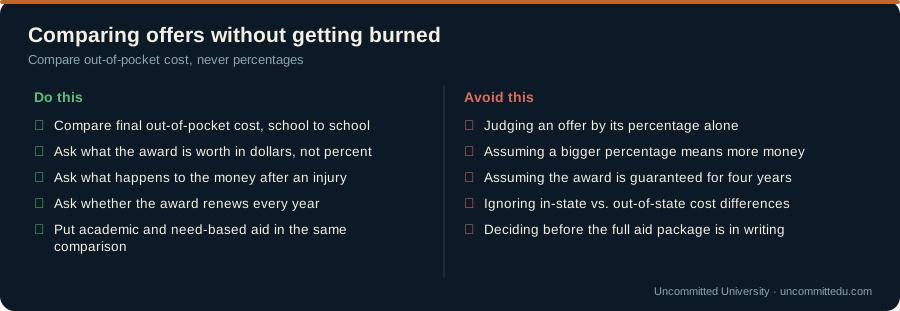
- Comparing percentages instead of real dollars. The single most common error: always convert every offer to an actual annual cost before comparing.
- Treating a verbal offer as final and stopping conversations with other schools before anything is in writing.
- Not asking about renewal terms until after signing, when it’s too late to negotiate that detail.
- Ignoring academic aid entirely because the conversation started with the coach, not the financial aid office: always loop in financial aid directly.
- Letting the athletic offer alone decide the school without weighing playing time, development, and fit: a bigger scholarship at a program where you’d rarely play is a worse outcome than a smaller one with a real role.
- Assuming every school handles injury situations the same way. Ask each program directly rather than assuming a general rule applies everywhere. This matters more since 2026: NCAA Divisions I and II eliminated medical hardship waivers along with seasons of competition, so a lost year no longer comes back, and how a program treats college baseball scholarships during that year is a question worth asking before you sign.
Frequently asked questions
These come up in almost every family conversation about college baseball scholarships.
What are the best colleges for baseball scholarships? The ones that fund the most of their limit at the level you can play. In 2026 that means opted-in Division I programs in the power conferences funding most of 34, NJCAA Division I programs where a full ride is common, and NAIA programs that stack institutional aid freely. A ranking of “best” would be a ranking of budgets nobody publishes. Ask each coach how many awards he funded last year and at what average percentage.
What baseball position gets the most scholarships? Pitchers, as a group, because they are half the roster and the arm is the scarcest asset. Per player, the premium goes to a catcher who can throw, a shortstop who can stay there and a left-handed pitcher. Position-by-position scholarship numbers are not published by any level; what is published is the roster, and half of it pitches.
Are there baseball scholarships for high school seniors who are uncommitted? Yes, and late money moves in two windows: after the November signing period, when a program’s commits fall through, and after the June transfer portal, when rosters reshuffle. NJCAA programs recruit seniors into the summer. An uncommitted senior with a current video, a certified transcript and a level-matched school list is not late, he is in the second market.
Do D2 programs always fund all 9 baseball scholarships? No. Nine equivalencies is the NCAA maximum for D2 baseball, not a guarantee that a school has funded them. Ask directly how much of the scholarship budget is actually funded this year: it is a fair question, and the answer changes what an offer is worth.
Do most college baseball players get a full scholarship? No. Baseball is an NCAA equivalency sport, meaning a program splits a fixed scholarship budget across the whole roster. True full rides are rare, and most offers are partial.
Is a bigger scholarship percentage always the better offer? Not necessarily. A smaller percentage at a more expensive school can be worth more in real dollars than a larger percentage at a cheaper school, especially once academic and need-based aid stack on top. Compare total out-of-pocket cost, not just the percentage.
Is a verbal scholarship offer binding? No. A verbal offer is real and worth taking seriously, but it isn’t binding until a written agreement or National Letter of Intent is signed. Get details in writing before treating a decision as final.
What happens to a baseball scholarship if a player gets injured? It depends on the specific program’s policy and agreement. Ask directly before signing what happens to the scholarship after an injury, and get the answer in writing rather than relying on a verbal reassurance.
Can walk-on players earn a scholarship later? Yes. Many walk-ons earn athletic scholarships after proving themselves on the roster, and scholarship money often opens up as players graduate, transfer, or get injured.
Is athletic scholarship money the only aid available? No. Academic scholarships, need-based aid, and outside scholarships can all stack with athletic money, and academic aid is often larger than the athletic piece. Ask each school’s financial aid office how the different types combine.
The short version: college baseball scholarships reward the families who compare final cost rather than headline percentages. Ask what an award is worth in dollars, what happens to it after an injury, and whether it renews each year, then compare college baseball scholarships across every school on those same three terms.
The short version
College baseball scholarships are split money, not full rides, except at the Division I programs that opted into the House settlement, which can now fund all 34 roster spots. Everywhere else the equivalency math still applies: 9 at D2, 12 in the NAIA, up to 30 signees at NJCAA Division I, and none at D3.
Uncommitted University tells every family the same thing: compare college baseball scholarships as a net four-year cost after academic aid, never as a headline percentage.
Your next step
Build a target list across levels (see the D1 vs. D2 vs. D3 vs. NAIA vs. JUCO breakdown) so you’re comparing real offers across schools that actually fit.
If NIL is part of the conversation, the NIL calculator gives a realistic range in a few seconds. No email, no account, and every multiplier is printed on the page so you can check the arithmetic yourself.
Written by Wayne Keeton, founder of Uncommitted University.