

Walk-On to Scholarship: How It Works
Walk-on to scholarship is a real, common path in college baseball, not a rare exception. Programs regularly convert walk-ons who earn it through performance.
This explains exactly how that path typically works. For the full picture, see the baseball transfer portal guide.
Quick answer: Walk-ons earn scholarships by outperforming expectations in practice and games, filling a roster need that opens up, and proving over a season or more that they belong on scholarship. It’s a proven, realistic path, not a long shot reserved for rare exceptions.
Key takeaways
- Walk-on to scholarship is a common path in college baseball, not a rare exception.
- How you arrive shapes how fast walk-on to scholarship can happen.
- A preferred walk-on already has the relationship, so walk-on to scholarship moves fastest there.
- Money frees up as players graduate, transfer or get injured.
- Walk-on to scholarship is usually a two-year plan, decided in year one.
Why programs carry walk-ons, and how walk-on to scholarship works
Rosters are almost always bigger than the number of available scholarships, especially at D1 and D2, where baseball’s equivalency structure limits total scholarship dollars. Walk-ons fill out depth, push starters in practice, and sometimes outperform scholarship players entirely.
The math behind this is simple: baseball’s scholarship equivalency system spreads a limited pool of scholarship money across a much bigger roster. That gap is exactly where walk-ons live.
Walk-on to scholarship paths compared
The table below compares how walk-on to scholarship works from each starting point.
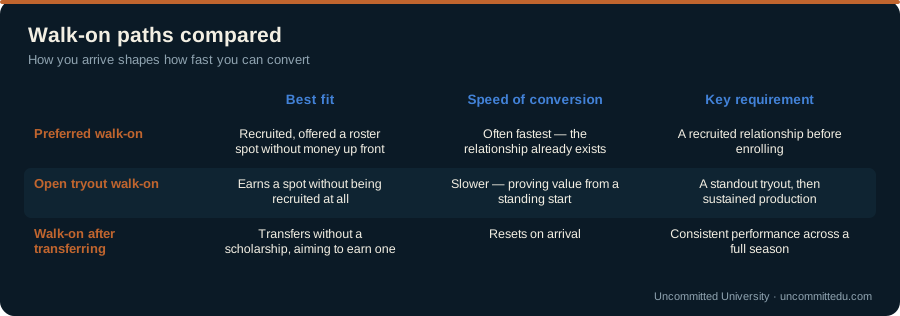
Not every walk-on situation looks the same. Here’s how the common paths differ.
| Path | Best fit | Speed of conversion | Key requirement |
|---|---|---|---|
| Preferred walk-on | Recruited players offered a roster spot without scholarship money upfront | Often the fastest: a role and reputation are already established with the staff | Recruited relationship with the coaching staff before enrolling |
| Open tryout walk-on | Players who earn a spot without being recruited at all | Slower: has to prove roster value from a standing start | Standout tryout performance, then sustained practice production |
| Walk-on after transferring | Players who transfer without a scholarship, aiming to earn one at the new school | Similar timeline to a fresh walk-on, resets on arrival | Consistent performance across a full season at the new program |
How to walk on to a college baseball team, step by step
Email the coach before you enroll, not after. Ask two questions: does the program hold a fall tryout, and what would a roster spot take. Send a profile with a measured number and video, get admitted, register with the Eligibility Center, show up in shape on the tryout date, and have a written answer from the coach about what happens if you make it. Every one of those steps is skipped by most of the players who turn up cold in September, which is why most of them go home.
- Pick the schools where a walk-on spot exists. Ask the question in the recruiting email: opted-in Division I programs work to a 34-man cap and rarely carry an unfunded player; opted-out D1s, Division II, Division III, the NAIA and junior colleges still do. The divisions guide has the roster picture by level.
- Email the coaching staff the spring before you enroll. Recruiting coordinator first. Name your position, one verified number, your GPA, your admission status and the sentence “I would like to earn a roster spot as a walk-on.” The walk-on email template is written out.
- Get admitted on your own. A walk-on has no admissions help. Apply early, and tell the coach the day the acceptance arrives.
- Clear eligibility before campus. Register with the NCAA Eligibility Center for D1 and D2, or the PlayNAIA center for the NAIA, and have the physical and the school’s athletics paperwork done before the tryout date. A player who is not cleared cannot try out.
- Arrive with the numbers already sent. The tryout is a confirmation of the video, not a first look. Run the 60, throw, hit, and do the one thing your position is judged on, at the level you showed on film.
- Get the terms in writing. Roster spot or practice squad, travel roster or not, how athletic aid is awarded the following year, and who decides. A preferred walk-on offer that does not say those four things is a conversation, not an offer.
Then play the first year the way the section below describes, because the tryout gets you in the room and the season is what earns the money.
How walk-on to scholarship actually happens
- Outperforming in practice. Coaches notice players who compete hard and produce, regardless of how they arrived on the roster.
- Filling a real need. An injury, a transfer out, or graduating seniors can open scholarship money mid-career.
- Proving it over time. A single strong scrimmage rarely converts a scholarship: sustained performance across a season does.
- Being ready when the opportunity comes. Staying prepared and available matters as much as raw talent.
A few specific moments tend to open the door faster than a normal season would:
- An injury to a scholarship player at your position. Being ready to step in immediately, without hesitation, gets noticed.
- A player transferring out. Departures open both a roster spot and, sometimes, scholarship money that has to go somewhere.
- A coaching staff reallocating aid at year-end. Scholarship money is often redistributed after a season based on who actually earned it that year.
The diagram below traces the walk-on to scholarship path from roster spot to award.

What makes a walk-on to scholarship situation realistic
Not every walk-on spot is equal. Before committing as a walk-on, look for signals that conversion is genuinely possible:
- A program with a track record of actually converting walk-ons to scholarship
- A realistic roster spot at your position, not one already deep with scholarship players
- A coaching staff willing to talk openly about the path and what it takes
A year-by-year look at how walk-on to scholarship typically happens
This isn’t a real player: it’s a composite scenario reflecting a common pattern across programs.
- Year one: A walk-on sees limited game action, but stands out in practice and scout-team work. Coaches notice effort and consistency more than stats at this stage.
- Year two: A specific opportunity opens (an injury, a transfer, a graduating senior), and the walk-on is ready to take real innings or at-bats.
- Mid-to-late year two or year three: After a full season of proof at the level, the program moves him onto partial or full scholarship, often timed to the next financial aid cycle.
The timeline varies by program and position, but the pattern holds: readiness before the opportunity, then sustained performance after it, not a single standout moment.
How walk-on to scholarship money actually gets allocated
Scholarship decisions aren’t made in a vacuum. A few realities shape when and how a walk-on gets money:
- Budgets are typically set annually, meaning a mid-season promise is often really a commitment for the following year’s aid cycle.
- Coaches balance the whole roster, not just one player’s case: a strong walk-on competes against other roster needs for the same limited dollars.
- Partial scholarships are common before a full ride. Conversion is often gradual, not a single jump from zero to fully funded.
Build a profile that keeps proving your case
Keep your metrics and video current, walk-on or not, it’s how coaches track real progress.
What if the walk-on to scholarship move never comes
It’s worth being honest about this upfront: not every walk-on earns a scholarship, and that doesn’t automatically mean the experience wasn’t worth it.
- Roster spot and development still have real value. Playing college baseball at all, developing physically, and being part of a program are outcomes independent of scholarship money.
- Playing time can matter more than the scholarship label. A walk-on getting real innings is often better positioned than a scholarship player buried on the bench.
- A walk-on year can still lead somewhere else. Strong film and stats as a walk-on can support a transfer to a program that offers scholarship money directly.
Go in with a realistic view: pursue the scholarship, but don’t measure the whole experience against it.
Some of the most successful college baseball careers include a walk-on year that never converted to a scholarship at all: the player still got everyday at-bats or innings, developed into a legitimate professional or college coaching prospect, and used the experience as a real credential. Scholarship money is one measure of success here, not the only one.
Preferred walk-on vs. open tryout: what actually differs
These two paths onto a roster look similar from the outside, but the starting position is different.
- A preferred walk-on is recruited, has a relationship with the coaching staff before enrolling, and usually has a clearer sense of his role going in.
- An open tryout walk-on earns his spot cold, often with less certainty about role or long-term outlook, and has to build the coaching relationship from scratch.
- Both paths can lead to a scholarship. The preferred route tends to move faster since trust is already established, but performance is still what ultimately earns the money in either case.
Whichever route got you on the roster, the standard for earning a scholarship afterward is the same: sustained performance, evaluated over a full season, not the story of how you arrived.
Questions to ask about walk-on to scholarship before accepting an offer
- How many walk-ons have earned scholarships here in recent years?
- What does the path to scholarship actually look like: is it performance-based or budget-dependent?
- What’s the realistic playing time outlook, separate from the scholarship question?
A coach willing to answer these honestly is showing you exactly how seriously the program treats walk-ons.
What to do in your first year as a walk-on
The steps below are what a walk-on to scholarship first year should actually look like.
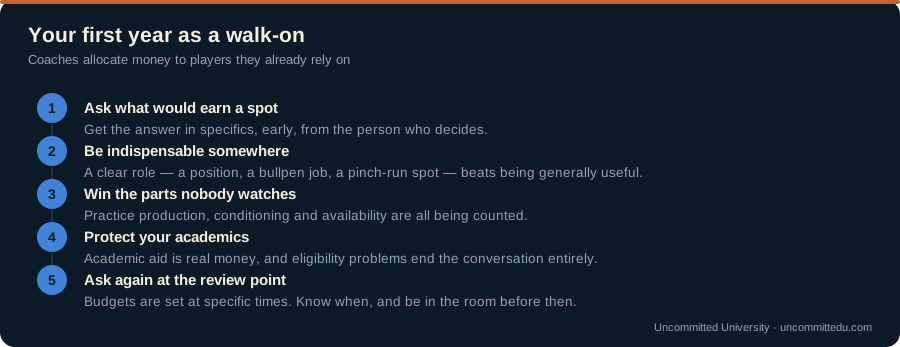
The first year sets the tone for everything that follows. A few habits matter more than raw talent at this stage:
- Show up early and stay late, consistently, not just when it’s convenient. Coaches notice who’s actually putting in the extra work.
- Compete in every drill like it’s being scored, because in a real sense, it is: scout-team and practice reps are your audition.
- Build a real relationship with the coaching staff, not just your position coach. Head coaches make the scholarship calls.
- Keep your academics and eligibility clean. A scholarship offer disappears fast if academic or conduct issues put your eligibility at risk.
- Track your own development honestly. Know specifically what you’ve improved and what still needs work: it makes conversations with coaches more productive.
None of this guarantees a scholarship in year one, or ever. But it’s the version of a walk-on year that gives a program every reason to convert you when the opportunity comes.
Common walk-on to scholarship mistakes
The checklist below covers the habits that end a walk-on to scholarship plan in year one.
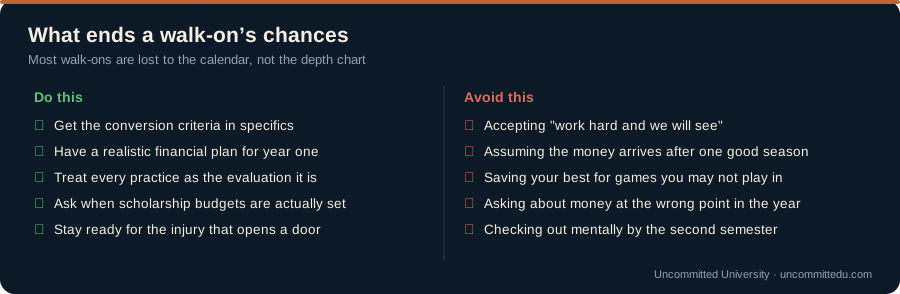
- Assuming a scholarship is guaranteed eventually. It has to be earned: nothing is automatic.
- Choosing a walk-on spot at a program with no track record of converting them. Ask directly before committing.
- Losing motivation without a scholarship attached. Consistency is exactly what gets noticed.
- Comparing yourself to scholarship teammates instead of your own progress. The path is different: measure your own development, not someone else’s starting point.
- Never directly asking the coaching staff where you stand. A specific, honest conversation once or twice a year beats guessing at your own status.
Paying for school as a walk-on
Without an athletic scholarship, the financial side of a walk-on year deserves its own plan:
- Academic scholarships and financial aid still apply, independent of athletics: file the FAFSA and check institutional academic aid regardless of your roster status.
- Some athletic departments offer partial aid packages below a full scholarship, worth asking about directly even before full conversion happens.
- Budget as if the scholarship might not come, at least for the first year or two. Treat any athletic aid as a bonus on top of a plan that already works without it.
- Ask about work-study and campus jobs. Some walk-ons offset costs with on-campus work that fits around a practice and travel schedule: ask your academic advisor what’s realistic.
How roster caps changed the walk-on to scholarship route
This route has genuinely changed since 2025, and advice written before then is now misleading at the Division I level.
Under the old system a Division I programme had 11.7 scholarships and no cap on roster size. Carrying extra unfunded players cost nothing, so rosters ran to 40 or more and the walk-on to scholarship story had somewhere to start.
The House settlement replaced that at schools which opted in. Those programmes now work to a hard 34-player roster cap, and they can fund every one of those spots.
The consequence is blunt. When every roster spot can be paid, an unfunded developmental spot is a spot the programme is choosing to waste. The traditional walk-on to scholarship path has narrowed sharply at opted-in schools.
It has not closed everywhere. Programmes that opted out kept the old model: 11.7 equivalencies and no roster cap, which means unfunded roster spots still exist and still make sense for them.
And nothing changed below Division I. Division II, the NAIA and junior colleges all still carry larger rosters with room to earn your way up.
So the first question is no longer whether you can walk on. It is which system this specific programme is operating under, and you have to ask.
It is also worth being precise about what walking on means, because three different things share the name. A recruited walk-on was actively pursued and offered a place without money. A preferred walk-on has a guaranteed roster spot but no aid. A true walk-on makes the team through open tryouts, and that is rare and getting rarer.
Where the walk-on to scholarship move still happens, the mechanics are unchanged. Athletic aid is awarded year to year, so a player who contributes can be funded the following year as the budget frees up.
What actually earns it: being genuinely useful rather than merely present, filling a role the roster needs, and being the player the staff would have to replace.
Ask directly in recruiting. Have players moved from walk-on to scholarship here in the last three years, and how many? A programme that does it will name them. A programme that does not will talk about opportunity in general terms.
Frequently asked questions about walk-on to scholarship
What does preferred walk-on mean in baseball? A player the staff recruited and wants, who is guaranteed a roster spot on arrival but no athletic aid. A true walk-on earns the spot at an open tryout with no guarantee; a recruited walk-on was pursued but promised nothing in writing. “Preferred” is worth exactly what the coach puts in the email: ask whether the spot is on the travel roster, whether it survives a bad fall, and how aid is decided for the second year.
Can you walk on to a D1 baseball team? At some. Division I programs that opted in to the House settlement carry 34 players and can fund every spot, so an unfunded walk-on is rare there and a preferred walk-on is usually a player they meant to recruit. Programs that opted out kept 11.7 scholarships and no roster cap, and still hold tryouts. Ask each program which model it runs before you plan around it; the answer changes the odds more than your 60 time does.
Do colleges still do walk-on tryouts? Yes, most of college baseball does. Division II, Division III, the NAIA and junior colleges hold fall tryouts every year, usually in the first weeks of the semester, and many post the date on the athletics site in August. Opted-in Division I programs mostly do not. To try out you must be enrolled full time, cleared by the school’s compliance and sports medicine offices, and, at D1 and D2, certified by the Eligibility Center, so the paperwork starts in the summer.
How long does it typically take a walk-on to earn a scholarship? It varies widely by program and position, but conversion commonly happens after a full season or more of proven, consistent performance, rarely in year one.
Do all walk-ons eventually get a scholarship? No. Conversion has to be earned through performance and a real roster or budget opening, it’s a realistic path, not a guarantee.
What’s the difference between a preferred walk-on and a regular walk-on? A preferred walk-on is recruited and offered a roster spot before enrolling, without scholarship money attached. A regular (or open-tryout) walk-on earns a roster spot without being recruited at all.
Can a walk-on get a partial scholarship instead of a full one? Yes, and it’s common. Conversion is often gradual: from no scholarship, to partial aid, to a larger award over time as performance and budget allow.
Should I choose a walk-on offer over a small scholarship elsewhere? It depends on fit, playing time outlook, and the program’s actual track record of converting walk-ons. Compare honestly rather than assuming the scholarship offer is automatically the better option.
What’s the biggest mistake walk-ons make? Assuming a scholarship is inevitable if they just wait it out. It has to be earned through sustained, visible performance, not assumed as a reward for patience alone.
The short version: walk-on to scholarship is decided long before money is discussed. Ask the person who decides exactly what would earn a spot, become indispensable in one clear role, protect your academics, and know when scholarship budgets are actually set. Accepting a vague “work hard and we will see” is the most common way a walk-on to scholarship plan quietly dies.
The short version
The walk-on to scholarship path narrowed at Division I schools that opted into the House settlement, because a 34-man roster cap with every spot fundable leaves little reason to carry unfunded players.
It remains realistic at opted-out Division I programmes, and throughout Division II, the NAIA and junior college, where rosters are larger and aid is awarded year to year.
Uncommitted University tells walk-ons to ask one question before committing: how many players here have gone from walk-on to scholarship in the last three years, and what were their names.
Get the roster number and the opt-in answer in the same conversation. A programme carrying 34 funded players has a very different walk-on to scholarship picture from one carrying 42 with 11.7 to spread across them.
Your next step
If you’re weighing a walk-on offer against other options, compare it honestly against the full picture in the D1 vs. D2 vs. D3 vs. NAIA vs. JUCO breakdown.
Written by Wayne Keeton, founder of Uncommitted University.