

Recruiting Questionnaire: The Complete 6-Field Guide
Updated September 2026. Sourced from the recruiting questionnaires of 1,600+ college programs in the app’s coach directory, with the fields read line by line on 40 of them.
You found a school you like. Then you found the “recruit me” link, and it turned into ten screens of dropdowns. That form is a baseball recruiting questionnaire, and almost every college program runs one.
Most players fill it out once and never think about it again. That is a mistake. The recruiting questionnaire is the first data point a coach’s staff has on you, and how you complete it decides whether a real person reads your name next. It should not be the first time they see that name: in our system it is touch four of seven, and the three before it make your name familiar when the form lands.
Here is what this guide covers, in order:
- What a baseball recruiting questionnaire actually is and why programs use one
- The fields that matter most, and the ones coaches skim past
- How recruiting questionnaire answers turn into a real look from a staff
- What to do after you submit, since submitting is not the finish line
- The mistakes that get a recruiting questionnaire filed and forgotten
- A free way to find and fill out every program’s recruiting questionnaire in one place
Key takeaways
- A baseball recruiting questionnaire is a program’s own intake form, not a national database.
- Coaches use it to sort players by grad year, position, and measurables before any conversation starts.
- 97.9% of coach profiles in the app’s directory carry a direct link to that program’s recruiting questionnaire.
- A recruiting questionnaire alone rarely gets a reply. It has to be followed by outreach and video.
- Filling one out wrong, guessed numbers, no video link, is worse than skipping it.

What is a baseball recruiting questionnaire?
A baseball recruiting questionnaire is a form hosted on a college program’s own athletics site. It asks for your grad year, position, school, GPA, contact info, and usually your top measurables like exit velocity, 60-yard time, or fastball velocity.
Every school runs its own version. Filling out Vanderbilt’s recruiting questionnaire does nothing for your file at Ole Miss. There is no shared national form, no matter what a camp flyer implies.
That single fact trips up more players than any part of the process. A recruiting questionnaire is not exposure. It is paperwork a coach’s staff sorts through once a week, at best.
Why coaches use a recruiting questionnaire at all
Coaching staffs get hundreds of emails a month. A recruiting questionnaire lets a grad assistant sort players by grad year and position before anyone reads a full message.
Most staffs run the same triage. They filter by class year first, then position need, then measurables against a rough cutoff for their level. A number below that cutoff usually ends the look before it starts.
That is not personal. It is volume management. A program fielding recruits at every position cannot read every full email, so the form does the first pass.

The fields that actually matter
Not every field on a recruiting questionnaire carries equal weight. Coaches told us and other outlets the same handful move the needle.
| Field | Why it matters | Common mistake |
|---|---|---|
| Grad year | Sorts you into the right recruiting class instantly | Listed wrong after a reclass or gap year |
| Primary position | Matches you to open roster spots | Listing three positions with no primary |
| Measurables (velo, exit velo, 60) | The first real filter against the level | Rounded up or untested numbers |
| GPA and test scores | Screens for admissions and academic index at some levels | Left blank entirely |
| Video link | The only way a staff verifies your numbers | No link, or a link to a highlight video with no full innings |
| Travel or school team schedule | Tells a coach when they can see you live | Left blank, so nobody plans a trip around you |
Notice video sits in the middle of that list, not the top. A recruiting questionnaire with strong numbers and no video gets treated as unverified. Coaches see inflated stats often enough that they discount anything they cannot check.

Filling one out: field by field
Work through a recruiting questionnaire the same way every time so nothing gets guessed.
Grad year and position first. Confirm both against your current transcript and your primary spot, not the position you play when a team is short.
Measurables from a real test. A number from a showcase, a school tryout, or a tracked bullpen carries weight. A number you estimated at home does not, and coaches can usually tell.
Academic fields, filled in full. Programs above the JUCO level often screen on GPA and test scores before a coach ever sees your athletic profile. A blank field reads as a red flag, not neutral.
One video link, cued to real innings. Skip a highlight reel alone. Include at least one full at-bat or full inning so a coach sees you against real pitching or hitting, not just the best three plays of your season.
Once your recruiting profile and video are in order, the free coaches directory links straight to each program’s recruiting questionnaire, so you are not hunting through ten athletics sites by hand.
Find your recruiting questionnaire links →

What happens after you submit
A submitted recruiting questionnaire almost never earns a reply on its own. It sits in a shared inbox or a recruiting database until a staff member runs a report, often weekly.
If your numbers clear their bar, you usually get an automated confirmation, not a personal note. A personal reply means a coach pulled your file specifically, which is rare from the questionnaire step alone.
Treat it as one touch in a sequence. The next is direct outreach: a short, specific email or a cold email to that same coach referencing the questionnaire you just filled out, so it is not the only signal they have from you.
Where the questionnaire sits
- Touch 1
- Touch 2
- Touch 3
- Touch 4: the recruiting questionnaire, this article
- Touch 5
- Touch 6
- Touch 7
Seven touches, in order, about three weeks per school. The order and the scripts are the course.
How long a program keeps your answers
Most programs keep questionnaire submissions for one full recruiting cycle, roughly the two years before your grad year, though this varies by staff.
An outdated submission is worse than a fresh one. If your measurables improve after a showcase, resubmit rather than assume the old numbers still represent you.
Update at three points every year: after your school season ends, after a summer showcase, and again in the fall before your target class’s signing period opens.

Questionnaire versus recruiting profile versus outreach
Players often confuse three separate tools that work together, not as substitutes for each other.
| Tool | Who controls it | What it does |
|---|---|---|
| Program questionnaire | The college | Sorts you into that program’s own recruiting board |
| Recruiting profile | You | A permanent page any coach can reference after first contact |
| Direct outreach email | You | Puts your name in front of a specific coach on purpose |
A strong questionnaire without a profile or outreach behind it rarely converts. Run all three together and each one reinforces the others.
Mistakes that get a questionnaire ignored
A handful of errors show up on nearly every wasted submission.
- Rounded or guessed measurables. A coach comparing your number against a tracked showcase reading will notice the gap.
- No video, or a video with no full at-bats. Unverifiable stats get discounted fast.
- Wrong grad year. This routes you into the wrong recruiting class before anyone reads further.
- One-and-done submission. Filling out a form once as a sophomore and never updating it wastes the work you put in later.
- Submitting with no follow-up plan. A form alone is not outreach. Pair it with an outreach plan on your recruiting timeline.

How questionnaires differ by division
A questionnaire at a Division I program and one at a Division III program ask for the same basic fields, but the staff behind each one reads your answers differently.
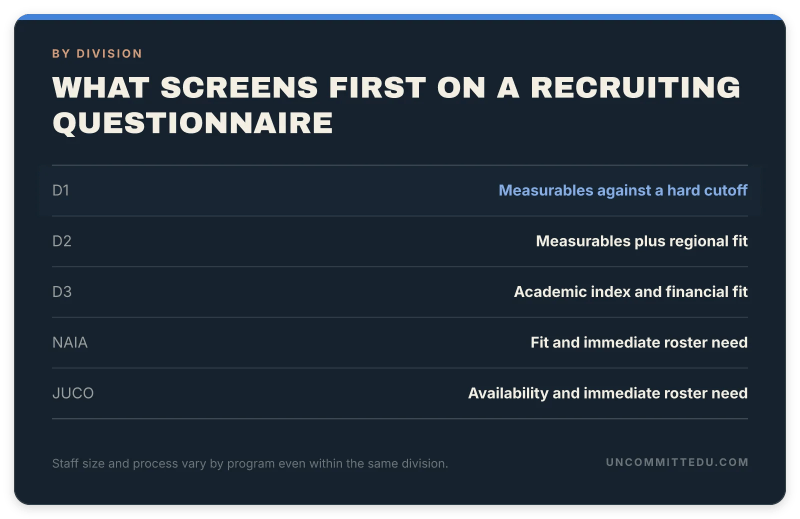
At the D1 level, measurables screen first. A staff fielding hundreds of submissions a cycle uses velocity, exit velocity, and 60-yard time as a hard cutoff before anyone reads your academics. Fall short of that number and the form often goes no further, no matter how strong your grades are.
At the D3 level, and often at NAIA and JUCO programs, academics and fit carry more weight relative to raw tools. A D3 coach cannot offer athletic scholarships, so admissions strength and financial fit matter as much as your bat speed. See the differences across every level in our guide to college baseball divisions.
JUCO questionnaires tend to be shorter and less formal. Many junior college staffs are smaller, so a direct call after submitting often moves faster than waiting on the form alone.
| Level | What screens first | Typical staff size |
|---|---|---|
| D1 | Measurables against a hard cutoff | 4 to 8 full-time coaches |
| D2 | Measurables plus regional fit | 3 to 5 full-time coaches |
| D3 | Academic index and financial fit | 2 to 4 coaches, often part-time assistants |
| NAIA | Fit and immediate roster need | 2 to 4 coaches |
| JUCO | Availability and immediate roster need | 1 to 3 coaches |
Reading a real questionnaire, field by field
Program questionnaires vary in layout, but most share the same core sections. Walking through a typical one shows why order matters.
The first section is always identity: name, grad year, high school, and contact info. Get this exactly right. A typo in your email address means a coach’s reply, if one comes, goes nowhere.
The second section covers athletic profile: position, bats and throws, height and weight, and measurables. This is the section coaches skim fastest and weigh heaviest. Keep every number current and sourced from an actual test.
The third section is academic: GPA, test scores if you have them, and intended major. Many players skip the intended major field since it feels irrelevant to baseball. Do not skip it. Coaches at academically selective programs use it to gauge admissions fit before they invest time in you.
The last section is almost always a link field for video and, sometimes, a coach reference or travel team name. Treat this section as your proof section. Everything above it is a claim; this section is what backs the claim up.

What a strong submission looks like next to a weak one
The gap between a questionnaire that gets a second look and one that gets filed away usually comes down to specificity, not talent.
| Element | Weak submission | Strong submission |
|---|---|---|
| Measurables | “Around 85 mph” from memory | “84.6 mph, tracked at [showcase], June 2026” |
| Video | A three-minute highlight reel | A full inning or full at-bat, plus highlights |
| Position | “SS/2B/OF” with no clear primary | “Primary SS, has reps at 2B” |
| Academic fields | Left blank | GPA, test score, and intended major all filled in |
None of these fixes require new talent. They require treating the form as the first real impression it is, not a box to check on the way to a camp invite.
A faster way through every program’s form
There are hundreds of college baseball programs, and each one hosts its own questionnaire on its own site design. Hunting them down one at a time burns hours you could spend on video and outreach instead.
The app’s coaches directory links directly to a program’s questionnaire wherever the program publishes one, sorted by division and region so you can work through a target list in order.
Build your questionnaire list the same way you build your outreach list: by fit first, reach second. A realistic level match gets read. A reach school questionnaire, filled out honestly, still costs you nothing to send.
Questionnaires by position
Coaches weigh different fields depending on what position you play, since roster needs are position-specific and the numbers that matter shift accordingly.
Pitchers. Velocity dominates the initial screen, but spin rate and pitch mix increasingly show up as optional fields on programs that use data in their evaluation. If a questionnaire has an open text field, list your full arsenal, not just your fastball number. A coach recruiting a bullpen piece cares whether you also throw a changeup for strikes.
Catchers. Pop time is the number that gets you a second look, usually alongside exit velocity. See the exact ranges scouts use in our speed and pop time benchmarks by level. A catcher questionnaire with no pop time listed reads as incomplete, even if every other field is filled.
Infielders. Range and arm strength matter, but exit velocity and a clean fielding percentage from your most recent season carry the most weight on the form itself, since those are the two numbers a coach can compare across a full recruiting class at once.
Outfielders. Exit velocity and 60-yard time both matter, and coaches at the college level increasingly want to see both listed rather than just one. A strong bat with a slow 60 time narrows your fit to corner outfield spots specifically, so be precise about which outfield position you actually play.
Pairing a questionnaire with real outreach
A questionnaire by itself puts your name into a system. It does not put your name in front of a person until you add a second, human step.
The strongest pairing looks like this: submit the questionnaire, then send a short direct email to the position coach within a few days, referencing that you just submitted. This does two things. It confirms a real person is behind the form, and it gives the coach a reason to pull your file immediately instead of waiting for the weekly batch review.
Keep that email short. Three or four sentences: who you are, your grad year and position, one or two headline numbers, and a link to your video.
Save the full story for a reply, not the first message. Coaches skim first messages fast, so the shortest version of your pitch is usually the one that actually gets read all the way through. Our full guide to emailing a college baseball coach covers subject lines, timing, and what to send if you do not hear back.
Players who pair every questionnaire with a direct email consistently report faster responses than players who rely on the form alone. The form sorts you. The email is what gets you read.
What coaches told us about the form
Assistant coaches who run recruiting intake describe the same pattern across programs of every size: the form is a filter, not a conversation, and players who treat it like a conversation waste effort on the wrong details.
One recurring note is about tone. Some questionnaires include an open comments field, and players sometimes use it to plead a case, listing accolades or asking directly for a scholarship offer.
Coaches consistently say this field works better as a factual add-on than as a sales pitch. A note about an upcoming showcase, or a stat line from a recent tournament, reads better than a plea.
The numbers and video do the selling. The comment field should support them, not replace them. Treat it the way you would a short caption, not an appeal.
Another note concerns timing. Submitting a questionnaire right after a strong outing, a showcase, or a tournament with a coach in attendance gets read faster than a random submission with no context. Staffs remember who they just saw play, so a submission that arrives within a day or two of an event carries more weight than the same information sent cold three months later.
A third theme is persistence without repetition. Submitting the same questionnaire twice in a short window does not move you up any queue. It can read as unfamiliarity with the process. Instead, update the existing submission if the program allows it, or follow up by email referencing your original submission date.
Building this into your weekly routine
Players who stay on top of questionnaires treat it as a weekly task, not a one-time offseason errand.
Set a recurring reminder to check for new target schools once a week during your recruiting window. Each new school on your recruiting timeline gets a questionnaire submission and a follow-up email within the same week, so nothing sits half-finished.
Keep a simple log of every program you have submitted to, the date, and whether you sent a follow-up email. A spreadsheet works fine. The goal is knowing at a glance which schools still need action, so a promising program never slips through because you assumed you had already reached out.
Review that log once a month and prune it. Drop schools that have gone silent for more than two full recruiting cycles despite repeated outreach, and add new ones as your measurables improve and new levels open up. A questionnaire list that grows without ever shrinking becomes unmanageable fast.
Keeping seven touches straight across thirty schools is the hard part. The course walks you through it.
Frequently asked questions
Does filling out a questionnaire mean a coach is recruiting me?
No. It means your information is now inside that program’s system. A coach still has to review it, compare it against roster needs, and decide to reach out or wait for you to follow up.
Should I fill out questionnaires for reach schools?
Yes, but weight your time toward realistic-fit schools first. A reach school questionnaire costs a few minutes and stays on file in case your measurables jump later.
How often should I update my questionnaire answers?
Update after your school season, after any summer showcase, and again before your grad year’s main signing window opens. Three updates a year keeps your file current without becoming a chore.
Is a questionnaire the same as applying to the school?
No. A recruiting questionnaire only reaches the athletics department. You still need to apply to the school itself through its normal admissions process, separate from any athletic recruitment. If you plan to play at the NCAA level, you also register separately with the NCAA Eligibility Center for amateurism and initial-eligibility certification, a step no athletics questionnaire covers on its own.