

How to Email a College Baseball Coach
Learning how to email a college baseball coach well is one of the highest-leverage skills in recruiting. It costs nothing. It takes minutes. And it’s how most players end up on a coach’s radar in the first place.
Most attempts to email a college baseball coach fail for the same reasons: too vague, too long, or too generic. This covers exactly what to send, when, and how to follow up, a companion to the full college baseball recruiting guide.
Quick answer: A recruiting email that gets a reply includes your name, grad year, position, one or two verified numbers, a working video link, and one specific reason you’re reaching out to that program, sent to your full target list, with one respectful follow-up two to three weeks later if there’s no response.
Key takeaways
- When you email a college baseball coach, lead with verified numbers and a video link that opens instantly.
- Address one named coach at one programme: mass emails are obvious and get deleted.
- There are five reasons to email a college baseball coach, and each has a different job.
- Follow up at 2-3 weeks, but only with a genuinely new data point.
- Reply within 24 hours whenever a coach reaches out first.
- Research the programme before you email a college baseball coach, or the specifics will not be there.
When to email a college baseball coach, and which email to send
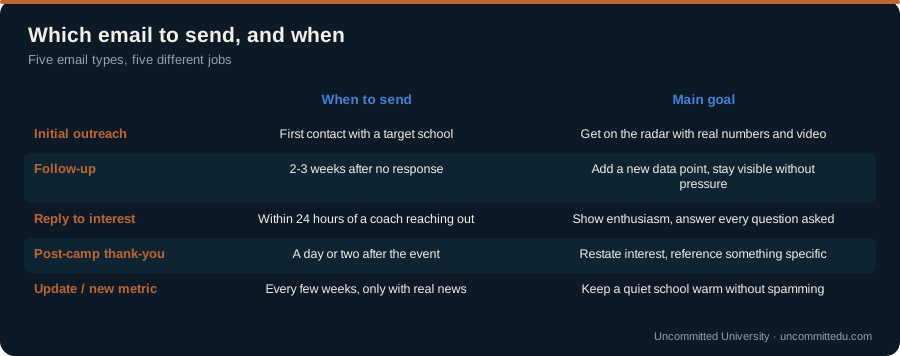
The table below sets out five reasons to email a college baseball coach and what each is trying to achieve.
| Email type | When to send | Main goal |
|---|---|---|
| Initial outreach | First contact with a target school | Get on the coach’s radar with real numbers and video |
| Follow-up | 2-3 weeks after no response | Add a new data point, stay visible without pressure |
| Reply to inbound interest | Within 24 hours of a coach reaching out | Show enthusiasm, answer every question asked |
| Post-camp/visit thank-you | Within a day or two of the event | Restate interest, reference something specific |
| Update / new metric | Every few weeks, only with real news | Keep a quiet school warm without spamming |
What a coach wants to see when you email a college baseball coach
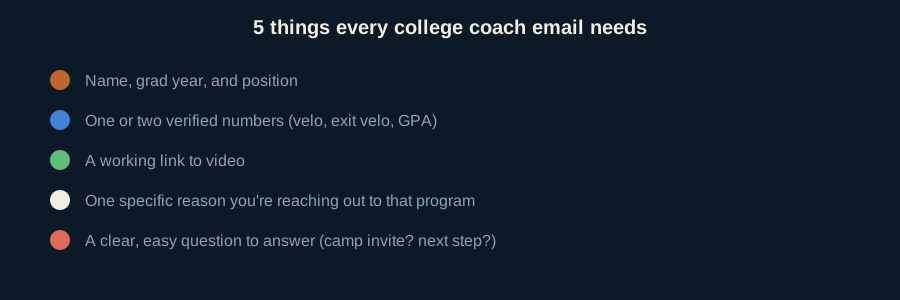
Coaches read dozens of these a week, often on their phone between practices. The ones that get a reply hit five things fast:
- Name, grad year, position
- One or two verified numbers
- A working video link
Everything else is secondary.
Verified numbers beat adjectives. “Hard-throwing right-hander” tells a coach nothing. “88 mph fastball, 7.1 60-yard time” tells him everything.
Be specific about the program. One sentence on why you’re reaching out to that school: their conference, a need at your position, their style of play. It proves you didn’t mass-blast 200 coaches.
The breakdown below shows what belongs in the message when you email a college baseball coach.
You’ll need a link to send → get one free
Every template below has a spot for “video and recruiting profile: [link].” Create yours before you send your first email.
How to email a college baseball coach: the initial outreach
Subject: 2027 RHP – [Your Name] – [City, State]
Coach [Last Name],
My name is [Name], a 2027 right-handed pitcher at [high school/travel team] in [city, state]. I’m currently sitting at [X] mph on my fastball with a [X] curveball, and carry a [GPA] GPA. I’ve followed [Program]’s season and really like how your staff develops pitchers. I think I’d fit well in your program.
Here’s my video and recruiting profile: [link]. Would you be open to me attending one of your camps this year, or is there anything specific you’d want to see from me first?
Thanks for your time,
[Name] | [phone] | [email]
The follow-up email (2-3 weeks later, no response)
Subject: Following up – 2027 RHP – [Your Name]
Coach [Last Name],
Wanted to follow up on my note from a few weeks ago. Since then I’ve [new metric, recent outing, upcoming showcase]. Still very interested in [Program] and happy to send anything else that would help: game video, a transcript, references from my current coach.
[Name] | [phone] | [email]
One follow-up is normal. Coaches are busy, not uninterested. A second attempt to email a college baseball coach rarely hurts. Two unanswered follow-ups with no new information? Move that school down your list.
How to research a program before you email a college baseball coach
The “one specific reason you’re reaching out” line is the part players skip, and it’s the part that separates a real email from a mass-blast. Ten minutes of research is usually enough:
- Check the roster by grad year. Most college athletics sites list class year for every player. If a program is losing three seniors at your position next year, that’s worth naming directly.
- Look at their schedule and conference. Knowing who they play, and at what level of competition, shows you understand the program instead of just its name recognition.
- Watch one clip of their team playing. Style of play (small-ball and speed versus a power-heavy lineup) tells you whether your game actually fits, and gives you something real to reference.
- Note the coaching staff’s background. A pitching coach who played professionally, or an assistant who recruited your region before, is a natural detail to mention.
None of this needs to be more than a sentence in the email itself. The research is for you, so the sentence sounds true instead of copy-pasted.
Responding to a coach who reaches out first
Reply within a day. Keep it enthusiastic and specific. Answer every question he asked first.
A slow, generic reply to his own outreach reads as low interest, even when it isn’t.
What happens after a coach replies positively
Getting a reply is the start of a new phase, not the finish line. What typically comes next:
- A request for more film or data: usually game video rather than a showcase clip, or a specific metric they want verified.
- An invite to a camp or event: treat this as a real evaluation, not just a chance to be seen. Coaches invite players they’re already considering.
- A phone or video call: expect questions about your academics, your timeline, and what other schools you’re talking to. Answer honestly; coaches compare notes with each other more than players expect.
- A quiet stretch: even after a great first reply, programs go quiet while they finish evaluating a full class. Don’t read silence after initial interest as a change of heart. A brief, low-pressure update every few weeks keeps you visible without being a bother.
Keep replying quickly and keep sending real updates. Momentum in recruiting fades fastest when a player stops being responsive right after getting good news.
Common mistakes when you email a college baseball coach
The checklist below is the difference between a reply and a deletion when you email a college baseball coach.
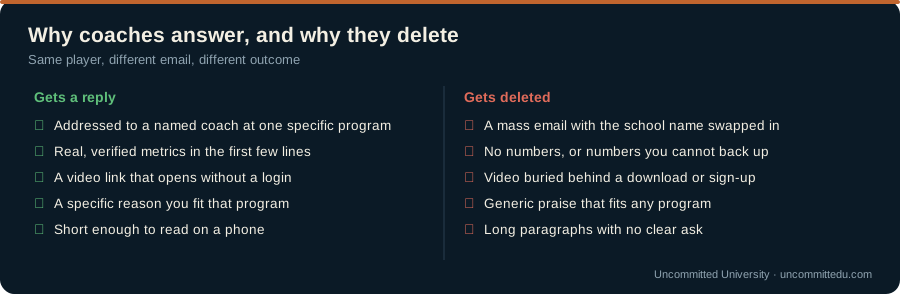
- The same email to every school. Coaches can tell. A program-specific line takes thirty seconds.
- Unverified or exaggerated numbers. A metric that doesn’t hold up on video kills your credibility for every future email.
- No video link, or one buried in a hard-to-find profile. Make the link the easiest part to act on.
- Parents sending the email instead of the player. Coaches want to see the player manage his own communication.
Three more templates: the walk-on email, the JUCO transfer email and the camp-invite reply
The first-contact email above covers most players. Three situations need their own shape: asking about a walk-on spot, moving up from a junior college, and answering a mass camp invitation without wasting the opening. Copy the shape, not the words, and keep every one under 150 words.
Walk-on email
Subject: 2026 SS walk-on interest, [Name], admitted to [School]
Coach [Last Name], I have been admitted to [School] for fall 2026 and I am writing to ask whether you hold walk-on tryouts and what you need to see beforehand. I am a 2026 shortstop from [high school, city, state], 6-foot, 175, running a 6.9 sixty with an 88 mph exit velocity, and I carry a 3.6 GPA. Profile and video: [link]. If a tryout is not on the calendar, I would value ten minutes to hear what a roster spot would take. Thank you, [Name] | [phone] | [email]
JUCO transfer email
Subject: JUCO 2B, [Name], .340 at [College], 2 years of eligibility, spring 2027
Coach [Last Name], I am a sophomore second baseman at [Junior College] with two years of eligibility left and I will graduate with my associate degree in May. This season I hit .340 with 12 doubles in [Conference], run a 6.8 sixty and carry a 3.4 GPA, and my coach, [Name], is expecting your call at [phone]. Video from this season and my profile: [link]. I am looking at [your level] programs in [region] that need a middle infielder for 2027 and yours is at the top of the list because [one specific reason]. Thank you, [Name] | [phone] | [email]
Reply to a camp invitation
Subject: Re: [their subject], 2028 RHP [Name], one question before I register
Coach [Last Name], thank you for the invitation to the [date] camp. Before I register I want to make sure I am a fit for what you are recruiting: I am a 2028 right-hander sitting 84 to 86 with a breaking ball I command, 3.7 GPA, from [city, state]. Profile and video: [link]. If a 2028 arm at that velocity is on your board, I will be there. If not, I would rather hear that now and save us both the day. Thank you, [Name] | [phone] | [email]
The last one gets more honest replies than any email on this page. A coach who answers “come anyway” has told you the camp is a fundraiser. A coach who answers with a question about your curveball has told you he read it.
Subject lines that get opened when you email a college baseball coach
A coach scanning his phone decides whether to open an email from the subject line alone. Keep it short and dense: grad year, position, name.
Example: “2027 RHP – [Your Name]” or “2026 SS/2B – [Your Name] – [State].” Avoid vague lines like “Interested in your program”, they’re easy to skip.
How often should you email a college baseball coach?
No fixed number, but the pattern that works when you email a college baseball coach: one solid initial email, one follow-up after two to three weeks, then lower-frequency updates every few weeks after that.
Some quiet stretches aren’t about your email: NCAA recruiting periods restrict when coaches can respond. Choosing to email a college baseball coach more than once a week without new information reads as pressure, not interest.
Etiquette when you email a college baseball coach
Use a professional email address, not a nickname. Proofread before sending: small errors undercut the same attention-to-detail coaches evaluate on the field.
Always reply, even briefly, if a coach says “not right now.” It keeps the door open for later.
What not to attach when you email a college baseball coach
Nothing. Send links, not files, every time you email a college baseball coach. An attachment is the fastest route to a spam folder or a read-later pile that never gets read.
- No PDF resume. A coach reading on a phone between innings will not download and open one. Put the same information in the body of the message.
- No video files. Large attachments get stripped or bounced by university mail systems. One link to hosted video is the entire point.
- No images in the signature. Logos and headshots push a message toward spam filtering and add nothing a coach needs.
- No link shorteners. A bare, readable URL looks like what it is. A shortened link looks like something a filter should inspect.
- No group send. Several addresses in the To or CC field is the clearest possible sign of a mass-blast, and it is visible instantly.
The format rule underneath all of it: everything that matters should be readable in the body of the message on a phone, with one link to your video and one to your profile. Anything that needs a download is something that will not get opened.
Who to email, exactly
Start with the recruiting coordinator or the assistant coach for your position group. They manage the list day to day. CC the head coach only once there’s real mutual interest.
Not sure who that is at a given school? The college baseball coach directory covers 6,934 coaches at 1,649 programs, and a free profile lets you search it by division, state and academics.
Sample ways to email a college baseball coach in specific situations
- After a strong showcase performance: lead with the result: “I wanted to follow up after this weekend’s [showcase name], where I ran a new personal-best [X].”
- A school with no prior contact, a long shot at the level: be direct: “I know [Program] competes at a high level; I’d love the chance to be considered.”
- Thanking a coach after a camp or visit: keep it short, specific, and restate your interest.
- Asking about walk-on opportunities: be upfront rather than vague: “I understand scholarship spots may be limited; I wanted to ask whether a walk-on tryout or roster spot could be possible for [grad year].”
- Letting a school know you’ve committed elsewhere: a short, respectful note closes the loop professionally: “I wanted to let you know I’ve committed to [Program]. I appreciated your time and interest throughout this process.”
Should you CC your coach when you email a college baseball coach?
Usually, no. Coaches want to see the player drive his own communication. But your high school or travel coach can help in a different way:
- A direct call or email from your coach to a college coach carries real weight
- Ask him to send it separately, after your own email, not attached to it
- Give him your target list so he knows which programs you’re talking to
A coach-to-coach conversation is one of the strongest signals in recruiting. Use it, but don’t let it replace your own outreach.
What to do if a coach never replies at all
Silence usually means one of three things: no current need at your position, the roster’s full, or the email got buried. Don’t over-analyze it.
Move that school down your list. Keep the door open with an occasional update. Put your energy into schools that are actually responding.
What if two or three programs reply at once?
This happens more than players expect once outreach picks up, and it creates a good problem: how to manage several real conversations without dropping any of them.
- Don’t go silent on the others while you focus on a favorite. A slow reply reads as declining interest, even if you’re just busy juggling multiple threads.
- Keep your communication honest. If a coach asks where else you’re talking, naming other levels or conferences (without over-sharing specifics) is normal and expected, coaches do the same with each other.
- Use your tracker to compare, not just remember. Response speed, scholarship signals, and roster fit are easier to weigh side by side than from memory.
- Set your own timeline if a decision is dragging. A polite “I’m hoping to make a decision by [date], is there anything you’d need from me before then?” is a fair question, not a pressure tactic.
Final checklist before you email a college baseball coach
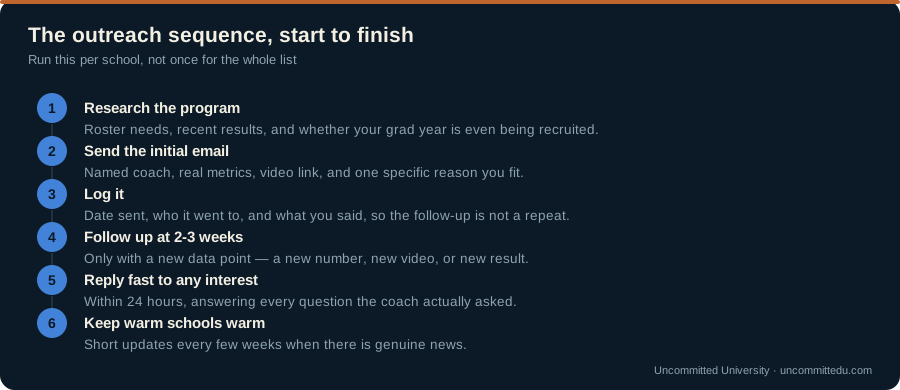
The sequence below runs per school, so nothing depends on one message landing.
- Subject line includes grad year, position, and your name
- Coach addressed by last name, spelled correctly
- One or two verified numbers included, not vague adjectives
- Video link tested and working from a different device
- One sentence specific to that program, not a generic line
- Contact info (phone and email) included at the bottom
- Proofread once, out loud, before sending
Skipping any single item on this list won’t necessarily sink an email, but hitting all seven consistently is what separates players who build a real pipeline of replies from players who wonder why nobody’s writing back.
What to do after you email a college baseball coach
Most advice stops at send. That is the part players actually get wrong.
Give it two weeks. Coaches are managing a roster, a season and a recruiting board at once, and the first time you email a college baseball coach, that message lands near the bottom of the pile.
Then follow up once, on the same thread, with something new: an updated velocity, a new video, an upcoming schedule they could see you at. A follow-up that only says “just checking in” gives a coach nothing to act on.
If the second message gets nothing either, move that school down your list and keep going. Two unanswered emails is information, not failure.
Never send the same message to two coaches at the same school. They talk, and a recruiting coordinator who sees an identical note to the head coach reads it as a mass mailing.
One more rule: when you email a college baseball coach and they do reply, answer inside 24 hours. Response speed is the cheapest signal of seriousness you will ever send, and it is the one most players waste.
Keep a simple record of it all: school, coach, date sent, date replied, what you sent. Thirty schools in, memory stops being reliable, and duplicate or contradictory emails do real damage.
Watch for the reply that is not a rejection but reads like one. Send us your summer schedule is a request, and it means you are still live. Answer it the same day with specifics: dates, locations, field numbers, and your jersey number.
And read the signature line. If a reply comes from a recruiting coordinator or a volunteer assistant rather than the head coach, that is normal and not a downgrade. At most programs those are exactly the people who run the board.
Frequently asked questions
These are the questions that come up most often before a player sits down to email a college baseball coach.
Do D1 coaches respond to emails? Yes, when the email fits a need and the calendar allows it. Before August 1 before your junior year a Division I coach is not permitted to reply to you at all, so silence from a sophomore’s email is the rule, not a verdict; the email still goes in a file. After that date, a coach answers the emails that name a position he is recruiting in your class with a number in his range and a video he can open in one click. Expect replies from roughly one in five programs on a well-built list, more at D2, D3 and the NAIA, and treat a questionnaire link as a real reply.
When should I start emailing college coaches for baseball? The summer after sophomore year is the practical start for most players, because by then you have a measured number and a video worth sending. You can email earlier; nothing stops you, and D3, NAIA and JUCO coaches can write back at any age. Just know that a D1 or D2 coach cannot reply before the contact date for the division, so an early email is a file entry, not a conversation.
How do I reach out to a college baseball coach? Email first, always, because it is the channel a coach can act on and forward. Fill out the program’s recruiting questionnaire the same day, since many staffs sort by it. Then, if you have a real reason to be on campus, ask about a prospect camp or an unofficial visit in the follow-up. Social media is for after a coach knows your name: follow the program, engage lightly, and never open with a direct message.
Should you attach your video file when you email a college baseball coach? No. Send a link. Large attachments get stripped or bounced by university mail systems, and a coach reading on a phone will not download anything. One hosted video link and one profile link is the format that works.
What should the first email to a college baseball coach include? Your name, grad year, position, one or two verified numbers, a working video link, and one specific reason you’re reaching out to that program.
How long should I wait before following up with a coach? Two to three weeks is typical if there’s been no response. Bring a new piece of information, like an updated metric or upcoming showcase, rather than repeating the same email.
Should my parents email the coach instead of me? No. Coaches want to see the player manage his own communication. Parents can help behind the scenes, but the email itself should come from the player.
Is it okay to send the same email to every school? No. Coaches can usually tell when an email is mass-blasted. A single program-specific sentence takes about thirty seconds and makes a real difference in response rates.
What if a coach never replies at all? Silence usually means no current roster need, a full class, or a buried email rather than a hard no. Move that school down your list and put your energy into schools that are responding.
Who should I email at a program, the head coach or an assistant? Start with the recruiting coordinator or the assistant coach who handles your position group. They manage outreach day to day. CC the head coach only once there’s real mutual interest.
The short version: when you email a college baseball coach, the message is doing one job: getting a real evaluation started. Name the coach, lead with numbers you can back up, link video that opens without a login, and give one specific reason you fit that roster. Then log it and follow up once with something new. Do that per school rather than in bulk, and you will email a college baseball coach far less often but hear back far more.
The short version
When you email a college baseball coach, the goal is not to impress → it is to be easy to evaluate. Position, graduation year, verified numbers, a video link and your schedule, in a message short enough to read on a phone between innings.
The players who get replies are the ones who make a coach’s job easier, not the ones with the best adjectives.
Uncommitted University recommends you email a college baseball coach from your own address rather than a parent’s, keep the subject line factual, and never email a college baseball coach twice in the same week.
Your next step
Build your target list first using the D1 vs. D2 vs. D3 vs. NAIA vs. JUCO breakdown. Not sure what level to target? Run your numbers through the Find Your Level calculator first.
Track every send in a spreadsheet. It’s the difference between a scattered process and a real one.
Written by Wayne Keeton, founder of Uncommitted University.