

Exit Velocity Benchmarks by Level and Age
Exit velocity benchmarks by level are one of the most-asked questions in baseball recruiting. Coaches use them as a reference point, not a hard cutoff.
This breaks the ranges down by level, and explains why the number alone doesn’t decide anything. For the full picture, see the college baseball level guide.
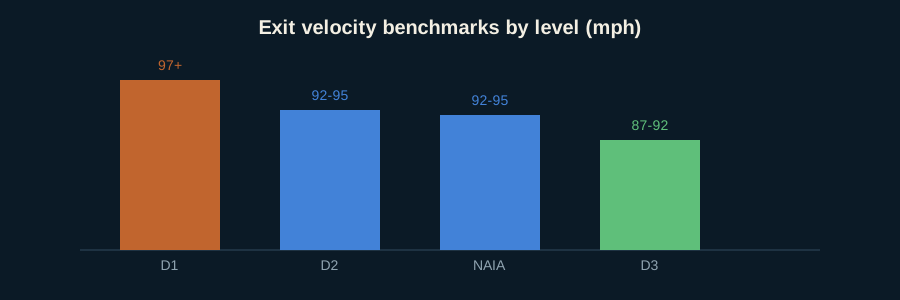
Quick answer: D1 hitters generally sit in the upper-90s mph and above on exit velocity, D2/NAIA in the low-to-mid 90s, and D3/JUCO in the high 80s to low 90s. These are general reference ranges, not official cutoffs: position, contact ability, and defense all factor into real recruiting decisions.
Key takeaways
- Exit velocity benchmarks run roughly upper-90s at D1, low-to-mid 90s at D2 and NAIA, high 80s to low 90s at D3 and JUCO.
- Exit velocity benchmarks only mean something next to your age and grad year.
- Exit velocity benchmarks shift by position: a shortstop gets more leeway than a first baseman.
- Coaches trust exit velocity benchmarks measured repeatedly on a stated device, not a single peak reading.
- Exit velocity benchmarks open the door; game video is what keeps it open.
Exit velocity benchmarks by level: the general ranges
| Level | Typical range |
|---|---|
| NCAA D1 | Upper-90s mph and above |
| NCAA D2 | Low-to-mid 90s mph |
| NAIA | Low-to-mid 90s mph |
| NCAA D3 | High 80s to low 90s mph |
| JUCO | High 80s to low 90s mph |
Treat these as reference bands, not lines you must clear exactly. A player just below a range with strong contact skills and defense can still recruit well at that level.
Exit velocity benchmarks by grad year
The table below places the same exit velocity benchmarks against age, which is how a coach actually reads your number.
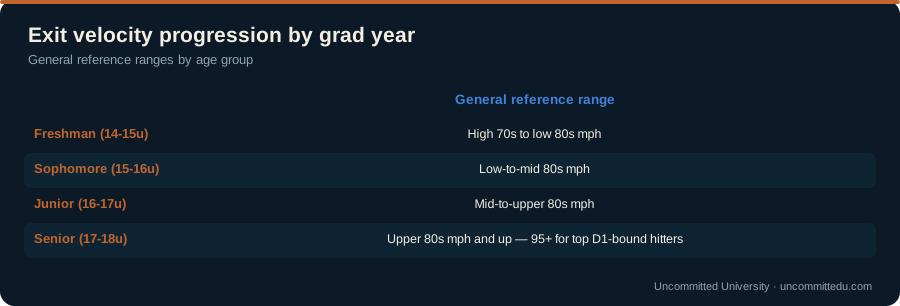
Exit velocity isn’t a fixed number: it typically climbs as a player adds strength and refines swing mechanics through high school. These are general reference ranges seen across showcase circuits, not a standard any single player must hit on schedule:
| Grad year / age group | General reference range |
|---|---|
| Freshman (14-15u) | High 70s to low 80s mph |
| Sophomore (15-16u) | Low-to-mid 80s mph |
| Junior (16-17u) | Mid-to-upper 80s mph |
| Senior (17-18u) | Upper 80s mph and up, 95+ for top D1-bound hitters |
A freshman posting a number in the junior range is a notable early indicator. A senior still in the freshman range is a signal to look hard at contact skills, defense, and position value instead of leaning on raw power.
Measured exit velocity by age, 13 to 17: 552 showcase readings
At a summer 2026 showcase the middle 17 year old posted a max exit velocity of 95 mph with a batting-practice average of 86. The middle 15 year old was at 93 and 82, the middle 14 year old at 85 and 77, and the middle 13 year old at 80 and 69. Those are measured numbers, not reference bands: 552 hitters in the published write-ups of 35 public showcase events across nine states, read from the same event reports that gave us the measured 60 times, with no names kept. Each hitter gets one max and one round average, both off a launch monitor in batting practice.
| Age in summer 2026 | Class | Hitters | Max EV, slower quarter | Max EV, median | Max EV, faster quarter | BP average EV, median |
|---|---|---|---|---|---|---|
| 17 | 2027 | 138 | 92 | 95 | 99 | 85.8 |
| 16 | 2028 | 157 | 90 | 95 | 98 | 85.7 |
| 15 | 2029 | 89 | 89 | 93 | 96 | 82.3 |
| 14 | 2030 | 121 | 82 | 85 | 89 | 77.2 |
| 13 | 2031 | 43 | 76 | 80 | 84.5 | 69.4 |
Three things to read into it. First, the max and the average are ten points apart at every age, and the average is the number closer to what a coach means by exit velocity; a profile that lists only the max is listing the outlier. Second, the jump from 14 to 15 is the biggest in the table, eight points of max and five of average, which is the strength gain of a first real off-season. Third, these are showcase hitters, who skew stronger than a high school roster, so a varsity average sits below these medians, not on them. By position among the 16 and 17 year olds, first basemen led at a 99 median max, third basemen 96.5, catchers and shortstops 95, outfielders 93, second basemen 89.
Why exit velocity alone doesn’t get you recruited
- Contact matters. A hitter who squares the ball up consistently at 88 mph often outperforms one who hits 95 mph off the end of the bat occasionally.
- Position matters. A plus defensive shortstop gets more leeway on exit velo than a first baseman, where offense carries most of the value.
- Projection matters. Coaches recruit trajectory. A younger player trending up matters more than a single measurement.
The chart below shows the exit velocity benchmarks each level generally works from, before any adjustment for position or age.
Exit velocity benchmarks by position
Coaches don’t apply one flat exit velocity standard to every position on the field. Offensive expectations shift with defensive value:
- Corner infield, corner outfield, and DH: these roles are recruited primarily for offense, so exit velocity expectations run highest here: a corner bat without power is a tough sell at any level.
- Middle infield and catcher: defensive value (range, hands, pop time, blocking) offsets a lower exit velocity, since these positions are harder to fill defensively.
- Center field: sits in between, coaches want some pop, but range and instincts often carry more weight than raw exit velo.
This is why two players with the same exit velocity number can have very different recruiting outcomes: the number means something different depending on the glove that comes with it.
How exit velocity benchmarks are actually measured
Most showcases and camps, including events run by organizations like Perfect Game, use a radar device positioned behind or beside home plate, measuring the ball’s speed off the bat on contact. Consistency across multiple swings matters more than a single peak reading.
Ask any event how the number is measured and recorded. A legitimate one will explain it clearly.
Tools used to track exit velocity benchmarks
- Radar gun: the simplest and most common method, used at most showcases and by many high school and travel programs. Accurate but only captures one number per swing.
- HitTrax: a camera-and-radar system common in training facilities that logs exit velo alongside launch angle and projected distance for every swing in a session.
- Rapsodo Hitting: a compact camera unit increasingly used in home and facility setups, tracking exit velo, launch angle, and spin.
- Trackman: the system most college programs and elite showcases use, offering the most complete swing-by-swing data set, including bat speed and attack angle alongside exit velocity.
Numbers from different systems aren’t always perfectly interchangeable. If a recruiting profile lists an exit velo number, it’s worth noting which system produced it.
See where your real number puts you
Enter your actual exit velo alongside your other stats for an honest read across every level.
How to actually improve exit velocity
Moving up through the exit velocity benchmarks happens in the order below: strength first, bat speed second, contact quality third.

- Strength and rotational power training, built around bat speed specifically
- Consistent, high-quality swings: quality reps beat sheer volume
- Regular re-testing to track real progress, not guesswork
A number that’s improving over a season tells a coach more than a single strong reading.
A closer look at improving exit velocity
- Build rotational strength, not just gym strength. Traditional lifting helps, but exit velocity gains come more from hip and torso rotational power: medicine ball work, rotational cable exercises, and explosive movement training tend to move the number faster than general strength training alone.
- Train bat speed directly. Overload/underload bat training (swinging bats heavier and lighter than gamer weight) is one of the more consistently supported methods for adding bat speed, which is the biggest single driver of exit velocity.
- Fix the swing before you fix the number. A mistimed or mis-sequenced swing caps exit velocity no matter how strong the player gets. A hitting coach who can diagnose sequencing often unlocks more velocity than another offseason in the weight room.
- Track it the same way every time. Comparing a HitTrax number from one week to a radar-gun number from another makes it look like progress stalled or spiked when it may not have. Keep the measurement method consistent.
Exit velo by hitting approach
Two hitters with the same exit velo number can look very different in games.
- Pull-heavy power hitters often post higher peak numbers but with more swing-and-miss.
- All-fields contact hitters may show a slightly lower peak but far more consistency.
- Coaches evaluate both the peak number and the average across your best swings, not just your single hardest-hit ball.
A consistent 90 mph average often reads better than an occasional 96 mph peak with little else around it.
Common mistakes when chasing exit velo
The checklist below separates exit velocity benchmarks a coach will trust from the ones they quietly discount.

- Swinging for max effort on every rep. A max-effort swing that misses the barrel reads worse than a controlled one that squares up.
- Ignoring the rest of your game. A high exit velo with poor defense or contact rates doesn’t automatically translate to offers.
- Testing under bad conditions. A cold day, bad ball, or unfamiliar cage can skew a single reading. Don’t judge yourself on one bad session.
- Reporting only the best swing of the day. Coaches increasingly ask for an average of several swings, not just a peak. A recruiting profile that only lists a peak number can look inflated or cherry-picked.
- Not knowing your own trend. A player who can’t say whether their number is up or down from six months ago is missing one of the most useful things to tell a coach.
Questions to ask before trusting an exit velo reading
- What device measured this number, and is it the same device coaches typically reference?
- Was this a peak swing or an average across multiple swings?
- What were the conditions: indoor cage, outdoor field, temperature, ball type?
- How recent is the number, and has anything changed physically since then (growth, strength training, swing changes)?
How exit velocity fits into a full recruiting profile
Exit velocity is one line on a much longer sheet. Coaches typically build a full offensive picture by layering it with other numbers and context:
- Launch angle and hard-hit rate. A high exit velo with a launch angle that consistently produces ground balls doesn’t turn into extra-base power in games. Coaches and analytics-driven programs increasingly look at the combination, not exit velo alone.
- Game production. Batting average, on-base percentage, and extra-base hit totals against real competition either confirm or complicate what a showcase number suggests.
- Strikeout rate. A hitter who trades a lot of strikeouts for occasional loud contact profiles very differently than one who rarely swings and misses.
- Body projection. A 15-year-old with an 85 mph exit velo and a frame that clearly has more strength to add gets valued differently than a fully-grown senior at the same number.
None of this means exit velocity doesn’t matter: it’s simply one input among several, and the players who recruit best are usually the ones who understand which of those inputs are actually their strengths.
Exit velocity red flags coaches notice
- A number with no supporting video. A profile that lists an impressive exit velo but has no game or BP video to back it up raises questions rather than answering them.
- A number that hasn’t moved in years. Stagnant exit velocity across multiple seasons can suggest a plateau in strength or swing development, which is worth addressing directly rather than hoping a coach won’t notice.
- A number wildly out of line with in-game performance. If a showcase reading is far higher than what shows up on file in real games, coaches will trust the game video first.
Why two exit velocity readings of the same hitter disagree
Here is the part that confuses almost every family: a player can post 92 at one event and 86 at another in the same week, and both numbers can be honest.
The reason is that exit velocity benchmarks assume a measurement method, and events do not all use the same one.
Off a tee is the most controlled and the most repeatable. It removes timing entirely, so it measures how hard you can hit a stationary ball. Most published exit velocity benchmarks are tee numbers.
Front toss or batting practice usually reads a little higher for a hitter with good timing, because the incoming ball contributes energy. It is also far less repeatable.
In-game exit velocity is the most meaningful and the least flattering. Live pitching, real velocity, real movement: game maximums usually sit below cage maximums.
Then there is the question of which number gets reported. A maximum is one swing; an average is a skill. A player with a 95 max and an 82 average is a different hitter from one at 92 max and 89 average, and the second is usually the better prospect.
Equipment differs too. Different tracking systems read slightly differently, and an outdoor radar can behave differently from a cage-mounted unit.
So when you compare yourself to exit velocity benchmarks, compare like with like: tee to tee, max to max. And when you report your number to a coach, say how it was measured and on what. A number with its method attached is credible. A bare number invites doubt.
Frequently asked questions about exit velocity benchmarks
What is the average exit velocity for high school baseball? At showcases in summer 2026, the median 15 to 17 year old posted a max of 93 to 95 mph and a batting-practice average of 82 to 86, across 384 hitters in that age band. A typical varsity roster sits below that, because showcase hitters are the stronger end of the pool: a high school regular with an 80 to 85 average and a max in the high 80s is normal, and a max in the mid 90s is a recruitable bat at most levels.
What should a 14 year old’s exit velocity be? The measured 14 year old at a showcase in 2026 had a median max of 85 mph, with the faster quarter at 89 and above and the slower quarter at 82 and below, and a batting-practice average of 77. Anything in the high 80s at 14 is well ahead. Below 80 is not a verdict at that age; the biggest gain in the whole table comes between 14 and 15.
What is a good exit velocity for D1 baseball? A max in the upper 90s or better and a batting-practice average in the 90s, by the time you are being recruited. The measured 17 year olds who reach that are the faster quarter of showcase hitters, which is about the share of a showcase field that ends up on a Division I roster. Position moves it: a first baseman or corner outfielder needs the top of that range; a shortstop or catcher who defends recruits at Division I with a max in the low 90s.
What is considered a good exit velocity for a high schooler? It depends heavily on grad year and target level, but low-to-mid 80s mph is a reasonable range for an underclassman, while D1-caliber senior hitters are often in the mid-90s or above. See the level breakdown above for full context.
Does exit velocity matter more than batting average? Neither exists in isolation. Coaches weigh exit velocity as one predictor of offensive ceiling, but batting average, contact rate, and approach all factor into how a hitter actually profiles in games.
Can exit velocity be improved quickly, or does it take years? Meaningful, lasting gains usually take a full offseason or more of focused strength and bat speed training. Short-term spikes can happen but tend to reflect measurement variance more than real improvement.
Is a radar gun reading as accurate as Trackman or HitTrax? Radar guns are generally reliable for exit velocity specifically, but they don’t capture the additional context (launch angle, spin, bat speed) that camera-based systems like Trackman and HitTrax provide.
Should I list my peak exit velo or my average on a recruiting profile? Both, when possible: a peak number shows ceiling, and an average across several swings shows consistency. Listing only a peak can come across as cherry-picked to an experienced recruiter.
Do left-handed and right-handed hitters have different exit velocity expectations? No, exit velocity benchmarks apply the same regardless of handedness. Handedness affects things like matchup value and defensive positioning far more than the raw exit velo number itself.
The short version: exit velocity benchmarks are a filter, not a verdict. Measure on the same device across several sessions, publish the honest average rather than your best-ever reading, and always send game video alongside it. A repeatable number inside the exit velocity benchmarks for your level beats a bigger one nobody can reproduce.
The short version
Exit velocity benchmarks are only comparable when the measurement method matches. Tee numbers, batting-practice numbers and in-game numbers are three different scales, and the same hitter will read differently on each.
Uncommitted University advises reporting your average alongside your maximum. Coaches trust the pairing far more than a single best swing, and it is the fastest way to look honest.
Track the trend as well as the number. A hitter who has moved from 84 to 90 across eighteen months is telling a coach something that a single reading never can, and exit velocity benchmarks read very differently in the context of that slope.
Bear in mind that exit velocity benchmarks are age-sensitive. A number that is unremarkable for a college junior can be genuinely notable for a sophomore in high school, and coaches recruit the age-adjusted version.
And remember what the metric cannot tell anyone: it says nothing about whether you can recognise a breaking ball, control the strike zone, or handle velocity. Those decide at-bats. The tee tells a coach only that the raw power is there to work with.
Your next step
Pair your exit velo with the rest of your metrics: see < href="https://uncommittedu.com/pitching-velocity-benchmarks-by-level/">pitching velocity benchmarks if you also pitch, or 60-yard dash benchmarks for speed context.
Written by Wayne Keeton, founder of Uncommitted University.