

60 Yard Dash Times by Level
60-yard dash benchmarks are the first speed number coaches check, and the bar moves by level: a time that wins at D3 is below average at D1.
This breaks down the ranges and explains why a corner infielder and a center fielder are judged on very different scales. For the full picture, see the college baseball level guide.
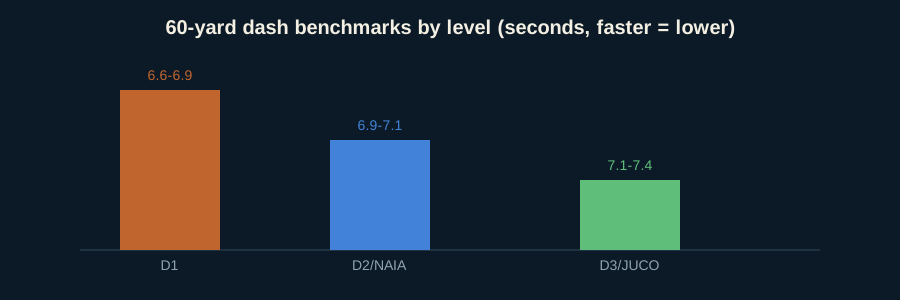
Quick answer: D1 players generally run 6.6-6.9 seconds in the 60, D2/NAIA around 6.9-7.1, and D3/JUCO around 7.1-7.4. Speed-first positions (center field, shortstop, second base) need faster times than corner power positions.
Those ranges are the general bar. The bar that matters is the one for your position: a 7.0 that reads slow for a center fielder is plenty for a catcher. The position-group table below is the one coaches actually use.
Key takeaways
- 60-yard dash benchmarks run roughly 6.6-6.9 at D1, 6.9-7.1 at D2 and NAIA, 7.1-7.4 at D3 and JUCO.
- 60-yard dash benchmarks shift by position: a catcher is not measured against a centre fielder.
- Most of the time gained comes from the first 10-20 yards, not from stride length.
- Timing method and surface change a 60 more than most players realise.
- Coaches re-time you in person, so publish 60-yard dash benchmarks you can actually repeat.
60-yard dash benchmarks by level: the general ranges
| Level | Typical range |
|---|---|
| NCAA D1 | 6.6-6.9 seconds |
| NCAA D2 / NAIA | 6.9-7.1 seconds |
| NCAA D3 / JUCO | 7.1-7.4 seconds |
Speed-first positions push toward the faster end of these ranges. Power positions have more room.
What is a good 60 yard dash time?
A good 60 yard dash time is under 7.0 seconds for a high school player, 6.6 to 6.9 for the NCAA D1 range, and 6.5 or faster for elite, speed-first college prospects. A good time depends on two things, your position and the level you are chasing, so the same 6.8 reads differently for a center fielder and a catcher. The table below cuts the ranges on this page by time, so you can find your number and read what it means before you compare it to anybody.
| Your 60 time | What it reads as | Position note |
|---|---|---|
| 6.5 or faster | Elite. Faster than the D1 general range for every position group. | The D1 floor for middle infield and center field. |
| 6.6 | D1 range at every position. | Speed-first D1. |
| 6.7 | D1 range. | Third base and corner outfield reach the D1 band here. |
| 6.8 | D1 range for speed-first and blend positions. Senior high school range. | Top of the D2/NAIA band for middle infield and center field. |
| 6.9 | Top of the D1 general range. D2/NAIA general range. | First base and catcher reach the D1 band here. |
| 7.0 | D2/NAIA range. Junior to senior high school range. | Top of the D1 blend band, top of the D3/JUCO speed-first band. |
| 7.1 | Top of the D2/NAIA general range. D3/JUCO general range. | Junior high school range. |
| 7.2 | D3/JUCO range. Sophomore to junior high school range. | Top of the D2/NAIA blend band. |
| 7.25 | D3/JUCO range for blend and power positions. | Sophomore high school range. |
| 7.3 | Top of the D3/JUCO general range. | Still inside the band for first base and catcher at D3/JUCO. |
| 7.4 | Edge of the D3/JUCO general range. Freshman to sophomore high school range. | Power-first positions only at the college level. |
| 7.5 to 7.6 | Below the college general ranges. Freshman high school range. | First base and catcher at D3/JUCO run to 7.6. |
| 7.7 or slower | Freshman range. College bands not reached yet. | The start and the first ten yards are where the time comes off. |
Two rules for reading it. A hand time runs about two tenths faster than a laser time, so ask which one you have before you place yourself on the table. And a time is one number on a profile, not the profile: the exit velocity benchmarks sit beside it, and Find Your Level reads the two together against real rosters.
60-yard dash benchmarks by position group
The table below adjusts those 60-yard dash benchmarks by position group, which is how a coach actually reads your time.
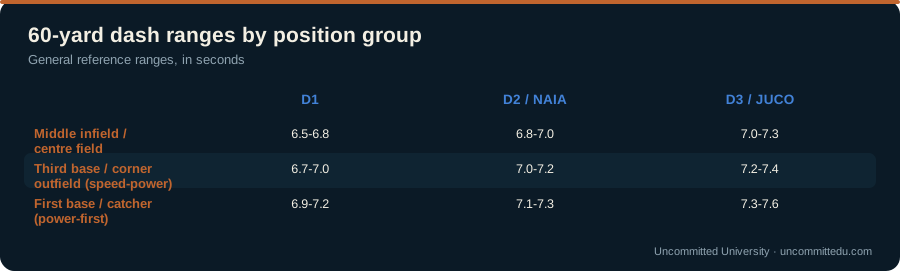
The level ranges above are a starting point, but position shifts them meaningfully. These are general reference bands, not hard cutoffs. A player just outside a range with strong instincts or power can still recruit well:
| Position group | D1 general reference | D2/NAIA general reference | D3/JUCO general reference |
|---|---|---|---|
| Middle infield / center field (speed-first) | 6.5-6.8 sec | 6.8-7.0 sec | 7.0-7.3 sec |
| Third base / corner outfield (speed-power blend) | 6.7-7.0 sec | 7.0-7.2 sec | 7.2-7.4 sec |
| First base / catcher (power-first) | 6.9-7.2 sec | 7.1-7.3 sec | 7.3-7.6 sec |
A shortstop and a first baseman with the identical 60 time are not evaluated the same way: the shortstop’s number is closer to the position’s floor, while the first baseman’s is comfortably above it.
This also explains why a player moving between position groups, such as an outfielder shifting to a corner infield spot, can suddenly look faster relative to peers even without changing a single tenth of a second on the stopwatch. The number stays the same; the bar it’s measured against moves.
How 60-yard dash benchmarks change in value by position
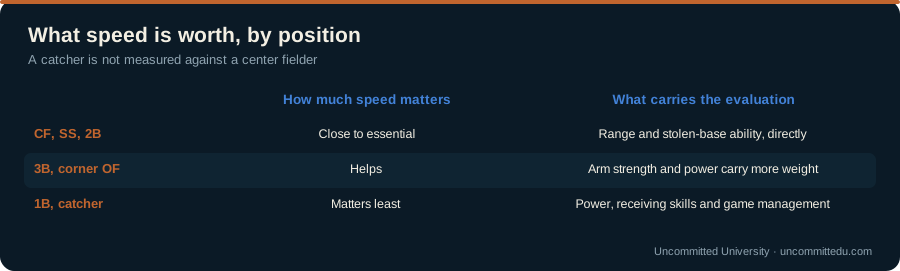
- Center field, shortstop, second base: speed is close to essential. Range and stolen-base ability matter directly.
- Third base, corner outfield: speed helps, but arm strength and power carry more weight.
- First base, catcher: speed matters least. Power, receiving skills, and game management dominate the evaluation.
The chart below shows the 60-yard dash benchmarks each level generally works from.
60-yard dash benchmarks by grad year
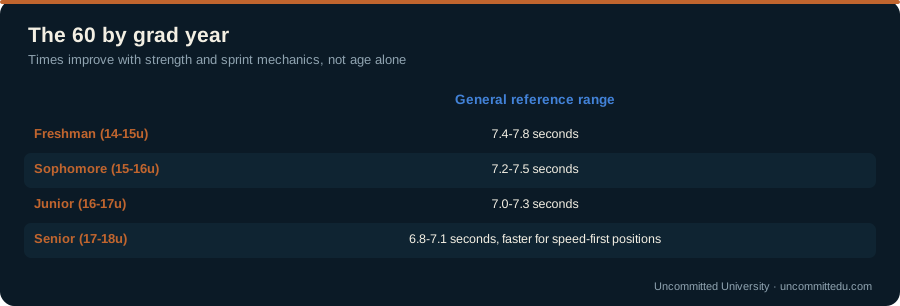
Like other benchmarks, 60 times generally improve through high school as players add strength and refine sprint mechanics. These are general reference ranges, not a schedule to hit exactly:
| Grad year / age group | General reference range |
|---|---|
| Freshman (14-15u) | 7.4-7.8 seconds |
| Sophomore (15-16u) | 7.2-7.5 seconds |
| Junior (16-17u) | 7.0-7.3 seconds |
| Senior (17-18u) | 6.8-7.1 seconds, faster for speed-first positions |
Average 60 yard dash time by age, 14 to 18
The same ranges, labelled by age instead of grad year, because that is how the question gets typed. A 14 year old runs the freshman range, an 18 year old the senior range, and most players move about two tenths a year as they add strength and clean up the start.
| Age | Grad year equivalent | Average 60 yard dash range |
|---|---|---|
| 14 | Freshman (14-15u) | 7.4-7.8 seconds |
| 15 | Freshman to sophomore | 7.2-7.6 seconds |
| 16 | Sophomore to junior | 7.0-7.4 seconds |
| 17 | Junior to senior | 6.9-7.2 seconds |
| 18 | Senior (17-18u) | 6.8-7.1 seconds, faster for speed-first positions |
An age table misleads on its own. A 14 year old shortstop and a 14 year old catcher are not judged against the same number at any age, so read your row here, then move to the position table above. The age tells a coach where you are on the curve. The position tells him whether the number matters.
Measured 60 yard dash times by age, 13 to 17: 496 timed runs
The ranges above are reference bands. The table below is measured. We read 34 public Prep Baseball event write-ups from summer 2026 across nine states and pulled every 60 time a scout recorded next to a grad year: 496 runs, no names kept. These are event times, laser or scout timed, from players good enough to be at a showcase, so they run faster than an average school team. Read the middle column as “a typical player at an event”, not “a typical player”.
| Age in summer 2026 | Class | Timed runs | Faster quarter | Median | Slower quarter |
|---|---|---|---|---|---|
| 17 | 2027 | 116 | 6.98 | 7.18 | 7.41 |
| 16 | 2028 | 141 | 6.95 | 7.19 | 7.47 |
| 15 | 2029 | 79 | 7.13 | 7.36 | 7.60 |
| 14 | 2030 | 115 | 7.48 | 7.76 | 8.07 |
| 13 | 2031 | 42 | 7.88 | 8.19 | 8.73 |
Three things the measured numbers say. The step from 13 to 14 is the biggest on the curve, about four tenths at the median, and 14 to 15 is another four tenths. From 16 to 17 the median barely moves, which is where position and training start to separate players more than age does. Under 7.0 was 27 percent of the 16 and 17 year olds at these events, 16 percent of the 15 year olds, and 2 percent of the 13 and 14 year olds, so a sub 7.0 at 14 is genuinely rare, not “good for his age”.
For 12 year olds and under we have no measured runs and will not invent one. The curve above moves about four tenths a year at the young end, so a 12 year old median near 8.5 to 8.6 is a reasonable expectation, and anything under 8.0 at 12 is ahead of it. When we have timed runs for 2032 and 2033 classes this table grows a row.
How the 60 is actually run and timed
Standard 60-yard dash timing uses either hand timing or an electronic gate system, similar to what showcases like Perfect Game use at their events. Electronic times run slightly slower than hand times. Ask which method an event uses before comparing your number to a benchmark.
Hand-timed 60s are typically started on the athlete’s first movement as seen by the timer, while electronic gates start on the actual break of a laser or beam. That gap alone can account for a couple tenths of a second of difference between two “60-yard dash” numbers measured differently, which is why comparing across events without knowing the method can be misleading.
See where your full profile puts you
Speed is one piece. Enter all your stats for an honest read across every level.
How to actually improve your time
Moving down through the 60-yard dash benchmarks happens in the order below, and the first step is free.
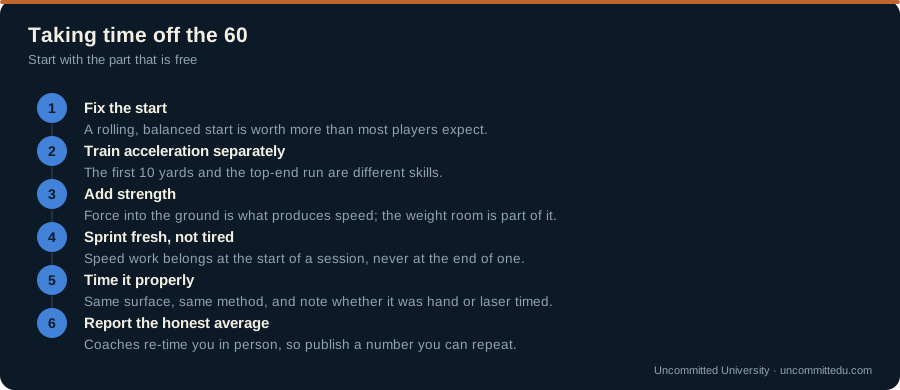
- Sprint mechanics work: starts, first-step quickness, and stride efficiency
- Strength training focused on explosive power, not just raw endurance
- Regular re-testing under the same conditions to track real change
A closer look at improving your 60 time
- Fix the start before the top-end speed. Most of the time gained in a 60-yard dash comes from the first 10-20 yards: a clean, low, powerful start often shaves more off a final time than working on stride length alone.
- Train specifically for acceleration, not just sprinting. Resisted sprints (sled pushes, bands) and plyometrics build the explosive power that a full 60 relies on more than steady-state running does.
- Address mobility, not just strength. Tight hips or a limited stride pattern can cap speed gains no matter how much strength work gets added.
- Re-test on the same surface, in the same shoes. A time recorded on turf in trainers and a time recorded on grass in cleats aren’t a fair comparison, even a few weeks apart.
Speed on the bases vs. speed in the field
60-yard dash benchmarks measure straight-line speed, but coaches also evaluate:
- First-step quickness: how fast you react and get moving, separate from top-end speed
- Baserunning instincts: reading pitchers, taking good angles, and stealing bases at a high success rate
- Range in the field: lateral quickness matters as much as pure sprint speed for infielders and outfielders
A slightly slower 60 time with excellent instincts and range can still play at a high level.
Testing conditions that skew your number
The checklist below separates 60-yard dash benchmarks a coach will believe from the ones they quietly discount.

- Surface matters: turf generally runs faster than grass or dirt
- Footwear makes a real difference: test in real cleats, not training shoes
- A tired legs day after a tournament will read slower than a fresh one
Re-test under good conditions before trusting a number as your real baseline.
Stolen bases and speed as a recruiting asset
A high stolen-base total gets noticed, but coaches read it in context rather than at face value. A player who goes 20-for-20 on stolen base attempts shows something different than a player who goes 20-for-35: the first suggests elite jumps and pitch-reading, the second suggests raw speed without the instincts to use it efficiently yet. Both can be valuable, but they tell a coach to look for different things on video: refined baserunning IQ in one case, developing raw tools in the other.
How coaches weigh speed against the rest of a profile
Speed rarely stands alone on a recruiting sheet. It gets read alongside the job a player is being recruited to do:
- For a leadoff-profile player, speed and on-base ability are the headline; a 60 time near the top of the range for the position group is close to a requirement.
- For a middle-of-the-order power bat, an average or even below-average 60 time is tolerated if the exit velocity and defensive value are strong enough.
- For a defensive-first middle infielder, speed shows up less in the 60 time itself and more in range, first-step quickness, and the ability to cover ground side to side, metrics that don’t reduce neatly to a single sprint number.
This is why a player shouldn’t read a 60 time in a vacuum. The same number can be a strength or a limitation depending entirely on the role a coach envisions.
Myths about speed and 60-yard dash benchmarks
- “A fast 60 time guarantees good baserunning.” Straight-line speed and game instincts are related but separate skills: plenty of fast runners get thrown out on bad reads, and plenty of average runners steal bags through timing and jumps.
- “Speed can’t be trained, you either have it or you don’t.” Sprint mechanics, start technique, and explosive strength are all trainable, and meaningful time drops are common with focused work.
- “Corner power hitters don’t need to worry about speed at all.” Even at power-first positions, a well below-average time can limit defensive range and baserunning enough to matter in close recruiting decisions.
Common mistakes players make with 60-yard dash benchmarks
- Reporting a hand-timed number as if it were electronic, or vice versa, without noting which method was used. This is one of the fastest ways to lose credibility with a coach who checks.
- Testing once and never again. A single 60 time from two years ago tells a coach almost nothing about where a player is now.
- Chasing a flat-out sprint time while ignoring first-step quickness and baserunning instincts, which often matter more in actual games than the 60 itself.
- Comparing across surfaces without adjusting. A 7.0 on grass and a 7.0 on turf are not the same level of speed.
How to present 60-yard dash benchmarks on a recruiting profile

- List the timing method. “6.9 (hand-timed)” or “7.1 (electronic gate)” is far more useful to a coach than a bare number with no context.
- Note the date and surface. A time from a specific showcase, on a specific surface, tells a coach more than an undated number with no source.
- Pair it with baserunning and defensive video. A 60 time backed by game footage showing real range or stolen-base success carries more weight than the number alone.
- Update it every time it changes meaningfully. A stale time from freshman year on a senior’s profile undersells real progress.
Questions to ask before trusting 60-yard dash benchmarks
- Was this hand-timed or electronically timed?
- What surface and footwear were used?
- How recent is the number, and has strength or mechanics work changed since?
- Does the time match what shows up in actual game baserunning and range?
How the 60 is timed, and why 60-yard dash benchmarks are not all the same
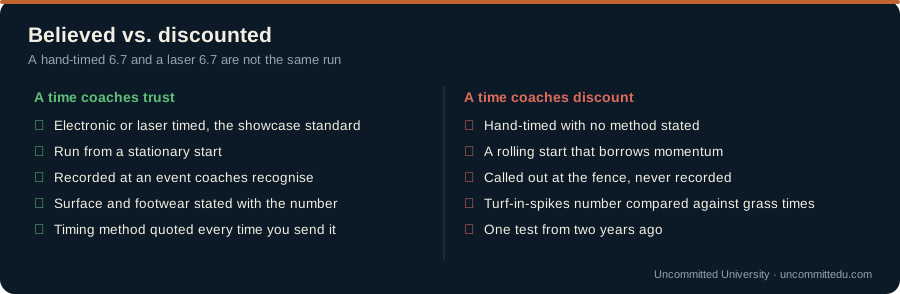
This is the most inflated number in amateur baseball, and mostly not on purpose. The timing method changes the result more than the runner does.
Hand timing starts when a person sees you move and stops when they see you finish. Human reaction time sits at both ends, and it almost always shortens the time. Hand-held numbers routinely come in meaningfully faster than electronic ones.
Electronic or laser timing removes the human from both ends. It is the standard at the larger showcases, and it is what most credible 60-yard dash benchmarks are built on.
The start matters too. A rolling or rocking start borrows momentum that a stationary start does not, and the difference is real.
So does the surface. Turf in spikes is quicker than wet grass, and an indoor facility in trainers is a different test again. Wind helps more than people expect over 60 yards.
The practical consequence: a hand-timed 6.7 and a laser 6.7 are not the same run. Coaches know this, which is why an unverified time carries so little weight.
That is also why the number a coach trusts is the one recorded at an event they recognise, electronically, with the method stated. When you send a time, send where and how it was run.
It is worth knowing what the 60 is for. It is a proxy: for first-step quickness, for range in the outfield, for whether you can be a threat on the bases. Coaches watch you run to a ball in a game and weigh that against the stopwatch.
A player who tests well and plays slow gets found out quickly. So use 60-yard dash benchmarks as a training target, and make sure the speed shows up in the game.
Frequently asked questions about 60-yard dash benchmarks
What is a good 60 time for a 13 year old? Measured at 2026 showcases, the median 13 year old (class of 2031) ran 8.19, the faster quarter ran under 7.88 and the slower quarter over 8.73. So under 7.9 at 13 is a fast time for the age, and anything near 8.2 is normal, not slow. Expect about four tenths to come off in the next year without doing anything but growing and playing.
Is a 6.8 60 yard dash good? Yes. A 6.8 sits inside the D1 general range and the D1 band for speed-first and blend positions, at the top of the D2/NAIA band for middle infield and center field, and in the senior high school range. For a catcher or first baseman it is well ahead of the college bands.
Is a 7.25 60 yard dash good? It is a D3/JUCO time for blend and power positions and a normal sophomore time in high school. For a junior or senior chasing D1 or D2 at a speed-first position it is behind the band, and the start is usually where the two tenths come off.
What is a good 60 time for a 14 year old? The freshman range is 7.4 to 7.8 seconds, so anything under 7.4 at 14 is ahead of the curve. The number that matters more at 14 is the drop over the next two years, about two tenths a season with strength work and a cleaner first ten yards.
What is a good 60-yard dash time for a high school player? It depends on position and grad year, but a time in the low 7s is reasonable for an underclassman, while D1-caliber speed-first seniors are often in the 6.5-6.8 range. See the position and level tables above for full context.
Does the 60-yard dash matter for pitchers? Less than for position players, but pitchers who field their position well and hold runners are still evaluated on basic athleticism, and a very slow time can raise questions about overall movement quality.
Is a hand-timed 60 comparable to an electronically-timed one? Not directly. Hand times generally run a few tenths of a second faster than electronic times for the same actual speed, so always note which method produced a given number.
Can a slower 60 time still lead to a college offer? Yes, especially at power positions like first base, catcher, or corner outfield, where offensive production and defensive value matter more than straight-line speed.
How often should a player re-test their 60 time? Every few months is reasonable for a player actively training speed, ideally under similar conditions each time so the trend is meaningful rather than noisy.
Does weight room strength training help or hurt sprint speed? Done well, it helps. Explosive strength work (squats, power cleans, jumps) builds the force output that underlies acceleration. Strength training that only builds bulk without power or mobility work can hurt speed if it isn’t balanced with movement-specific training.
The short version: 60-yard dash benchmarks are the cheapest number to improve and the easiest to inflate, which is exactly why coaches re-time everyone. Fix the start, sprint fresh, state your timing method, and publish an honest average. A repeatable time inside the 60-yard dash benchmarks for your level is worth far more than a fast one nobody can reproduce.
The short version
60-yard dash benchmarks only mean something with the timing method attached. Electronic times are the credible standard; hand times run faster and coaches discount them accordingly.
Uncommitted University advises getting one electronically timed 60 on record and quoting that, rather than the best number anyone has ever called out at you from the fence.
Train the start, not just the sprint. Most amateur runners lose more time in the first ten yards than anywhere else, and that is the portion a coach also sees on every steal attempt and every ball in the gap.
Position changes what a good time means. 60-yard dash benchmarks matter most for a centre fielder and a middle infielder, and least for a first baseman or a catcher, where coaches are weighing arm strength and receiving instead.
One caution: do not run a timed 60 cold, and do not run one the day after a long tournament. A bad recorded time is difficult to unpublish, because showcases keep their results on file and coaches go looking for the full history rather than the single number you chose to send them.
Your next step
Pair your speed number with the rest of your profile: see what D1 coaches actually look for by position for how it all fits together.
Written by Wayne Keeton, founder of Uncommitted University.