

NCAA Redshirt Rules for Baseball
NCAA redshirt rules have been abolished at Division I and Division II. The NCAA’s own list of eliminated rules names athletics redshirt rules outright, and the replacement took effect for the 2026-27 academic year.
This explains exactly how NCAA redshirt rules work for baseball. For the full picture, see the NCAA baseball eligibility guide.
Quick answer: NCAA redshirt rules no longer exist at Division I or Division II. Seasons of competition, athletics redshirt rules and medical hardship waivers were all eliminated for 2026-27 and replaced by a five-year period of eligibility that starts at first full-time college enrollment, or the academic year after your 19th birthday, and then runs continuously.
Key takeaways
- NCAA redshirt rules were eliminated at Division I and Division II for the 2026-27 academic year.
- What replaced them is a five-year period of eligibility, starting at first full-time college enrollment or the academic year after your 19th birthday, whichever comes first.
- The clock runs continuously, which is why the NCAA says athletes, coaches and athletics departments no longer have to track athletic redshirts.
- Medical hardship waivers were eliminated too, so a medical redshirt is no longer a route at Division I or Division II.
- Only three exceptions can delay or pause the clock: pregnancy, active-duty military service and official religious missions.
- Some current athletes are still assessed under the previous rules, which is why the NCAA redshirt rules detail below still matters.
What does redshirt mean in college baseball?
A redshirt is a player who is on the roster, practices and travels, but does not appear in a game all season, so that season is not spent. He stays a “redshirt freshman” on paper while his classmates become sophomores, and under the old rules he kept four seasons to play in the remaining four years. The word comes from the red practice jersey non-competing players once wore in football. It is a status, not a punishment: the player is a full member of the team in every way except the box score.
The 2026 catch: at NCAA Division I and Division II that status no longer buys anything. Seasons of competition were eliminated and a continuous five-year period took their place, so a year spent not playing is simply a year off the clock. Redshirting still means exactly what it says at Division III, in the NAIA and in the NJCAA, where seasons are still counted. Everything below explains what the term did, what replaced it, and where it still applies.
Do NCAA redshirt rules still exist?
No, not at Division I or Division II. The NCAA eliminated athletics redshirt rules along with seasons of competition, and the change took effect immediately for the 2026-27 academic year.
Division I adopted the age-based eligibility model in June 2026. The Division II Executive Board adopted emergency legislation mirroring it in August 2026, on the recommendation of the Management Council.
Here is what replaced NCAA redshirt rules:
- A five-year period of eligibility. It begins at the earlier of two events: full-time enrollment at any college or university, domestic or international, including a junior college; or the start of the regular academic year immediately after your 19th birthday.
- A date most write-ups miss. The age trigger applies if you turn 19 before Sept. 1. Turn 19 on or after Sept. 1 and the period begins at the start of the subsequent academic year instead, unless you enrol full time sooner. That single boundary is why the NCAA age limit question finally has a concrete answer.
- No more counting seasons. Seasons of competition are gone as a concept at Division I and Division II, which is what makes NCAA redshirt rules unnecessary rather than merely relaxed.
- A period that does not pause. The NCAA is explicit that it does not stop because an athlete fails to compete, transfers, sits out, changes teams or takes time away from participation. That single sentence is what made NCAA redshirt rules redundant.
One caution. Being inside the five years is not the same as being eligible. Academic and other athletics-related rules still apply, so an athlete can be inside the five-year period and still ineligible for other reasons. That was as true under NCAA redshirt rules as it is now.
The abolition of NCAA redshirt rules is Division I and Division II legislation. Division III is not covered by it, and neither the NAIA nor the NJCAA is affected: both write their own eligibility rules and still run their own clocks.
What NCAA redshirt rules used to do
Under the previous model, athletes got four seasons of competition to use within an eligibility window: five years at Division I, ten semesters or fifteen quarters at Division II. A redshirt year preserved one of those seasons by having a player sit out actual games while still practicing, training, and being part of the team.
It was never a punishment or a sign a player was not good enough. It was a development tool, and the development logic has not gone anywhere.
What has gone is the accounting. With no seasons of competition left to preserve, there is nothing for NCAA redshirt rules to protect.
Why coaches used redshirts under the old NCAA redshirt rules
Three reasons drove almost every redshirt decision, and all three still drive the choice to hold a young player out. What changed is that the choice no longer carries an eligibility price.
- Physical development. An extra year of strength and conditioning before facing college-level competition.
- Roster management. Staggering when players are eligible to compete helps balance a roster year to year.
- Academic adjustment. Extra time to acclimate to college coursework without also facing full competition pressure.
What a year without competition looks like day to day
A year without competition is not a year on the sideline, and the rule change did not alter that. In most programs, a player being held out:
- Practices with the team on the same schedule as competing teammates
- Travels with the team for some or all road games, depending on the program’s roster and travel-squad policies
- Gets extra reps in practice and in intrasquad scrimmages that don’t count as official contests
- Works individually with position coaches and strength staff on specific development goals for the year
The main difference is simply not appearing in official box scores. Everything else about being part of the program continues.
The diagram below shows how NCAA redshirt rules applied across a college baseball season under the previous model, still worth reading if you are one of the athletes being assessed under it.
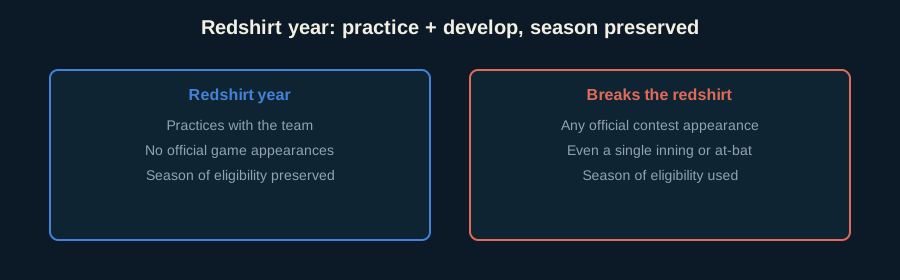
What used to break a redshirt under NCAA redshirt rules
Appearing in any official contest (even for a single inning or at-bat) typically used that season of eligibility and ended the redshirt for that year. Coaches and compliance staff tracked it carefully.
Practice, scrimmages against your own team, and off-season competition generally did not affect it. Official games did.
Under the age-based model that replaced NCAA redshirt rules, none of that arithmetic exists. A single at-bat costs nothing, because there is no season to spend: only the calendar, which was already running.
Medical redshirts and NCAA redshirt rules: the hardship waiver is gone too
Medical hardship waivers were eliminated alongside the athletics redshirt rules. They appear by name on the NCAA’s list of deleted waiver categories, together with extension-of-eligibility waivers, season-of-competition waivers, athletics activity waivers and delayed enrollment waivers.
Under the previous system a season-ending injury early in the year could be waived back to you, provided you had played only a limited share of the season. That route no longer exists at Division I or Division II.
The reason is structural rather than unsympathetic. A waiver restored a season of competition, and seasons of competition no longer exist. There is nothing left for it to give back.
Injury is not one of the three exceptions. Only pregnancy, active-duty military service and official religious missions can delay or pause the five-year period, and the NCAA Eligibility Center administers all three.
- Military service, religious missions and similar service commitments. That time may be excluded from the five years if the athlete does not take part in organized competition during the service. Compete during it and the exception does not apply at all.
- Pregnancy. The period may be paused for the actual span during which the individual cannot compete, with supporting medical documentation.
The asymmetry decides real cases: the service exception is forfeited by competing, while the pregnancy exception is bounded by the actual period of inability to compete.
One more catch if you are weighing the two rulebooks. An athlete who stays under the previous NCAA redshirt rules keeps the old arithmetic but permanently gives up the eliminated waiver categories.
Types of redshirts under the old NCAA redshirt rules, compared
Four different things get called a redshirt, and the table below shows how NCAA redshirt rules treated each one. This is the previous model, kept because athletes in the transition groups are still assessed against it.
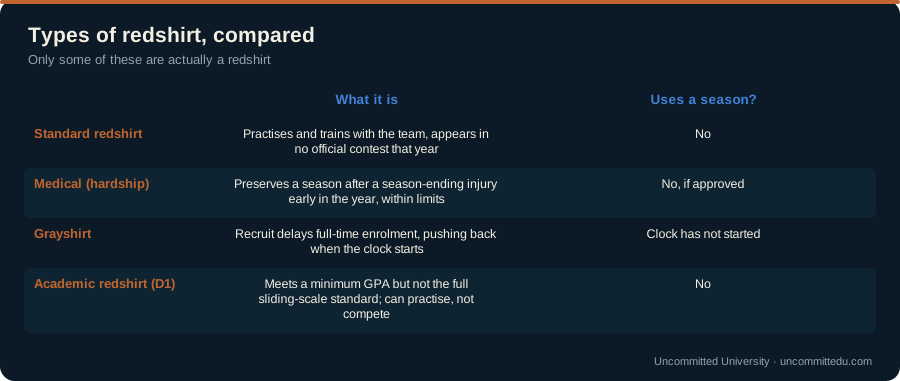
“Redshirt” gets used loosely to describe several different situations. They’re not interchangeable, and mixing them up leads to confusion with coaches and compliance staff.
| Type | What it is | Uses a season of eligibility? |
|---|---|---|
| Standard redshirt | Practices and trains with the team, doesn’t appear in any official contest for the year | No |
| Medical (hardship) redshirt | Preserves a season after a season-ending injury early in the year, under specific limits | No, if approved |
| Grayshirt | Recruit delays full-time enrollment, often by a semester, pushing back when the eligibility clock starts | N/A | clock hasn’t started yet |
| Academic redshirt (D1) | Player meets a minimum GPA but not the full sliding-scale standard; can practice and receive aid, not compete | No |
Here is where each of those four stands now at Division I and Division II. Standard and medical redshirts are gone, because the seasons they protected are gone. Academic nonqualifier season limitations were eliminated in Division I, so the academic-redshirt row needs checking against your own certification rather than assumed. The grayshirt has been inverted: delaying full-time enrollment no longer postpones the clock, because the academic year after your 19th birthday starts it anyway.
Confirm which category applies to your own situation with a program’s compliance office, because the transition rules decide whether the old column or the new one governs you. The NCAA redshirt rules in that table are history at Division I and Division II either way.
What if an injury happens partway through a season now
Under the age-based model an in-season injury does not cost you a season, because there is no season to lose. NCAA redshirt rules were the mechanism for protecting one, and that mechanism is gone. It costs calendar time, and the calendar was already running before the injury.
That is a real gain for some athletes and a real loss for others. A player hurt in April keeps everything except the games. A player who loses two full years to injury has no waiver route to recover them, because injury is not one of the three exceptions.
Under the previous NCAA redshirt rules a medical hardship waiver generally required the injury to happen early in the season, with the player having competed in only a limited number of contests or a limited percentage of the season beforehand. If you are in a transition group being assessed under those rules, those deadlines still apply to you.
Either way, tell the compliance office the day the injury happens. Documentation gathered in the moment is worth more than documentation reconstructed in June, and that held true under both rulebooks.
Confirm your own eligibility timeline
See exactly how many seasons you have left, including redshirt scenarios.
NCAA redshirt rules: how to tell where you actually stand
There was never a form a player signed to become a redshirt. It was a status that showed up in the paperwork, which is why players sometimes found out after the fact.
The NCAA redshirt rules question has changed shape rather than disappeared. Instead of was I redshirted, it is now which rulebook am I assessed under, and when does my five-year period end.
Three things to check:
- Which transition group you are in. Athletes who used their final season under the previous rules in 2025-26 get no additional eligibility. Athletes with eligibility remaining after 2025-26, and prospects first enrolling full time in 2026-27, are reviewed under the previous rules or the age-based rule, whichever is most beneficial. Anyone first enrolling full time in fall 2027 or later is on the age-based rule only.
- Who runs that comparison for you. Campus compliance staff run it for current student-athletes. The NCAA Eligibility Center runs it for incoming 2026-27 enrollees. Two different offices, and asking the wrong one wastes a month.
- Your actual start date. The five-year period that replaced NCAA redshirt rules begins at the term you first enrolled full time anywhere (including a junior college, including an international institution) or the academic year after your 19th birthday, whichever came first. Our guide to the NCAA eligibility clock walks through both triggers.
Ask in writing, once a year. A short email to compliance asking which rules you are assessed under and when your eligibility period ends gives you a record. Verbal reassurance from a coach is not that record, and the two do come apart.
A note on spelling, since it splits the search results: you will see this written as “redshirt” and as “red shirt.” They mean the same thing, and the one-word version is the NCAA’s own usage.
NCAA redshirt rules and transfers
This is where the change bites hardest. The five-year period does not pause because you transfer, sit out, change teams or take time away from participation. The NCAA states that directly.
A JUCO transfer meets the same fact in a different form: full-time enrollment at a two-year college starts the NCAA period, so arriving at a four-year school starts nothing fresh.
Confirm your exact status with a new program’s compliance office before committing, and read the JUCO eligibility clock rules if that is your route.
NCAA redshirt rules by position: what it typically looked like
Development patterns are not identical across every position, and none of this was ever a hard rule. With NCAA redshirt rules abolished these are now purely coaching decisions rather than eligibility decisions, which if anything makes them easier to discuss honestly.
- Pitchers are redshirted often, partly for arm health and long-term development, and partly because pitching depth means a roster can absorb one more year of a young arm not yet in the rotation.
- Position players are more likely to see early playing time if a roster has an immediate need, but still redshirt regularly when a program is deep at that position.
- Catchers often redshirt for the same defensive-development reasons pitchers do, the position rewards experience that’s hard to simulate in practice alone.
None of this should be read as a guarantee. Ask a program directly how it’s handled specific positions in recent recruiting classes rather than assuming a pattern applies to you.
NCAA redshirt rules compared with NAIA and JUCO
NCAA redshirt rules never carried across to the NAIA or the NJCAA, and neither body is affected by the NCAA’s 2026 change: the table below shows where each one now stands.
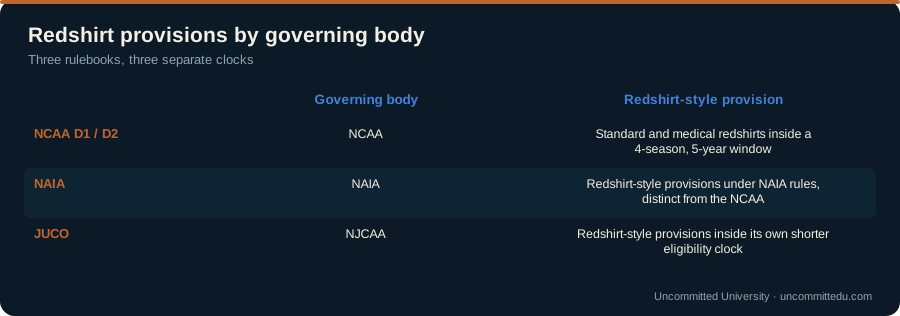
Redshirt-style provisions still exist outside NCAA Division I and Division II, and the specifics are set by each level’s own governing body.
| Level | Governing body | Redshirt-style provision |
|---|---|---|
| NCAA D1 / D2 | NCAA | None | redshirt rules and medical hardship waivers eliminated for 2026-27, replaced by a continuous five-year eligibility period |
| NCAA D3 | NCAA | Not covered by the Division I and Division II age-based legislation | confirm current Division III provisions directly |
| NAIA | NAIA | Redshirt-style provisions under NAIA-specific rules, distinct from the NCAA |
| JUCO | NJCAA | Redshirt-style provisions under NJCAA rules, within its own shorter eligibility clock |
Never assume a redshirt rule from one level carries over to another. Confirm directly with the specific governing body and program compliance office.
How a redshirt year affects MLB draft timing
Baseball’s draft eligibility rules interact with redshirt status in a way other sports don’t deal with. MLB draft eligibility for college players is generally tied to class standing (being a junior) or turning 21, not directly to how many seasons of NCAA eligibility remain.
A non-competing year can shift when a player reaches junior academic standing relative to their draft class, which in turn shifts the earliest year they become draft-eligible. That interaction survives the rule change untouched, because MLB sets its own draft rules. What changed is the other side of the trade: a development year now costs five-year clock time and nothing else, so the calculation is simpler than it was under NCAA redshirt rules. This is our reading of how the two rulebooks meet, not NCAA guidance.
This is a planning conversation, not a rule to memorize. Talk it through with a coach who has helped players navigate it before.
Redshirting as a walk-on vs. a scholarship player
Redshirt decisions apply the same way to walk-ons as to scholarship players, there’s no separate eligibility rule based on scholarship status.
The practical difference is usually about roster math rather than rules: walk-ons sometimes redshirt more readily simply because a program has less financial pressure riding on their immediate playing time. That’s a program-culture pattern, not an NCAA requirement, so it’s still worth asking about directly rather than assuming.
Common misconceptions about NCAA redshirt rules
The checklist below separates what NCAA redshirt rules actually said from what families usually assumed, plus one new misconception the 2026 change has already created.
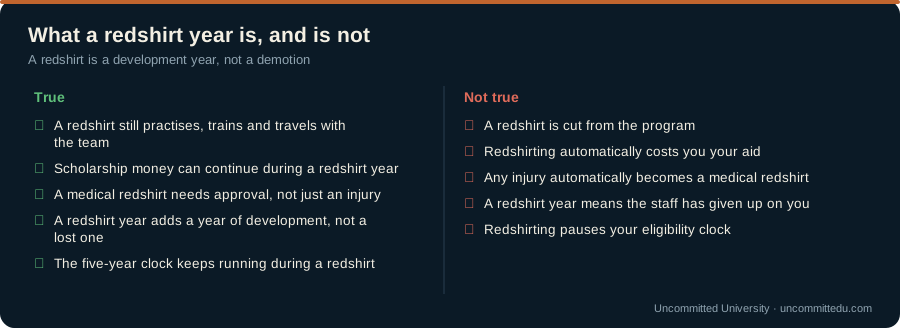
- “Redshirting means you’re not good enough.” Plenty of redshirted freshmen become key starters within a year or two.
- “You can redshirt more than once.” Under the old NCAA redshirt rules a standard redshirt was a one-time tool. At Division I and Division II the question is moot: there is no redshirt left to use once or twice.
- “Practice time doesn’t count against anything.” It never used eligibility and it still does not, but it is governed by NCAA practice-time rules either way.
- “The new clock is a 5-for-5 rule.” The NCAA rejects that phrase by name. The model centres on age and initial full-time enrollment, and it does not guarantee five years to everyone, least of all athletes who delay enrolling.
How to talk to a coach about NCAA redshirt rules now
Don’t wait for a coach to bring it up. The questions have changed, so ask directly:
- Do you plan to have me compete as a freshman, or develop for a year first?
- Which rulebook does your compliance office think I fall under: the previous rules or the age-based model?
- What does a development year look like here in terms of practice reps and specific goals?
- How have players at my position developed into contributors after a year of not competing?
A coach’s answer here tells you a lot about whether the program actually develops players or just recruits and hopes.
Questions to ask before accepting a redshirt-heavy recruiting offer
If a coach signals early that redshirting is likely, that’s useful information, not a red flag by itself. Get specific before deciding what it means for you.
- Is this based on roster depth at my position, or on a specific development plan for me?
- What would it take to compete for playing time earlier than planned?
- How has the program used a redshirt year for players at my position in the past, and where are they now?
- Does redshirt status affect my scholarship percentage or renewal in any way?
A program that’s transparent about this is usually a program that’s thought it through, which is a good sign regardless of the specific answer.
What redshirting means for scholarship money
A redshirt year doesn’t automatically affect scholarship money: a player can be redshirted and still receive the same athletic aid as a competing teammate, depending on the program’s scholarship structure and NCAA division.
What can change is the conversation around scholarship renewal. NCAA rules require scholarships to be renewed or non-renewed annually, and a redshirt year is exactly the kind of year where a family should confirm renewal expectations directly, rather than assuming a redshirt year signals anything about a coach’s confidence in the player.
Ask directly, every year: is this scholarship guaranteed for the length of the original offer, and does redshirt status change anything about that conversation.
The clock replaced NCAA redshirt rules entirely
Here is the thing that reframes all of this: a redshirt was never something you applied for. There was no redshirt form. The word described what happened, not a status you were granted, which is exactly why it could be deleted without anything taking its place.
What used to exist was a clock and a count. NCAA redshirt rules at Division I and Division II gave you four seasons of competition inside an eligibility window. What exists now is only the clock: a five-year period that starts at first full-time enrollment anywhere, or the academic year after your 19th birthday, and then runs without pausing.
A redshirt year was simply a year inside that window where you were enrolled, practised with the team, and did not compete. The season went unused. The clock still ran.
Only the second half of that sentence survives. The NCAA puts it plainly: athletes, coaches and athletics departments no longer have to track athletic redshirts.
That distinction was the whole of it, and the new model resolved it in one direction. Time always moves. Nothing else is being counted any more.
The ordinary redshirt used to be a freshman decision. A player who needed a year in the weight room, or who sat behind an established starter, banked the season and got a more useful fifth year later. The banking is gone. The weight-room year is not.
The medical hardship waiver was the part of NCAA redshirt rules that got misdescribed most often, and it is now eliminated by name at Division I and Division II. There is no season to restore, so there is nothing to apply for.
The three exceptions that remain are narrower, and none of them is injury: pregnancy, active-duty military service and official religious missions, all administered by the NCAA Eligibility Center. Medical documentation still matters for the pregnancy exception, which is why athletic training staff should be involved early rather than at the end of a year.
A few things the five-year period does not do. It does not make you eligible on its own: academic and other athletics rules still apply, so an athlete can be inside the five years and ineligible for other reasons. It does not stop you practising, travelling or being on scholarship. And it does not reach Division III, the NAIA or the NJCAA, none of which are covered by this legislation.
JUCO is the case that changed most. NJCAA baseball still runs its own two-year window under its own rules, but full-time enrollment at a junior college now starts your NCAA five-year period: the NCAA names two-year colleges explicitly.
The practical advice has flipped. Under the old NCAA redshirt rules the thing to protect was the season; under the new clock it is the calendar. Enrol on time, and if a gap year is on the table, price it in years of eligibility before you take it.
What baseball families should do now that NCAA redshirt rules are gone
None of this section is NCAA guidance. The NCAA has published no baseball-specific direction on the age-based model, so what follows is our reading of what the end of NCAA redshirt rules means for a baseball timeline.
- Treat a post-graduate year as a purchase, not a free option. If you turn 19 before Sept. 1 of that year, the period starts anyway. A PG year that once cost nothing can now cost a year of the five.
- Reprice the JUCO route. Two years at a junior college are two years of the same five, because full-time enrollment at a two-year college starts the NCAA period. The route still works. It just no longer buys time.
- Stop planning around a redshirt freshman year. There is nothing left to bank. If a program pitches a redshirt year plus five years of eligibility, ask which rulebook it thinks applies to you.
- In-season appearances are now free. Fall ball and scrimmages always were. Under the old NCAA redshirt rules a March weekend could cost a season; now it cannot, so a coach has no eligibility reason to hold a healthy freshman out.
- Put the draft conversation and the clock conversation in one meeting. MLB draft eligibility runs on class standing and age rather than NCAA seasons, so the two timelines now move independently.
The NCAA advice to prospects is blunt: plan your college enrollment timeline carefully, especially if you are considering a gap year, delayed enrollment or another nontraditional path after high school. Delaying enrollment beyond age 19 may reduce the eligibility available to you in Divisions I and II.
Frequently asked questions about redshirt rules
Can you play a few games and still redshirt? Not in baseball, and never at Division I or II now. The four-game allowance people quote is a football rule. In baseball under the old rules one at-bat or one pitch in a countable contest used the season. Under the 2026 age-based model there is no season to protect at D1 or D2, so the question only arises at Division III, the NAIA and the NJCAA, where one appearance still spends a season.
Is it good or bad to be redshirted? It was a development year when the coach planned it and a warning sign when he did not. At D1 and D2 in 2026 the label has lost its meaning: a freshman who does not play has spent one of five years with nothing banked. Ask the coach what the year is for, what the plan is for year two, and whether the scholarship holds. The answers matter more than the word.
Do coaches decide who gets redshirted? The coach decides who plays, and playing is what spends a season where seasons still count. A player cannot declare himself a redshirt. Where the status still exists, at D3, NAIA and JUCO, it is the coach’s roster decision plus the governing body’s paperwork, and the scholarship agreement is a separate document that says what happens to the money.
Do NCAA redshirt rules still exist in 2026-27? Not at Division I or Division II. Athletics redshirt rules and seasons of competition were eliminated for 2026-27 and replaced by a continuous five-year eligibility period. Division III is not covered by that legislation, and the NAIA and NJCAA are unaffected by it.
Are medical redshirts still allowed under NCAA redshirt rules? No. Medical hardship waivers appear by name on the NCAA list of eliminated waiver categories for Divisions I and II. Injury is not one of the three exceptions that can pause the five-year period: only pregnancy, active-duty military service and official religious missions can.
Does a redshirt year count against a scholarship? Not automatically. A player can be redshirted and still receive athletic aid, though scholarships are renewed annually and should be discussed directly each year.
Can a player redshirt more than once? Under the previous rules a standard redshirt was a one-time tool, with medical hardship as a separate provision. At Division I and Division II the question no longer applies, because both were eliminated for 2026-27.
What is a grayshirt, and is it the same as a redshirt? No. A grayshirt delays a recruit’s full-time enrollment, pushing back when the eligibility clock starts. A redshirt happens after enrollment and uses a year of development without using a season of competition.
Does practicing during a non-competing year count against eligibility? No. Practising never used a season of competition, and with seasons eliminated at Division I and Division II there is nothing left for it to use. NCAA practice-time rules still apply.
Can a transfer redshirt at their new school? Often yes, depending on transfer rules and how many seasons were already used. Confirm directly with the new program’s compliance office.
Who decides which eligibility rules apply to you? Playing time is still the coaching staff call. The rulebook is not: campus compliance staff run the comparison for current student-athletes, and the NCAA Eligibility Center runs it for incoming 2026-27 enrollees.
The short version: NCAA redshirt rules no longer exist at Division I or Division II, so a year of development costs calendar time and nothing else. Before accepting a development-heavy offer, ask what the plan is, what happens to your aid, and which rulebook the compliance office says you fall under.
The short version
NCAA redshirt rules were eliminated at Division I and Division II for 2026-27, along with seasons of competition and medical hardship waivers. What is left is a five-year period of eligibility that starts at first full-time enrollment or the academic year after your 19th birthday, and then runs whether you play or not.
Injury no longer buys a season back. The only three exceptions are pregnancy, active-duty military service and official religious missions, and the NCAA Eligibility Center administers all three.
Uncommitted University advises settling one question with the compliance office before opening weekend: which rulebook governs you, the previous rules or the age-based model, and when your five-year period ends.
Get the answer in writing if you can, even informally by email. Coaching staffs change, and a verbal understanding from a coach who leaves in June is worth very little in February.
Your next step
Work out your own dates first. Read how the NCAA eligibility clock starts and runs, and check the NCAA age limit rules if your 19th birthday falls near a Sept. 1 boundary. Both explain the system that replaced NCAA redshirt rules.
Check your own eligibility clock, and if you’re coming from JUCO, review the JUCO eligibility clock rules specifically.
Written by Wayne Keeton, founder of Uncommitted University.