

Get Noticed: 4 Real Channels to College Baseball Scouts
Updated September 2026. Sourced from the NCAA rulebook, Prep Baseball and Perfect Game event structures, and the uncommittedu.com coach directory of 1,689 programs.
You post a highlight video. Nothing happens. You go to a camp. Still nothing.
Meanwhile a player with worse numbers than you has three schools calling. That gap is not talent. It is process, and learning how to get noticed by college baseball scouts is a process you can run on purpose.
This guide shows you exactly how college baseball scouting works, then gives you the four channels that actually put your name in front of a coach, plus the video, stats, and email rules that make each channel work. Run all four and you get noticed faster.
- How college baseball scouting really works, and who is watching you
- The four channels that get a player found, ranked by return on effort
- What a recruiting profile needs to earn a click
- What your video has to prove in the first thirty seconds
- Which showcases and camps are worth the entry fee
- The exit velocity and sixty yard numbers that open a coach’s notebook
- How to email a coach so it gets answered
- When to start, by grad year
Key takeaways
- Most college baseball scouting is done by the college coaches themselves, not by paid pro scouts.
- Perfect Game and Prep Baseball run the event data coaches trust, but neither service represents you to a school.
- A recruiting profile with video, verified stats, and a transcript link gets opened first.
- Coaches read exit velocity and sixty yard times before they read your batting average.
- A direct email to a coach beats a general inquiry form nearly every time.
- The uncommittedu.com coach directory holds questionnaire links for 97.9 percent of the 1,689 programs we track.
How to Get Noticed by College Baseball Scouts: Why Scouting Works This Way
College baseball scouting is not pro scouting. A Major League scout works for one team and tracks a small pool of draft eligible players. A college coach works for one school and needs to fill a full roster every single year.
That coach is the person you are trying to get noticed by, not a scout in a stadium seat behind home plate. Most programs run recruiting through an assistant coach or a recruiting coordinator, and that person spends the offseason on video, email, and event data, not on the road.
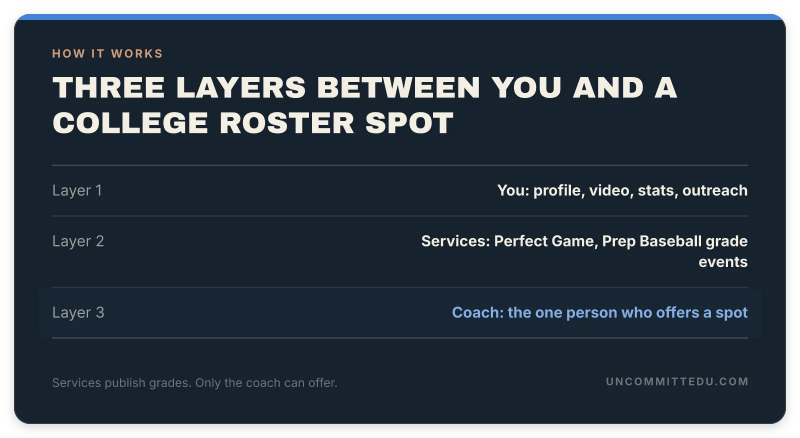
Services like Perfect Game and Prep Baseball sit between you and the coach. They collect verified stats at their own events and publish grades, but they do not place players anywhere. A high grade gets you seen by more programs. It does not get you recruited on its own, and treating an event grade as an offer is the single biggest mistake we see.
Coaches also lean on their own network: former players now coaching summer ball, trusted scouts of their own, and other head coaches they call before a signing period opens. That network runs on relationships built over years, which is exactly why a clear recruiting plan matters more than any single event you attend.
Understanding this layered system changes how you spend your time. You stop chasing one big showcase and start building four channels that reinforce each other, all pointed at the actual decision maker.
A small school with three assistants cannot watch every event in the country. You have to work to get noticed. A power conference program with a bigger staff still cannot watch every player either, since the pool of high school talent is enormous every single year. That is why the burden of getting found sits mostly on you, not on the system finding you by luck.
Coaches also trust repetition over a single data point. A player who shows up in a showcase database, then in a coach’s own inbox, then in a summer league report, reads as more credible than a player who appears exactly once, no matter how strong that one appearance was.
This is also why timing your outreach around real events pays off. Time it right and you get noticed sooner. A coach who just watched you at a camp is far more likely to open your follow up email the same week, while the memory is still fresh, than three months later with no reminder at all.
The Four Channels That Get a Player Found
Every player who gets recruited was found through one of four channels, each one a way to get noticed. Most players use only one channel and then wonder why nothing moves for an entire season.
- Direct outreach. You email the coach with video, stats, and grades attached.
- Verified events. A showcase or camp logs your numbers into a system coaches already trust.
- Summer ball. A travel or summer league coach vouches for you directly to a college staff.
- Online profile. A public page with video and stats that a coach finds while searching your name or your position.

Run all four channels at once and each one reinforces the others. One channel alone means you get noticed slower. A coach who gets your email, then sees your verified sixty time from a camp, then finds your public profile, has three separate reasons to believe your numbers are real.
Players who rely on one channel alone almost always pick the passive one, the online profile, and then wait. Sending the email is how you get noticed. Waiting is the single slowest path in recruiting. The players who move fastest are the ones sending the first email.
Think of the four channels as four separate doors into the same building. A coach only needs to walk through one to find you, so opening all four multiplies your odds without multiplying your workload much at all.
Rank the channels by effort, not by comfort. Effort, not comfort, is what helps you get noticed. Direct outreach costs you an evening and a template. A showcase costs a weekend and an entry fee.
Summer ball costs a full season. A profile, once built, costs almost nothing to maintain, which is exactly why it should never be your only channel.
Track which channel actually produces a reply. The channel that replies is helping you get noticed. Most players discover quickly that one or two channels do the heavy lifting for their specific division and region, and the rest exist mainly as backup evidence a coach checks after that first contact lands.
Build a Recruiting Profile That Gets Clicked
A recruiting profile is the page a coach opens after your email lands. It needs to answer four questions in under ten seconds: who are you, what do you play, what are your numbers, and how do they reach you.
Put your best video first. Put your verified stats second. Put your academic information third, since GPA and test status decide eligibility before talent ever gets discussed at all.

Skip the long bio. A sharp line, not a long bio, helps you get noticed. Coaches skim between classes and practice. A one line summary with position, grad year, and top two numbers beats three paragraphs about your love of the game every single time.
Keep your contact information current and obvious. Hidden contact info means you never get noticed. A coach who has to search for your email simply moves to the next name.
Build your free profile on uncommittedu.com and it becomes a page you can drop straight into an email, a text, or a bio link on social media.
Update the profile every time a number changes. A current profile helps you get noticed. A stale page with last year’s sixty yard time undersells a player who has gotten faster, and a coach comparing two profiles will trust the one that looks current over the one that looks abandoned.
A profile also works while you sleep. A coach scanning names after a tournament, or searching a position group for next year’s class, can land on your page without any outreach from you at all, which is the entire point of keeping it current.
Add your travel schedule to the profile too. A visible schedule can get noticed by a scouting coach. A coach deciding whether to attend an event will sometimes check which players are confirmed to play there.
What Your Video Has to Prove
A recruiting video is not a highlight reel of your best five plays from three different seasons. Coaches want to see your mechanics under normal conditions, not your one perfect swing against weak pitching.
Lead with game footage, not a bullpen or a tee session. Show your full at bat, not just the moment of contact. Show a full defensive sequence, not just the throw at the end of it.

Keep it under four minutes. A tight video helps you get noticed. A coach with two hundred emails in the inbox will not watch fifteen minutes of footage from a player they have never heard of before this week.
Label the video clearly with your name, grad year, and position in the title, and add a short caption naming the pitch speed or competition level whenever you have it. Context turns raw footage into evidence.
Our full recruiting video guide covers shot list, camera angle, and exact length by position, so you are not guessing what to film next.
Refilm every season, not once and done. A current video helps you get noticed as you are now. A body changes fast between freshman and junior year, and a coach comparing an old video against current numbers will notice the mismatch.
Skip the walk-up song and the slow motion intro entirely. None of that helps you get noticed. Every second spent on production is a second not spent proving you can play, and coaches skip past intros within the first few seconds regardless of how well made they are.
If you play multiple positions, film each one separately rather than blending them into a single reel. A coach recruiting an outfielder who can also pitch wants two clear, distinct sections, not a confusing mix that forces them to guess which role you are showing at any given moment.
Showcases and Camps Worth the Entry Fee
Not every event is worth your travel budget. Some exist mainly to sell you a package of photos and rankings. Others put real, verified numbers in front of real coaches who can offer you a spot.
| Event type | Who attends | What you get |
|---|---|---|
| National showcase (Perfect Game, PBR National) | D1 and D2 staff, pro scouts | Verified stats, national exposure, high cost |
| Regional showcase | Local and regional college staff | Verified stats, lower cost, targeted exposure |
| School-run camp | The host school’s own staff | Direct look from one program, cheapest option |
| Private lesson combine | No college staff present | Skill feedback only, no exposure value |

Pick events by who actually attends, not by the size of the logo on the flyer. Attendance, not the flyer, helps you get noticed. A school-run camp at a program you genuinely want puts you in front of the one coach who matters most to your decision.
See our full breakdown of recruiting camps and showcases before you book anything, since some regional events quietly outperform national ones for mid-major exposure.
Budget matters here as much as strategy. The right budget event can still get noticed. A family that can only afford one event a year should pick the one closest to the schools actually recruiting that region, not the biggest national brand three states away.
Ask the event directly which programs sent a coach last year. A legitimate showcase answers with real school names.
Bring a printed stat sheet to every event, even a small one. A clean stat sheet helps you get noticed later too. Coaches sometimes take notes by hand between games, and a sheet with your name, grad year, position, and top numbers saves them from mistyping details later from memory.
The Numbers That Open a Coach’s Notebook
Coaches read two numbers before anything else on a player card: exit velocity and sixty yard time. Both are fast to record, both are verifiable, and both predict projection better than a batting average pulled from an uneven schedule.
We measured 552 exit velocity readings and 496 sixty yard times across our coach directory to build level by level benchmarks. A hitter without a tracked exit velocity number reads as unverified to a coach, even when the bat speed itself is real.

Get both numbers recorded at a real event with a certified radar gun, not off a phone app at home. A verified number helps you get noticed. A number without a source is a number a coach will simply discount or ignore entirely.
Compare your own against our exit velocity benchmarks and sixty yard benchmarks by level and age before you decide which events to chase next.
Arm strength for infielders and catchers, and pitching velocity for pitchers, sit right behind those two numbers in importance. A shortstop with a strong sixty time but a weak throw across the diamond gets projected to a different position, which changes the entire list of programs that fit.
Numbers alone do not replace game performance, but they set the floor for whether a coach opens your video at all. A player who clears the level benchmark earns a longer look. A player who falls short of it has to prove it another way, usually through live game footage against strong pitching.
Retest every few months, especially during a growth spurt. A fresh number helps you get noticed today. A number recorded a year ago can undersell a player who has since added strength and speed.
Emailing Coaches So It Gets Answered
Most recruiting emails die in the first two lines, a wall of text about loving the school, unread past the video link below it.
Lead with your numbers, not your story. Name your grad year, position, GPA, and top verified stat in the first sentence. Link the video and the profile right after that sentence.

Ask one direct question, like whether the program has open roster spots at your position for your grad year. A specific question helps you get noticed and is easy to answer. A vague one gets skipped.
Follow up once, not five times. A short, factual second email after two weeks reads as serious interest and still helps you get noticed. Five in a month reads as pressure, and gets a player filtered out.
Our step by step guide covers the exact wording in how to email a college baseball coach, including subject lines that actually get opened.
Send from your own email, never a parent’s account. Sending it yourself helps you get noticed directly, since a program wants a relationship with the player, not a middleman.
Copy a second coach on the same staff only if the first email goes unanswered for two full weeks. A second name can get noticed by staff. A recruiting coordinator and a head coach both missing the same email is rare, and a second name in the thread often gets the whole conversation moving.
Keep a simple log of every email you send, with the date, the coach, and whether you got a reply. That log shows what actually helps you get noticed. Six months into a recruiting cycle, that log tells you exactly which programs to prioritize and which ones to quietly drop from the list.
This whole path to getting noticed is the seven touches in the course, ending at touch seven.
When to Start, by Grad Year
Freshmen and sophomores should build the profile and start collecting verified numbers early, without any pressure to email coaches yet. That comes later, once there is real data to send.
Juniors should be emailing coaches directly every week during the season and through the summer that follows it. This is the year outreach helps you get noticed most. This is the year most rosters get built, and silence during it costs real opportunities.

Seniors without an offer should widen the list fast, including JUCO and D3 programs that recruit later than most D1 staffs. A wider list can still get noticed late.
The exact contact windows change by division and by grad year, and getting a date wrong can waste a whole recruiting cycle. The NCAA’s own baseball page is the source of record for those dates, so check it before you assume an old window still applies. Our full college baseball recruiting timeline lays out every date so you are never guessing when a coach is even allowed to respond to you.
Starting early is an advantage, not a requirement. Plenty still get noticed after one strong spring with almost no prior outreach. What matters more is whether your numbers, video, and profile are ready when a coach looks.
Whatever your grad year, the fastest path forward is the same: get your numbers verified, get your video current, get your profile live, and start sending the emails today instead of after the next tournament.
Frequently asked questions
What age do college scouts look at baseball players?
College coaches start tracking players as early as freshman year through showcases and summer ball, but real, sustained contact usually ramps up junior year, once grades, growth, and verified stats give a coach enough information to project accurately.
What are D1 baseball coaches looking for?
D1 coaches look for verified exit velocity, sixty yard time, and arm strength first, then academic eligibility, then game performance against strong competition. A clean recruiting profile with real video closes the gap between a good player and a recruited one.
How do I get noticed by college scouts?
Combine all four channels at once. Build a public recruiting profile, email coaches directly with your numbers, attend a verified event for stats, and play summer ball where a trusted coach can vouch for you personally.
How do baseball players get scouted?
Most players get scouted through their own outreach plus verified event data, not through a scout finding them by chance. The player who emails, tracks numbers, and keeps a live profile gets found. The player who waits usually does not.