

Official vs Unofficial Visits: The Rules
Official vs unofficial visits get mixed up constantly, and the mix-up is expensive: one costs your family money, the other usually signals a staff is close to an offer.
This covers exactly what each one is, when to expect it, and how to make the most of it. For the full process, see the college baseball recruiting guide.
Quick answer: Unofficial visits happen any time, at your own expense, with no limit, a low-pressure way to see a campus early. Official visits are partly paid by the school, limited by NCAA rules, and usually happen later, once a program has real, specific interest in you.
What actually separates them: who pays, how many you get, and what accepting one tells the coaching staff. Below: the rules for each, the timeline, and the mistakes that cost players real offers.
Key takeaways
- Official vs unofficial comes down to who pays and how many you are allowed.
- Unofficial visits are unlimited and self-funded; official visits are capped and part-funded.
- The official vs unofficial difference that matters most is what the invitation signals.
- An unofficial visit signals your interest; an official visit signals theirs: that is the whole official vs unofficial distinction in one line.
- Official vs unofficial rules differ by level, so confirm them with the specific programme.
Official vs unofficial baseball visits at a glance
The table below sets out the official vs unofficial differences that actually affect your decision.
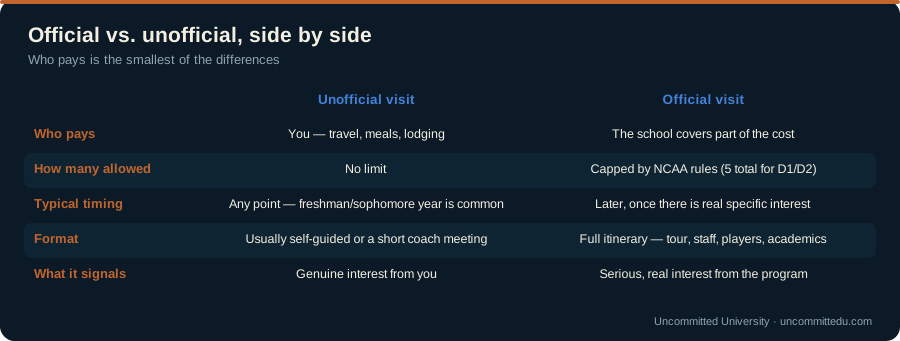
| Unofficial visit | Official visit | |
|---|---|---|
| Who pays | You: travel, meals, lodging | School covers part of the cost |
| How many allowed | No limit | No NCAA cap on the number in D1 since 2023: one per school. Confirm D2 with the program |
| Typical timing | Any point, often early: freshman/sophomore year is common | Later, once there’s real specific interest |
| Format | Usually self-guided or a short meeting with a coach | Full itinerary: tour, staff, current players, academics |
| What it signals | Genuine interest from you | Serious, real interest from the program |
Unofficial visits
- Can happen at any point in the recruiting process
- You pay your own way: travel, meals, lodging
- No limit on how many you can take
- Usually self-guided or a quick meeting with a coach, not a full program
Take these early and often, on any school you’re genuinely interested in. They’re free information, and showing up signals real interest.
Official visits
- The school covers part of the cost: travel, lodging, some meals
- Limited by NCAA rules: a capped number of official visits total
- Usually happen once a program has specific, real interest in you
- Include a full itinerary: campus tour, coaching staff, current players, academics
An official visit is a strong signal. Programs don’t spend the money and staff time on players they aren’t seriously considering.
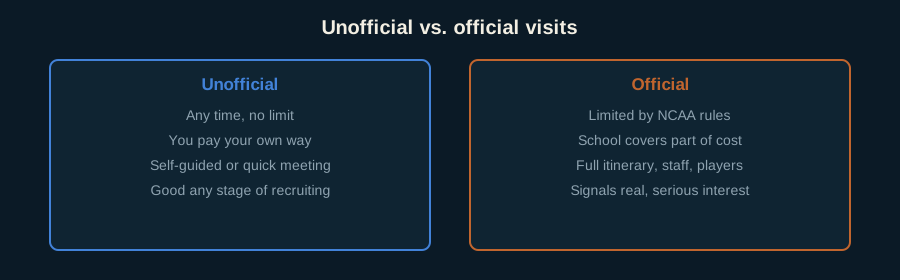
The chart below compares official vs unofficial visits side by side.
A sample official visit, hour by hour
Official visits vary by program, but a typical two-day itinerary usually includes something like this:
- Arrival afternoon: Meet the coaching staff informally, drop bags at a host player’s dorm or a hotel, casual introduction to a few current players.
- Evening: Team dinner or a small group dinner with players in your position group, pay attention to how players talk about the program when coaches aren’t in the room.
- Morning: Formal campus tour, academic support center, athletic facilities, weight room and training staff introduction.
- Midday: Meeting with the head coach and recruiting coordinator to talk specifics: role, scholarship numbers, depth chart timing.
- Afternoon: Practice observation or a workout, sometimes with you participating in a light capacity.
- Before you leave: A closing conversation with the head coach, often where real numbers or next steps get discussed directly.
Every program runs this differently, but the pattern is the same: casual time to see the real culture, and formal time to get real answers. Prepare for both.
What to actually do on an official vs unofficial visit
Whether official or unofficial, come with real questions ready:
- Who else is being recruited at your position and grad year?
- What does the depth chart look like the year you’d arrive?
- How does the coaching staff communicate with players during the season?
- What’s the actual roster size at your position?
- What does a normal week look like: academics, training, travel?
A coach who answers these directly is showing you exactly how the program treats its players.
Academic questions worth asking beyond the coaching staff
A visit is also a chance to evaluate the school itself, not just the program. Some questions are better asked of an academic advisor or admissions rep than a coach:
- What academic support exists specifically for athletes: tutoring, study hall, travel accommodations for missed classes?
- How do professors in your intended major typically handle athletic travel conflicts?
- What’s a realistic four-year graduation plan for an athlete in your major?
- Is need-based or academic aid available on top of any athletic scholarship, and who do you talk to about stacking them?
A program that connects you directly with academic support staff during a visit, without being asked, is usually a good sign about how it treats the “student” half of student-athlete.
Official vs unofficial: which visit should you ask for first?
Ask for an unofficial visit. Almost always. An official visit costs the program money. An unofficial visit costs it nothing, and that asymmetry should drive the whole plan.
Getting the official vs unofficial order wrong burns the scarcer of the two on a school you had not finished researching.
- Use unofficial visits to shorten the list. Campus, facilities, the town, the drive home at Thanksgiving: an unofficial visit answers all of it, and a coach can say yes without spending anything.
- Save official visits for programs that have shown their hand. A staff spending its own budget on you is a signal in itself, and it is the clearest official vs unofficial tell there is.
- Do not ask for an official visit too early. Asking before a program has real interest puts a coach in the position of saying no, and there is no upside in that conversation.
- Sequence beats volume. Five unofficial visits to schools you have actually researched will teach you more than one official visit to a school you have not.
One caution on the official vs unofficial split: what a program is allowed to pay for is governed by rules that differ by level and get revised. Confirm what a specific school can cover before you build a travel budget around an assumption.
Timing: when official vs unofficial visits usually happen
Unofficial visits can start as early as you want, freshman or sophomore year is common for players serious about a level. Official visits typically come later, once a program has moved from general interest to a real, specific offer conversation.
Don’t wait for an official visit invite to see a campus. An unofficial visit costs you a trip, not a relationship with the program.
Get on a program’s radar before you visit
A visit means more when a coach already knows your name. Build your free profile first.
What parents should and shouldn’t do
Parents play a real role in visits, just not the leading one.
- Do handle logistics: travel, scheduling, paperwork.
- Do ask your own questions about cost, academics, and support structure.
- Don’t answer questions directed at the player.
- Don’t negotiate scholarship details on the player’s behalf without him in the room.
Coaches are evaluating maturity as much as talent. A player who speaks for himself stands out.
How many visits is normal, official vs unofficial
There’s no fixed number. Some players take a handful of unofficial visits total. Others visit ten or more schools before deciding.
What matters, official vs unofficial, is that each visit is to a school genuinely on your list, not a visit for its own sake. The old five-visit cap is gone: the Division I Council removed the limit on how many official visits a prospect may take, effective July 1, 2023. You still get one official visit per school, a second only if the head coach changes after your visit. Division II sets its own rules, so confirm the current position there directly.
That makes the official vs unofficial calculation about cost rather than quota. The school pays for an official visit, which is what keeps them scarce in practice, so use them on programs where the interest is real and mutual.
How many official visits can you take, by division
As many as programs will host, one per school. The Division I five-visit cap ended July 1, 2023, Division II and III never cap the total, and the NAIA does not regulate visits at all. What limits official visits now is the school’s budget, not a rulebook, which is why a program spending one on you is the signal it is.
| Level | Official visits allowed | Per school | Length and cost |
|---|---|---|---|
| NCAA Division I | No cap on the total since July 1, 2023 | One. A second only after a head coaching change. | Up to 48 hours. The school can pay travel, lodging and meals for you and your parents or legal guardians. |
| NCAA Division II | No cap on the total | One | Up to 48 hours, school pays, same family coverage. |
| NCAA Division III | No cap on the total | One | Up to 48 hours. The school may cover expenses, and many D3 programs run an official visit that looks like an admissions visit with the team attached. |
| NAIA | Not regulated | Not regulated | Each school sets its own practice. Ask. |
| NJCAA | Not capped in practice | Ask the program | Usually a campus look and a conversation with the staff. |
| Transfers (NCAA) | Same rules as a high school recruit once you are in the portal | One per school | Programs recruiting out of the portal move fast, so the visit is often days after first contact. |
Unofficial visits have no cap at any level and never did. The only unofficial visit rule that bites in baseball is timing, covered next.
When can a baseball recruit take an official visit? Dates by division
Division I baseball: August 1 before your junior year, and not a day earlier. Division II: June 15 after your sophomore year. Division III: January 1 of your junior year. NAIA and JUCO: whenever the program invites you. Division I baseball also blocks recruiting conversations and unofficial visits arranged through the athletic department before that same August 1, so a sophomore walking a D1 campus is doing it as a regular visitor, not a recruit.
| Level | Earliest official visit | Unofficial visits |
|---|---|---|
| NCAA Division I baseball | August 1 before junior year | Any time as a regular campus visitor. No coach contact or athletics-arranged unofficial visit before August 1 before junior year. |
| NCAA Division II | June 15 after sophomore year | Any time. Coach contact opens the same June 15. |
| NCAA Division III | January 1 of junior year | Any time, with coach contact allowed at any point. |
| NAIA | No restriction | No restriction |
| NJCAA | No restriction | No restriction |
These are the NCAA’s sport-specific dates for baseball as published for 2025-26, read 2026-09-12. They move occasionally, and a program’s compliance office has the current version, so confirm the date with the school before booking travel. The recruiting guide lays out what to do in the two years before that August 1 arrives.
How official vs unofficial rules differ by level
Visit rules are written level by level and they do not carry across. Here is the official vs unofficial picture by level:
- D1: No cap on how many official visits you take, the five-visit limit was removed effective July 1, 2023. One official visit per school, and a second only after a head coaching change.
- D2: Governed by Division II legislation, which is separate from the Division I action above. Ask the D2 program what its current visit rules are rather than assuming the D1 answer.
- D3: Since D3 doesn’t offer athletic scholarships, visits function differently: expect more emphasis on unofficial visits and admissions-related campus visits alongside any athletic conversation.
- NAIA: Governed by its own visit rules, separate from the NCAA, so confirm specifics directly with each program rather than assuming NCAA limits apply.
- JUCO: Visit structure tends to be far less formal, often just a direct conversation with the coaching staff and a campus look, reflecting the faster overall recruiting timeline at this level.
Always confirm the exact rule with the program or a compliance office: this is a general reference, not a substitute for checking your specific situation.
Visit etiquette and the follow-up that matters
A short, specific thank-you email within a day or two of any visit (official or unofficial) reinforces interest and shows the same attention to detail coaches look for on the field. Reference something specific: a conversation with a player, a detail about the coaching staff, an academic program you liked.
Skipping this step is one of the most common, easily avoidable mistakes players make after an otherwise strong visit.
Official vs unofficial: mistakes to avoid on a visit
The checklist below applies to official vs unofficial visits equally: staffs evaluate the whole day.
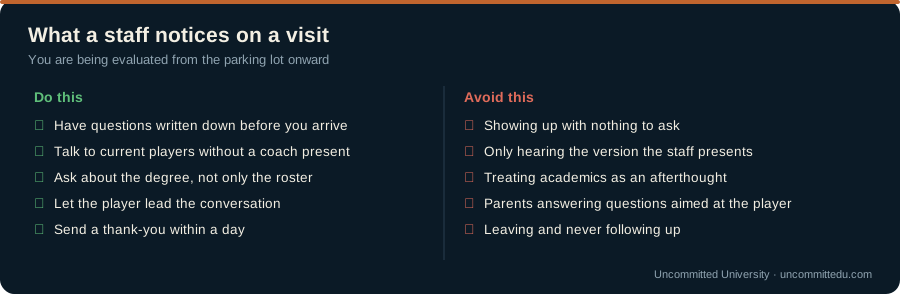
- Showing up unprepared. No questions, no knowledge of the roster or coaching staff.
- Letting a parent do all the talking. Coaches want to hear from the player.
- Not following up after. A visit without a thank-you email is a missed chance to reinforce interest.
- Judging a program only on facilities. Ask about playing time and development, not just what looks impressive.
What earns a player an official visit: the official vs unofficial signal
An official visit rarely comes out of nowhere. It usually follows a pattern:
- Verified metrics and video the staff has actually reviewed, not just a submitted profile sitting unread.
- Consistent responsiveness throughout earlier calls, emails, and camp interactions: coaches invest official visit budget in players who’ve shown they’ll follow through.
- A realistic scholarship or roster picture already discussed, at least in broad terms, before the visit itself.
- Positive feedback from your current coach, if the college staff has reached out to him: this often happens quietly, before an invite goes out.
If you haven’t gotten an official visit invite yet, an honest look at these four points usually explains why, and points to what to focus on next.
Virtual visits
Many programs now offer virtual tours and video calls with coaches, especially early in the process or for players who live far away.
- Useful for a first look before committing to travel
- Not a substitute for an in-person visit once things get serious
- Still worth preparing the same questions you’d ask in person
Treat a virtual visit as a step, not the finish line: an in-person visit still matters before a final decision.
What to pack for an official vs unofficial visit
- Presentable, casual clothes for the campus tour and meals: you’re being evaluated on more than just baseball.
- Workout gear in case a practice observation turns into a chance to participate.
- A notebook or notes app for questions you want to ask and answers you’ll want to remember later.
- A copy of your transcript and test scores if academics come up in detail, especially at academically selective D3 and NAIA programs.
- A short list of your other visits or offers in case a coach asks where else you stand: being honest here builds trust rather than costing you leverage.
How to evaluate a program after you’ve left
The steps below keep your official vs unofficial comparisons honest once the excitement wears off.
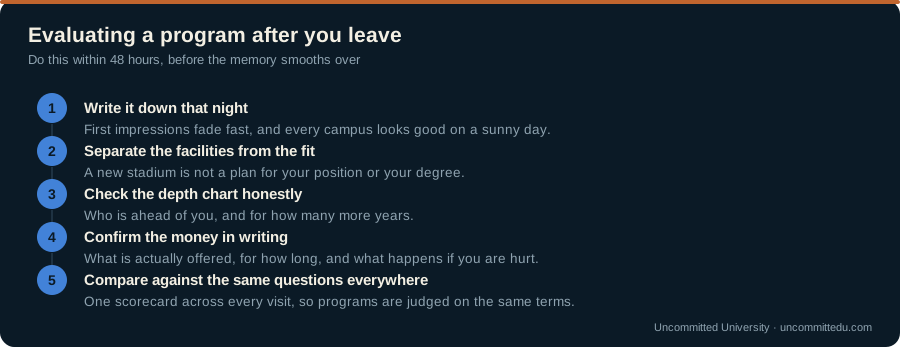
The visit itself is only half the process. What you do in the days after matters just as much:
- Write down your honest impression immediately, before the excitement (or disappointment) fades. Specific details fade fast within a week.
- Compare against your own checklist, not against the last school you visited. Recency bias is real: a great visit right before a mediocre one can make the mediocre one look worse than it is.
- Talk to current players again if you can, outside the formal visit itself. A follow-up text to a player you connected with often gets a more candid answer than anything said during the official tour.
- Weigh the coach’s directness as much as his enthusiasm. A coach who gives you an honest, specific answer about depth chart timing is more useful long-term than one who’s simply upbeat about everything.
A visit that felt good in the moment but leaves you with vague, general answers to your specific questions is worth a second look before it moves up your list.
What to actually evaluate on each visit type
The official vs unofficial distinction is about who pays. What you should be doing with the day barely changes, but what you can realistically get access to does.
On an unofficial visit, you are paying your own way, and you can take as many as you like. Use them early and use them cheaply. Walk the campus, sit in on a class, watch a practice or a game as a regular spectator, and see whether you would want to be there without baseball.
Ask yourself the unglamorous questions: could I get to my major from this dorm, could my family drive here, would I be happy in this town in February.
On an official visit, the school is paying, which means the school has decided you matter. The access changes accordingly: you will typically get real time with the coaching staff, a player host, academic support, and the facilities you would actually use.
That is when the harder questions belong. Where do you see me on the roster in year one? Who else are you recruiting at my position? What happens to my aid if I get hurt? How many players in my position group transferred out last year?
The official vs unofficial question families get wrong is treating the official visit as the reward. It is not a celebration. It is the last, best chance to gather information before a decision that shapes four years.
One practical note on both: write your impressions down the same night. After a third campus they blur, and the notes are what stop you choosing on the strength of the nicest weather.
Bring a parent to the official visit and send them to different conversations than you. Players hear the baseball answers. Parents hear the money, medical and academic-support answers, and comparing the two afterwards is where the real picture appears.
Talk to a current player without a coach in the room. Ask what the fall schedule actually looks like, how playing time gets decided, and what they would change. Most will tell you honestly.
Be careful about the halo effect on a well-run visit. A great weekend tells you a program is good at hosting weekends: it does not tell you where you sit on the depth chart.
The official vs unofficial decision that matters most is what you do afterwards: go home, wait 48 hours, and see whether the school still feels right once the hospitality has worn off.
Frequently asked questions
These are the questions that come up most often on the official vs unofficial call.
How many official visits can you take to one school? One. That is true at every NCAA division. In Division I a second official visit to the same school is allowed only after a head coaching change. There is no longer a cap on the total number of schools: Division I removed its five-visit limit on July 1, 2023, and Divisions II and III never had one. Unofficial visits to the same school are unlimited.
Do D1 schools pay for official visits? Yes, that is what makes a visit official. The school can cover transportation, lodging and meals for the recruit and for parents or legal guardians, for up to 48 hours on campus. On an unofficial visit you pay your own way, and the most a program can give you is complimentary admission to a home game. A school offering to pay is a school that has decided you are worth a line in its budget.
Are unofficial visits worth it? Yes, and they are the visit you control. You choose the school, the date and the questions, you see the campus without a script, and a coach who agrees to meet you for thirty minutes on an unofficial visit has told you something real without spending a dollar. For Division I baseball remember the timing rule: before August 1 before junior year you visit as a regular student, not through the baseball office.
What’s the difference between an official and unofficial college baseball visit? Unofficial visits happen any time, at your own expense, with no limit. Official visits are partly paid by the school, are limited to one per school, and usually happen later once a program has real, specific interest.
How many official visits am I allowed to take? In Division I there is no longer a cap on the number. The Division I Council removed the five-visit limit effective July 1, 2023, and the rule now is one official visit per school, with a second allowed only if the head coach changes after your visit. Division II, the NAIA and other levels follow their own rules, so confirm directly with each program.
Should I take an unofficial visit before an official one? Yes, in almost every case. An unofficial visit costs the program nothing to host, so a coach can say yes to it early, and it tells you whether a school is worth spending a scarcer official visit on later.
When do official visits typically happen in the recruiting process? Usually later than unofficial visits, once a program has moved from general interest to a real, specific offer conversation. Unofficial visits can start as early as freshman or sophomore year.
Should parents talk to the coach during a visit? Parents can handle logistics and ask their own questions about cost and academics, but coaches want to hear the player answer questions directed at him and speak for himself.
Is a virtual visit as good as an in-person visit? A virtual visit is a useful first look, especially for players who live far away, but it isn’t a substitute for an in-person visit once things get serious and a real decision is on the table.
Do I need to send a thank-you note after a visit? Yes. A short, specific follow-up within a day or two reinforces interest and reflects the same attention to detail coaches evaluate on the field. Skipping it is a common, easily avoidable mistake.
The short version: official vs unofficial is less about the money than about the message. Use unofficial visits early and often to learn what you actually want in a campus, and treat an official visit invitation as evidence of real interest. Either way, arrive with written questions, talk to current players without a coach present, and write your impressions down the same night: the official vs unofficial label changes the logistics, not the homework.
The short version
Official vs unofficial comes down to who pays and what it signals. Unofficial visits are yours to take early and often at your own cost. An official visit is funded by the school, which means you are genuinely on their board.
Use unofficial visits to build the list. Use the official vs unofficial upgrade as the moment to ask the questions you cannot ask by email.
Uncommitted University advises visiting at least one school you expect to dislike. The official vs unofficial comparison only becomes useful once you have something to measure a favourite against.
Your next step
Take unofficial visits early on schools from your target list: see the D1 vs. D2 vs. D3 vs. NAIA vs. JUCO breakdown to build that list realistically.
Before you go, check who is actually on the staff. The coach directory covers 6,934 coaches at 1,649 programs, and a free profile lets you search it by division, state and academics.
Written by Wayne Keeton, founder of Uncommitted University.