

NCAA Eligibility Clock: When It Starts
The NCAA eligibility clock is the one rule that decides how much college baseball you actually get, and almost no family can say when theirs started.
Here’s the problem: under the age-based model Division I adopted in June 2026 and Division II adopted in August 2026, the NCAA eligibility clock can start while you are still in high school, still in a gap year, or still deciding. It does not wait for you to put on a uniform.
This guide covers exactly when the NCAA eligibility clock starts, the Sept. 1 birthday split almost every other write-up skips, the three exceptions that can pause it, and the three myths that quietly cost players a full year.
Quick answer: The NCAA eligibility clock is a five-year period of eligibility that begins at the earlier of two events: your first full-time enrollment at any college, or the start of the regular academic year after your 19th birthday. It then runs continuously. Only pregnancy, active-duty military service and official religious missions can pause it, and all three are administered by the NCAA Eligibility Center.
Key takeaways
- The NCAA eligibility clock runs for five years and starts at whichever trigger arrives first.
- A 19th birthday can start the NCAA eligibility clock with no college enrollment anywhere.
- Birthdays on or after Sept. 1 push the NCAA eligibility clock back a full academic year.
- A redshirt, a transfer or a sit-out year does not stop the NCAA eligibility clock.
- Three exceptions (pregnancy, military service and religious missions) can pause the NCAA eligibility clock.
- Being inside the NCAA eligibility clock is not the same thing as being eligible to play.
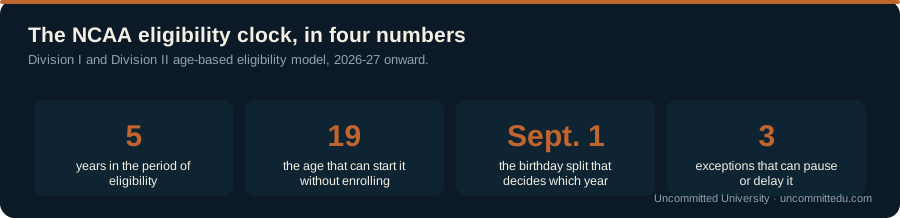
What the NCAA eligibility clock actually is
The NCAA eligibility clock is the five-year period of eligibility created by the age-based model Division I adopted in June 2026 and the Division II Executive Board adopted by emergency legislation in August 2026.
It replaced a system built on counting seasons. Division I used to allow four seasons of competition inside a five-year window; Division II used 10 semesters or 15 quarters. Both are gone.
Now there is one window, and your job is to know when it opened. Everything else (how many seasons you play, whether you sit a year, whether you transfer) happens inside that window rather than extending it.
Here’s why that matters more than it sounds. The NCAA eligibility clock is now tied to your age and your enrollment date, two things that happen to you whether or not a coach ever recruits you. The old system only started counting once you arrived on campus.
Go deeper on the age side of it: is there an NCAA age limit, and what changed in 2026.
When does the NCAA eligibility clock start?
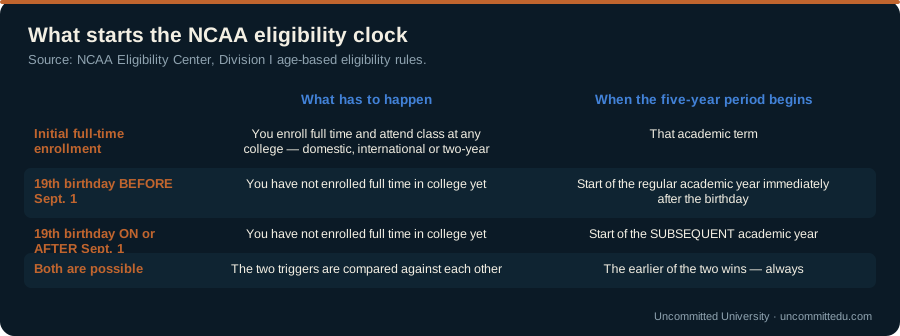
The NCAA eligibility clock starts at the earlier of two events: the academic term you first enroll full time at any college, or the start of the regular academic year immediately after your 19th birthday. Whichever comes first is the one that counts.
The NCAA Eligibility Center states the first trigger this way:
“Initial full-time college enrollment: The academic term when the student-athlete first enrolls full time and attends class at any college or university, including a domestic institution, international institution or two-year college.”
Read that list again. Any college. A junior college counts. A university abroad counts. A local community college where you never touch a baseball counts, as long as the enrollment is full time and you attend class.
The second trigger is the age one, and it is where the detail lives:
“Age-based trigger: The start of the regular academic year immediately following the student-athlete’s 19th birthday, if the student-athlete turns 19 before Sept. 1. For an individual who turns 19 on or after Sept. 1, the period of eligibility begins at the start of the subsequent academic year, unless the individual enrolls full time in college earlier.”
Read the table below before you assume you know which trigger applies to you.
The Sept. 1 birthday split most guides get wrong
“Your NCAA eligibility clock starts at 19” is the version you will read almost everywhere. It is not the rule.
The rule has a hinge date, and the hinge is Sept. 1:
- Turn 19 before Sept. 1: the NCAA eligibility clock starts at the beginning of the academic year that immediately follows. A birthday in March or June starts your clock that same fall.
- Turn 19 on or after Sept. 1: that academic year has already begun, so the clock starts at the beginning of the subsequent academic year instead. An October birthday buys you nearly a full extra year.
Two players born four months apart, following the exact same plan, can arrive on campus with a different number of years left. That is not a loophole. It is the rule as written, and it is the single most useful thing to know about the NCAA eligibility clock.
One caveat that cancels the whole benefit: the later start applies unless the individual enrolls full time in college earlier. Enroll, and enrollment wins.
Myth 1: a redshirt or a transfer stops the NCAA eligibility clock
It does not. Once the five-year period starts, nothing about your playing status slows it down. The NCAA Eligibility Center is unusually blunt about this:
“Once the five-year period starts, it runs continuously. It does not pause because a student-athlete does not compete, transfers, sits out, changes teams or takes time away from participation, meaning student-athletes, coaches and athletics departments no longer have to track athletic ‘redshirts.’”
Count what is on that list: not competing, transferring, sitting out, changing teams, stepping away. All of it leaves the NCAA eligibility clock running.
Athletics redshirt rules were not weakened. They were deleted, along with medical hardship waivers, season-of-competition waivers, extension-of-eligibility waivers and the delayed-enrollment rules. There is no longer a mechanism to give a year back at Division I or Division II.
Now: this changes how a transfer decision should be made. A season spent in the portal is a season off your five years whether you play or not, so the calendar cost of a move is real even when the transfer itself is free. See how the mechanics work when entering the transfer portal.
Myth 2: the NCAA five-year rule guarantees everyone five years
It does not, and the NCAA says so by name. The nickname circulating for the NCAA five-year rule is “5 for 5”: five seasons in five years for everybody. The Eligibility Center rejects it directly:
“While some have referred to this as the NCAA ‘5 for 5’ rule, that is not accurate. The age-based rules actually centers on a student-athlete’s age and when the student initially enrolls full time in college, and it does not guarantee five years for all student-athletes, particularly those who delay enrollment.”
Here is the mechanism behind that sentence. The NCAA eligibility clock can start before you enroll anywhere. Every month between the age trigger and your first day of college is a month burning off a five-year window you have not begun to use.
The NCAA’s own advice to prospects is worth quoting because it is the practical version of the same point:
“Prospective student-athletes should pay close attention to both age and enrollment timing. Delaying college enrollment beyond age 19 may reduce the amount of eligibility available in Divisions I and II.”
What’s the bottom line? Five years is a ceiling, not a promise. The NCAA five-year rule measures a window, and how much of that window you can actually use depends on how early you enroll.
Myth 3: inside the five years means you are eligible
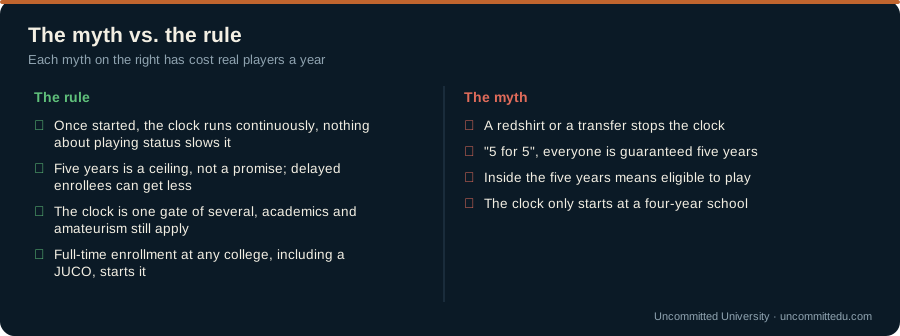
Being inside the NCAA eligibility clock is a necessary condition, not a sufficient one. The Eligibility Center says it plainly:
“Other eligibility rules – including academic and other athletics-related rules – will still apply, meaning a student-athlete may be inside the five-year eligibility period and still be ineligible for other reasons.”
Core-course requirements, GPA standards, progress-toward-degree rules and amateurism certification all survived this rule change untouched. The NCAA eligibility clock answers one question, how long is the window, and nothing else.
A player can be in year two of five and still be sitting out for an academic reason. The two systems are independent, and the clock keeps running while the academic problem gets fixed.
NCAA eligibility clock exceptions: the three that can pause it
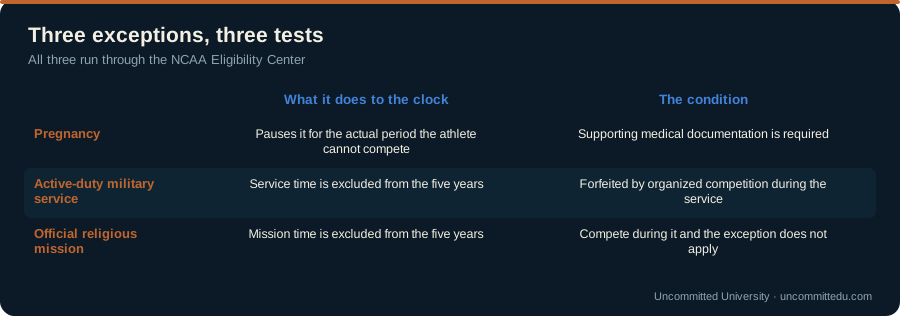
Three exceptions can delay or pause the five-year period, and there are no others. The NCAA states the list without hedging:
“There are three exceptions available to student-athletes under this rule that may delay or pause the five-year period of eligibility: pregnancy, active-duty military service and official religious missions. All three exceptions will be administered by the Eligibility Center.”
The NCAA eligibility clock exceptions are not waivers you argue for after the fact. They are defined conditions, and each one has a test you either meet or you don’t.
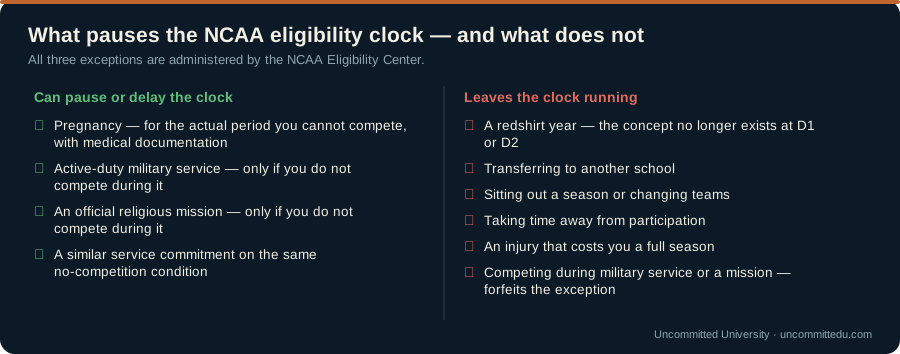
Pregnancy
The pregnancy exception pauses the period for a measured stretch of time, not for a whole academic year by default. The rule text:
“Pregnancy Exception: A pregnant student-athlete may pause the eligibility period for the duration of the actual period during which the individual cannot compete. Supporting medical documentation is required.”
Two things are load-bearing there. The pause is bounded by the actual period of inability to compete, so the length is a medical question rather than a calendar one. And supporting medical documentation is required: without it, there is nothing for the Eligibility Center to certify.
Active-duty military service
Military service is handled under a broader heading that also covers missions and comparable commitments:
“Military Service, Religious Missions and Similar Service Commitments: Time spent in active-duty military service, on an official religious mission or in a similar service commitment may be excluded from the five-year period if the student-athlete does not participate in organized competition during that service. If the student-athlete competes during the service period, the exception does not apply.”
Notice the word: time is excluded, not paused. Service time comes out of the five-year period entirely, provided the condition holds.
Official religious missions
An official religious mission runs on the same condition and the same trap. Compete during the service, and the exception does not apply. Not reduced → does not apply.
That is a genuinely dangerous line for a baseball player. A mission or a deployment where you play in an organized league to stay sharp is exactly the choice that forfeits the exclusion, and it is a choice that feels harmless at the time.
All three of the NCAA eligibility clock exceptions run through the NCAA Eligibility Center, not through your school and not through your coach. Document as you go, because the certification happens later.
Three baseball paths, read against the NCAA eligibility clock
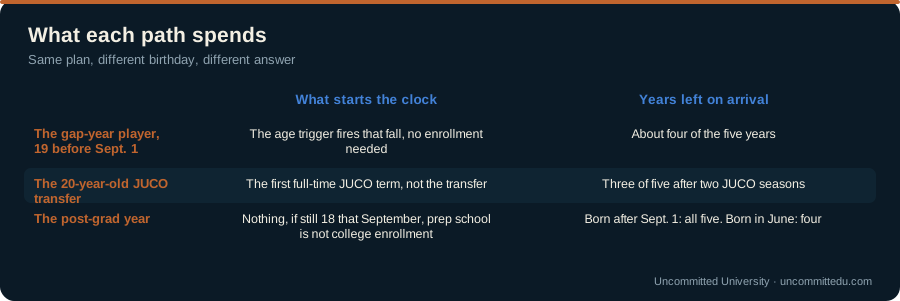
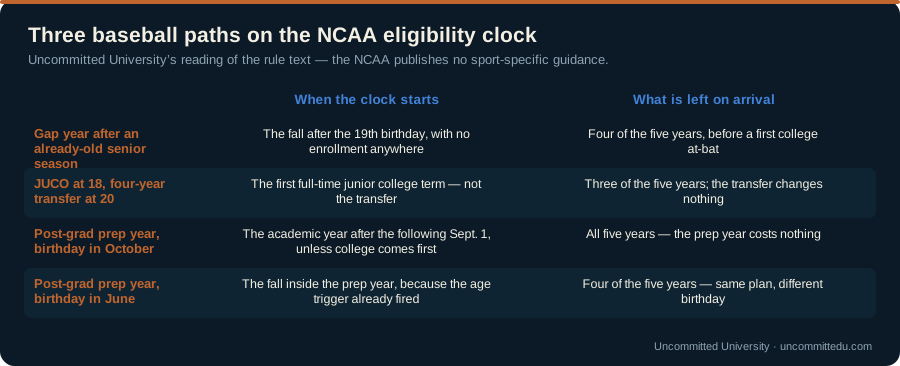
The NCAA publishes no baseball-specific guidance on the age-based model, so what follows is our reading of the rule text rather than anything the NCAA has said about the sport. Confirm your own situation with the Eligibility Center and a compliance office before planning around it.
The gap-year player
A player who was already old for his graduating class turns 19 in March of his senior spring, then takes a training year instead of enrolling.
His birthday landed before Sept. 1, so the age trigger fires that fall. He is not enrolled anywhere, and the NCAA eligibility clock starts anyway. When he arrives on campus the following autumn, roughly four of his five years remain and he has not had a college at-bat.
Reading it the other way is just as useful: a gap year is close to free for a player whose 19th birthday has not yet arrived, and expensive for one whose birthday has passed.
The 20-year-old JUCO transfer
A player enrolls full time at a junior college at 18, plays two seasons, and moves to a four-year program at 20.
His NCAA eligibility clock started at that first full-time junior college term (two-year colleges are named in the rule), not on the day he transferred. Two of the five years are behind him on arrival, and the transfer itself neither reset nor paused anything.
The NJCAA runs its own separate clock on its own rules, and this NCAA change does not touch it. The two systems have to be tracked side by side: how the JUCO eligibility clock works.
The post-grad year
Two players do identical post-grad prep years. One was born in October, one in June.
The October player turns 19 after Sept. 1, so his age trigger points at the following academic year. A prep-school post-grad year is not full-time college enrollment, so nothing fires early. He reaches campus with the full five years intact.
The June player turns 19 before Sept. 1. His clock starts that fall, in the middle of the post-grad year, and he arrives with four years left. Same plan, same prep school, different birth month.
And one variation flips the answer for both of them: a post-grad year taken as full-time enrollment at a junior college is initial full-time college enrollment. That starts the NCAA eligibility clock immediately, regardless of birthday.
Who the new NCAA eligibility clock applies to
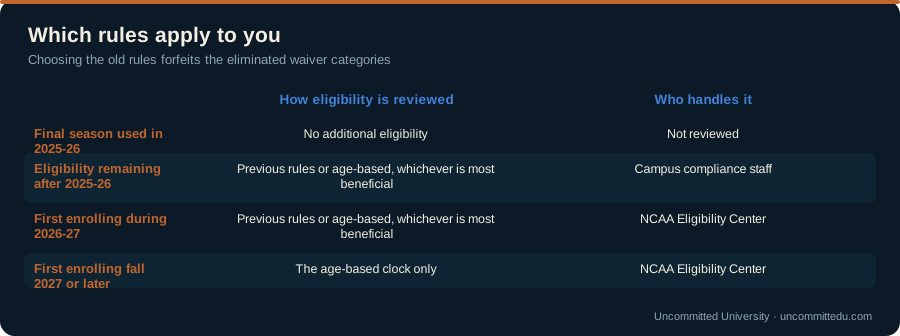
The age-based model took effect for the 2026-27 academic year, and it does not land on everyone the same way.
| Your situation | How eligibility gets reviewed |
|---|---|
| Used your final season under the previous rules during 2025-26 | No additional eligibility |
| Current student-athlete with eligibility remaining after 2025-26 | Previous rules or the age-based rule, whichever is most beneficial |
| First enrolling full time at any college during 2026-27 | Previous rules or the age-based rule, whichever is most beneficial |
| First enrolling full time in fall 2027 or later | The age-based NCAA eligibility clock only |
Two different offices run that comparison. Campus compliance staff handle it for athletes already enrolled; the NCAA Eligibility Center handles it for prospects first enrolling in 2026-27.
There is a catch on choosing the old rules, and it is permanent: an athlete who stays under the previous system will not have future waiver opportunities through the eliminated waiver categories. The safety net comes off either way.
Division II adopted the model in its own vote and the mechanics mirror Division I, but the surrounding D2 rules are not identical, and the detail is here: Division II eligibility rules explained.
What the NCAA eligibility clock does not cover
This is Division I and Division II rule text. It is narrower than most coverage of it suggests.
- Division III is not part of the age-based model. Neither NCAA source extends it past Divisions I and II, so do not assume a D3 program is running this clock.
- The NAIA is a separate association with its own eligibility system, unaffected by NCAA legislation.
- The NJCAA runs its own clock for junior college athletes, also unaffected, while simultaneously starting your NCAA eligibility clock the moment you enroll full time.
That last one is the combination that catches families out. One enrollment date, two governing bodies, two clocks running on different rules.
Find out where your clock actually stands
Uncommitted University’s eligibility calculator checks your birthday and enrollment dates against the NCAA eligibility clock, and against NAIA and JUCO rules.
NCAA Division 3 eligibility clock: 10 semesters, no five-year period
Division III never adopted the age-based model, and it does not run a continuous clock. The D3 rule is four seasons of participation inside 10 semesters or 15 quarters of full-time enrollment. Only full-time terms count, so a part-time semester, a gap year or a year out of school does not spend D3 time the way it spends Division I and II time. That is the whole difference: at D1 and D2 the calendar runs, at D3 the enrollment counter runs.
| Level | What limits you | Does sitting out cost you? |
|---|---|---|
| NCAA Division I and II | One five-year period from the earlier of full-time enrollment or the academic year after your 19th birthday | Yes. The period runs whether you enroll, compete or sit. |
| NCAA Division III | Four seasons of participation within 10 full-time semesters (15 quarters) | No, if you are not enrolled full time. A full-time semester counts, played or not. |
| NAIA | Four seasons of competition within 10 semesters of attendance, under NAIA rules | Terms of attendance count. Check the current NAIA eligibility guide. |
| NJCAA | Two seasons per sport under NJCAA rules, while your NCAA period runs from your first full-time JUCO semester | Two clocks at once. See the JUCO clock guide. |
A D3 proposal to adopt a five-year model has been discussed, and nothing has passed. Until D3 votes, the 10-semester rule stands. A player weighing D3 against D2 in 2026 is comparing two different clocks, not two lengths of the same one.
Where the NCAA five-year rule stands in court, September 2026
Search results for the five-year rule fill with lawsuits, so here is the status in one place. Diego Pavia’s December 2024 injunction against counting a JUCO season produced an NCAA blanket waiver for 2025-26 only. Wisne v. NCAA, brought by the high school class of 2022, won a class-wide preliminary injunction on July 31, 2026 granting a fifth season, and the Tenth Circuit paused that injunction on August 21, 2026. Individual state cases continue. The COVID-19 waiver that added a year for 2020-21 athletes is exhausted for anyone still enrolling. None of it changes the rule text above for a player entering college now, and none of it should be planned around. Your compliance office reads your file; this page reads the rule.
NCAA start date calculator: find your exact date
Enter your birthday and your first full-time enrollment term and the eligibility calculator returns the day your five-year period started, the day it ends, and how many years you have left. It reads the Sept. 1 split and the JUCO trigger for you. Free, no account.
Frequently asked questions about the NCAA eligibility clock
Does the NCAA 5 year rule apply to D3? No. Division III runs four seasons of participation within 10 full-time semesters or 15 quarters. There is no continuous five-year period at D3, and a semester you are not enrolled full time does not count against you.
How do I check how many years of NCAA eligibility I have left? Work the two triggers. Find the earlier of your first full-time college term and the academic year after your 19th birthday (with the Sept. 1 split), add five academic years, and that is your end date. The eligibility calculator does the arithmetic from your birthday and enrollment history, and your school’s compliance office holds the official count.
Did the COVID year add time to the NCAA eligibility clock? Only for athletes enrolled in 2020-21, who received an extra season and, in most cases, an extra year on the old clock. A player enrolling in 2026 or later has no COVID year. Under the age-based model there is no season to give back, only the five-year period.
When does the NCAA eligibility clock start? It starts at the earlier of two events: the academic term you first enroll full time and attend class at any college, or the start of the regular academic year after your 19th birthday. If you turn 19 on or after Sept. 1, it starts at the beginning of the subsequent academic year instead, unless you enroll full time before then.
Does a redshirt year stop the NCAA eligibility clock? No. Athletics redshirt rules were eliminated at Division I and Division II, and the five-year period runs continuously whether or not you compete. Not competing, sitting out and changing teams all leave the clock running.
What are the NCAA eligibility clock exceptions? Pregnancy, active-duty military service and official religious missions. Pregnancy pauses the period for the actual time the athlete cannot compete, with medical documentation. Service time is excluded only if the athlete does not compete during it. All three are administered by the NCAA Eligibility Center.
Does the NCAA five-year rule give every athlete five years? No. The NCAA states directly that the model “does not guarantee five years for all student-athletes, particularly those who delay enrollment.” The window is five years long; how much of it you can use depends on when you enroll.
Does junior college enrollment start the NCAA eligibility clock? Yes. The rule names two-year colleges alongside domestic and international institutions, so full-time enrollment at a junior college starts the five-year period even though the NJCAA runs a separate clock of its own.
Can I be inside the five years and still be ineligible? Yes. Academic and other athletics-related rules still apply, so an athlete can be well inside the NCAA eligibility clock and unable to compete for a completely separate reason.
When the clock does expire, the real question is which rulebook you play under next. We mapped every route in our guide to extra eligibility.
The short version
The NCAA eligibility clock is five years long, it starts at the earlier of full-time college enrollment or the academic year after your 19th birthday, and it runs continuously once it starts. A birthday on or after Sept. 1 pushes the start back a year. A redshirt, a transfer or a sit-out year does not push it back at all.
Three exceptions (pregnancy, active-duty military service and official religious missions) can pause or exclude time, and the Eligibility Center administers every one of them. Everything else leaves the NCAA eligibility clock running.
Sources, both primary: the NCAA Eligibility Center’s Division I age-based eligibility rules, and NCAA.org’s announcement that Division II adopted the age-based eligibility model on Aug. 5, 2026.
Your next step
Work out your own start date before anyone else does it for you. It takes two facts: your date of birth, and the first academic term you enrolled full time anywhere.
Check your eligibility, free
Answer a few questions and see how many years you have left under NCAA, NAIA or JUCO rules.
Written by Wayne Keeton, founder of Uncommitted University.