

What D1 Coaches Look For, by Position
What D1 coaches actually look for, by position, goes well beyond a single number on a radar gun. Every position has its own checklist.
This breaks it down position by position. For the full picture, see the college baseball level guide.
Quick answer: D1 coaches evaluate pitchers on velocity plus command and a usable second pitch, catchers on pop time and blocking, middle infielders on range and hands first, and corner infielders/outfielders mostly on power and bat speed. Lead with the metric that matters for your position.
Key takeaways
- What D1 coaches look for splits into a primary tool that gets you watched and a secondary that keeps you on the board.
- What D1 coaches look for at a corner spot is offence; up the middle it is defence first.
- Most players are cut at the numbers screen, before anyone watches the video.
- What D1 coaches look for is filtered by roster need in your grad year, not by talent alone.
- The same tools matter at D2, NAIA, D3 and JUCO, the thresholds move, the priorities do not.
- Play your actual position well rather than shaping your game around what D1 coaches look for.
- Physical projection is part of what D1 coaches look for, especially for younger recruits.
What D1 coaches look for by position, at a glance
The table below reduces what D1 coaches look for to a primary and a secondary tool per position.
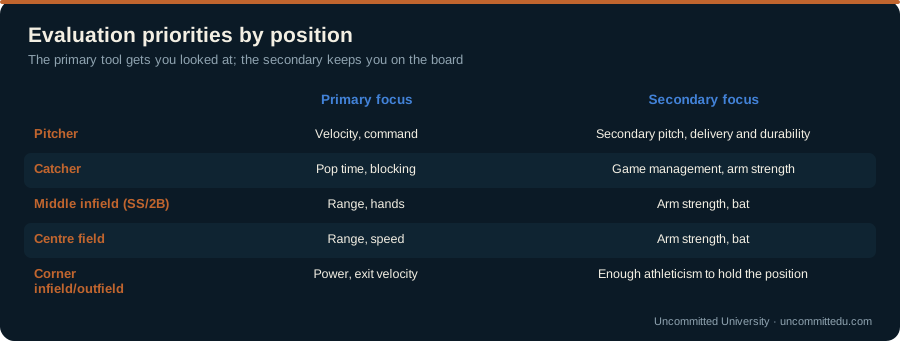
| Position | Primary evaluation focus | Secondary evaluation focus |
|---|---|---|
| Pitcher | Velocity, command | Secondary pitch, delivery/durability |
| Catcher | Pop time, blocking | Game management, arm strength |
| Middle infield (SS/2B) | Range, hands | Arm strength, bat |
| Center field | Range, speed | Arm strength, bat |
| Corner infield/outfield | Power, exit velocity | Enough athleticism to hold the position |
This is a general reference, not a rigid formula: a program short on power at the corners one recruiting cycle may prioritize differently than this table suggests.
Pitchers
Velocity gets the first look, but it’s not the deciding factor by itself.
- A repeatable, clean delivery: coaches worry about durability and consistency
- Command: the ability to locate, not just throw hard
- At least one usable secondary pitch
- How you perform against real competition, not just showcase readings
An 88 mph fastball with command and a real breaking ball often beats a 92 mph fastball with neither.
Go deeper: pitching velocity benchmarks by level and age.
Catchers
Offense matters less here than at almost any other position.
- Pop time: the time from catch to glove at second base
- Blocking ability and receiving skills
- Game management: how you handle a pitching staff
- Arm strength, separate from pop time itself
A catcher who controls a running game and blocks well gets real interest even with modest offensive numbers.
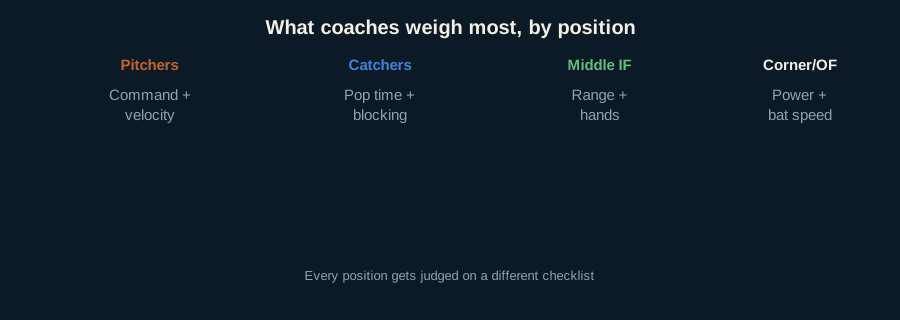
The diagram below summarises what D1 coaches look for at each position on the field.
Middle infielders
Range, hands, and arm strength come first. Offense is evaluated separately and more leniently than at the corner spots.
- Actual range side to side, not just a good glove
- Clean hands on the transfer
- Enough arm to make the throw from deep in the hole
Go deeper: 60-yard dash benchmarks by position for the speed context behind that range.
Center fielders
Center field gets evaluated a little differently than the other outfield spots. It’s a premium defensive position, so range and closing speed on the ball carry real weight even before offense enters the conversation.
- Range and route-running to both gaps
- Closing speed on balls hit over the head, not just straight-line 60 time
- Enough arm to hold runners and make the throw to third or home
- Offense as a bonus on top of a strong defensive profile, rather than the headline
A center fielder who can really go get it defensively often has more margin for error offensively than a corner outfielder, where the bat is the whole conversation.
Corner infielders and outfielders
These are largely offense-first evaluations.
- Exit velocity and bat speed
- In-game power projection, not just batting practice
- Enough athleticism to actually stay at the position
Go deeper: exit velocity benchmarks by level.
What D1 coaches look for by position: the numbers
The tools above have numbers attached, and a D1 staff reads them before it reads anything else: a fastball that sits 90 or better, an exit velocity in the upper 90s, a 60 under 6.9, a pop time under 2.0. Below those, the video has to be very good to earn a second look. They are reference ranges, the same ones quoted at every showcase, not a rule, and a program’s need at your position in your class moves every one of them.
| Position | The first number a D1 coach checks | The second one | What lets you fall short of it |
|---|---|---|---|
| Pitcher | Fastball sitting 90 to 94, touching higher | A breaking ball or changeup that gets swings, and strike percentage | Left-handed, projectable frame, or command good enough that 87 to 89 plays |
| Catcher | Pop time under 2.0 seconds in a game, 1.9 or better in a showcase | Receiving and blocking on video, arm strength around 78 mph or better | A bat with real power, since a catcher who hits is scarce |
| Shortstop and second base | Infield velocity in the mid 80s or better, 60 under 6.9 | Exit velocity 90 or better, hands and footwork on video | Elite defense at shortstop buys a lighter bat; a heavy bat moves you to second or third |
| Center field | 60 in the 6.5 to 6.8 range | Outfield velocity upper 80s, reads and routes on video | Very little. Speed is the job. |
| Third base and corner outfield | Exit velocity 95 or better | Arm strength upper 80s, enough range to hold the spot | Power that already shows in games, not only off a tee |
| First base and designated hitter | Exit velocity upper 90s and up, in-game power | Contact rate and approach against velocity | Nothing. The bat is the whole evaluation. |
Measure on the devices coaches trust, name the device and the date next to the number, and read your numbers against your age before you read them against this table: the pitching velocity, exit velocity and 60-yard dash benchmark pages break each one down by level and grad year.
Designated hitter and utility roles: what D1 coaches look for
Not every valuable roster piece has a clean defensive position attached.
- DH-only profiles face the highest offensive bar of any role, since there’s no defensive value to offset a quiet bat. Exit velocity, contact rate, and in-game power production carry the entire evaluation.
- True utility players (capable of multiple infield or outfield spots without a major drop-off) are undervalued by families but genuinely useful to coaches building a bench and managing a long conference schedule.
- A player still finding a defensive home should be honest about it on a recruiting profile rather than picking one position and hoping it sticks. Coaches would rather know upfront where the versatility and question marks are.
How video and in-person looks factor into what D1 coaches look for
None of these checklists get filled in from a stat sheet alone. Most D1 evaluations combine three sources:
- Game or showcase video, watched specifically for the position-relevant skills above: a coach evaluating a shortstop is watching footwork and transfer, not just measuring range from a highlight clip.
- In-person viewings, either at a school’s own camp or at a event the coaching staff attends, where live reads of the checklist items happen in real time.
- Third-party references (high school and travel coaches, private instructors, and other programs a staff trusts) often confirm or contradict what the video and in-person look suggested.
A player who understands which of these three a given program leans on most can prioritize accordingly. Some staffs recruit heavily off video, others almost exclusively off in-person camps.
Lead with what matters for your position
Build a profile that highlights the right metrics for where you actually play.
How evaluations run, and what D1 coaches look for at each stage
The flow below shows where what D1 coaches look for actually gets applied, and where most players get cut.
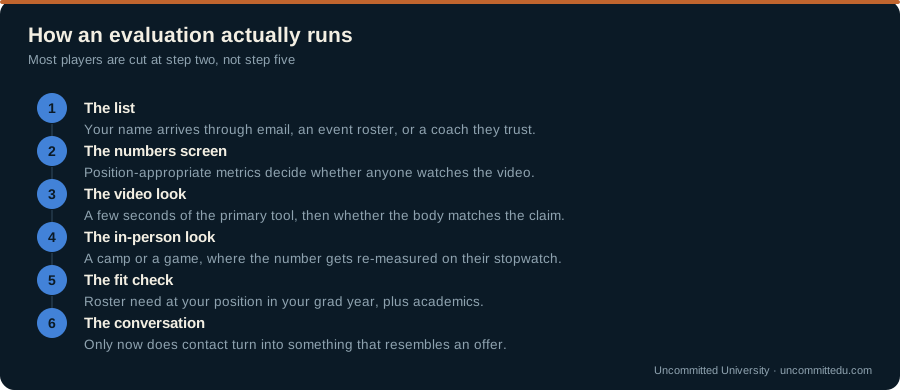
D1 staffs typically split evaluation duties by position group among assistant coaches, who report back to the head coach with recommendations. Understanding this helps explain why your first real relationship is often with an assistant, not the head coach directly: see the NCAA’s recruiting rules for exactly when that contact is allowed to start.
Building a relationship with the right assistant coach early is often more valuable than a single email to the head coach.
How what D1 coaches look for shifts at D2, NAIA, D3, and JUCO
The categories above hold at every level, but the balance shifts. At D2, NAIA, D3, and JUCO programs:
- Roster-building is often more forgiving of a raw tool that needs development, since staffs have more time and reps to work with a player who isn’t finished physically.
- Two-way value gets rewarded more often. A player who can both pitch and play a position, or catch and DH, is a more attractive roster piece outside of well-funded D1 programs with deep depth charts.
- Academic fit and cost of attendance frequently factor into a coach’s evaluation as much as the on-field checklist, since scholarship dollars are more limited.
The underlying skills a coach values by position don’t change level to level: what changes is how much projection and versatility get weighted against a finished tool.
Common mistakes players make when trying to fit the checklist
Trying to fit what D1 coaches look for goes wrong in the predictable ways listed below.
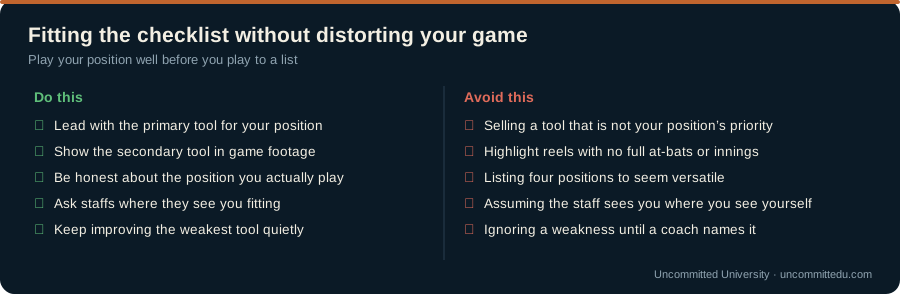
- Leading with the wrong metric for the position. A corner outfielder opening a recruiting email with a 60 time instead of exit velocity is leading with the wrong number for the job.
- Ignoring the position’s defensive bar entirely. Even at power positions, a player who can’t stay on the field defensively becomes a DH-only profile, which narrows the list of programs that will look.
- Assuming every program weighs the checklist identically. Roster need varies year to year: a team that just landed a great shortstop class may value a different skill set from a middle infielder the following year.
- Undervaluing makeup and coachability. Two players with the same checklist numbers can get very different offers based on how they’re described by high school and travel coaches who’ve worked with them directly.
Questions to ask about what D1 coaches look for
- What does the current roster look like at my position, and what’s the timeline for the next class?
- What specific metrics or tools matter most to your staff for this position?
- Is there flexibility for a player who’s strong in one area of the checklist but still developing in another?
- How does your staff weigh academic fit alongside the athletic evaluation?
How physical projection factors into what D1 coaches look for
Coaches don’t just evaluate what a player can do today. They project what a frame is likely to become. That projection is read differently by position:
- A lean, athletic middle infielder with room to add strength is often viewed as having more offensive upside ahead, since range and hands rarely disappear as a player fills out.
- A physically maxed-out corner power bat with a fully mature frame has already shown most of what a coach can expect to see, which raises the bar on the current numbers alone.
- A projectable pitcher’s frame (height, arm action, present strength relative to age) often matters as much to a college pitching coach as the current radar reading, since it hints at whether the current velocity is a ceiling or a floor.
This is one reason two players with identical current numbers can get very different levels of interest: one is viewed as a finished product, the other as a player still climbing toward one.
What’s true across every position
- Coaches recruit trajectory, not just a snapshot
- Academics matter: a strong student opens more doors, especially outside D1
- Makeup and work ethic show up in how you handle adversity in games, not just tryouts
What D1 coaches look for beyond the tools
Ask a Division I staff to describe a recruit and the measurables run out after about thirty seconds. The rest of what D1 coaches look for is behaviour, and they evaluate it constantly.
What you do between pitches. Where your eyes go after an error. Whether you are still moving on defence when the game is out of hand. Coaches watch the innings you are not involved in, because that is where habits show.
How you treat the people who cannot help you. Teammates on the bench, the opposing catcher, the umpire, your own parents in the parking lot afterwards. Staffs ask about this deliberately.
How you take coaching in real time. A player who gets an adjustment between innings and applies it in the next at-bat is showing the single most valuable trait on this list: coachability is much of what D1 coaches look for, because they intend to change you.
Then there is the academic profile. At many programs it works as a tiebreaker: between two similar players, the one whose grades open up institutional aid or who is not an admissions risk is simply the cheaper, safer recruit.
Durability counts too. Availability is a skill, and a long injury history changes the conversation whatever the tools say.
And they look at your family. Fairly or not, a parent who coaches from the fence or emails the staff about playing time is a factor in what D1 coaches look for, because staffs have all managed that situation before.
None of this replaces the tools. You still have to be able to play at the level. But among the many players who can, these are the things that decide which ones get the call.
Frequently asked questions about what D1 coaches look for
What do college baseball coaches look for in pitchers? In order: velocity that sits in the band for their level, then strikes, then a second pitch that gets swings, then a delivery that looks like it will hold up. At Division I the band starts around 90. Below it, an 87 to 89 fastball with command and a real breaking ball recruits ahead of a 92 with neither, and a left-hander gets a little more room at every level. Coaches also watch how the velocity holds from the first inning to the fifth, which a showcase reading never shows.
What do college coaches look for in a catcher? Pop time first, under 2.0 seconds in a game at Division I, then receiving and blocking on video, then arm strength on its own, then how the catcher runs a pitching staff. The bat matters less at catcher than at any other position, and a catcher who controls the running game and blocks well gets real interest with modest offensive numbers. A catcher who also hits for power is the scarcest player in a recruiting class.
Do college baseball coaches look at high school stats? Barely. A batting average or an ERA against high school pitching tells a coach almost nothing about the level of competition behind it. What they read instead is measurables with a device and a date, video against good travel-ball competition, and for pitchers the strike percentage and strikeout-to-walk ratio, which travel better than an ERA. Put the stats on the profile if you like, but lead with the numbers a radar gun produced.
Does a player have to be great at everything on the checklist to get recruited? No. Coaches look for a clear strength that fits a roster need, with the rest of the profile solid enough not to be a liability. Few recruits check every box.
Do coaches value two-way players differently than specialists? Often, yes, especially outside deep-roster D1 programs. A two-way player adds roster flexibility, though most D1 programs eventually project a player into one primary role.
How early do D1 coaches start building their position checklists for a class? Evaluation and relationship-building often start well before official contact is permitted, through camps, showcases, and film, see the NCAA recruiting rules linked above for exactly when direct contact opens up.
Is arm strength evaluated the same way for every infield position? No. Shortstop and third base demand the most arm strength given the length of the throw, while second base and first base can succeed with a shorter, quicker release even without elite arm strength.
Should a player try to play multiple positions to appeal to more programs? Versatility can help, especially below D1, but it shouldn’t come at the cost of mastering a primary position. Coaches still want to know what a player’s best position actually is.
What role does a recruiting profile or video play compared to an in-person camp? Both matter, but their weight varies by program. Some staffs do most of their initial evaluation off video and stats before ever inviting a player to campus; others rely almost entirely on in-person camps to make a first impression. Sending a strong, well-organized video profile rarely hurts, regardless of which a program favors.
The short version: what D1 coaches look for is a sequence of filters, not a wish list. Lead with the primary tool for your position, prove the secondary one in uncut game footage, and be honest about where you actually play. If you are unsure how your tools map to what D1 coaches look for at your spot, measure first and ask a staff directly rather than guessing.
The short version
What D1 coaches look for is a player who can help at the level and will not cost them anything off the field. Tools get you evaluated. Makeup, grades, durability and coachability decide it.
Uncommitted University tells players to assume the evaluation starts when they get out of the car, because for most staffs it does.
It is worth being realistic about volume. A Division I staff may track hundreds of players for a handful of spots, so a no is very often about roster need at your position rather than a judgement on you.
That is also why what D1 coaches look for changes year to year. A program losing three left-handed pitchers recruits differently from one returning all of them, and none of that is visible from outside.
Your next step
Check your own numbers against the ranges in exit velocity and pitching velocity benchmarks, then build a profile that leads with your strongest, most position-relevant metric.
Written by Wayne Keeton, founder of Uncommitted University.