

Does JUCO Count Towards NCAA Eligibility?
JUCO eligibility clock rules trip up players who assume NCAA rules simply carry over. They don’t. The NJCAA runs its own separate system, and since 2026 the NCAA runs a second clock alongside it that starts the moment you enrol full time at a junior college.
This explains exactly how the JUCO eligibility clock works. For the full picture, see the NCAA baseball eligibility guide.
Quick answer: JUCO eligibility runs under the NJCAA, with its own eligibility clock, academic standards and amateurism rules, separate from the NCAA, and not changed by the NCAA’s 2026 rule change. What did change is on the NCAA side: full-time enrollment at a junior college now starts the NCAA five-year period of eligibility at Divisions I and II, and that period does not pause if you sit a year out.
Key takeaways
- The JUCO eligibility clock is two seasons of competition, generally usable within three years.
- The JUCO eligibility clock starts at first full-time enrolment at any college, not when you first play.
- A brief full-time stint at a four-year school can start the JUCO eligibility clock earlier than expected.
- The NJCAA administers the JUCO eligibility clock entirely; NCAA rules do not carry across.
- Confirm the JUCO eligibility clock with compliance rather than assuming when it started.
- Two clocks now run at once: the NJCAA’s, and the NCAA five-year period that your full-time JUCO enrollment starts.
- The NCAA age-based model did not touch NJCAA rules. It changed what your JUCO years cost you at Division I and Division II.
JUCO eligibility clock rules: how the NJCAA system works
JUCO players generally have a set number of seasons of competition to use, tied to their own enrollment timeline at the two-year school. The JUCO eligibility clock and its rules are administered entirely by the NJCAA, not the NCAA.
Players moving between JUCO and a four-year school need to confirm exactly how their JUCO seasons count toward their remaining eligibility at the next level.
How the JUCO eligibility clock breaks down, semester by semester
The timeline below breaks the JUCO eligibility clock down term by term.
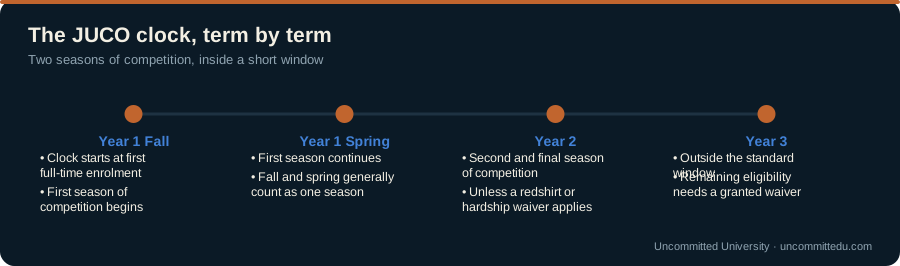
The JUCO eligibility clock is generally described as two seasons of competition, usable within three years of first full-time enrollment. Here’s roughly how that plays out for a typical two-year JUCO path.
| Term | Typical status |
|---|---|
| Year 1, Fall | Clock starts at first full-time enrollment; first season of competition begins |
| Year 1, Spring | First season of competition continues (fall/spring generally counted as one season in JUCO baseball) |
| Year 2, Fall/Spring | Second and final season of competition, unless a redshirt or hardship waiver applies |
| Year 3 | Outside the standard window for using remaining eligibility, unless a waiver was granted |
Exact term structure varies by conference and by how a redshirt or hardship waiver is applied. Confirm your own specific timeline directly with the program’s compliance staff rather than relying on a general outline.
Does JUCO count towards NCAA eligibility in 2026? The short answer
Yes, as time. No, as seasons. Under the age-based model Divisions I and II adopted for 2026-27, your first full-time semester at a junior college starts the NCAA five-year period, and that period runs whether you play or sit. What it no longer does is spend a season: seasons of competition were eliminated at Divisions I and II, so a JUCO year is no longer one of four. The NJCAA side is unchanged, two seasons per sport under the NJCAA’s own rules.
The headlines saying “JUCO no longer counts” come from the court cases. A December 2024 injunction for Vanderbilt quarterback Diego Pavia led to an NCAA blanket waiver for 2025-26 only. A class-wide injunction in Wisne v. NCAA on July 31, 2026 was paused by the Tenth Circuit on August 21, 2026, and state cases continue. None of that changes the rule below for a player enrolling now. Your compliance office reads your file; this page reads the rule.
How many years of eligibility after JUCO? Three worked examples
| Path | Old NCAA rules (through 2025-26) | Age-based model (2026-27 on) |
|---|---|---|
| One JUCO season, then D1 | Three of four seasons left, inside a five-year clock that started at JUCO enrollment | About four years of the five-year period left, no season count, every year usable |
| Two JUCO seasons, then D1 | Two seasons left | About three years of the period left |
| Two JUCO years, one a redshirt, then D1 | Three seasons left, if the redshirt was documented | About three years left. The redshirt saved nothing on the NCAA side because the period ran anyway |
“About” because the period is measured from the start of the academic year, and a player who turned 19 before enrolling started it earlier than his first JUCO semester. The eligibility calculator gives the exact expiry date from your birthday and enrollment history, and the NCAA age limit guide explains the 19th birthday trigger.
Does JUCO count towards NCAA eligibility?
Yes, and since 2026 the way it counts has changed. Full-time enrollment at a junior college starts the NCAA five-year period of eligibility at Divisions I and II, and that period then runs continuously whether you compete or not.
The NCAA names two-year colleges explicitly. The period begins at the earlier of two events: full-time enrollment at any college or university, domestic or international, including junior colleges; or the start of the regular academic year immediately after your 19th birthday.
What JUCO does not do is reset anything. That was true before and it is more true now.
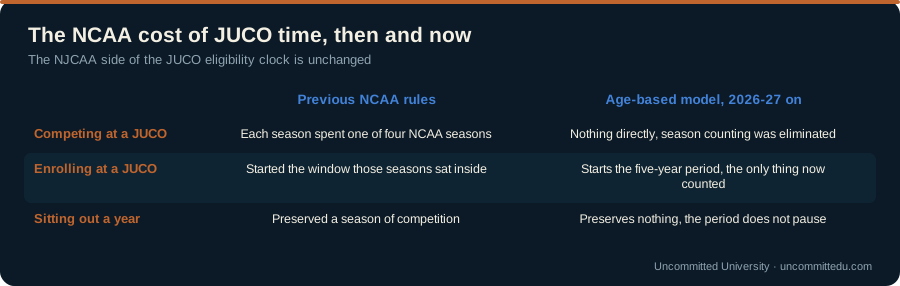
Here is the old answer and the new one side by side, because both are live at the same time.
| The question | Previous NCAA rules | Age-based model, 2026-27 on |
|---|---|---|
| What competing at a JUCO costs you | Each JUCO season spent one of your four NCAA seasons of competition | Nothing directly | seasons of competition were eliminated at Divisions I and II |
| What enrolling at a JUCO costs you | It started the window you had to use those seasons inside | It starts the five-year period, which is now the only thing being counted |
| Sitting out a year | Preserved a season of competition | Preserves nothing at the NCAA level; the period does not pause for sitting out or transferring |
| Who each column applies to | Athletes still assessed under the previous rules in the transition groups | Anyone first enrolling full time in fall 2027 or later; earlier enrollees get whichever is most beneficial |
The old arithmetic has not disappeared, it has narrowed. Two JUCO seasons leaving two NCAA seasons is still the right answer for athletes assessed under the previous rules, and current student-athletes with eligibility remaining after 2025-26, plus prospects first enrolling full time in 2026-27, are reviewed under the previous rules or the age-based rule, whichever is most beneficial.
- The JUCO eligibility clock is not the NCAA clock. They start at the same event (first full-time collegiate enrollment) but the NJCAA runs its own two-season system while the NCAA now runs a five-year calendar. Both are ticking, and they measure different things.
- Sitting out no longer buys NCAA time. The five-year period does not pause because you do not compete, transfer, sit out, change teams or take time away from participation.
- Academic credit is still a separate question. Credits that do not transfer cost you progress-toward-degree standing even when your eligibility calendar is fine.
- Redshirt years follow the host rulebook. A redshirt-style year at a JUCO is governed by NJCAA rules and is unaffected by any of this. What changed is that it no longer has an NCAA counterpart to land on, because athletics redshirt rules were eliminated at Divisions I and II.
Do one thing before you enroll anywhere: ask the compliance office at your target four-year school, in writing, which rulebook they expect to assess you under and what date your NCAA five-year period starts. Both answers are dates and numbers, and they should match what the JUCO tells you.
Why the JUCO eligibility clock matters for transfers
- Your NCAA five-year period is already running from your first full-time term at the junior college, so transferring starts nothing fresh at Division I or Division II.
- Seasons used at JUCO still count for the NAIA, and for NCAA athletes being assessed under the previous rules in the transition groups.
- Redshirt-style provisions exist at JUCO and follow NJCAA rules. The NCAA no longer has an equivalent at Divisions I and II.
- Academic transfer credit is evaluated separately from athletic eligibility, both need confirming.
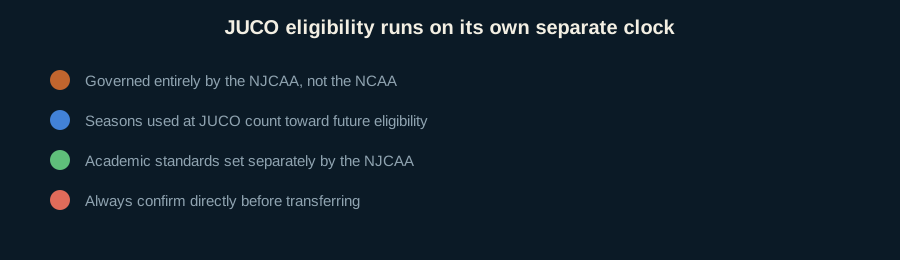
The diagram below shows how the JUCO eligibility clock runs from first enrolment onward.
What the NCAA age-based model changed for JUCO players
It changed the NCAA side only. The NJCAA writes its own eligibility rules and the JUCO eligibility clock described on this page is not affected by NCAA legislation.
What the Division I and Division II age-based model did is replace seasons of competition with a five-year period of eligibility, effective immediately for 2026-27. Division I adopted it in June 2026; the Division II Executive Board adopted matching emergency legislation in August 2026.
Four consequences land specifically on junior college players:
- Your NCAA period starts at the JUCO, not at the four-year school. Full-time enrollment at a two-year college is named in the rule as a trigger.
- Two JUCO years are two of the five. Not two of four seasons: two years of a calendar that does not stop.
- Age can start it before you enrol anywhere. The period also begins at the start of the regular academic year immediately after your 19th birthday, if you turn 19 before Sept. 1. Turn 19 on or after Sept. 1 and it begins the following academic year instead, unless you enrol full time sooner. The NCAA age limit guide works through both cases.
- Three exceptions can pause it, and none of them is a JUCO decision. Pregnancy, active-duty military service and official religious missions, all administered by the NCAA Eligibility Center.
Two guardrails on the scope of this, because they get lost quickly. Division III is not covered by the age-based legislation. The NAIA and the NJCAA are not covered either: they are separate associations that write their own rules, and the JUCO eligibility clock on this page still runs exactly as the NJCAA defines it.
And being inside the five years does not by itself make you eligible. Academic and other athletics rules still apply, so an athlete can be inside the NCAA period and ineligible for other reasons.
Academic standards at JUCO
JUCO academic eligibility standards are set by the NJCAA and typically differ from NCAA core-course requirements. Many players use JUCO specifically because its academic entry bar is more accessible, with a real path to raise standing before transferring.
What counts as “enrollment” for starting the clock
The JUCO eligibility clock generally starts at first full-time enrollment at any collegiate institution, not necessarily the JUCO program you end up competing for.
A few situations that catch players off guard:
- Enrolling full-time at a four-year school, even briefly, before transferring to a JUCO can start the JUCO eligibility clock earlier than expected
- Part-time enrollment generally doesn’t start the clock the same way full-time enrollment does, but the exact threshold is defined by the NJCAA, not assumed
- A gap year or delayed enrollment can affect the three-year window differently depending on the specific circumstances
Confirm your own enrollment history against the JUCO eligibility clock directly with compliance staff. Don’t assume the clock started only when you first suited up for a game.
Redshirt and hardship waivers and the JUCO eligibility clock
JUCO programs can use redshirt-style and hardship waiver provisions, governed entirely by NJCAA rules and untouched by the NCAA’s 2026 change. They used to have NCAA counterparts. Those counterparts (athletics redshirt rules and medical hardship waivers) were eliminated at Divisions I and II for 2026-27, so the NJCAA versions now stand alone.
- Standard redshirt-style year: A player practices and develops without appearing in official competition, preserving a season for later use, under NJCAA-specific conditions.
- Hardship waiver: Available in some cases following a season-ending injury or documented hardship, following its own approval process through the NJCAA.
Because the JUCO eligibility window is shorter than the NCAA’s, using a redshirt year carries more weight, there’s less margin to make up lost time. Confirm directly with your program whether a redshirt year makes sense given your specific development needs and remaining window.
One factor to weigh that did not exist before 2026: a redshirt year at a junior college preserves an NJCAA season, but it spends a year of your NCAA five-year period regardless. The JUCO eligibility clock and the NCAA clock will disagree about what that year cost you, and both are right.
How the JUCO eligibility clock compares to NCAA and NAIA
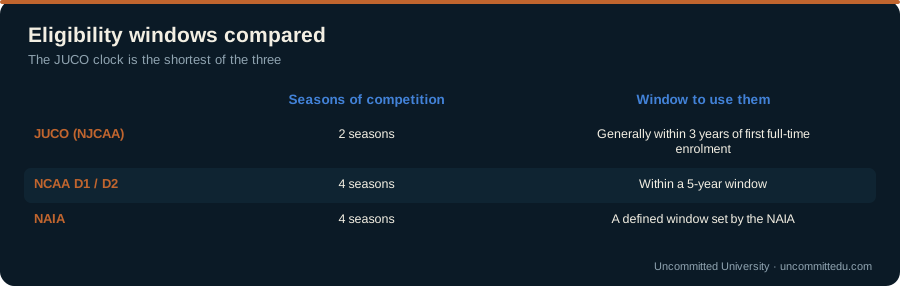
The table below sets the JUCO eligibility clock against the NCAA and NAIA windows.
| Level | Seasons of competition | Window to use them |
|---|---|---|
| JUCO (NJCAA) | 2 seasons | Generally within 3 years of first full-time enrollment |
| NCAA D1 / D2 | No season limit | seasons of competition eliminated for 2026-27 | A five-year period starting at first full-time enrollment anywhere, or the academic year after a 19th birthday |
| NAIA | 4 seasons | Defined window set by the NAIA |
The shorter JUCO window is exactly why tracking seasons carefully matters so much for players planning to transfer to a four-year program afterward.
Read the rows carefully, because they no longer measure the same thing. The JUCO eligibility clock counts seasons. The NCAA now counts only years. The NAIA runs its own system and is not affected by the NCAA change. Our guide to the NCAA eligibility clock covers the middle row in detail, and the D2 eligibility rules guide covers how Division II adopted it.
Confirm your eligibility before you commit
Check your seasons and standing under JUCO, NCAA, or NAIA rules.
Steps before enrolling: protecting your JUCO eligibility clock
- Confirm the specific eligibility rules with the JUCO’s own compliance staff
- Ask directly how seasons used at JUCO will count if you plan to transfer later
- Keep detailed academic and athletic records throughout your time there
- Reconfirm eligibility with any four-year program before enrolling there too
Common misconceptions about the JUCO eligibility clock
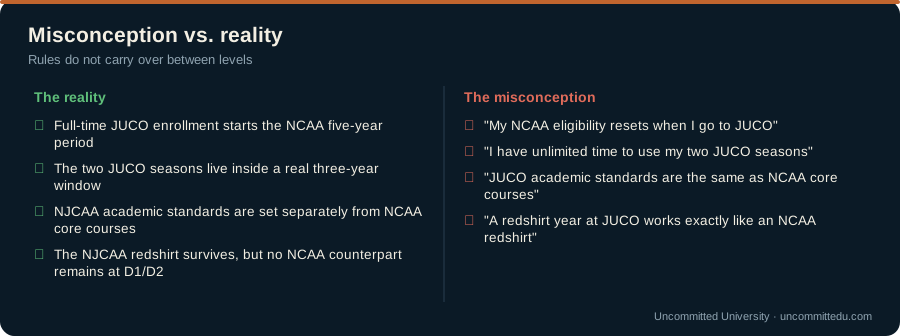
- “My NCAA eligibility resets when I go to JUCO.” It doesn’t, and under the age-based model it is worse than that. Full-time JUCO enrollment starts the NCAA five-year period, so a junior college is where the clock begins rather than a pause before it.
- “I have unlimited time to use my two JUCO seasons.” The three-year window is a real limit, not a suggestion.
- “JUCO academic standards are the same as NCAA core courses.” They’re set separately by the NJCAA and the enrolling college.
- “A redshirt year at JUCO works exactly like an NCAA redshirt.” There is no NCAA redshirt to compare it to any more at Divisions I and II. The NJCAA provision is its own and survives the NCAA change untouched.
Most of these misconceptions come from assuming rules carry over between levels. They don’t. Confirm everything directly rather than assuming.
How four-year coaches evaluate JUCO transfers
Coaches at four-year programs look at more than raw stats when evaluating a JUCO transfer‘s eligibility picture.
- How many seasons of competition are actually left, not just how many years of school remain
- Whether academic credits will transfer as core-course equivalent toward NCAA or NAIA certification
- Whether a redshirt year was used at JUCO, and why
Coming to a conversation with a four-year coach already knowing these answers (instead of finding out together) makes a transfer conversation move much faster.
What to do if you’re not sure your clock has already started
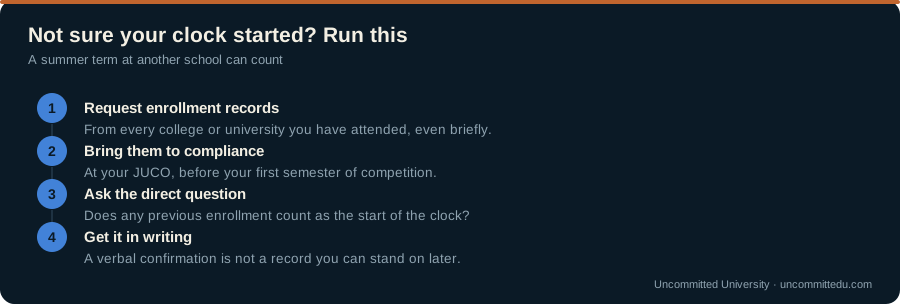
Some players arrive at a JUCO without a clear sense of whether a previous enrollment (a summer term, a brief stint at another school) already started their eligibility clock.
- Request enrollment records from every college or university you’ve attended, even briefly
- Bring these records to your JUCO’s compliance office before your first semester of competition
- Ask directly whether any previous enrollment counts as the start of your clock
- Get the answer in writing, not just a verbal confirmation
This is a five-minute conversation that can prevent a much bigger problem discovered a year or two later.
International student-athletes at JUCO
International players face additional steps in the JUCO eligibility process, on top of the standard clock and academic requirements.
Transcript evaluation for international coursework generally takes longer, and visa and enrollment status can interact with when the eligibility clock is considered to start. Confirm both directly with the JUCO’s international student office and its athletic compliance staff, the two offices don’t always coordinate automatically.
Confirming your JUCO eligibility clock mid-way through your JUCO career
Don’t wait until your final semester to confirm exactly where you stand. A mid-point check gives you time to adjust if something’s off.
- Request a written eligibility status update from your compliance office each academic year, not just when a question comes up
- Confirm how many seasons of competition you’ve actually used, not just how many years you’ve been enrolled
- Ask specifically whether your remaining eligibility window still lines up with your transfer timeline
A mid-point check costs almost nothing and can catch a clock discrepancy while there’s still time to address it.
This is especially worth doing before your final JUCO semester, when transfer decisions and eligibility timing tend to collide with the least amount of room to fix a surprise.
Common JUCO eligibility clock mistakes
The checklist below covers where the JUCO eligibility clock catches players out.
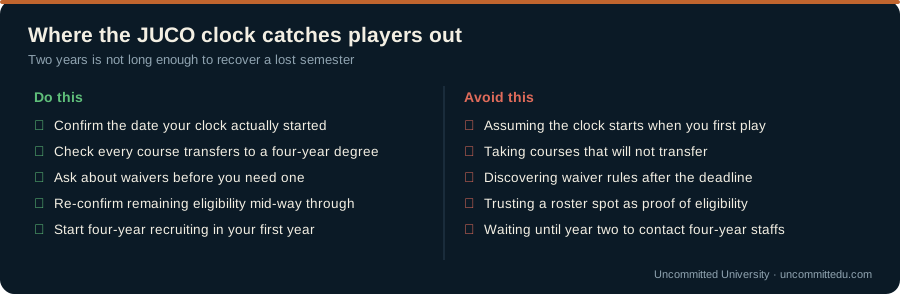
- Assuming NCAA rules apply. They don’t. The NJCAA runs a fully separate system.
- Not tracking seasons used carefully. This matters enormously once you transfer.
- Skipping confirmation with a new program’s compliance office before enrolling or competing.
Questions to ask about the JUCO eligibility clock before choosing a program
- How does this program’s eligibility clock actually work for my situation?
- What’s the program’s track record of players transferring to four-year schools?
- Will my credits transfer as core academic credit at a four-year program?
- What does a realistic two-year plan look like, athletically and academically?
A JUCO program with a strong transfer track record is worth more than one with flashier facilities and no clear path forward.
Building your JUCO-to-four-year recruiting timeline
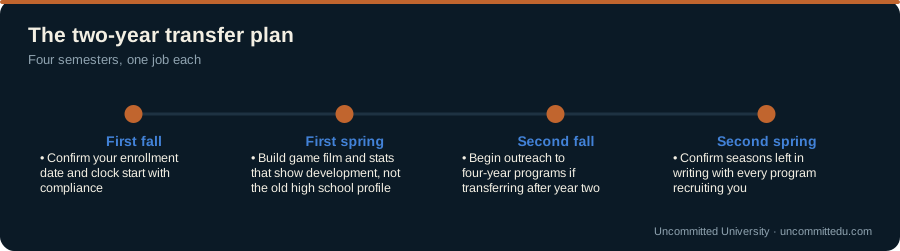
Players planning to use JUCO as a stepping stone to a four-year program benefit from mapping the transfer timing out early, not waiting until their second JUCO season to think about it.
- First fall: Confirm your enrollment date and clock start directly with your JUCO’s compliance office.
- First spring: Start building game film and stats that reflect your development, not just your recruiting profile from high school.
- Second fall: Begin outreach to four-year programs if transferring after your sophomore JUCO year is the plan.
- Second spring: Confirm exactly how many seasons of eligibility you’ll have left with any program seriously recruiting you.
A JUCO path works best when the transfer timing is planned, not improvised in the final semester.
JUCO scholarships and eligibility status
Scholarship money at the JUCO level isn’t directly tied to eligibility status the way some families assume: a redshirt season or an eligibility question doesn’t automatically threaten aid.
That said, JUCO scholarship structures vary widely by conference and by program, more so than at the NCAA level. Confirm directly with your specific program how aid is structured year to year, and whether anything about your eligibility timeline affects it.
What actually starts and stops the JUCO eligibility clock
The NJCAA does not run the same system as the NCAA, and importing NCAA assumptions is where families go wrong.
The core of it: you get two seasons of competition at the junior college level. That is the number that matters to the NJCAA, and the JUCO eligibility clock is built around seasons used rather than a calendar.
The calendar has not gone away. It has moved to the other rulebook. The NCAA five-year period is ticking in the background from your first full-time junior college term, and nothing you do at the JUCO pauses it.
A season is used when you compete, not when you enrol. Practising, travelling and being on the roster do not spend one.
That makes a redshirt year at junior college conceptually simple: you were there, you did not play, the season is intact. But it is a bigger decision than at a four-year school, because you only have two.
Spending one of two seasons is spending half your junior college eligibility. At a four-year school a redshirt costs a quarter of yours.
Where the JUCO eligibility clock gets genuinely complicated is when a player has already attended a four-year institution. Time and competition at an NCAA or NAIA school does not simply vanish when you arrive at a junior college.
If you are moving down from a four-year programme, get your specific situation confirmed in writing by the compliance officer at the junior college before you enrol. This is not a question to settle with a coach over the phone.
The other half of the picture is what happens on the way out. Transferring from a junior college to an NCAA school brings in the NCAA’s own transfer requirements, which turn on credits completed, degree progress and the courses actually transferring.
The JUCO eligibility clock and your academic progress are the same conversation. A player with two seasons remaining and credits that will not transfer is not, practically speaking, eligible to go anywhere.
So plan the degree from the first semester. Meet the academic adviser and the compliance officer in your first month, and ask specifically which of your courses transfer to the kind of school you intend to attend next.
Frequently asked questions about the JUCO eligibility clock
Can you redshirt at a JUCO? Yes, in effect. The NJCAA charges a season of participation only when you appear in a regularly scheduled contest, so a year on the roster without playing keeps both NJCAA seasons. It does not stop the NCAA five-year period, which runs from your first full-time semester regardless.
What are the JUCO to JUCO transfer rules? Your NJCAA seasons travel with you: two per sport in total, however many colleges you attend, and the receiving college processes the transfer under NJCAA rules. Your NCAA five-year period keeps running through the move. Confirm your remaining NJCAA seasons with the new school’s athletic director before you enroll.
Is there an NJCAA age limit? No. The NJCAA has no maximum age. Eligibility is two seasons per sport plus academic standing. The age that matters is the NCAA’s: the academic year after your 19th birthday starts the Division I and II five-year period whether you are at a JUCO or not.
What GPA do you need for JUCO eligibility? To enroll and play, a high school diploma or equivalent. To stay eligible, the NJCAA requires full-time enrollment, 12 credit hours, and a minimum GPA that steps up after your first full-time term (1.75, then 2.00 cumulative). The exact thresholds are in the current NJCAA eligibility pamphlet, and your four-year target will want a transferable 2.5 or better regardless.
Does JUCO count towards NCAA eligibility if you never play a game? Yes. Full-time enrollment starts the NCAA five-year period even if you never appear in a contest, and under the age-based model there is no season of competition left to preserve at Divisions I and II. Not playing preserves an NJCAA season. It preserves nothing on the NCAA calendar.
Do JUCO seasons count towards NAIA eligibility too? Yes, though the NAIA counts them under its own system: terms of attendance rather than a five-year clock. Confirm the number with the NAIA program directly rather than assuming NCAA arithmetic carries across.
How many seasons of eligibility does a JUCO player get? Generally two seasons of competition at the JUCO level, under NJCAA rules.
How long is the window to use JUCO eligibility? Generally three years from first full-time enrollment, though specifics can vary by circumstance. Confirm directly with the NJCAA.
Do JUCO seasons count against NCAA eligibility after transferring? Under the previous rules yes, and that still applies to athletes in the transition groups and at the NAIA. Under the age-based model at Divisions I and II, seasons of competition were eliminated, so what carries across is the calendar rather than a season count.
Can a JUCO player redshirt? Yes, under NJCAA-specific redshirt and hardship waiver provisions. Those are unaffected by the NCAA’s 2026 change, which eliminated athletics redshirt rules and medical hardship waivers at Divisions I and II only.
Does part-time enrollment start the JUCO clock? Generally not in the same way full-time enrollment does, but the exact threshold is defined by the NJCAA. Don’t assume without confirming.
What happens if I enrolled full-time at a four-year school before JUCO? The eligibility clock may have already started at that point. Confirm your enrollment history directly with compliance staff before assuming your JUCO clock starts fresh.
The short version: the JUCO eligibility clock is short and it does not wait. Confirm the exact date it started, keep every course on a transferable degree track, and begin four-year recruiting in your first year rather than your second. Players who lose the JUCO eligibility clock almost always lose it to paperwork, not to performance.
Two clocks running at once also means one can expire while the other still has room. Our extra eligibility guide covers exactly what that leaves open at JUCO, the NAIA and D3.
The short version
The JUCO eligibility clock gives you two seasons of competition, and a season is spent only by competing. Enrolling, practising and redshirting do not use one at the NJCAA level, and with only two, a redshirt year costs proportionally twice what it does at a four-year school.
They do all spend NCAA calendar time, though. Your five-year period at Divisions I and II started the day you first enrolled full time, and the JUCO eligibility clock has no power to stop it.
If you attended a four-year school first, confirm your standing with the junior college compliance officer in writing before enrolling.
Uncommitted University tells JUCO players to treat credit transfer as part of the JUCO eligibility clock, because seasons remaining are worthless without credits that move with you.
Keep your own written record of seasons used, terms enrolled and credits earned each semester. Compliance offices are generally accurate, but you are the only person who follows your file from one institution to the next.
That record costs you ten minutes a term and it is the single best protection against a JUCO eligibility clock dispute at the exact moment you can least afford one.
Your next step
Two more pieces if a four-year NCAA program is the destination: how the NCAA eligibility clock starts and runs, and whether the NCAA age limit trigger applies to your birthday.
See how JUCO fits into your overall path in the JUCO baseball explained guide, and check the D1 vs. D2 vs. D3 vs. NAIA vs. JUCO breakdown for the full level comparison.
Written by Wayne Keeton, founder of Uncommitted University.