

Grad Transfer Rules for Baseball (2026)
Grad transfer rules for baseball let a player with a completed degree and remaining eligibility move to a new program, often with immediate eligibility to compete.
This explains exactly how it works. For the full picture, see the baseball transfer portal guide.
Quick answer: A grad transfer is a player who’s completed their undergraduate degree, has remaining NCAA eligibility, and transfers to pursue a graduate program, often with immediate eligibility to compete, unlike some undergraduate transfer situations.
Key takeaways
- Grad transfer rules require a completed bachelor’s degree and remaining eligibility.
- Grad transfer rules often allow immediate eligibility to compete at the new school.
- Programs use grad transfer rules to fill one specific hole for one season.
- Graduate admission is a hard gate, and it moves slower than recruiting does.
- Grad transfer rules windows close fast, and the market is small.
Who qualifies under grad transfer rules
Generally, a player needs to have completed their bachelor’s degree and still have eligibility remaining under NCAA rules. What counts as remaining eligibility changed in 2026, and that is the first thing to establish about yourself.
NCAA Divisions I and II moved to an age-based eligibility model: Division I in June 2026, Division II in August. It replaced seasons of competition with a single five-year period, and eliminated athletics redshirt rules and medical hardship waivers with it. Division III, the NAIA and the NJCAA were not part of the change.
So there are now two different routes into eligibility under grad transfer rules, and which one applies to you depends on when you first enrolled full time.
- If you first enrolled before 2026-27, you may still be on the old arithmetic. A true-freshman redshirt, a medical redshirt or a hardship waiver really did bank a season, and current student-athletes are reviewed under the previous rules or the age-based rule, whichever is more beneficial. Campus compliance staff run that comparison.
- If you first enrol full time in fall 2027 or later, only the age-based rule applies. There is no season to bank and no redshirt to spend. What creates a graduate transfer is finishing the degree with calendar time still on the five-year clock.
- An accelerated degree does both jobs. Finishing a bachelor’s degree in three or three and a half years through summer courses or AP and dual-credit hours leaves time on the clock under either set of rules, which is why it is now the most reliable route in.
- Prospects first enrolling in 2026-27 get the choice. The Eligibility Center compares the old rules and the age-based rule and applies whichever is more beneficial. Choosing to stay on the old rules costs you the eliminated waiver categories permanently.
The common thread: the degree has to actually be finished, not just close. A program recruiting a grad transfer will confirm degree completion directly with the registrar, not just take a player’s word for it.
Why grad transfer rules make these players attractive
- Immediate impact. A grad transfer is typically an experienced player who can contribute right away.
- Filling a specific need. Programs often target grad transfers at positions with a graduating gap.
- Lower long-term roster risk. A one-year need filled by an experienced player, without a multi-year commitment.
Grad transfer rules vs. other transfer paths
The table below sets grad transfer rules beside the other two transfer routes.
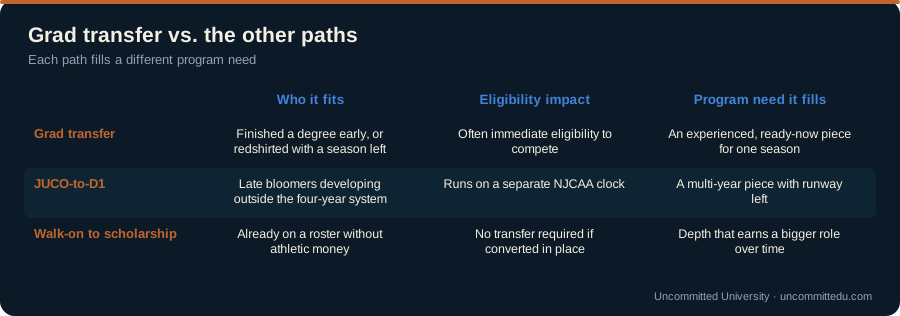
A grad transfer solves a different problem than a JUCO-to-D1 move or a walk-on conversion. Here’s how the three compare.
| Path | Who it fits | Eligibility impact | Typical program need it fills |
|---|---|---|---|
| Grad transfer | Players who finished a degree early, or banked a season under the pre-2026 rules, with time left on the clock | Often immediate eligibility to compete | An experienced, ready-now piece for one season |
| JUCO-to-D1 | Late bloomers developing outside the four-year system | Runs on a separate NJCAA eligibility clock | A multi-year roster piece with development runway left |
| Walk-on-to-scholarship | Players already on a roster without an athletic scholarship | No transfer required if converted in place | Depth that earns a bigger role over time |
Programs often run all three strategies at once: developing younger JUCO and walk-on talent while using grad transfers to patch a specific, immediate gap.
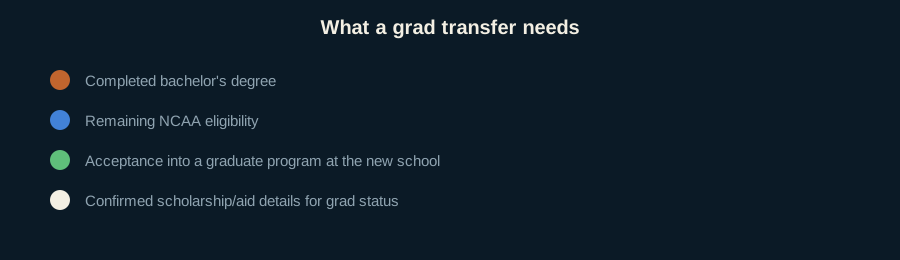
The overview below summarises how grad transfer rules work in college baseball.
Grad transfer rules at Division III, the NAIA and JUCO
Division III and the NAIA both let a player with a finished degree keep competing, and neither uses the NCAA Division I five-year period. The junior college route is built for players who have not finished a degree. The three read very differently, so if your search includes a D3 or NAIA program, ask that school’s compliance office or registrar directly rather than applying anything from the Division I section above.
| Level | Can a graduate compete? | What governs it |
|---|---|---|
| NCAA Division I and II | Yes, with time left on the five-year period and full-time graduate enrollment | The age-based model from 2026. Degree first, admitted to a real graduate or second-degree program, academically eligible on the way out. |
| NCAA Division III | Yes. D3 does not treat a graduate student as a transfer at all | 10 semesters or 15 quarters of full-time enrollment and four seasons of participation, counted from your first full-time term anywhere. Must be enrolled in a full-time graduate program as the school defines it. No residence year, no transfer exception to meet. |
| NAIA | Yes, since the 2023 bylaw update, including from an NCAA school | 10 semesters and four seasons remaining. Full-time graduate load, or a second bachelor’s degree, completed each term. The 24/36-hour rule does not apply to graduate students; a 2.0 graduate GPA does. Register with the PlayNAIA Eligibility Center. |
| NJCAA | Do not plan on it | Two-year programs, two seasons, and eligibility rules written for players before a degree. A bachelor’s degree holder should confirm with the NJCAA national office before assuming any eligibility exists. We could not verify the current bylaw text on 2026-09-12. |
Two things trip people up here. First, D3 counts semesters, so a player who took five years to finish a degree at a D1 has spent ten semesters and has nothing left at a D3 even if the D1 clock shows time. Second, the NAIA rule changed in 2023: older forum threads still say a graduate cannot transfer in, and they are out of date. The NAIA eligibility guide has the current numbers and the eligibility clock guide covers the D3 semester count. Sources: NCAA Division III transfer Q&A on EM-2025-1 and the NAIA interpretations repository, both read 2026-09-12.
What grad transfer rules require you to confirm
- Exact remaining eligibility, confirmed with both current and new school compliance offices
- Graduate program acceptance at the new school: this is a real academic requirement, not a formality
- Scholarship or aid details specific to graduate transfer status, which can differ from undergraduate aid
The graduate program angle in grad transfer rules
A grad transfer is enrolling as a real graduate student, and that side of the move deserves as much attention as the athletic one.
- Confirm the specific program exists and admits students on your timeline. Not every school offers every graduate program, and application deadlines don’t bend for baseball.
- Ask how the program’s schedule interacts with practice and travel. A demanding graduate course load combined with a full competition schedule is a real workload: ask current players how it’s actually handled.
- Understand what happens if you don’t finish the graduate degree. Confirm this in writing rather than assuming it’s a formality.
- Check whether your undergraduate GPA and test scores meet admission requirements. Athletic interest doesn’t override a graduate program’s academic standards.
- Talk to the graduate program directly, not just the athletic department. An academic advisor can answer questions a coach simply isn’t positioned to answer accurately.
How a decision under grad transfer rules actually plays out
This isn’t a real player. It’s a composite scenario reflecting a common pattern.
A player enrols straight out of high school and finishes his bachelor’s degree in three and a half years, leaving well over a year on his five-year period. Rather than staying at a program with a crowded depth chart at his position, he identifies a handful of programs with a specific graduating-senior gap, reaches out directly with his stats, academic transcript, and film, and confirms graduate program acceptance before committing. He starts immediately in the fall, in a role the roster genuinely needed filled.
The pattern that shows up again and again: players who move quickly once eligible, target genuine need rather than the biggest name, and confirm the academic side early, land in the best situations.
Confirm your exact eligibility first
Check your remaining seasons before starting the grad transfer process.
Grad transfer rules and scholarships, in more detail
Financial aid for a grad transfer works differently than a typical undergraduate athletic scholarship, and the differences are worth understanding before you commit.
- Graduate assistantships sometimes apply. Some schools combine athletic aid with a graduate assistantship, a role that includes a stipend or tuition waiver tied to work outside athletics.
- Tuition costs differ from undergraduate rates. Graduate tuition is sometimes higher per credit than undergraduate tuition, which changes what a “full scholarship” actually covers.
- Aid is typically a one-year commitment. Unlike a four-year athletic scholarship offer, grad transfer aid usually covers the single season of remaining eligibility: confirm exactly what happens if your program takes longer than expected.
- Outside scholarships and assistantships can stack differently. Ask the financial aid office directly how various forms of aid combine, since NCAA and institutional rules both apply.
- Housing and cost of attendance can shift too. A new city, a different cost of living, and graduate housing options all affect the real financial picture beyond the scholarship number itself.
None of this is a reason to avoid a grad transfer move, it’s a reason to get the actual numbers in writing before assuming it mirrors undergraduate scholarship terms.
When a grad transfer can enter the portal
In Division I baseball a player who will enroll as a graduate student can enter the transfer portal at any point in the academic year, but must be in before the sport’s final window closes. For baseball that window opens the day after the NCAA tournament field is announced and runs through the end of June. The open-ended graduate exception that used to exist is gone. Football removed it entirely; every other sport kept the early-entry part and added the hard deadline.
In practice that means a December graduate can enter in January and start talking to programs six months before the undergraduate window opens, which is the single biggest timing advantage a grad transfer has. Miss the June close and you wait a full year. Exact dates move a little each season, so check the NCAA’s Division I notification of transfer windows list for the current year, and read the transfer portal guide for how the window works once you are in it.
When the windows under grad transfer rules tend to open
Grad transfer timing follows the shape of the academic and competitive calendar more than a fixed date:
- Right after a season ends, once graduating roster gaps become clear and a program knows exactly what it needs to fill.
- Right after a player’s own degree completion is confirmed, which for early graduates can be mid-year rather than at the traditional end of a four-year run.
- Faster than most other transfer types, since both sides are usually working against a real, immediate deadline: a season opener, not a multi-year plan.
Because of this speed, a grad transfer who waits to confirm eligibility until “closer to decision time” often finds the best-fit opportunities already filled.
How to approach a search under grad transfer rules
The steps below turn grad transfer rules into an actual search you can run.
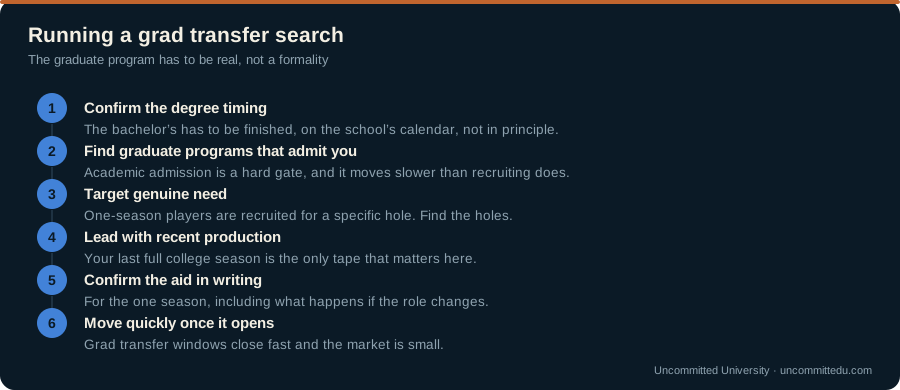
- Reach out directly to programs with a specific need at your position
- Lead with your college stats, film, and academic standing: all three matter here
- Confirm graduate program fit, not just athletic fit: you’re enrolling as a grad student too
- Move quickly once you’re eligible: grad transfer windows tend to move fast, since programs are filling immediate needs
Questions to ask about grad transfer rules before accepting an offer
- What specific role am I being brought in to fill? Get a direct answer, not a general statement about competing for playing time.
- What happens to my scholarship if I’m injured? A one-year grad transfer scholarship should be confirmed in writing, including injury contingencies.
- How does this program support graduate students athletically and academically? Ask current or recent grad transfers directly if possible.
- Is this a genuinely open competition, or is the room already set? A grad transfer year is short: walking into a role that’s effectively already decided against you wastes it.
Common mistakes with grad transfer rules
The checklist below covers where players come unstuck under grad transfer rules.
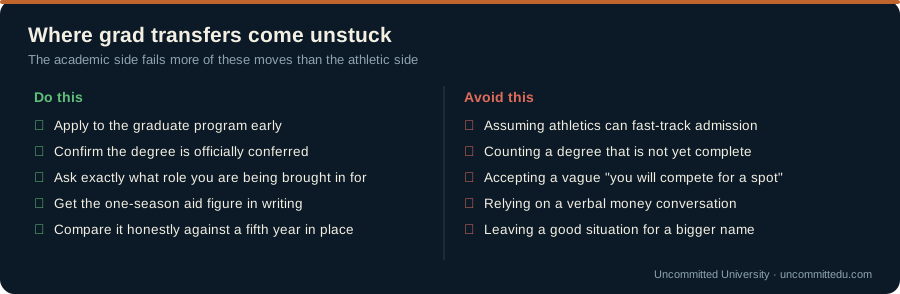
- Not confirming eligibility early enough. This process moves fast once you’re in it.
- Ignoring the academic side. Graduate program acceptance is a real requirement, not a rubber stamp.
- Not asking about the depth chart honestly. A grad transfer year is too short to spend fighting for a role that was effectively decided before you arrived.
- Skipping the financial details. Confirm exactly what “full scholarship” covers under graduate tuition rates before assuming it matches undergraduate aid.
- Only targeting big-name programs. A grad transfer year is about fit and playing time as much as prestige.
The eligibility arithmetic behind grad transfer rules
The graduate transfer is widely misunderstood as a bonus year. It is not. Grad transfer rules do not create eligibility → they let you use eligibility you already have somewhere else.
The arithmetic is what decides whether it is available to you at all, and in Divisions I and II it is now a single number: how much of your five-year period of eligibility is left.
That period starts at the earlier of two events: your first full-time enrollment at any college, junior colleges and international schools included, or the start of the regular academic year after your 19th birthday. Then it runs continuously.
It does not pause because you did not compete, transferred, sat out or took time away from the sport. Only pregnancy, active-duty military service and official religious missions can pause it, and the Eligibility Center administers all three.
So the classic version of this move has changed shape. It used to be a banked season: redshirt as a freshman, play four, graduate with one left. Now it is spare calendar: graduate inside four years and use what remains of the five. An accelerated degree is what creates the opportunity, not a year on the bench.
If your five-year period has run out, grad transfer rules do nothing for you, however few games you played. That is the hard edge of the new model, and it is why the NCAA describes the age-based rules as more predictable but less flexible.
Players already in the system are not stranded by this. A current student-athlete with eligibility left after 2025-26 is reviewed under the previous rules or the age-based rule, whichever is more beneficial, so a banked season from a genuine redshirt year still counts if it helps you.
So the first question is never where to go. It is how much of the clock is left, and which set of rules am I being read under. Get both confirmed by compliance before you plan anything else, and if you are moving to a D3, NAIA or JUCO program, ask them separately, because none of this applies there.
The appeal is real when the arithmetic works. You arrive with a completed degree, you enrol in a graduate programme, and you are typically eligible to compete immediately.
The academic side is where graduate transfers actually come unstuck. You must be admitted to a genuine graduate programme at the new institution, and admission is decided by the graduate school, not by the baseball staff.
A coach can want you and the graduate programme can still say no. Start those applications early, and confirm your undergraduate degree will be conferred in time.
It is also worth checking that a programme you would actually want exists there. Enrolling in a one-year course you have no interest in, purely to play, tends to go badly for both halves of the year.
One practical note that catches people: grad transfer rules interact with your degree completion date. A degree conferred late can cost you the autumn, so confirm the paperwork with your current registrar rather than assuming.
Done properly, it is one of the cleanest moves in the sport: a free agent with a degree, a year of eligibility and no adjustment period to justify.
Frequently asked questions about grad transfer rules
Can a grad transfer enter the portal at any time? Almost. In Division I sports other than football, a player who will enroll as a graduate student can enter the portal at any point in the academic year, but must enter before the sport’s final transfer window closes. For baseball that close is the end of June. After that the door shuts until the next year’s window.
Can you grad transfer to an NAIA school? Yes. Since the NAIA’s 2023 bylaw update a player who has finished a bachelor’s degree can transfer to an NAIA school and compete, in a graduate program or a second bachelor’s degree, as long as terms of attendance and seasons remain: 10 semesters and four seasons in total. The 24/36-hour rule does not apply to graduate students. Register through the PlayNAIA Eligibility Center.
Do Division III grad transfer rules differ from Division I? Yes, completely. Division III does not treat a graduate student as a transfer, so there is no residence year and no exception to meet. What counts is the D3 limit of 10 semesters of full-time enrollment and four seasons of participation, both counted from your first full-time term at any college, plus full-time enrollment in a graduate program at the new school.
Do grad transfers get immediate eligibility to compete? Often yes, which is one of the main reasons programs recruit them, but this should still be confirmed directly with both the current and new school’s compliance offices.
Can any player become a grad transfer? Only players who’ve completed a bachelor’s degree and still have NCAA eligibility remaining. In Divisions I and II that now means time left on your five-year period, most often because you finished the degree early. A pre-2026 redshirt year can still count if you are being reviewed under the previous rules.
Do grad transfers count against a team’s scholarship limit the same way? Grad transfer scholarships come out of the same overall NCAA equivalency limits as any other scholarship: programs budget for them like any roster spot.
How fast does the grad transfer process move? Quickly. Since programs are usually filling one immediate, specific need, grad transfer decisions often happen faster than a typical undergraduate transfer.
Does a grad transfer have to attend graduate school full time? Requirements vary by school and program, so confirm directly, but graduate program acceptance and enrollment are real requirements, not a formality attached to the athletic move.
What’s the biggest mistake in a grad transfer decision? Confirming eligibility too late. This process moves fast once a player is eligible, and hesitating can mean the best-fit opportunities are already filled.
Staying for a fifth year vs. transferring
Not every eligible player should transfer. Some programs offer a returning grad player a fifth year in place, without a move at all, and that’s often the simpler, lower-risk option.
The fifth year has to exist before either option is real. In Divisions I and II grad transfer rules do not create it and no program can grant it; it is whatever is left of your five-year period after four years of school. If you enrolled straight out of high school and stayed enrolled, a fifth year is exactly what the clock leaves you, and it is the last one. There is no sixth via a redshirt, because that route was eliminated in 2026.
- Staying means no new academic transition, no new team culture to learn, and no risk of a role that doesn’t materialize as promised.
- Transferring makes the most sense when the current roster has no realistic role available, or when a specific program offers a clearly better athletic or academic fit.
- Either way, get the terms in writing. A verbal “we’d love to have you back” from your current coach deserves the same scrutiny as an offer from a new program.
There’s no default right answer here. The same discipline that applies to any transfer decision applies to staying, too: get the role, the scholarship, and the academic details confirmed directly, rather than assuming familiarity means the details will work themselves out.
The short version: grad transfer rules reward players who treat the academic side as seriously as the athletic one. Confirm the degree is actually conferred, apply early to a graduate programme that will admit you, target genuine roster need rather than the biggest name, and get the one-season aid figure in writing. Most moves that fail under grad transfer rules fail on admissions and timing, not on ability.
The short version
Grad transfer rules let you use remaining eligibility at a new school after finishing your degree. They do not grant an extra year. You need both an unused season and time left on the five-year clock.
Admission to a real graduate programme is decided by the graduate school, not the coaching staff, and it is where most attempted moves fail.
Uncommitted University advises confirming seasons remaining, clock remaining and your degree conferral date with compliance before contacting a single school about grad transfer rules.
Give the graduate application at least as much attention as the baseball conversation. Deadlines for graduate programmes often fall earlier than undergraduate ones, and a missed application date ends the move regardless of how much a coach wants you.
Your next step
Confirm your eligibility in the NCAA baseball eligibility guide, then build a target list of programs with a real need at your position.
Written by Wayne Keeton, founder of Uncommitted University.