

Baseball Recruiting Red Flags and Scams
College baseball recruiting attracts services that profit from anxious families. Some are genuinely useful. Others are selling false hope.
This covers exactly what to watch for. For the full recruiting process, see the college baseball recruiting guide.
Quick answer: Watch for guaranteed offers, pressure to pay fast for a “limited spot,” and services that never ask about your real metrics or academics. No legitimate service can guarantee a scholarship: that decision always belongs to the coach.
Key takeaways
- The clearest of all baseball recruiting red flags is a guaranteed offer: no service controls a coaching decision.
- Manufactured urgency is one of the baseball recruiting red flags that costs families the most money.
- A service that never asks for your metrics is showing you one of the loudest baseball recruiting red flags there is.
- Vague promises of exposure to hundreds of coaches rank among the most common baseball recruiting red flags.
- Every one of these baseball recruiting red flags can be checked in about ten minutes, before any money moves.
Baseball recruiting red flags and scams: the checklist
The table below puts six baseball recruiting red flags next to what a legitimate service says instead, so the contrast is easy to spot in a live pitch.
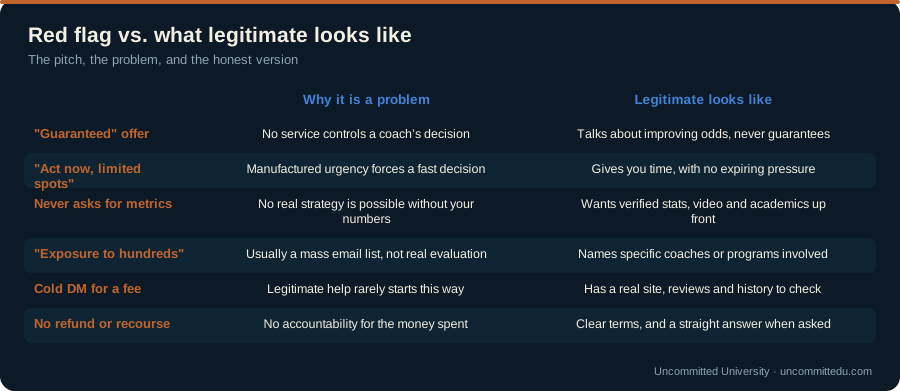
| Red flag | Why it’s a problem | What legitimate looks like |
|---|---|---|
| “Guaranteed” offer or scholarship | No service controls a coach’s decision | Talks about improving your odds, never guarantees |
| “Act now, limited spots” | Manufactured urgency pressures a fast decision | Gives you time to think it over, no expiring pressure |
| Never asks for your real metrics | Can’t build a real strategy without your numbers | Wants verified stats, video, and academics upfront |
| Vague “exposure to hundreds of coaches” | Usually just a mass email list, not real evaluation | Names specific coaches or programs involved |
| Cold DM offering to “get you seen” for a fee | Legitimate help rarely starts this way | Has a real website, reviews, and history you can check |
| No refund or recourse if nothing happens | No accountability for the money spent | Clear terms and a real answer if you ask about it |
Guaranteed offers or scholarships
No service, no matter how expensive, can guarantee a coach will offer you a scholarship. That decision belongs entirely to the coaching staff.
Any company promising a guaranteed offer is either overpromising or planning to blame you when it doesn’t happen.
Artificial urgency: one of the loudest baseball recruiting red flags
“Limited spots,” “act now,” “prices go up tomorrow.” Legitimate camps and services don’t need fake pressure to fill seats.
Take a day to think it over. A real opportunity doesn’t disappear overnight.
Services that skip your actual numbers
A real recruiting strategy starts with your real metrics: velocity, exit velo, GPA, test scores. If a service will “get you recruited” without ever asking for these, it’s selling a mailing list, not a strategy.
The checklist below is the short version of every one of the baseball recruiting red flags covered on this page.

Baseball recruiting red flags: common scam patterns
Beyond the general baseball recruiting red flags, a few specific patterns show up repeatedly:
- The fake “elite” combine. A high entry fee, a big-sounding name, and no real coaches present, just staff running drills and handing out a certificate or ranking that means nothing to an actual recruiter.
- The all-star team pay-to-play pitch. An invitation to a prestigious-sounding “national team” that’s really just a roster anyone can buy a spot on, with no actual selection process behind the name.
- The recruiting “guarantee” contract. A service that asks for a large upfront payment in exchange for a written guarantee of interest or offers: read any such contract closely, since the guarantee language is often written to be unenforceable in practice.
- The urgent financial-information request. Any recruiting contact (real or fake) asking for banking details, a social security number, or payment information beyond a standard camp or service fee should be treated with serious caution. Legitimate camps invoice through normal payment processors, not by requesting sensitive personal or financial data directly.
- The fake “coach” reaching out on social media. A profile claiming to be a college coach, contacting you directly on social media rather than through a school email address, is worth verifying independently before you respond with any personal information.
None of this means every paid camp, ranking, or service is a scam. Most aren’t. It means treating the specific pattern, not just the price tag, as the signal worth watching.
Are baseball recruiting services worth it?
For most families, no. A college coach recruits off measurable numbers, video and a conversation, and every one of those is free to produce and send yourself. A paid service is worth considering only when your metrics already match a level and you want someone to run the logistics. That is the honest split, and it is the same one the families on Reddit’s r/Homeplate and the high school baseball forums land on after they have paid.
When a service is not worth it:
- Your numbers do not match the level yet. A 78 mph fastball will not become a Division I recruit because a profile got emailed to 200 coaches. Spend the money on training and testing instead, then compare against the benchmarks by level.
- You have not tried outreach yourself. A coach reads a short email with a video link and a schedule the same whether a service sent it or you did. Do ten yourself before paying anyone to do a hundred.
- The pitch is access. Nobody sells access to a coach. If the value is “we get you seen”, the value is an email list.
When a service can earn its fee:
- Your tools already fit a specific level and the family is drowning in emails, video edits and camp schedules. Paying for organisation is a fair trade.
- The service does real work you can hold: a filmed and edited video, an in-person evaluation with a written report, a target list built from your actual numbers.
- It names the schools it has placed players at in your position and level, and lets you call one of those families.
The free version of the logistics is a verified profile a coach opens in one click, plus your own target list. Build that first. If you still want help after, you will buy it knowing exactly what you are paying for.
How much do baseball recruiting services cost?
Anywhere from free to more than $6,000, and the biggest companies do not publish a price list, which is itself one of the baseball recruiting red flags on this page. The number you are quoted arrives on a phone call, and families report the same tier quoted at different prices. Ask for the full price, the refund terms and what the package contains in writing before the call ends, and never buy on the first call.
| Type of service | What families report paying | What you get |
|---|---|---|
| Free profile platforms | $0 | A searchable listing coaches can open. The free tier on the big platforms is a real profile, not a trial. |
| Subscription platforms | Roughly $200 to $600 a year | Profile, video hosting, coach messaging, often bought through a club or travel team. |
| Package services | Roughly $500 to $6,000 or more, quoted by phone | Tiers add an assigned advisor (a staff member, not a college coach), outreach help and calls. The top tiers cost more than a year of in-state tuition at many junior colleges. |
| Private advisors and “agents” | Roughly $3,000 to $10,000 or more | One person handling outreach for you. Worth it only with named placements you can verify by phone. |
Ranges are what families report in public forums and reviews as of September 2026, not published rate cards, so treat them as the shape of the market rather than a quote. Whatever you are quoted, compare it against what a free verified profile and your own ten emails already do.
How to use a paid service the right way
- Use it to speed up outreach, not replace it
- Keep your own metrics, video, and target list regardless of what a service provides
- Ask for references from real families who used the service
- Compare the cost against what you’d spend doing the outreach yourself
A good service saves you time. It never replaces your own numbers and direct coach contact: those are what coaches actually evaluate.
Build your own recruiting profile, free
Skip the expensive packages. A free, verified profile does the same job: a link coaches can check in one click.
Comparing a service’s claims against what you can verify yourself
Before signing up for anything paid, it’s worth running a simple gut check between what a service claims and what you can confirm independently:
- Claim: “We work directly with hundreds of college coaches.” Verify: ask for three specific coach names and programs, then see if you can independently confirm the relationship: a coach’s own athletics staff directory is a good starting point.
- Claim: “Our players get recruited at [X] rate.” Verify: ask how that rate is calculated and whether it counts walk-on tryouts, JUCO transfers, or players who would likely have been recruited regardless.
- Claim: “This ranking reflects real evaluation.” Verify: ask directly whether the rating comes from in-person measurement and film review, or from a form you filled out yourself.
- Claim: “This is your best and only chance.” Verify: nothing. This is close to always false. Recruiting runs on a multi-year timeline with many entry points, not a single make-or-break event.
A legitimate service answers these questions specifically and without defensiveness. A vague or irritated response to a reasonable question is itself useful information.
Recruiting rankings and “star” services
Some services sell star ratings or national rankings. Treat these carefully.
- A ranking based on self-reported numbers, with no video verification, isn’t worth much to a coach.
- Ask whether the service actually watches film or measures you in person before assigning a rating.
- A high ranking from an unknown service rarely moves the needle with real coaches, verified metrics and video do.
Social media “recruiters” and DMs
Watch for accounts that message players directly, offering to “get you seen” for a fee, often with urgency built into the pitch.
- Legitimate recruiting help doesn’t usually start with a cold DM.
- Check for a real website, real reviews, and a real business behind the account before sending any money.
- If the pitch focuses entirely on payment and never asks about your actual metrics, treat it as one of the clearest baseball recruiting red flags.
Why families fall for baseball recruiting red flags, and how to stay grounded
None of this is about a lack of intelligence. Recruiting anxiety is real, timelines feel opaque, and a confident-sounding pitch that promises certainty is genuinely appealing when the process feels out of your control.
- Remind yourself that the actual levers in recruiting are within your control: verified metrics, a real target list, direct outreach, and follow-through. No purchase replaces those four things.
- Talk it through with your current coach before committing money to any outside service: a second, experienced opinion catches most bad pitches before they cost anything.
- Slow down on any decision that has to be made “right now.” Real recruiting opportunities and legitimate services can survive a day of research.
Questions that expose baseball recruiting red flags before you pay
The fastest filter: ask an eligibility question you already know the answer to. The real rules are public, and our D2 eligibility rules guide is one place to check an answer against, free.
- What exactly do I get, in specific, measurable terms?
- Which coaches or programs will actually see my information?
- Can you provide references from families who used this service?
- What happens if I don’t get any real interest, is there a refund?
How to verify a service and avoid baseball recruiting red flags
These five checks take about ten minutes and catch most baseball recruiting red flags before any money changes hands.
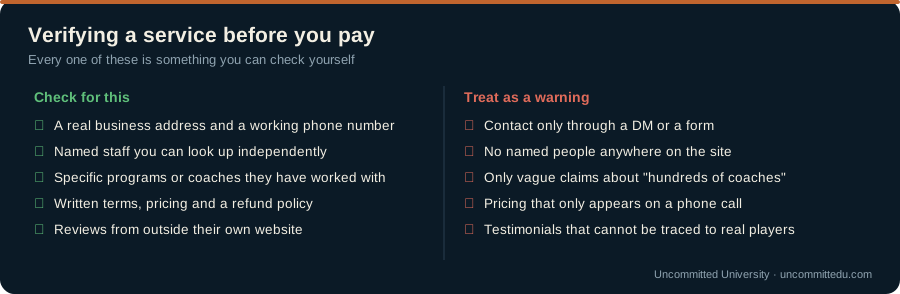
- Look up the company: a real address, real staff, and a history that predates last month
- Search for independent reviews outside the company’s own website, or check the Better Business Bureau
- Ask if you can speak with a current or past client directly
- Check whether any actual college coaches are named as references, and verify it with the coach if possible
A few minutes of checking saves families real money and real disappointment.
Spotting a fake camp invite: baseball recruiting red flags in your inbox
Not every scam is a full service. Sometimes it’s a single suspicious email dressed up as a showcase invite. A few tells:
- A generic greeting instead of your name. A real invite tied to your actual profile or a coach’s interest usually addresses you directly.
- A sender domain that doesn’t match the organization’s real website. Check the actual email address, not just the display name, before clicking anything.
- Urgent language pushing an immediate click or payment rather than giving you time to research the event first.
- No verifiable event history. A quick search should turn up the event’s past dates, location, and some independent mention of it, not just the event’s own promotional page.
When in doubt, go directly to the organization’s official website rather than clicking a link in the email itself.
Learning to tell a real offer from an “interest” pitch
Confusing genuine interest with an actual offer is one of the most common, and most emotionally costly, mistakes in recruiting, and it overlaps with how some services oversell what they’ve delivered.
- A real offer comes directly from a coach, names a specific role and scholarship or financial aid detail, and is usually followed up in writing.
- Genuine interest (a coach asking for more film, inviting you to a camp, or saying he “likes what he sees”) is a real and positive signal, but it isn’t a commitment.
- A verbal offer from a coach is real and worth taking seriously, but it isn’t binding the way a written scholarship agreement or National Letter of Intent is. Get any real offer confirmed in writing before treating a decision as final.
- Be wary of any third party (a service, an event, or a social account) claiming they can convert “interest” into an “offer” for a fee. That conversion only happens through the coach’s staff, never through a paid intermediary.
What to do if you think you’ve already been scammed
If you already missed the baseball recruiting red flags and paid, the steps below limit the damage and put the facts on record.
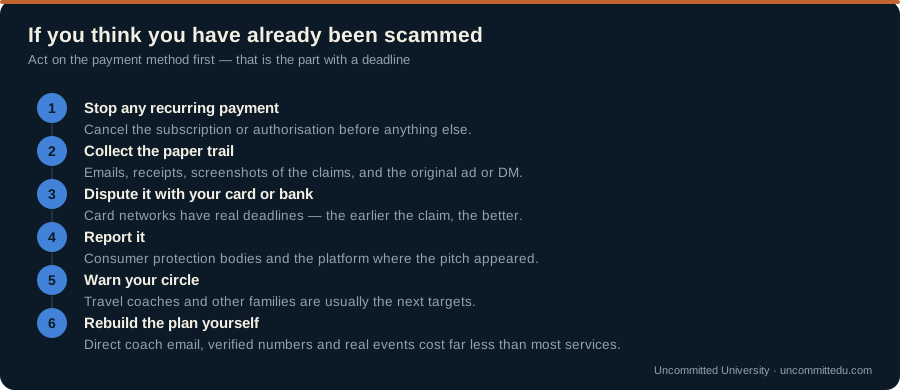
- Stop any further payment immediately, including recurring charges: check whether the service auto-bills and cancel it directly with your bank or card issuer if needed.
- Document everything. Save emails, screenshots of promises made, and payment records before a website or account disappears.
- Report it. The Better Business Bureau and your state’s consumer protection office both take complaints about recruiting and combine-style services, and a paper trail helps other families avoid the same pitch.
- Don’t let it stop your actual recruiting process. A bad experience with one service doesn’t reflect on your talent or your chances: refocus on direct coach outreach and your own verified metrics.
- Talk to your high school or travel coach. They’ve often seen these patterns before and can tell you quickly whether a specific company or event has a real reputation.
The money-shaped baseball recruiting red flags
The costliest scams in this space are not the obvious ones. They are the services that look exactly like legitimate help and simply do not deliver anything a coach cares about.
Any guarantee of placement is the clearest of all baseball recruiting red flags. Nobody can promise a roster spot or a scholarship. The people who decide that are college coaches, and they do not sell that decision to a third party.
Be equally careful with the phrase “we have relationships with coaches”. Every service says it. Ask for three specific programs and the name of the coach they dealt with there, then email those programs and ask.
Watch the fee structure. A large sum up front, before any work is done, is one of the more reliable baseball recruiting red flags: legitimate services bill for a defined deliverable such as video editing, testing or a profile.
Treat high-pressure deadlines the same way. “This price ends Friday” is a sales tactic, not a recruiting reality. Coaches recruit for years; nothing about your future turns on a Friday.
Another of the quieter baseball recruiting red flags is a service that will not let you contact coaches yourself, or insists all communication route through them. That is a business protecting its margin, not your recruitment.
And be sceptical of testimonials with no last names, no schools and no years. Real commitments are public record: you can verify almost any of them on a college roster page in about a minute.
What legitimate help looks like, by contrast: honest evaluation you may not enjoy hearing, a defined scope of work, verifiable references, and complete transparency about the fact that outcomes are never guaranteed.
Frequently asked questions
These are the questions families ask most often about baseball recruiting red flags. Each answer points at a specific behaviour you can check, rather than at the feeling that something is off.
Are baseball recruiting services worth it? For most players, no. Coaches recruit off numbers, video and a conversation, all of which you can produce and send for free. A service earns its fee only when your metrics already fit a level and you want someone to run the logistics, or when it does real work you can hold, such as an edited video or a written evaluation.
How much do baseball recruiting services cost? From free to more than $6,000. Free profile platforms cost nothing, subscription platforms run a few hundred dollars a year, and package services quote by phone in tiers families report between roughly $500 and $6,000 or more. Private advisors can run higher. The largest companies do not publish a price list, so get the price, the contents and the refund terms in writing before you decide.
Is NCSA legit or a scam? NCSA is a real company, owned by IMG Academy, and coaches do have accounts on it, so it is not a scam in the fraud sense. The questions to ask are the same as for any package service: what does the paid tier do that the free profile does not, what is the full price, and what is the refund policy. The phone call you get after signing up for a free profile is a sales call from a staff recruiting coordinator, not a college coach. Treat it as one.
Can a recruiting service guarantee a scholarship offer? No. No service controls a coach’s decision. Any company promising a guaranteed offer is either overpromising or setting up to blame the player when it doesn’t happen.
Is fast-payment pressure one of the baseball recruiting red flags? Yes. Legitimate camps and services don’t need artificial urgency like ‘limited spots’ or ‘prices go up tomorrow’ to fill seats. A real opportunity gives you time to think it over.
Are recruiting star ratings and rankings worth paying for? Only if the ranking is based on verified video and in-person measurement, not just self-reported numbers. A high ranking from an unknown service with no verification rarely moves the needle with real coaches.
Should I respond to a college coach who messages me on social media? Verify it independently first. A profile claiming to be a college coach that contacts you directly on social media rather than through a school email address is worth confirming before you share any personal information.
What should I do if I think I’ve been scammed by a recruiting service? Stop any further payment immediately, document all communication and payment records, report it to the Better Business Bureau or your state consumer protection office, and keep moving forward with your own direct outreach and verified metrics.
Is it normal for a recruiting service to ask for banking details or a social security number? No. Legitimate camps and services invoice through standard payment processors for a stated fee. A request for banking details or a social security number beyond that is a serious red flag.
The short version: the baseball recruiting red flags that matter all share one trait: they ask for money before they ask about you. A legitimate service wants your verified numbers, your video and your academics up front, names the programs it actually works with, and gives you time to think. Test any pitch against those three things and most baseball recruiting red flags become obvious immediately. When in doubt, spend the money on a camp where a target-list coach is running the drills instead.
The short version
Most baseball recruiting red flags reduce to one question: is this person selling access, or selling work? Access cannot be sold, because coaches do not sell it. Work (video, testing, evaluation, organisation) legitimately can.
Uncommitted University tells families to verify one claim before paying anyone. One phone call to one named program settles most of it.
If you spot baseball recruiting red flags after paying, stop sending money, keep every message, and dispute the charge with your card issuer rather than arguing with the company.
One last filter that catches most of it: ask what happens if you do not get recruited. An honest service explains what it delivered regardless of outcome. A scam changes the subject.
Your next step
Build your own free profile and target list first, see the D1 vs. D2 vs. D3 vs. NAIA vs. JUCO breakdown, before spending money on any paid service.
Written by Wayne Keeton, founder of Uncommitted University.