
Commit to a College for Baseball: 5 Real Steps
Updated September 2026. Sourced from the NCAA recruiting calendar, NCAA scholarship rules, and the uncommittedu.com coach directory of 1,689 programs.
You want to know how to commit to a college for baseball, and every result you click gives you a vague pep talk instead of an actual process. Nobody tells you when a coach is even allowed to talk to you, or what a commitment legally means once you make one.
This guide walks the real process end to end: the rules that govern when contact can start, the steps that turn interest into an offer, and what a commitment actually is once you make it. No vague encouragement, just the mechanics behind every real commitment story.
The process is identical whether you are a freshman just starting to think about recruiting or a junior who feels behind. What changes is the timeline, not the steps. Understanding both now saves months of wasted effort later.
- When college coaches are allowed to contact you, by rule
- The five steps that turn a recruit into a committed player
- What a verbal commitment actually is, and what it is not
- How to build a recruiting profile a coach will open
- Whether you can get a full ride playing college baseball
- What happens after you commit, step by step
- Common mistakes that stall a commitment
Key takeaways
- College coaches cannot make recruiting calls or extend offers before June 15 after a player’s sophomore year.
- A verbal commitment is a spoken, nonbinding agreement. Nothing is final until a written offer of athletic aid is signed.
- Committing runs on five steps: build a profile, get seen, get contacted, get an offer, accept it in writing.
- A true full ride is realistic mainly at D1 since its 2025 roster and scholarship reform. D2, D3, NAIA, and JUCO usually mean partial money.
- The National Letter of Intent ended in October 2024. A written offer of athletic aid is what makes a commitment official now.
- The uncommittedu.com coach directory carries questionnaire links for 97.9 percent of the 1,689 programs we track.
When can you commit to a college for baseball?
There is no single legal age or grade that lets you commit. What is regulated is when a coach can first contact you. Under the current NCAA baseball recruiting calendar, published on ncaa.org/sports/baseball, college coaches cannot call, text, or extend a verbal offer before June 15 following your sophomore year of high school.
Before that date, you can still reach out to a coach yourself, attend camps, and build a profile. What a coach cannot do is initiate contact or make an offer. That single rule is why most real commitments cluster in the summer after sophomore year and into junior year.

A player can technically commit earlier than June 15 if he initiates contact with a coach and the coach responds with informal interest, but no binding offer can exist until the calendar allows it. See our full college baseball recruiting timeline for every date by grad year.
The June 15 rule replaced an older, later contact date, and the change moved real recruiting earlier across the entire sport. That means a player who waits until junior year to start building a profile is already behind players who started the summer after sophomore year. Starting early does not guarantee an offer, but starting late almost guarantees a shorter list of programs still paying attention.
The rule also applies evenly across divisions. A D1, D2, D3, NAIA, or JUCO coach all face the same NCAA contact restriction before June 15, though NAIA and JUCO programs run under a separate governing body’s calendar in some cases. Confirm the exact rule for any non-NCAA program you are targeting, since NAIA and JUCO timelines can differ slightly from the NCAA calendar described here.
How to commit to a college for baseball, in five steps
Every real commitment follows the same five steps, in the same order. Skipping a step is the most common reason a strong player never hears back.
- Build a recruiting profile. Video, verified stats, academic info, and contact details in one place.
- Get seen. Verified events, summer ball, and direct outreach put your numbers in front of coaches.
- Get contacted. A coach reaches out once June 15 passes and your numbers match a roster need.
- Get an offer. A coach communicates a scholarship and roster spot, usually by phone first.
- Accept in writing. A written offer of athletic aid, sent by the school, makes the commitment official.
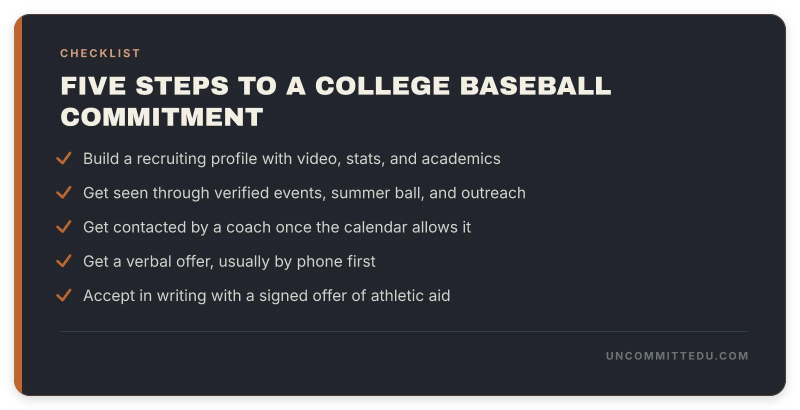
Most players stall between steps two and three, since getting seen does not guarantee getting contacted. A player with real video and stats but no active outreach plan can sit unseen for an entire recruiting cycle. Our college baseball recruiting guide covers the full process behind each step.
Running all five steps at once, rather than one after another, shortens the whole timeline. A player who builds the profile and starts outreach in the same week gets seen and contacted faster than one who finishes the profile first and only starts emailing coaches a month later. Recruiting rewards players who treat it as a parallel process, not a checklist done in strict order.
What a verbal commitment actually is
A verbal commitment is a spoken agreement between a recruit and a coach, and it is entirely nonbinding. Either side can back out at any point before a written offer of athletic aid is signed. It is a statement of intent, not a contract.
This matters because a lot of recruiting content treats a verbal commitment as the finish line. It is not. It is a strong signal, backed by nothing legal, that both sides plan to follow through once the calendar allows a written offer.

Our full recruiting guide and dedicated verbal commitment breakdown cover exactly what changes between a spoken agreement and a signed one, including what happens if either side changes their mind.
A coaching change is the most common reason a verbal commitment falls apart on the program’s side. A new head coach is not bound by a previous staff’s verbal offers, and a full review of the roster and recruiting class often follows a coaching change. Keep an eye on a program’s coaching staff stability, not just its interest level, while you are between a verbal yes and a signed offer.
Build a recruiting profile a coach will open
Nothing in the five step process works without a profile a coach can find, open, and trust in under a minute. That means real video first, verified stats second, and academic information third.
Skip a long personal essay about your love for the game. Coaches skim dozens of profiles a week. A one line summary with position, grad year, and top two numbers earns more attention than three paragraphs of biography.

Build a free profile on uncommittedu.com and it becomes the single link you drop into every email, text, and questionnaire you fill out.
Update the profile every time you have a new number worth showing. A stale profile with last season’s stats reads as inactive, even if you are actually training harder than ever. A coach checking back on a recruit a second time wants to see fresh evidence that the interest was worth following up on.
Can you get a full ride playing college baseball?
A true full ride is realistic mostly at the D1 level, and only since the 2025 reform that let D1 programs fund up to 34 full scholarships on a 34 player roster. Before that reform, D1 baseball split just 11.7 scholarships across a much larger roster, so a full ride was rare even there.
Outside D1, full rides stay uncommon. D2 programs split 9.0 equivalencies across a full roster, D3 programs offer no athletic scholarships at all, and NAIA programs split up to 12 equivalencies. JUCO scholarship money varies by division and school.
| Level | Max scholarships | Full ride realistic? |
|---|---|---|
| NCAA D1 | 34 (1:1 since 2025) | Yes, for a roster spot player |
| NCAA D2 | 9.0 equivalencies | Rare, usually partial |
| NCAA D3 | 0 (athletic aid banned) | No, financial aid only |
| NAIA | 12 equivalencies | Rare, usually partial |

Do not build a recruiting plan around a full ride as the expected outcome. Build it around finding the best combination of playing time, scholarship money, and academic fit. Our college baseball scholarships guide breaks the real math down by division.
Partial scholarship money still stacks with need based financial aid and academic scholarships a school offers separately from athletics. A partial athletic award combined with strong academic aid can land close to a full ride’s out of pocket cost, even without the label. Always ask for the full financial aid picture, not just the athletic scholarship percentage a coach quotes on the phone.
What replaced the National Letter of Intent
Older recruiting guides tell you to expect a National Letter of Intent, or NLI, once your commitment is final. That document no longer exists. The NCAA ended the National Letter of Intent in October 2024.
In its place, a written offer of athletic aid from the school itself is what finalizes a commitment now. It carries the same practical weight the NLI used to, spelling out the scholarship amount and the terms of the offer, but it comes directly from the college rather than through a separate national signing system.

If a coach, camp, or older article mentions signing an NLI, ask directly what document your target school now uses. Most schools moved to their own written aid agreement without much public explanation of the change, so it is worth confirming rather than assuming.
What happens after you commit
A verbal commitment starts a new phase, not the end of one. You still need to keep your grades, your test scores, and your on field performance at the level that earned the interest in the first place.
Register with the NCAA Eligibility Center if you have not already. A written offer of athletic aid requires a clean academic file behind it, and the Eligibility Center fee runs $120 for domestic students and $180 for international students.
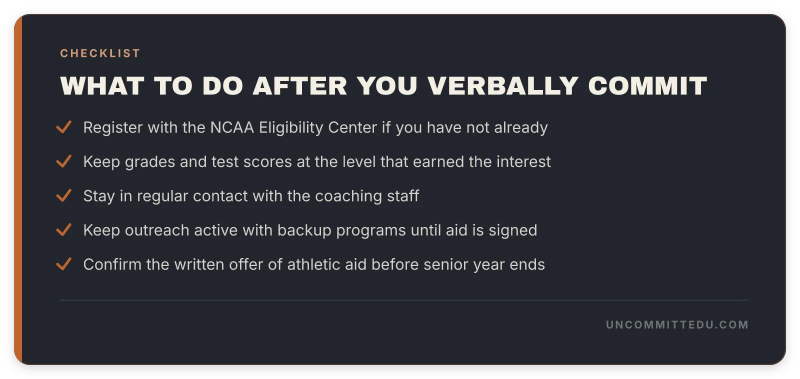
Stay in regular contact with the coaching staff through your senior year. A coach who goes quiet after a verbal commitment is not necessarily backing out, but silence on your end can be read the same way. Keep your own outreach active until the written offer is signed.
Track your recruiting status the same way you would track any other metric. Know exactly what has been said verbally, what has been put in writing, and what is still open. A player who cannot answer those three questions clearly for his own recruiting file is not as far along as he thinks he is.
Getting to the point where a coach is ready to let you commit is touch seven of the course, and this is exactly what it walks you through after that ask.
Common mistakes that stall a commitment
Most stalled recruiting stories share the same handful of mistakes. Fixing them does more for your outcome than any single showcase or camp.
- Waiting for coaches to find you. Direct outreach beats a passive online profile every time.
- Treating a verbal yes as final. It is not, and treating it that way stops your other outreach too early.
- Sending generic emails. A mass email to sixty coaches reads as one, and most coaches can tell in the first sentence.
- Ignoring academics. A weak transcript can undo months of athletic recruiting work in one Eligibility Center review.

Fix these four and the five step process moves the way it is supposed to. None of them require more talent, only a better process around the talent you already have. A player who fixes all four often sees a stalled recruiting cycle restart within a single summer, without changing a single number on the field.
Questions to ask before you commit
A verbal commitment is a two way decision, not just an answer to a coach’s question. Before you say yes, get clear answers to a short list of questions that most recruits forget to ask.
Ask about your projected role, not just your scholarship number. A coach who cannot describe how you fit into next year’s roster, or how the depth chart looks at your position, is asking you to commit on faith. Ask directly whether the offer is contingent on your senior year performance, your grades, or anything else that could still change the terms.
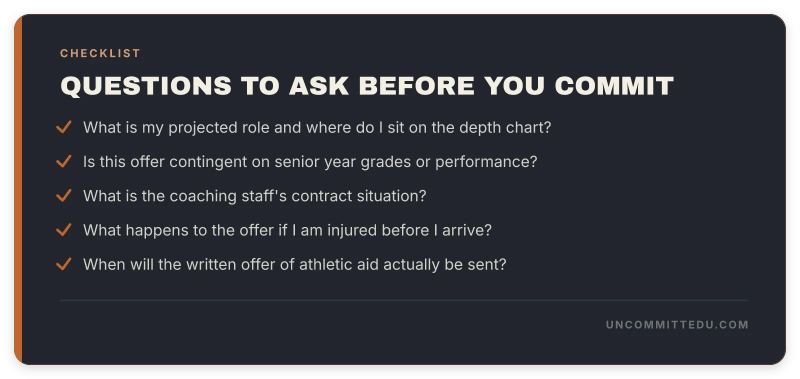
Ask about the coaching staff’s contract situation, if it is public information. A program with a coach on the last year of a contract carries more staff turnover risk than one with a coach recently extended. That risk directly affects whether your verbal agreement survives to a written offer.
Also ask what happens to your scholarship if you are injured before you arrive on campus. Most programs honor a written offer through a documented injury, but a verbal promise alone offers no such protection. Get anything you are relying on in writing as early in the process as the school allows.
One more question worth asking directly: how many other players at your position did the staff offer this same recruiting class. A roster that already carries three verbal yeses at your exact position is a different situation than one where you are the only name on the board. Neither answer should end the conversation on its own, but both change how you should read the offer in front of you.
What coaches look for before they extend an offer
A coach is not just scoring your fastball or your exit velocity. He is trying to solve a roster puzzle three or four years out, and an offer only happens when your profile fills a real gap in that puzzle. Understanding this shifts how you present yourself, since raw talent alone does not answer the question a coach is actually asking.
Roster need drives timing more than talent does. A program that just lost its starting shortstop to graduation will move faster on a strong shortstop recruit than a program with two years left on its current starter’s eligibility. This is why two similarly talented players can get offers on completely different timelines, and why a slower process is not automatically a sign of lower interest.

Coaches also weigh academic fit heavily, since a recruit who cannot clear the NCAA Eligibility Center or the school’s own admissions bar is a wasted roster spot regardless of tools. A transcript that shows steady grades across four years reads better than one strong semester surrounded by weak ones. Bring your academic record into every conversation, not just your athletic numbers.
Character references matter more than most recruits expect. A coach will often call a travel ball coach, a high school coach, or a summer league director before finalizing an offer, asking about coachability, work ethic, and how a player handles failure on the field. A great tool set attached to a poor reputation for coachability closes doors that talent alone cannot reopen.
Timing is the piece most recruits misread. A coach who says he is interested but not ready to offer is usually being honest, not evasive. He may be waiting on a graduating senior’s final decision, a transfer portal commitment, or budget approval from the athletic department before a scholarship number becomes official. Patience during this stretch matters as much as the outreach that got you noticed in the first place.
Multiple offers change the calculus for both sides. A recruit weighing two or three offers should tell each coach honestly where things stand, since a coach facing a deadline from his own administration will often move faster once he knows a decision is close. Hiding competing interest rarely speeds things up, and it can damage trust with a coach you end up committing to later.
Frequently asked questions
When can you commit to a college for baseball?
There is no fixed age, but college coaches cannot contact you or extend an offer before June 15 following your sophomore year of high school. Most real commitments happen after that date, through junior and senior year.
Can you get a full ride to college for baseball?
A true full ride is realistic mainly at D1, since its 2025 reform allows up to 34 full scholarships on a 34 player roster. Other levels usually split scholarship money as partial awards across a full roster.
How do you commit to a college for baseball?
You build a recruiting profile, get seen through events and outreach, get contacted by a coach once the calendar allows it, receive a verbal offer, and finalize it with a written offer of athletic aid once your senior year signing period opens.
Is a verbal commitment to a college baseball program binding?
No. A verbal commitment is a spoken, nonbinding statement of intent. Either the recruit or the coach can change their mind at any point before a written offer of athletic aid is signed.
What do college baseball coaches look for before offering a scholarship?
Coaches weigh roster need, academic eligibility, and character references from your travel ball or high school coach alongside your athletic tools. A player who fills an open roster spot and clears the academic bar moves faster than one who only has strong tools.