

D2 Eligibility Rules: The Five-Year Clock
D2 eligibility rules changed on Aug. 5, 2026, and the version most recruiting sites still describe is the old one. Division II threw out four seasons of competition inside 10 semesters and replaced it with a single five-year period of eligibility.
Here’s the deal: the new D2 eligibility rules are far easier to explain and far less forgiving of a slow start. This guide covers what the NCAA Division II Executive Board actually adopted, exactly when your clock starts, what got deleted, and who gets to choose between the old and new D2 eligibility rules.
Quick answer: The D2 eligibility rules now give you one five-year period of eligibility that starts at the earlier of two events: the term you first enroll full time at any college, or the academic year immediately after your 19th birthday. The clock then runs continuously. Seasons of competition, redshirts and medical hardship waivers no longer exist in Division II.
Key takeaways
- The D2 eligibility rules were rewritten by emergency legislation on Aug. 5, 2026, effective for 2026-27.
- NCAA 5 year eligibility in Division 2 is a period, not a count of seasons: the clock runs whether you play or not.
- The old 10 semesters / 15 quarters limit was a D2-only rule, and the D2 eligibility rules deleted it outright.
- Athletics redshirts and medical hardship waivers are gone under the new D2 eligibility rules.
- Nobody who finished their eligibility by 2025-26 gets a season back: the D2 eligibility rules are not retroactive.
What changed in the D2 eligibility rules on Aug. 5, 2026?
On Aug. 5, 2026, the NCAA Division II Executive Board adopted emergency legislation replacing the seasons-of-competition system with an age-based five-year period of eligibility. The NCAA’s own announcement states it plainly:

“The NCAA Division II Executive Board adopted emergency legislation to establish an age-based eligibility model as recommended by the Management Council in July.”
Three details matter in that sentence. It was emergency legislation, not a normal proposal cycle. It came from the Management Council’s July 2026 recommendation. And it was adopted by the Executive Board, which is why the D2 eligibility rules moved in weeks rather than a legislative year.
Division I got there first. The Division I membership adopted the same model in June 2026, and the Division II version explicitly mirrors it.
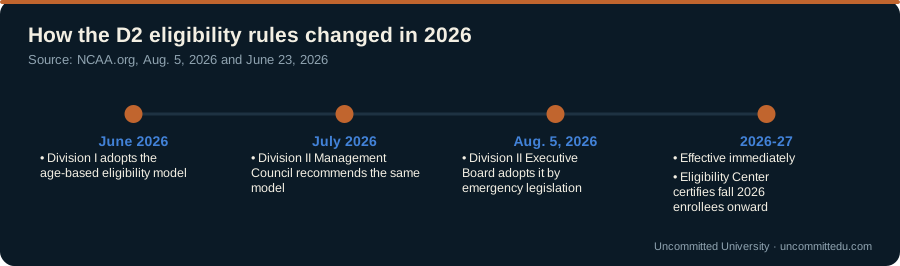
The rule change is effective immediately for the 2026-27 academic year. There is no phase-in period and no pilot. If you are competing in Division II in 2026-27, the new D2 eligibility rules are already the governing framework.
Source: Division II adopts age-based eligibility model, NCAA.org, Aug. 5, 2026.
The same shift is what drives the broader NCAA age limit question, and the honest answer there has changed too.
How many years of eligibility do you get in NCAA Division 2?
Five years, but it is a five-year window, not five seasons you can spend whenever you like. That distinction is the whole rule, and it is where most explanations of the D2 eligibility rules go wrong.
Under the old system, a Division II athlete had four seasons of competition to use inside 10 semesters or 15 quarters of full-time enrollment. Under the new D2 eligibility rules, you get a period. What you do inside it is up to you and your program.
Here is the before-and-after, side by side.
| Element | Previous D2 eligibility rules | D2 eligibility rules from 2026-27 |
|---|---|---|
| Core limit | Four seasons of competition | One five-year period of eligibility |
| Enrollment cap | 10 semesters / 15 quarters full time (Division II only) | Deleted |
| What starts it | Full-time enrollment | Full-time enrollment anywhere, or the academic year after your 19th birthday, whichever is earlier |
| Redshirt tracking | Required, by the athlete and the athletics department | Not required: athletics redshirt rules are eliminated |
| Medical hardship | Waiver available | Waiver category eliminated |
| Administered by | Campus compliance, with waivers through the NCAA | NCAA Eligibility Center certifies the period for fall 2026 enrollees onward |
One warning the NCAA issues itself: this is not a “5 for 5” rule. The Eligibility Center names that phrase and rejects it, because the model “does not guarantee five years for all student-athletes, particularly those who delay enrollment.”
Being inside the window is also not the same as being cleared to play. Academic standards, amateurism and institutional rules all still apply, so a player can sit comfortably inside the five years and still be ineligible for another reason entirely.
When does the NCAA Division 2 eligibility clock start?
Your NCAA Division 2 eligibility clock starts at the earlier of two events: your first full-time college enrollment anywhere, or the academic year that follows your 19th birthday. The NCAA Eligibility Center defines the first trigger this way:
“Initial full-time college enrollment: The academic term when the student-athlete first enrolls full time and attends class at any college or university, including a domestic institution, international institution or two-year college.”
Read “two-year college” carefully. Full-time enrollment at a junior college starts your NCAA five-year period, even though you are not yet an NCAA athlete. So does a full-time term at an international university. So does a semester at a school where you never played a game.
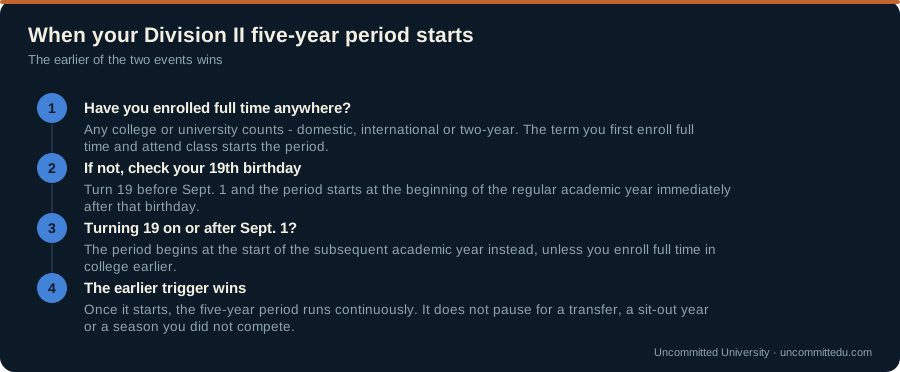
That single line rewrites how JUCO routes should be planned under the D2 eligibility rules. Two years of junior college now spends two years of a five-year period before a player ever sets foot on a Division II campus.
For a fuller walk-through of how the window behaves once it opens, see our guide to the NCAA eligibility clock.
The Sept. 1 split almost every write-up misses
The age trigger is not simply “age 19”: it turns on whether your 19th birthday falls before or after Sept. 1. Here is the Eligibility Center’s exact wording:

“Age-based trigger: The start of the regular academic year immediately following the student-athlete’s 19th birthday, if the student-athlete turns 19 before Sept. 1. For an individual who turns 19 on or after Sept. 1, the period of eligibility begins at the start of the subsequent academic year, unless the individual enrolls full time in college earlier.”
In plain terms: a summer birthday and an autumn birthday can be a full academic year apart in how the D2 eligibility rules treat them.
Now: that is a real planning variable for anyone considering a gap year, a post-graduate year or a delayed enrollment. The NCAA’s own advice is blunt about it: “delaying college enrollment beyond age 19 may reduce the amount of eligibility available in Divisions I and II.”
Source: NCAA Age-Based Eligibility Rules: Eligibility 101, NCAA Eligibility Center. Division II mirrors this legislation.
Does the D2 eligibility clock ever pause?
No: outside three narrow exceptions, the five-year period runs continuously from the day it starts. The Eligibility Center states it without qualification:
“Once the five-year period starts, it runs continuously. It does not pause because a student-athlete does not compete, transfers, sits out, changes teams or takes time away from participation, meaning student-athletes, coaches and athletics departments no longer have to track athletic ‘redshirts.'”
Every item in that list used to be a reason to protect a season. Under the D2 eligibility rules, none of them buy you time any more.
- Not competing: the year still burns.
- Transferring: the clock follows you; it does not restart at the new school.
- Sitting out a season: no longer preserves anything, because there is nothing left to preserve.
- An injury year: the medical hardship waiver that used to cover this is an eliminated category.
What’s the bottom line? Time is now the only currency in the D2 eligibility rules, and there is no way to bank it.
What the D2 eligibility rules deleted: redshirts, waivers and the 10-semester cap
Six rule categories and five waiver categories were eliminated, and two of them were Division II’s alone. The Eligibility Center publishes the list.
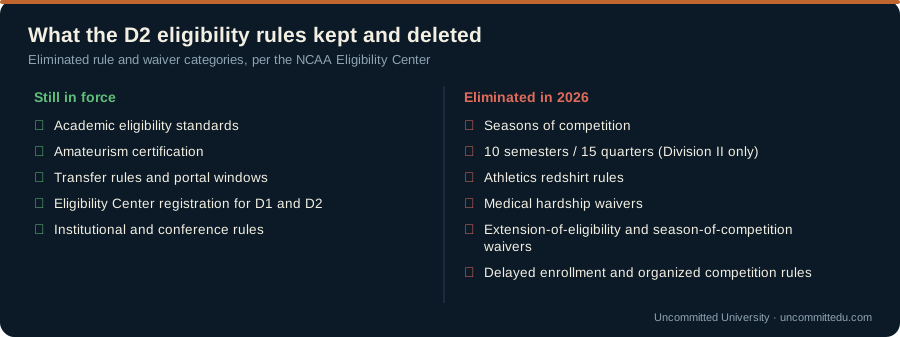
Rules eliminated: seasons of competition; athletics redshirt rules; delayed enrollment and organized competition rules; sport-specific enrollment timelines; academic nonqualifier season limitations (Division I only); and 10 semesters / 15 quarters of full-time eligibility, which was Division II only.
Waiver categories eliminated: medical hardship waivers; extension-of-eligibility waivers; season-of-competition waivers; athletics activity waivers; and delayed enrollment / organized competition waivers.
That second list is the one families feel. A medical hardship waiver was how a lost season came back after a serious injury, and under the new D2 eligibility rules there is no such application to file.
If you arrived here looking for how a redshirt year works, our breakdown of NCAA redshirt rules covers what the term used to mean and what still applies at levels the NCAA change does not touch.
But here’s the kicker: “no redshirts” is not the same as “no sitting out.” A player can still take a developmental year. It just costs a year of the period instead of costing nothing, which is a completely different decision.
Old rules or new rules: who chooses, and who decides
Whether you can pick between the previous system and the new D2 eligibility rules depends entirely on when you first enrolled full time. There are four groups, and two different offices run the comparison.
| Your situation | How eligibility is reviewed | Who runs the review |
|---|---|---|
| Used your final season of competition under the previous rules during 2025-26 | No additional eligibility | Not reviewed: the change does not reach backwards |
| Current student-athlete with eligibility remaining after 2025-26 | Previous rules or the age-based rule, whichever is most beneficial | Campus compliance staff |
| First full-time enrollment at any college during 2026-27, including those who have already turned 19 | Previous rules or the age-based rule, whichever is most beneficial | NCAA Eligibility Center |
| First full-time enrollment in fall 2027 or later | Age-based rule only | NCAA Eligibility Center |
Do not assume one office speaks for the other. If you are already on a Division II roster, your campus compliance office runs the most-beneficial comparison. If you are enrolling for the first time in 2026-27, the NCAA Eligibility Center does it.
There is also a cost to staying on the old system that is easy to miss. Athletes who continue under the previous rules “will not have future waiver opportunities to gain additional eligibility through eliminated waiver categories.” Choosing the old D2 eligibility rules means choosing them without the safety net that used to sit underneath them.
The Eligibility Center now certifies the period of eligibility for students initially enrolling in fall 2026 and beyond, on top of the academic and amateurism certifications it already handled. Schools still report discrepancies, advise current athletes and certify eligibility alongside it.
Do the new D2 eligibility rules apply retroactively?
No. Athletes whose eligibility was completed before the change do not get another season. The Division II Executive Board and Management Council issued a joint statement saying so directly:
“As Division II has continued to determine a path forward for a Division II eligibility model, it has been clear that any rule change should apply going forward, and not retroactively to student-athletes whose eligibility has been completed prior to the adoption of the change. Student-athletes who exhausted their eligibility by 2025-26 have received the full period of eligibility permitted by NCAA bylaws and the life-changing benefits college sports provides. Giving student-athletes another season would disrupt expected roster spots and playing time ahead of the upcoming seasons and alter financial aid packages for countless student-athletes, including incoming freshmen who are beginning (or have begun) their college athletics experience.”
Note the reasoning. The argument against retroactivity is not about the merits of the D2 eligibility rules themselves: it is about roster spots and financial aid packages that were already committed for the upcoming season.
The three exceptions that can pause the five-year period
Only pregnancy, active-duty military service and official religious missions can delay or pause the D2 eligibility rules clock, and the NCAA Eligibility Center administers all three.
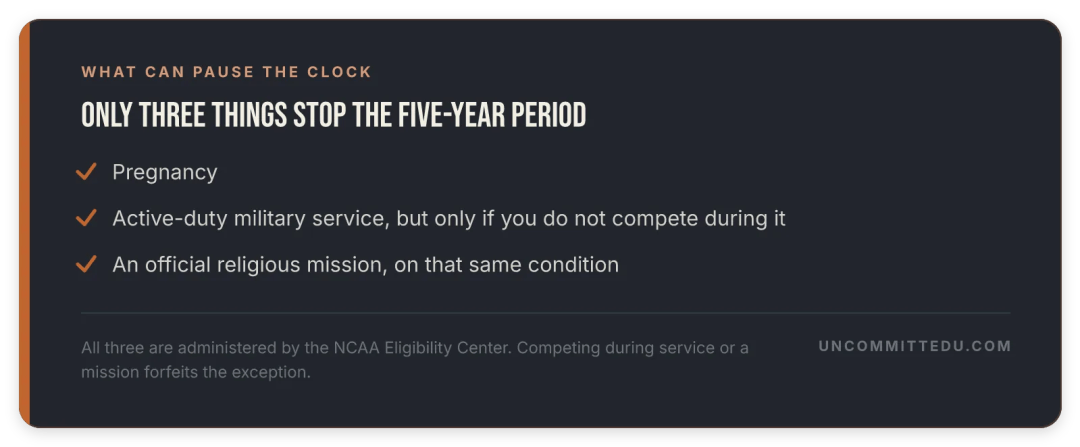
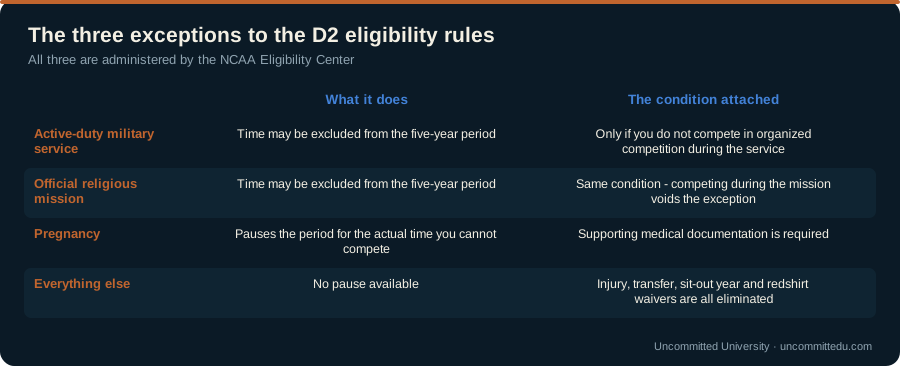
The conditions are not identical, and the difference is worth understanding before anyone plans around them.
- Military service and official religious missions. Time spent in active-duty service or on an official mission may be excluded from the five-year period, but only if the athlete “does not participate in organized competition during that service.” Compete during the service period and the exception does not apply at all.
- Pregnancy. The period may be paused “for the duration of the actual period during which the individual cannot compete,” and supporting medical documentation is required.
The asymmetry is deliberate. The service exceptions are forfeited by competing; the pregnancy exception is bounded by the actual time an athlete cannot compete. Neither is a general-purpose pause button, and nothing else on the old waiver menu survived into the D2 eligibility rules.
What the D2 eligibility rules mean for baseball recruits
This section is Uncommitted University’s analysis, not NCAA guidance. The NCAA has published no baseball-specific interpretation of the D2 eligibility rules, so everything below is reasoning from the rule text above. Confirm any individual case with the Eligibility Center or a compliance office.
With that said, five consequences look unavoidable for Division II baseball.
- The JUCO route now costs clock time up front. Two full-time years at a junior college start and spend two years of a five-year period. Under the previous D2 eligibility rules, a JUCO player arrived counting seasons; now they arrive counting years already gone.
- A developmental freshman year is a real expense. Baseball rosters have long used a quiet first year to add weight, velocity or at-bats. That year used to be protectable. It is now simply one of five.
- Injury risk sits entirely on the athlete. Arm injuries in particular cost full seasons, and the medical hardship waiver that used to answer for them is gone under the new D2 eligibility rules.
- A post-graduate year needs the Sept. 1 test run first. Anyone weighing an extra year before college should check their birthday against the Sept. 1 line before assuming the clock has not already started.
- Fifth-year plans need re-checking, not re-assuming. The arithmetic behind a fifth year changes when the limit is a period rather than a season count.
None of that makes Division II a worse destination. It makes the planning window earlier and the margin for a wasted year thinner. Our full guide to NCAA baseball eligibility covers the academic and amateurism side that sits alongside these D2 eligibility rules.
How D2 eligibility rules compare with NAIA and NJCAA
The 2026 change is NCAA bylaw only. The NAIA and the NJCAA are not affected by it. Their eligibility systems continue to run on their own rules and their own registration processes.

That creates a genuine contrast for the first time. The NCAA no longer counts seasons of competition in Divisions I and II; the NAIA and NJCAA still operate their own frameworks, which means a player comparing levels is now comparing two different kinds of limit rather than two versions of the same one.
The practical consequence: do not carry an assumption from one governing body to another. A season that behaves one way under NJCAA rules does not automatically behave the same way once the D2 eligibility rules take over.
NCAA Division 2 eligibility requirements: the academic side
The five-year clock above is the time rule. The requirements below are the academic rule, and a recruit needs both. This is what the Eligibility Center certifies before a Division II school can let you compete as a freshman.
| Requirement | Division II standard | Note |
|---|---|---|
| Core courses | 16 NCAA approved core courses | Only courses on your high school’s approved list count. Check the list before you build a schedule. |
| Core course GPA | 2.2 minimum | Calculated from the 16 core courses only, not your overall GPA. Division I is 2.3. |
| SAT or ACT | Not required | The NCAA dropped test scores for initial eligibility in January 2023. The old sliding scale is gone. Any page still quoting it is out of date. |
| Timing of the 16 courses | Any time before graduation | Division II has no 10 of 16 before senior year rule. That is Division I only. |
| Partial qualifier | Graduated but short of the standard | Can practice at home facilities and receive an athletics scholarship in year one, cannot compete. A nonqualifier gets neither. |
| Final step | Final official transcript with proof of graduation | Your counselor uploads it to the Eligibility Center. No transcript, no certification. |
The full course-by-subject breakdown is on the NCAA Division II initial eligibility page, and our core course guide walks the 16 by subject. Register with the Eligibility Center before junior year so the transcript review is done when a coach asks.
Frequently asked questions about D2 eligibility rules
What GPA do you need to be eligible for NCAA D2? A 2.2 in your 16 NCAA core courses, with no test score required since January 2023. Your overall GPA does not matter to the Eligibility Center, only the core course GPA does. Fall short with a diploma in hand and you are a partial qualifier: practice and scholarship in year one, no games.
In Division II, where do new policies or changes to existing policies originate from? From the membership. Division II legislation is proposed by member schools and conferences, or by the Management Council and Presidents Council, and adopted by a vote of the full membership at the annual NCAA Convention, one school one vote. The Aug. 5, 2026 age-based change was an exception: emergency legislation adopted by the Executive Board between Conventions.
What does an eligibility year mean under the new D2 rules? One of the five academic years inside your period of eligibility. Under the old rules a year was either a season used or a season saved. Under the age-based model there is nothing to save: each of the five years is available to compete in, and the period ends on the same date whether you played or not.
How many years of eligibility do you get in NCAA Division 2? One five-year period of eligibility, which starts at the earlier of your first full-time college enrollment anywhere or the academic year after your 19th birthday. It is a window of time rather than a count of seasons.
When did the NCAA 5 year eligibility rule change in Division 2 take effect? The Division II Executive Board adopted it by emergency legislation on Aug. 5, 2026, and it is effective immediately for the 2026-27 academic year.
Does junior college enrollment start the NCAA Division 2 eligibility clock? Yes. Full-time enrollment at any college or university starts the period, and the NCAA names two-year colleges, domestic institutions and international institutions explicitly.
Are redshirts still allowed under the D2 eligibility rules? Athletics redshirt rules were eliminated. A player can still sit out a year, but the year counts against the five-year period rather than being preserved.
Can I still apply for a medical hardship waiver in Division II? No. Medical hardship waivers are on the NCAA’s list of eliminated waiver categories, along with extension-of-eligibility, season-of-competition, athletics activity, and delayed enrollment waivers.
Do the D2 eligibility rules give a season back to athletes who already finished? No. The Division II Executive Board and Management Council stated the change applies going forward and not retroactively to athletes whose eligibility was completed before adoption.
If the D2 five-year period runs out with seasons still unused, the NAIA and the junior colleges do not run the same clock. The 11 extra eligibility paths cover what stays open to you.
The short version
The D2 eligibility rules are now one five-year period, started by whichever comes first: full-time college enrollment anywhere, or the academic year after your 19th birthday. The clock runs continuously after that, and only pregnancy, active-duty military service and official religious missions can pause it.
Seasons of competition, the 10 semesters / 15 quarters cap, athletics redshirts and medical hardship waivers are all gone. Current Division II athletes and 2026-27 enrollees get whichever set of rules is most beneficial; anyone first enrolling in fall 2027 or later gets the age-based D2 eligibility rules and nothing else.
Last reviewed: Aug. 6, 2026, against the NCAA’s Aug. 5, 2026 Division II announcement and the NCAA Eligibility Center’s age-based rules page.
Your next step
Find out how much of your five-year period is actually left, free.
Check your eligibility, free
Answer a few questions and see where you stand under the D2 eligibility rules, plus NAIA and JUCO.
Then confirm your own dates in writing with your campus compliance office or the NCAA Eligibility Center, because a five-year period that started earlier than you thought is the one mistake the D2 eligibility rules give you no way to undo.
Written by Wayne Keeton, founder of Uncommitted University.