

Division 2 Baseball: 5 Facts Explained
Updated September 2026. Sourced from the NCAA membership reports, NCSA’s division scholarship tables, and the uncommittedu.com coach directory of 1,689 programs.
You keep seeing “Division 2 baseball” pop up in your recruiting search and nobody explains what it actually means. Is it a real path to a scholarship, or a fallback for players who could not make a D1 roster?
Neither answer is right. Division 2 baseball is its own level, with its own scholarship math, its own roster culture, and its own route to pro ball. This guide breaks down exactly how it works, so you can decide if it fits you.
Most of what gets written about Division 2 baseball online is really written about D1, with a short paragraph tacked on for the other four levels. That leaves real gaps. Nobody explains the roster cap difference or how the postseason bracket runs. Nobody tells you what “9.0 scholarships” means for your own budget.
This page fills those gaps with real, sourced numbers. No filler, no vague encouragement, just the concrete facts you need to size up Division 2 as a real option next to D1, D3, NAIA, and JUCO.
- What Division 2 baseball actually is, and how many programs play it
- How Division 2 scholarships work, and why almost nobody gets a full ride
- Why Division 2 has no NCAA roster cap, unlike D1’s new 34 player limit
- How D1, Division 2, D3, NAIA, and JUCO stack up side by side
- Whether Division 2 players get drafted, and how often it happens
- How the Division 2 postseason works, from regionals to the Division 2 World Series
- How to get recruited to a Division 2 program, step by step
- Who Division 2 baseball actually fits best
Key takeaways
- 261 NCAA Division 2 baseball programs field teams, more than either D1 or NAIA.
- A Division 2 program can award up to 9.0 scholarship equivalencies, split across the roster, almost never as one full ride.
- Division 2 has no NCAA mandated roster limit. D1 adopted a 34 player cap in 2025. Division 2 did not.
- Division 2 players face the same MLB draft eligibility rules as every other NCAA division.
- The Division 2 postseason runs regionals into a best of three super regional, then the Division 2 World Series.
- The uncommittedu.com coach directory carries questionnaire links for 97.9 percent of the 1,689 programs we track, Division 2 included.
What Division 2 baseball is, and why it exists
Division 2 baseball is the NCAA’s middle competitive tier, sitting between D1’s revenue driven programs and D3’s no scholarship model. It runs under the same NCAA rulebook, the same academic eligibility floor, and the same Eligibility Center registration as D1.
The difference is funding and scale. Division 2 schools carry smaller athletic budgets, smaller travel radii, and a scholarship model built around partial awards rather than full rides. That keeps Division 2 baseball deep at the roster level and thin at the top of the pay scale.

As of the 2025-26 season, 261 NCAA Division 2 programs field a varsity baseball team, more than the roughly 300 D1 programs field on paper once you account for baseball specific sponsorship, and well ahead of the smaller NAIA and JUCO tiers by governance structure alone. Division 2 baseball has run under its current three division NCAA structure since 1973.
That scale matters for recruiting. A player who does not crack a competitive D1 roster still has 261 real programs to search, each with its own coach directory and questionnaire, inside our college baseball divisions guide.
D2 schools also skew smaller in total enrollment than most D1 flagship universities, which changes the campus experience as much as the baseball. Smaller travel radii mean more regional rivalries and fewer cross-country flights, which keeps missed class time lower across a long season. That detail rarely makes a recruiting pitch, but it matters to a player carrying a full academic course load through February to June, especially one aiming at a demanding major with labs or clinicals that a coach cannot simply excuse.
How D2 baseball scholarships actually work
Every D2 baseball program can offer up to 9.0 scholarship equivalencies, the same equivalency sport math D1 uses at a bigger number. That 9.0 is a team total, not a per player number, and a coach chooses how to slice it across the roster.
Almost no D2 player gets a full ride. With rosters routinely running 30 or more players and only 9.0 scholarships to spread, most awards land as partial money, often 25 to 50 percent of tuition, stacked with academic aid and financial aid the school offers separately.

Not every D2 program funds all 9.0 equivalencies. A school’s own budget decides how much of that maximum it actually spends, so two D2 programs in the same conference can offer very different money for the same production. Our full college baseball scholarships guide breaks down exactly how equivalency math splits across a roster.
Partial money at a D2 school still stacks with need based financial aid, academic scholarships, and state grants the same way it would at any other level. A recruit comparing offers should always ask for the total out of pocket cost after every source of aid, not just the athletic scholarship number a coach quotes on a phone call. Two schools offering the same percentage of athletic aid can land at very different final price tags once academic aid enters the math.
D2 roster size: no NCAA cap, unlike D1
Here is the detail most recruiting sites skip. Division 1 baseball adopted a hard 34 player roster limit in 2025, part of the wider House v. NCAA settlement that restructured D1 athletics. Division 2 was not a party to that settlement, and it did not adopt a matching cap.
That means a D2 baseball roster size is still set by each program’s own budget and coaching philosophy, not by a national rule. In practice, most D2 rosters still run somewhere between 30 and 40 players, similar to pre-2025 D1 norms, but a coach who wants a bigger bullpen or a deeper bench is free to carry one.

For a recruit, this cuts both ways. A bigger, uncapped roster means more spots to compete for, but it also means more depth at your position before you ever see the field. Weigh that against the roster size by division numbers before you commit to a plan built on playing time alone.
Ask a D2 coach directly how many players they carried last season. Ask how many of those players actually appeared in a game. A roster number alone hides how the innings and at bats really got spread around. A program that carries 38 players but plays only 22 of them in a normal week is a very different fit than one that plays 30 of 32.
Roster depth also changes how a fall practice period feels. A bigger roster means more scout squad reps and fewer live at bats in intrasquad games. A smaller, tighter roster means more reps for every player, at the cost of a thinner bench if injuries hit during the season. Ask about fall roster size separately from spring roster size, since many programs trim between the two.
D1 vs D2 vs D3 vs NAIA vs JUCO, side by side
Every level runs different scholarship math, different roster norms, and a different route to a diploma. Here is how D2 stacks up against the other four paths a baseball player can take.
| Level | Programs | Max scholarships | Roster limit |
|---|---|---|---|
| NCAA D1 | ~300 | 34 (equivalency, uncapped per player since 2025) | 34 players (NCAA mandated, 2025) |
| NCAA D2 | 261 | 9.0 equivalencies | No NCAA cap |
| NCAA D3 | 382 | 0 (athletic aid banned) | No NCAA cap |
| NAIA | 194 | 12 equivalencies | No national cap |
| JUCO (NJCAA) | varies by division | Varies by NJCAA division | No national cap |

D2 sits in an odd, useful spot on this table. It carries more scholarship money than D3 or most JUCO programs, more real programs than NAIA, and none of the roster cap pressure D1 just adopted. Read the full breakdown in our college baseball divisions guide before ranking your list.
None of these levels are ranked strictly above or below each other for every player. A strong D2 program with a real budget and a coach connected to pro scouts can offer a better path than a D1 program that carries you as a 34th man who never leaves the bench. Program fit inside a level matters as much as the level label on top of it.
Can D2 baseball players get drafted?
Yes. D2 players face the exact same MLB draft eligibility rules as D1 and D3 players. A player is draft eligible out of high school, or after his junior year, or once he turns 21, whichever hits first, regardless of NCAA division.
Pro scouts do cover D2 programs, especially ones near warm weather regions and ones with a track record of producing arms with velocity or bats with exit velocity numbers that carry. It happens less often than at D1, simply because fewer scouts are assigned to cover 261 programs than the smaller D1 pool.
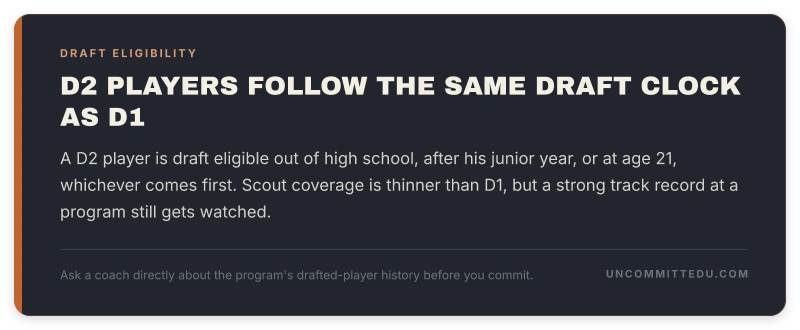
If pro ball is the real goal, a D2 program with a strong track record of drafted players and a coaching staff connected to scouts can matter more than the division label on your jersey. Check any program’s alumni history directly with the coach during a call, using our how to email a college baseball coach guide to open that conversation.
A useful gut check: search a program’s roster page for a “drafted alumni” or “pro alumni” list before you commit to it as a pro pipeline school. Programs that take pro development seriously usually publish this list themselves. It is a real recruiting asset for them. A program with no such page, and no clear answer when a coach is asked directly, is telling you something too.
Velocity and exit velocity numbers travel across division lines faster than a team’s win total does. A D2 arm sitting in the mid nineties gets scouted the same way a D1 arm at that velocity would, and a scout who hears about that number at a small D2 school will make the same drive. The division label opens doors. The radar gun number decides who walks through them.
How the D2 baseball postseason works
D2 baseball runs its own bracket, separate from D1 and D3. Conference champions and at large teams open in regional pools, then advance into a best of three super regional round.
The eight teams that survive both rounds move on to the NCAA Division 2 Baseball Championship, held annually in late May into early June. Winning it takes a program through three straight elimination rounds, which is why D2 postseason runs are treated as a real accomplishment inside the level, not a consolation bracket behind D1.

None of this changes eligibility or academic rules along the way. A player chasing a postseason run still needs to clear the same NCAA baseball eligibility requirements as every other division.
Regional pools are usually seeded around a host site, so a strong regular season can earn a program the right to host and play every postseason game in front of its own crowd. That home field advantage is a real edge in a short, elimination heavy format, and it is one more reason conference standings matter well before May.
How to get recruited to a D2 program
D2 recruiting runs on the same four channels as every other level: direct outreach, verified event numbers, summer ball connections, and a public recruiting profile a coach can find and click.
Start by building a list of D2 programs at your talent level, not just the ones you already know by name. Many strong D2 staffs recruit quietly, without a national media budget, so a cold email with real video and real numbers gets read more often than it would at a bigger program.

Use a coach directory that already has D2 programs filtered and questionnaire links attached, so you are not hunting down 261 separate contact forms one at a time.
Fill out the program’s own questionnaire before you ever send an email. Coaches often route new recruits through that form first. An email that skips it can sit unread while the questionnaire pipeline gets checked on a set schedule. Doing both, questionnaire first, then email, gets you into a program’s system the fastest.
Keep your outreach specific to each program. A generic email sent to sixty D2 coaches at once reads as a mass mailer, and most coaches can spot one in the first sentence. Name the school and a specific reason it fits your game, your major, or your grad year plan. That one line of specificity does more work than a longer, generic pitch ever will.
Building that first Division 2 list is step 4 of the course, and it filters for D2 fit before you write a single email.
Is D2 baseball good? Who it actually fits
“Good” depends on what you are optimizing for. If the goal is the most possible scholarship money for a mid to strong high school player, D2’s 9.0 equivalencies often beat what a marginal D1 roster spot pays. If the goal is maximum exposure to pro scouts, D1 still carries more raw scout traffic per program.
D2 tends to fit players who want real competition, real scholarship money, and a shorter bench than a big D1 roster, without giving up the postseason structure or the pro pipeline entirely. It is also a common landing spot for players who transfer down from D1 to find consistent playing time.

Compare your own numbers against level benchmarks before you decide. Our what college baseball level am I tool scores your stats against real D1, D2, D3, NAIA, and JUCO ranges, no guessing required.
Weather and conference geography matter more at D2 than the rankings suggest. A D2 conference clustered in a warm weather region plays more early season games outdoors, which means more live at bats and innings logged before a northern D1 team has even opened its season indoors. That extra game volume can matter as much as the division label when a scout is comparing two players with similar tools.
D2 baseball academics and eligibility
Academic eligibility at D2 runs on the same NCAA Eligibility Center registration and core course requirements as D1, spelled out directly on the NCAA’s own eligibilitycenter.org site. A recruit needs the same 16 core courses tracked on the same sliding scale against GPA and test scores, and the same Eligibility Center fee applies, $120 for domestic students and $180 for international students.
The gap between D1 and D2 academics shows up in admissions, not eligibility. D2 schools generally carry a wider admissions range than flagship D1 programs, which opens the door for strong players whose transcript would not clear a more selective D1 school’s general admissions bar, separate from athletics entirely.

Register with the NCAA Eligibility Center as early as sophomore year regardless of which division you are targeting. A clean, verified academic file removes one entire category of recruiting risk before a coach ever has to ask about it. Our full NCAA Eligibility Center registration guide walks through the exact steps and deadlines.
Eligibility clock rules now match at D1 and D2. Since August 2026, Division II runs the same age-based model as Division I: one five-year period of eligibility that starts at the earlier of your first full-time college enrollment or the academic year after your 19th birthday, and it counts no seasons.
Athletics redshirt rules and medical hardship waivers were eliminated with it, effective 2026-27. None of that changes based on scholarship size or roster count. Review the full NCAA redshirt rules for baseball before you assume a lost season costs you a year of eligibility.
Transfer rules run on the same NCAA transfer portal system too, regardless of division. A D2 player who wants to move up to D1, or down to D3 or JUCO, follows the same portal entry window and notification process as anyone else in the sport. Division is not a separate transfer track, it is a filter you apply once you are already inside the portal searching for a new roster spot. Read our baseball transfer portal guide before you enter it, since the notification window and communication rules trip up more players than the roster search itself.
Frequently asked questions
How many D2 baseball programs are there?
There are 261 NCAA Division 2 baseball programs as of the 2025-26 season, more than either D1 or NAIA field for the sport.
Does D2 baseball offer scholarships?
Yes. A D2 baseball program can award up to 9.0 scholarship equivalencies across its roster, split as partial awards for almost every player who receives one.
Does D2 baseball have a roster limit?
No NCAA mandated roster limit applies to D2 baseball. D1 adopted a 34 player cap in 2025 under the House v. NCAA settlement, but D2 was not part of that settlement and set roster size on its own.
Can D2 baseball players get drafted?
Yes. D2 players follow the same MLB draft eligibility rules as D1 and D3 players: eligible out of high school, after junior year, or at age 21, whichever comes first.
Is D2 baseball better than JUCO?
Neither level is strictly better. D2 offers up to 9.0 scholarships and a four year degree track from day one, while JUCO offers a shorter, cheaper path and a reset on the NCAA eligibility clock. A player chasing scholarship money and stability usually leans D2. A player who needs two years to develop, get seen, or fix grades usually leans JUCO.