
Verbal Commitment College Baseball: 5 Real Rules
Updated September 2026. Sourced from the NCAA recruiting calendar, NCAA rules on verbal commitments, and the uncommittedu.com coach directory of 1,689 programs.
Verbal commitment college baseball rules confuse almost every recruit and parent who searches the term, because a verbal commitment is a spoken agreement, and it carries no legal weight at all. Every recruiting forum treats it as a finish line, but the NCAA does not regulate it, does not track it, and does not enforce it in any way.
That gap between how people talk about a spoken agreement and what it actually is causes real confusion for players and parents. This guide covers exactly what a verbal commitment means, when it can happen, what can break it, and what actually makes it final.
None of this is about whether you should verbally commit early or late. It is about understanding the rules well enough to make that call with real information instead of forum folklore.
- What a verbal commitment to a college baseball program actually is
- The NCAA rules that govern when a verbal yes can happen
- Why a verbal pledge is not legally binding for either side
- What actually finalizes it now that the NLI is gone
- How a spoken agreement differs across D1, D2, D3, NAIA, and JUCO
- Common ways a verbal commitment falls apart, and how to protect yours
Key takeaways
- A verbal commitment is a spoken statement of intent. It is not a contract, and the NCAA does not track or enforce it.
- College coaches cannot make recruiting calls or extend a verbal offer before June 15 after a player’s sophomore year.
- Either side can back out of a spoken agreement at any point before a written offer of athletic aid is signed.
- The National Letter of Intent ended in October 2024. A written offer of athletic aid is what makes it official now.
- D3 programs cannot offer athletic scholarships, so a D3 verbal yes is not tied to scholarship money at all.
- The uncommittedu.com coach directory carries questionnaire links for 97.9 percent of the 1,689 programs we track.
Verbal commitment college baseball: what it actually means
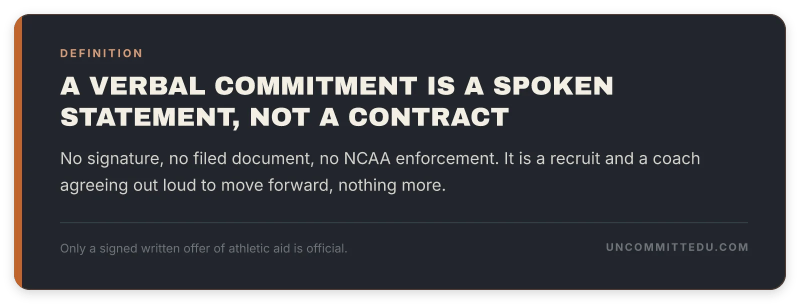
A verbal commitment is a spoken or informal agreement in which a recruit tells a coach he intends to play at that school, and the coach tells the recruit a roster spot and scholarship offer stand. Nothing is signed. Nothing is filed with the NCAA. It is a statement of intent, made out loud or in a text or email, and nothing more.
Because it feels significant, players and families often treat a spoken agreement as equivalent to signing. It is not. It carries social weight, since both sides usually stop actively recruiting elsewhere once it happens, but it carries no legal weight whatsoever.
Build a free recruiting profile at uncommittedu.com before you get anywhere near that conversation. A coach needs something concrete to point to when he floats an offer.
The term itself comes from contrast with a signed agreement. Before the National Letter of Intent ended, a verbal commitment was the informal step before that formal signing period. That structure is gone, but the informal verbal step still happens the same way it always did.
NCAA rules that govern when a verbal commitment can happen
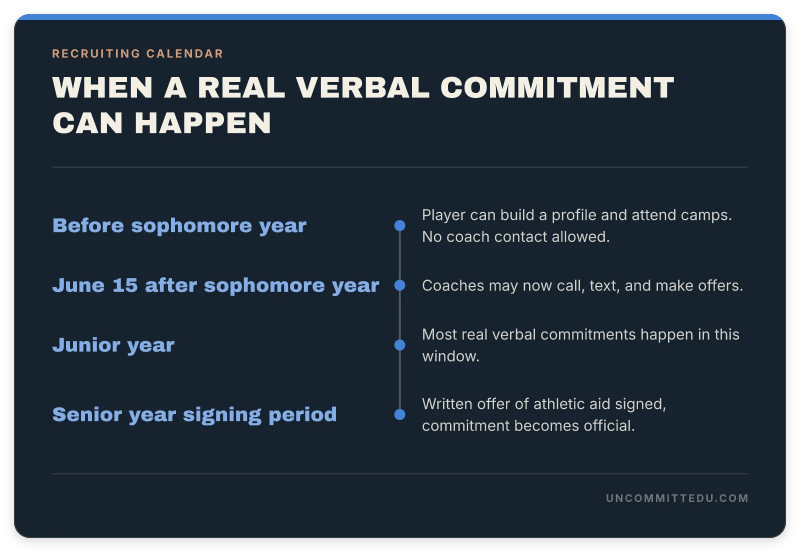
The NCAA does not have a rule that directly regulates verbal commitments, because it does not recognize them as an official recruiting event. What the NCAA does regulate is contact. Under the current baseball recruiting calendar, published on ncaa.org/sports/baseball, a college coach cannot call, text, or make an offer before June 15 following a player’s sophomore year of high school.
Since a coach cannot legally extend an offer before that date, a real verbal yes cannot happen before it either. A player can express interest in a school earlier. A coach can express informal interest back, but neither side can make the kind of offer a genuine verbal commitment actually requires until the calendar allows contact.
See our full college baseball recruiting timeline for the exact dates by grad year. It also covers how the calendar shifts for transfer portal recruits.
Some sports outside baseball allow much earlier contact, and stories about eighth grade verbal pledges in other sports get shared as if the same rule applies everywhere. It does not. Baseball’s June 15 rule is stricter than several other sports, and a coach who breaks it risks an NCAA recruiting violation for the program.
Why a verbal commitment is not legally binding
A spoken agreement has no signature, no filed document, and no enforcement body behind it. That means either the recruit or the coach can walk away from it at any point, for any reason, without any formal consequence.
The only thing that makes a baseball commitment official is a written offer of athletic aid, signed by both the school and the player. Until that document exists, a verbal yes is only a plan. It is not an obligation either side must follow.
| Stage | Binding? | What can still change |
|---|---|---|
| Verbal commitment | No | Anything: roster need, coaching staff, player performance |
| Written offer sent | No, until signed | Terms can still be negotiated before signing |
| Written offer signed | Yes | Locked, subject to normal eligibility rules |

This is not a loophole coaches abuse constantly, but it does happen. A coaching change is the single most common reason a spoken agreement falls apart, since a new staff has no obligation to honor a previous staff’s informal promises. Read our baseball recruiting red flags guide for other warning signs worth watching for during this stretch.
What replaced the National Letter of Intent
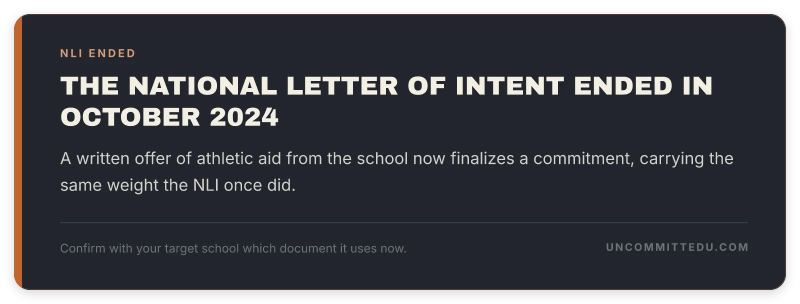
Older recruiting content tells you a verbal yes eventually becomes official through a National Letter of Intent, or NLI. That document no longer exists. The NCAA ended the National Letter of Intent in October 2024.
In its place, a written offer of athletic aid issued directly by the school is what finalizes a commitment. It spells out the scholarship amount and the terms of the offer. It carries the same practical weight the NLI used to carry, just without a separate national signing system behind it.
Sometimes an older article, a camp director, or a well meaning family friend still references signing an NLI. That information is out of date. Ask your target school directly what document it now uses to finalize an offer of athletic aid.
Verbal commitment differences across D1, D2, D3, NAIA, and JUCO
A verbal commitment means slightly different things depending on the level, mostly because of how scholarship money works at each one. D1 baseball moved to a 1:1 scholarship model with a 34 player roster cap after the 2025 reform. A D1 verbal yes often comes with a specific, meaningful scholarship number attached because of that shift.
D2 programs split 9.0 scholarship equivalencies across a full roster with no NCAA roster cap, so a D2 spoken agreement usually involves a partial award rather than a full ride. Our college baseball scholarships guide breaks the real math down level by level.
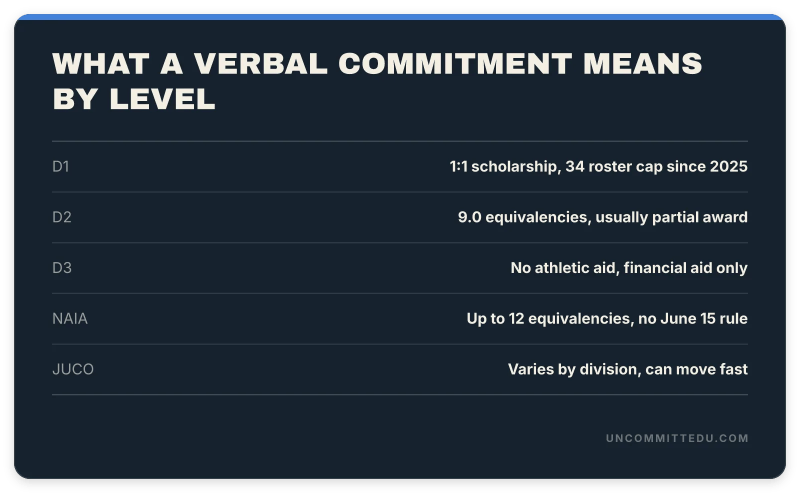
D3 verbal pledges are not tied to athletic scholarship money at all, since D3 programs are barred from offering athletic aid. A D3 verbal yes is really a pledge to attend and play. It is backed by the school’s normal financial aid process rather than an athletic scholarship offer.
NAIA programs split up to 12 equivalencies. They often move faster on this than NCAA programs, since NAIA does not follow the same June 15 contact restriction. JUCO programs vary widely by division and by state. A JUCO verbal commitment can sometimes convert to a signed offer within days rather than months.
Common ways a verbal commitment falls apart
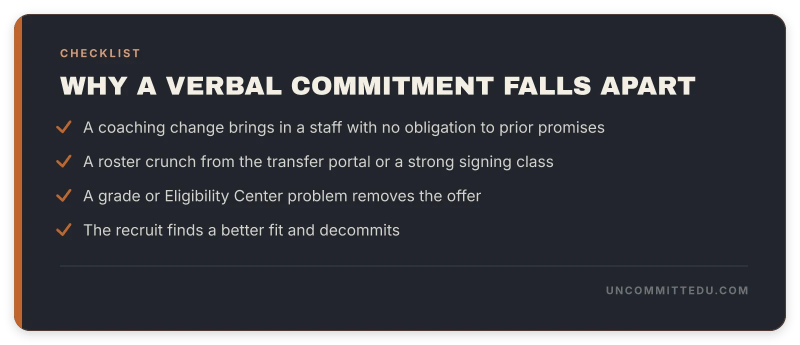
Most broken verbal commitments trace back to one of a small number of causes, and most of them are avoidable with the right process. Recognizing the pattern protects you from being blindsided.
- A coaching change. A new staff reviews the full recruiting class and is not bound by prior verbal promises.
- A roster crunch. Transfer portal additions or an unexpectedly strong signing class can crowd out a verbal yes at the same position.
- A grade or eligibility problem. A recruit who cannot clear the NCAA Eligibility Center loses the offer regardless of talent.
- The recruit finds a better fit. Spoken agreements run both directions, and players decommit for better offers too.
Protecting it means staying in regular contact with the coaching staff, keeping your grades and test scores at the level that earned the interest, and continuing light outreach with backup programs until the written offer is actually signed. None of that is about distrust. It is about treating a verbal commitment for what it actually is, a strong signal rather than a guarantee.
How to protect a verbal commitment once you make one
A verbal yes survives longer when both sides keep communicating openly instead of going quiet. Silence gets misread by both a recruit and a coach, and a misread silence is a common, avoidable way a good situation turns bad.
Ask the coaching staff directly what they expect from you between now and signing. Most staffs will tell you exactly what grades, workouts, or events they want to see. Following through on that list is the clearest way to keep the agreement on track.
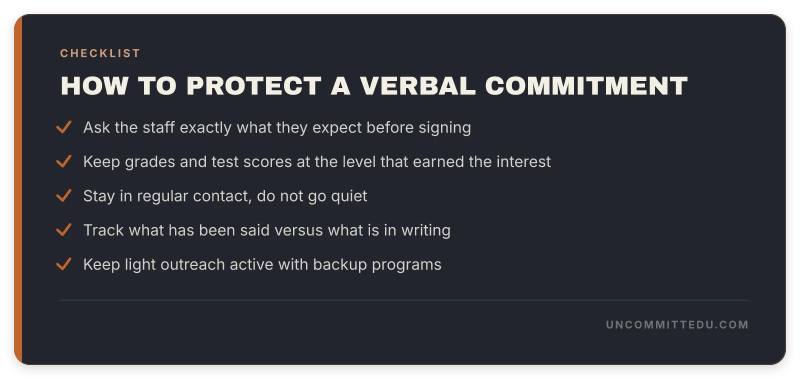
Keep your own recruiting file current even after a verbal yes. Track exactly what has been said out loud, what has been put in writing, and what still needs to happen before the offer is final. A recruit who cannot answer those three questions clearly is not as protected as he thinks he is, regardless of how good the relationship with the coach feels.
Stay realistic about the gap between a spoken agreement and a signed one. A coach who verbally commits to you in July of your junior year is making a real, good faith statement, but a lot can change before a signing period opens the following year. Treating the whole stretch as still active, rather than finished, is what actually protects the outcome you want.
Protecting a verbal commitment is touch seven and after in the course, the stretch where staying organized matters more than staying nervous.
What college coaches actually mean when they say verbal commit
Coaches use the phrase verbal yes loosely. It can mean slightly different things depending on the program and the point in the recruiting cycle. Understanding what a specific coach means by it protects you from reading more certainty into a conversation than actually exists.
At an early stage, a coach saying you have a verbal offer often means you are one of several players being considered for a limited number of remaining spots. It is real interest, backed by a real scholarship number, but it is not exclusive until both sides say so directly. Ask the coach point blank whether other players are being considered for the same roster spot.
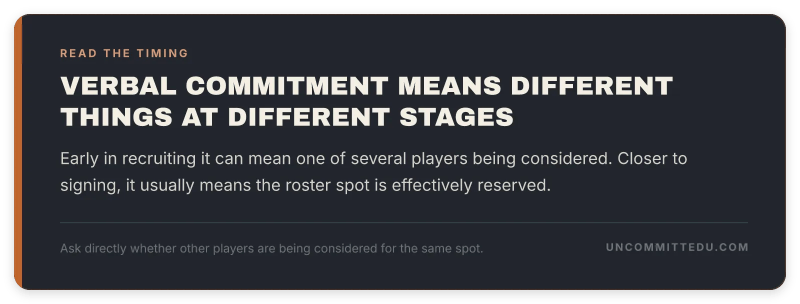
Later in the process, closer to a signing period, a verbal yes from a coach usually does mean the roster spot is effectively reserved for you, pending the written offer of athletic aid. The language does not change, but the certainty behind it grows as the recruiting class fills in. Read the timing, not just the words, when a coach uses this phrase.
A recruit’s own verbal yes works the same way in reverse. Saying you are verbally committed early in your sophomore or junior year signals strong intent, but it does not carry the same weight as saying it during your senior year signing window, when both sides are much closer to a written offer. Be honest with other coaches about where you actually stand at each stage. Misrepresenting an early verbal as a done deal can cost you real opportunities elsewhere.
Should you verbally commit early or wait?
There is no single right answer. Any guide that claims otherwise is oversimplifying a real tradeoff. Committing early locks in a roster spot and ends the stress of an open recruiting process. It also closes the door on programs that might make a better offer once you have more film, more strength, and more development behind you.
A player with an offer from a program that is clearly the right fit, academically and athletically, gains little by waiting purely to see what else appears. A player who is still developing quickly, especially a sophomore or early junior, often benefits from staying patient. Letting more programs see updated numbers before committing to anything usually pays off for that player.
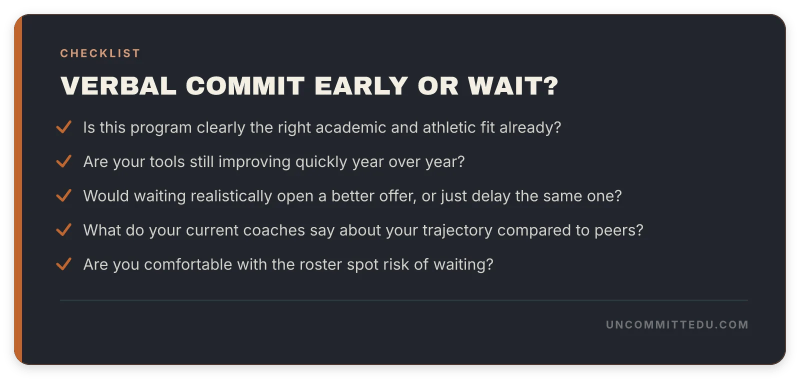
Consider your own growth curve honestly. A player who added several miles per hour to his fastball or several points to his exit velocity between sophomore and junior year has real reason to believe another jump is coming. Locking in too early can mean settling for an offer well below what a later version of the same player could have earned. On the other hand, a player whose tools are already close to fully formed loses little by committing as soon as the right offer appears.
Talk to your current coaches honestly about where your recruiting profile actually stands compared to your peers. A travel ball or high school coach who has walked other players through this same decision can often see your trajectory more clearly than you can from inside it. That outside perspective is worth more than any single forum thread on the subject.
Verbal commitment etiquette that actually protects your reputation
Baseball recruiting is a small world, and coaches talk to each other more than most recruits realize. How you handle a verbal commitment, and how you handle backing out of one if it comes to that, follows you for the rest of your recruiting process.
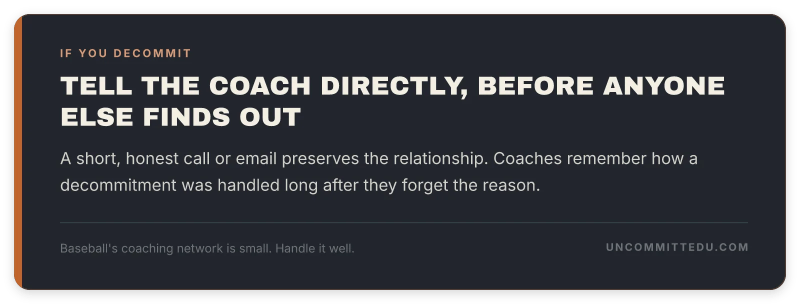
Tell a coach directly and promptly if you decide to decommit, rather than letting him find out secondhand. A short, honest call or email explaining your decision preserves the relationship far better than silence followed by a public announcement elsewhere. Coaches remember how a decommitment was handled long after they forget the reason behind it.
The same courtesy applies when a coach ends a verbal commitment on his side. A coach who calls to explain a roster change, rather than simply going quiet, is doing the recruit a real favor. Recognize that gesture and respond professionally, since baseball’s coaching networks are small enough that a good impression here can resurface in a positive way years later.
Keep every verbal commitment conversation, on either side, free of pressure tactics. A coach pushing for an immediate answer on the spot, or a recruit demanding a decision within days, usually signals a process moving faster than the actual information supports. Take the time a real decision deserves, and expect a program worth committing to will extend you the same courtesy.
Parents play a real role in how verbal commitment conversations go, and that role works best when it stays supportive rather than directive. A coach generally wants to hear from the recruit directly about his own decision, with a parent present for logistics and questions rather than doing the talking. Recruits who can speak clearly for themselves about why a program fits leave a stronger impression than ones who defer every question to a parent in the room.
Document every verbal commitment conversation in writing after it happens, even though the commitment itself is not a legal document. A short follow-up email from the recruit or parent, summarizing what was discussed and thanking the coach for the offer, creates a clear record of what was actually said. That record protects everyone if a disagreement about the terms comes up months later, and it costs nothing more than a few minutes to send. Keep a copy of every such email in one folder alongside your recruiting profile, so the full timeline is easy to produce if anyone ever needs it.
Frequently asked questions
Are there any NCAA rules about verbal commitments?
No specific rule governs verbal commitments directly, since the NCAA does not recognize them as an official event. The NCAA does regulate contact timing, and a coach cannot make an offer before June 15 following a player’s sophomore year.
What is a verbal commitment to college athletics?
It is a spoken or informal statement in which a recruit says he intends to attend and play at a school, and a coach confirms a roster spot and scholarship offer stand. It is not a contract and carries no legal weight.
When can I verbally commit to a college for baseball?
A real verbal commitment cannot happen before a coach is legally allowed to make contact, which is June 15 following your sophomore year of high school under current NCAA rules.
Is a verbal commitment legally binding?
No. Either the recruit or the coach can back out of a verbal commitment at any point before a written offer of athletic aid is signed by both sides.
Does a verbal commitment mean anything?
It means both sides intend to follow through, and it usually reduces active recruiting on both ends. It does not carry legal weight, and it is not the same as a signed offer of athletic aid.