
JUCO Baseball Explained: The Best Kept Secret
JUCO baseball gets treated as a fallback option. It shouldn’t be. It’s a real, legitimate path, and often the smartest one for a player who needs more development time.
This explains exactly how it works and why it’s not “lesser.” For the full picture, see the college baseball level guide.
Quick answer: JUCO (NJCAA) baseball is a two-year path many players use to add strength, refine mechanics, and raise their academic standing, then transfer to a D1 or D2 program with a far stronger recruiting profile than they had out of high school.
Key takeaways
- JUCO baseball runs under the NJCAA across three divisions with very different scholarship rules.
- JUCO baseball gives you at-bats and innings a four-year bench does not.
- The JUCO baseball clock is two seasons, generally within three years of first enrolling.
- Enrolling full time at a JUCO now starts your NCAA D1/D2 five-year eligibility clock.
- Transferable credits, not talent, are where most JUCO baseball plans fail.
- Four-year staffs recruit JUCO baseball players a full year before they arrive.
What is JUCO baseball, exactly?
JUCO baseball is college baseball played at two-year junior colleges, governed by the NJCAA rather than the NCAA. Players compete for two seasons, then transfer to a four-year program or finish an associate degree and move on. JUCO is simply short for junior college.
That is the mechanical answer. Here is what it means in practice.
- Two years, not four. A JUCO baseball roster turns over fast, which is why playing time arrives sooner than it does on a four-year bench.
- Its own governing body. The NJCAA writes the eligibility, recruiting and scholarship rules for JUCO baseball. NCAA rules do not carry over.
- Three divisions, three different scholarship pictures. NJCAA Division I, II and III are not interchangeable, and the table further down spells out the gap.
- A transfer route by design. Four-year staffs recruit JUCO baseball players deliberately, because those players arrive with recent in-season numbers against college pitching.
Put plainly: JUCO baseball is a two-year development level inside the college system, with its own rulebook and a well-worn exit ramp to D1 and D2.
JUCO programs fall under the NJCAA, with their own divisions, eligibility clock, and rules, separate from the NCAA entirely.
Two-year colleges field competitive baseball programs, some at a very high level, with a direct pipeline to four-year transfers.
NJCAA divisions at a glance
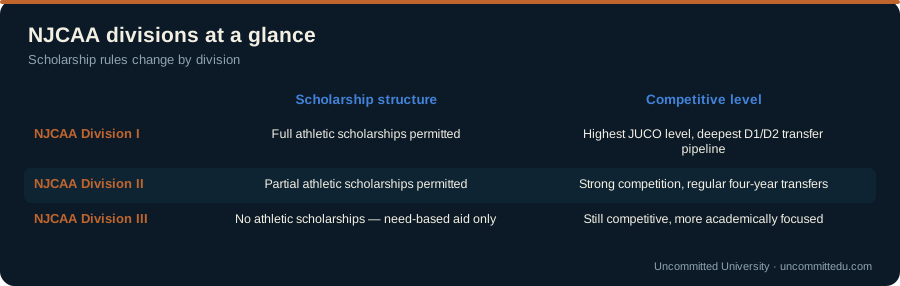
The table below compares the three NJCAA divisions, because JUCO baseball is not one uniform level.
| NJCAA division | General scholarship structure | Typical competitive level |
|---|---|---|
| NJCAA Division I | Full athletic scholarships permitted | Highest level of JUCO competition, deepest D1/D2 transfer pipeline |
| NJCAA Division II | Partial athletic scholarships permitted | Strong competition, regular four-year transfers |
| NJCAA Division III | No athletic scholarships (need-based aid only) | Still competitive, more academically-focused programs |
This structure runs parallel to, and separate from, the NCAA’s own D1/D2/D3 system covered elsewhere on this site, a common source of confusion for families new to the process.
Why JUCO baseball is underrated as a developmental path
- More development time. Extra strength, mechanics work, and physical maturity before a four-year commitment.
- A real season of college-level stats and film. Coaches trust current college performance more than high school numbers.
- A path to raise your academic standing. Struggling grades in high school don’t have to close doors permanently.
- Often a lighter financial commitment while you build your recruiting profile further.
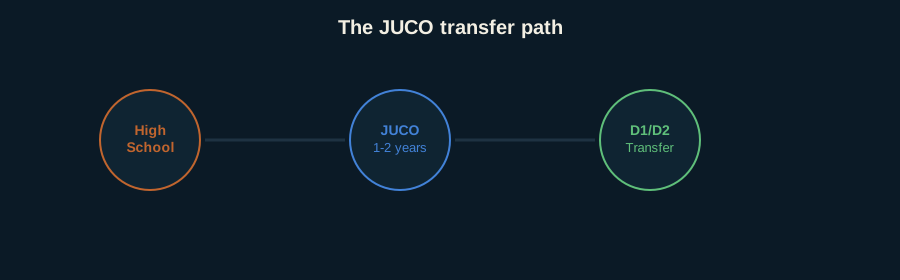
The diagram below traces the JUCO baseball development and transfer path end to end.
How the JUCO eligibility clock works
The JUCO clock only makes sense next to the NCAA one, and the NCAA clock now runs on age: it starts the academic year after you turn 19. Our NCAA age limit guide walks through exactly when it starts and what pauses it.
JUCO eligibility generally runs on its own two-year clock, set by the NJCAA. In practical terms, that means a player typically has two seasons of JUCO competition available before needing to transfer or exhaust eligibility at that level.
What changed in 2026 is the second clock running alongside it, and it is now the most important thing for a JUCO baseball player to understand. NCAA Divisions I and II adopted an age-based eligibility model (Division I in June 2026, Division II in August) under which a five-year period of eligibility begins at your first full-time enrollment at any college. The NCAA names junior colleges explicitly. So the day you enroll full time at a JUCO, the NCAA clock starts, whether or not you ever play an NCAA game.
Two years at a JUCO therefore spends two of those five calendar years, leaving three at the four-year school, if you enroll straight out of high school and stay enrolled. The clock does not pause because you did not compete, transferred, sat out or stepped away from the sport. The other trigger matters to anyone taking a gap year: if you turn 19 before Sept. 1, the period starts at the beginning of the next regular academic year even if you have not enrolled anywhere. Our JUCO eligibility clock guide works through the timing case by case.
NJCAA redshirt rules, medical hardship provisions and transfer timing all interact with the JUCO clock in ways that vary by situation. Do not carry any of them across to the NCAA side. Divisions I and II eliminated athletics redshirt rules and medical hardship waivers outright in 2026, and only pregnancy, active-duty military service and official religious missions can now pause a five-year period.
A compliance office at the JUCO program is the reliable source for a player’s specific eligibility picture, not a general assumption carried over from high school or another level, and for the NCAA side of it, ask the four-year school you are transferring into.
Cost and financial aid in JUCO baseball
One of the most underrated parts of JUCO baseball is cost. Many JUCO programs, especially at the NJCAA D1 level, offer meaningful athletic scholarship money, and tuition at a two-year public college is frequently a fraction of a four-year private or out-of-state program.
- A player can use two lower-cost years to build a stronger recruiting profile before committing to a more expensive four-year program
- Academic scholarships and need-based aid often stack with athletic aid in ways that aren’t always possible at the four-year level
- A strong JUCO transfer with two years of eligibility left is frequently a more attractive scholarship target for a four-year program than an unproven freshman
See if JUCO fits your numbers
Check your real stats against every level, JUCO baseball included.
How JUCO-to-D1/D2 transfers actually work
D2 deserves a hard look on this path, and its eligibility math has its own rules. The D2 eligibility rules guide covers what transfers in and what does not.
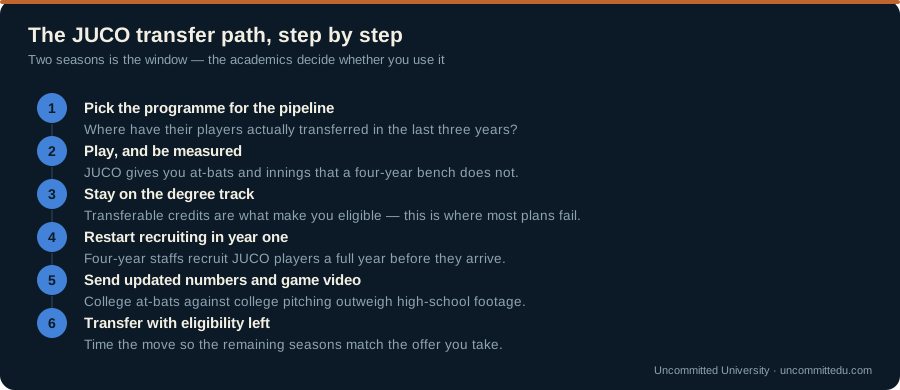
The steps below are the JUCO baseball transfer path in sequence, with the credit check where it belongs.
Coaches at four-year programs actively recruit JUCO players, especially ones performing well in-season. A strong JUCO season is often a stronger recruiting asset than a high school profile alone.
Track your stats and film throughout your JUCO season, and treat outreach to four-year programs the same way you would as a high schooler: build a target list, email coaches directly, and follow up.
Communication between JUCO and four-year coaching staffs happens more often than families expect. Many four-year coaches have working relationships with specific JUCO programs and check in on rosters regularly, which is another reason a strong, well-documented JUCO season tends to travel further than players assume.
How to choose the right JUCO baseball program
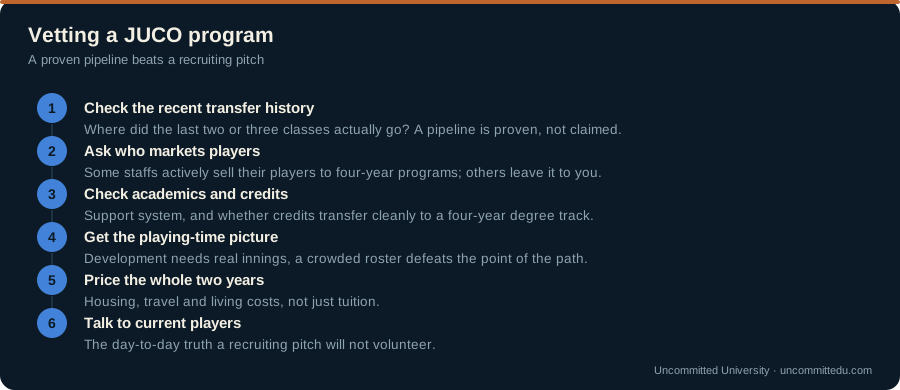
- Look at recent transfer history. A program with a strong, recent track record of sending players to D1 or D2 programs has a proven pipeline, not just a claim.
- Ask about the coaching staff’s role in transfer recruiting. Some JUCO coaches actively market their players to four-year staffs; others leave it entirely to the player.
- Check the academic support available. If academics were part of what brought a player to JUCO, the support system there matters as much as the baseball program.
- Understand the roster and playing time picture honestly. Development requires actual innings and at-bats: a crowded roster with limited playing time defeats the purpose of the JUCO path.
- Weigh geography and cost of living, not just tuition. Two JUCO programs with similar baseball reputations can differ significantly in total cost once housing, travel, and living expenses are factored in.
- Talk to current or recent players, not just the coaching staff. A player who’s lived the day-to-day experience can offer a perspective on culture and development that a recruiting pitch won’t.
What actually changes for a player in JUCO baseball
The day-to-day experience surprises a lot of families who assume JUCO is simply a smaller version of a four-year program:
- Class sizes and campus life are often closer to a large high school than a traditional four-year college experience, since many JUCO campuses are commuter-focused.
- Practice and competition schedules are frequently just as demanding as a four-year program, since coaching staffs are actively building players toward a transfer.
- The roster turns over faster. With players cycling through in one or two years toward transfers, a JUCO locker room looks different year to year than a four-year program’s does.
- Living situations vary widely: some JUCO programs have dorms and a full athletic department, others expect players to find their own housing near campus.
None of this makes JUCO harder or easier than a four-year program. It’s simply a different structure, and knowing what to expect ahead of time avoids an unpleasant surprise in year one.
JUCO baseball compared to going directly to a four-year program
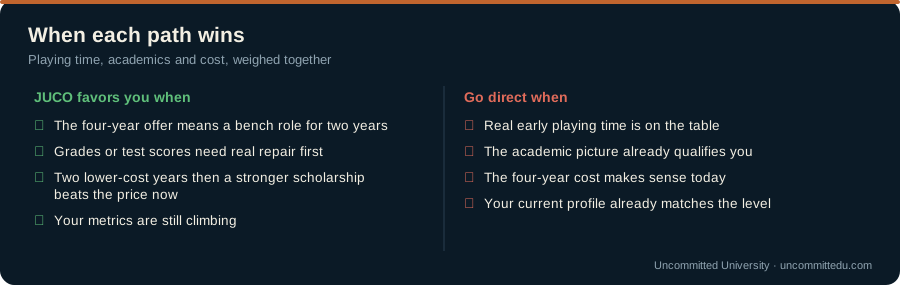
For a player sitting right on the edge between a JUCO offer and a four-year offer, a few honest questions help clarify the decision:
- Would the four-year offer mean a bench role for two years, or real early playing time? Real innings at JUCO often develop a player faster than a bench role at a four-year program.
- Is the academic situation a genuine concern? If grades or test scores are marginal, JUCO buys real time to fix that before it becomes a bigger problem later.
- Does the four-year program’s cost make sense right now, or would two lower-cost JUCO years followed by a stronger scholarship offer make more financial sense overall?
There’s no universally correct answer: the right call depends on playing time, academics, and cost, weighed together rather than any one factor alone.
It’s also worth remembering that this isn’t always a binary choice made once. Plenty of players commit to a four-year program, struggle for playing time or academic footing, and later transfer down to a JUCO program to reset and rebuild: the path runs in both directions, not just JUCO-to-four-year.
Questions to ask a JUCO baseball coaching staff
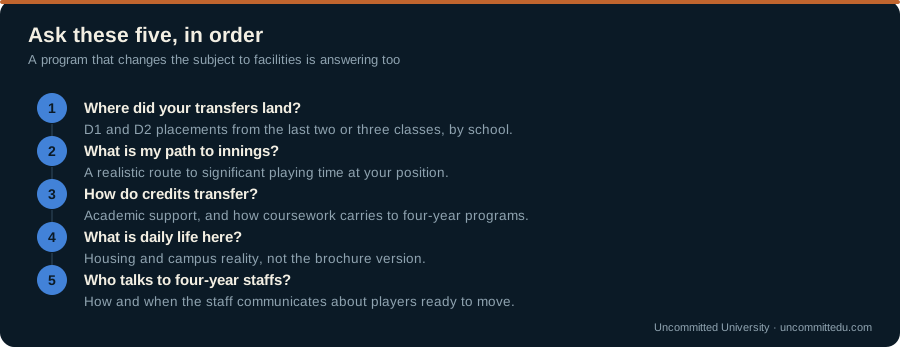
- How many players have transferred to D1 or D2 programs in the last two or three years, and to which schools?
- What does a realistic path to significant playing time look like at this position?
- What academic support is available, and how do credits typically transfer to four-year programs?
- What does housing and campus life actually look like day to day?
- How does the coaching staff communicate with four-year programs about players ready to transfer?
Who JUCO baseball is a realistic fit for
- Players who need more physical development before a four-year commitment
- Players whose academics need improvement before qualifying elsewhere
- Players managing a lighter recruiting or financial budget early on
- Late bloomers whose metrics are still climbing
Common mistakes players make when considering JUCO baseball
The checklist below covers what makes JUCO baseball work, next to what quietly wastes the two years.
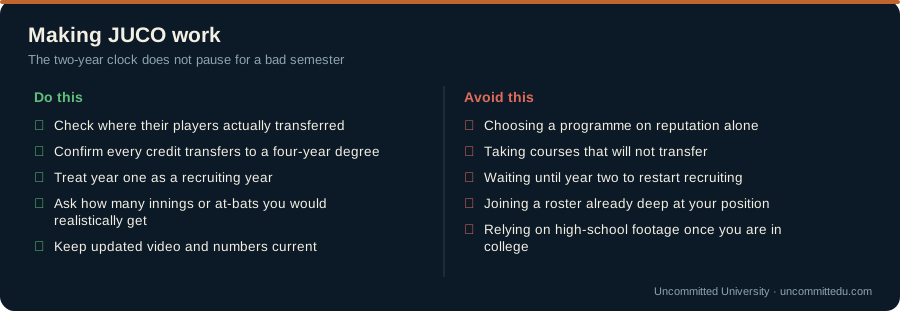
- Treating it as a one-year holding pattern instead of a real commitment. Players who show up without buying into the program rarely get the development or the transfer opportunity they were hoping for.
- Assuming transfers happen automatically. A strong JUCO season creates opportunity, but the player and coaching staff still need to actively market that season to four-year programs.
- Ignoring the academic side. Falling behind academically at JUCO can create the same eligibility problems that may have contributed to needing the JUCO path in the first place.
- Picking a program based on baseball alone, without checking academic transfer credit policies: some credits don’t transfer cleanly to a four-year program, which can cost a player time and eligibility.
Common misconceptions about JUCO baseball
- “JUCO means you weren’t good enough.” Plenty of JUCO players end up at D1 programs. It’s a path, not a ceiling.
- “JUCO doesn’t count for eligibility.” It does: see the recruiting guide for how eligibility works across levels.
- “No one recruits out of JUCO.” Four-year coaches actively scout JUCO rosters, especially in-season.
The JUCO baseball draft rule almost nobody explains
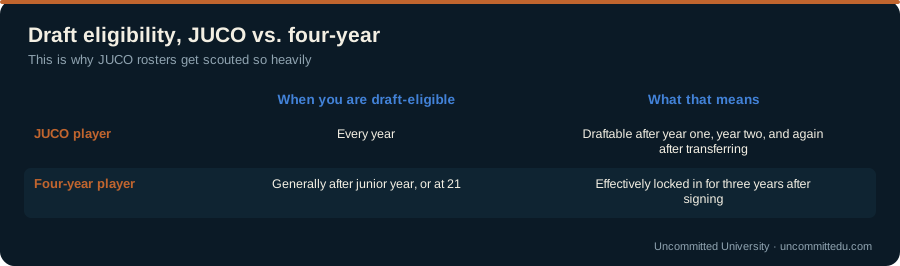
Here is the single biggest structural advantage of the JUCO baseball route, and it has nothing to do with development.
Junior college players are eligible for the MLB draft every year. Players at four-year colleges are not: they generally have to complete their junior year or turn 21 first.
Read that again, because it changes the whole calculation. A player who goes the JUCO baseball route can be drafted after his first year, after his second year, and again after transferring.
A player who signs with a Division I program out of high school and does not sign a pro contract is effectively locked in for three years before the draft is an option again.
That is why you see advisers steer certain high-school players toward JUCO baseball deliberately, rather than as a fallback. It preserves optionality that a four-year commitment removes.
It also explains why JUCO baseball rosters get scouted far more heavily than their level of play alone would justify.
The other half of the structure is the NJCAA itself, which runs three divisions rather than one. NJCAA Division I programs may offer full athletic scholarships including tuition, books, fees and housing. Division II is more limited. Division III offers no athletic aid at all.
So JUCO baseball is not one thing, and comparing an NJCAA Division I offer to an NJCAA Division III offer is a mistake families make constantly.
Now: the trade-offs are real. Two years at a junior college means transferring, which means new coaches, a new campus and credits that have to actually carry across. Academic planning is not optional on this path: it is the path.
Talk to the four-year programs you eventually want while you are still in your first JUCO baseball year, not your last. The schools recruiting sophomores have usually been watching since the previous spring.
How many JUCO baseball programs are there?
511 two-year college baseball programs in 43 states, on the 2026 rosters we track. About 400 of them play under the NJCAA across its three divisions. The rest belong to two bodies the word JUCO usually hides: the California Community College Athletic Association, 86 programs and the single biggest junior college baseball state, and the Northwest Athletic Conference, 28 programs across Washington and Oregon. Neither is NJCAA. Their eligibility rules, scholarship rules (California offers none) and transfer paperwork are their own, so a player recruited by a California JUCO is reading a different rulebook than one in Texas or Florida.
| State | Programs | Mostly |
|---|---|---|
| California | 87 | CCCAA, no athletic scholarships |
| Illinois | 42 | NJCAA |
| Texas | 34 | NJCAA |
| New York | 30 | NJCAA |
| Florida | 23 | NJCAA |
| Alabama, Washington | 18 each | NJCAA, NWAC |
| Kansas, Minnesota, Michigan | 17 each | NJCAA |
Every one of them is in Find Your Level with its coaches, so “what is the best JUCO for baseball” has a better answer than a ranking: the one whose roster your numbers fit and whose transfer pipeline goes where you want to end up.
Is JUCO baseball better than D2 or D3?
Different, not better, and the honest comparison is on four lines. Competition: the top NJCAA Division I programs play at a level that would hold its own in many NCAA D2 leagues, and the bottom of NJCAA D3 would not. D2 and D3 are narrower bands. Playing time: JUCO rosters turn over every two years, so a freshman plays; at a D2 or D3 he may sit behind juniors. Money: NJCAA D1 can offer full rides, NCAA D2 offers partials, D3 offers none athletically, and California JUCOs offer none at all. Time: two JUCO years spend two years of your NCAA five-year period and a D2 or D3 year spends one, but the JUCO route keeps the D1 door open in a way a D3 signing rarely does.
So the question is not which is better. It is which problem you have. A player who needs games and film to be seen should weigh JUCO. A player who has a D2 offer he would be happy to finish at should take it. A player choosing D3 for the school should not talk himself into JUCO for the baseball. The JUCO clock guide has the eligibility arithmetic for each path.
Frequently asked questions about JUCO baseball
Is it hard to play JUCO baseball? Harder than most families expect. NJCAA Division I rosters carry players with D1 offers, bounce-backs from four-year programs and 21 year olds on their second season. The bar to make a roster is real, and the bar to play is a coach’s decision every week. The advantage is that the roster turns over fast, so the chance comes sooner than it does at a four-year program.
Can you go D1 after JUCO baseball? Yes, and it is the most common route into Division I for players who were not recruited out of high school. Coaches recruit JUCO players because they arrive with college at-bats, college innings and a known body. Your NCAA five-year period started with your first JUCO semester, so two JUCO years leave about three at the D1.
Why do so many baseball players go to JUCO? Games, cost and the draft. A freshman plays instead of sitting, tuition is a fraction of a four-year school, and a JUCO player is draft eligible every year instead of waiting until after his junior season. Add the grade repair and the late-bloomer development year, and JUCO is a plan, not a fallback.
What does JUCO stand for? Junior college. In baseball it is shorthand for a two-year college program playing under the NJCAA, and it describes a level rather than any single school or conference.
Is JUCO baseball the same as community college baseball? In everyday use, yes. Most NJCAA member schools are community or junior colleges, and players use the two terms interchangeably. What decides your eligibility is the governing body (the NJCAA), not the word on the sign.
Is JUCO baseball considered NCAA or a separate organization? JUCO baseball operates under the NJCAA, a completely separate governing body from the NCAA, with its own divisions, rules, and eligibility structure.
How many years of eligibility does a JUCO player have? JUCO eligibility generally runs on a separate two-year clock from four-year eligibility, though specifics can vary by circumstance. A compliance office at the school is the authoritative source.
Do JUCO programs offer athletic scholarships? It depends on the division. NJCAA Division I programs can offer full athletic scholarships, Division II offers partial scholarships, and Division III relies on need-based aid rather than athletic scholarships.
Can a player go straight from JUCO to a D1 program? Yes, this is one of the most common and well-established transfer paths in college baseball, especially for players who perform well over their JUCO seasons.
Is JUCO a good option for a player with strong high school grades? It can be, particularly for physical development or cost reasons, but players with strong grades and metrics may have more direct four-year options worth exploring first.
Do MLB scouts pay attention to JUCO players? Yes. JUCO programs, especially at the NJCAA Division I level, have a long track record of producing MLB draft picks, and scouts regularly cover top JUCO programs alongside four-year schools.
The short version: JUCO baseball is a development path with a deadline, not a fallback. Pick the programme for its actual transfer record, keep every credit on a four-year degree track, and restart your recruiting in year one rather than year two. Played that way, JUCO baseball puts a proven college performer in front of four-year staffs with eligibility still on the clock.
The short version
JUCO baseball is a two-year window built for development, playing time and a second look, not a consolation prize. NJCAA Division I can fund a full ride, players are draft-eligible every year, and the level at the top is genuinely good.
The cost is a transfer you have to plan for from day one, with credits that transfer and a degree path that survives the move.
Uncommitted University tells players to choose a JUCO baseball program on the strength of where its players went next, not on its win-loss record.
Ask any junior college staff for a list of where their last three recruiting classes ended up. A program that moves players on will have the answer ready and will be proud of it. A program that does not will change the subject to facilities.
Ask about the academic side with the same directness: who advises on transfer credits, how many players finished an associate degree on time, and which four-year schools they have existing relationships with.
Those two answers tell you more about a JUCO baseball program than any campus visit will.
One financial point worth raising early. Junior college tuition is generally a fraction of four-year tuition, so even a partial award can leave a family paying very little for two years.
For players whose realistic four-year options were expensive and low on aid, that arithmetic alone can justify the route before anyone discusses development or the draft at all.
Your next step
Build a target list that includes JUCO options: see the D1 vs. D2 vs. D3 vs. NAIA vs. JUCO breakdown for the full comparison.
Written by Wayne Keeton, founder of Uncommitted University.