

Baseball Transfer Portal: The Best Guide (2026)
The college baseball transfer portal isn’t just for players who made a mistake picking a school. It’s become a normal, legitimate part of how rosters get built at every level.
This guide covers exactly how it works, the rules, the paths, and the real routes players actually use to end up somewhere better.
Quick answer: The college baseball transfer portal is a formal process for entering your name as available to transfer, with specific windows and NCAA rules governing contact and eligibility. JUCO-to-D1, grad transfers, and walk-on-to-scholarship moves are all common, legitimate paths, not signs something went wrong.
Key takeaways
- The college baseball transfer portal is an NCAA database recording your intent to transfer.
- Entering the baseball transfer portal starts a process, it does not guarantee a new home.
- Three routes run through the baseball transfer portal conversation: JUCO-to-D1, grad transfer and walk-on conversion.
- The baseball transfer portal has specific windows, and the timing shapes every option.
- Credits that do not transfer cost a year the depth chart never will.
What the baseball transfer portal actually is
The baseball transfer portal is a formal NCAA database where a player’s intent to transfer gets recorded, opening the door for other programs to contact them. Entering the portal doesn’t guarantee a new home, it starts the process.
Rules on timing, contact, and eligibility are set by the NCAA, and specific windows apply depending on your sport and situation.
Two separate clocks matter here: your NCAA eligibility clock and your transfer portal window, the specific period your sport allows for entering. Missing your window can mean waiting for the next one, so timing matters as much as the decision itself.
The first of those two changed in 2026, and it changed in the way that matters most to a transfer. NCAA Divisions I and II replaced seasons of competition with a single five-year period of eligibility: Division I in June 2026, Division II in August. It starts at your first full-time enrollment at any college, junior colleges included, or the academic year after your 19th birthday, whichever is earlier.
Then it runs continuously. The NCAA is explicit that it does not pause because a student-athlete does not compete, transfers, sits out, changes teams or takes time away from participation. So a year spent in the baseball transfer portal is a year off the clock, and there is no redshirt left to buy it back, athletics redshirt rules and medical hardship waivers were eliminated by the same legislation. Division III, the NAIA and the NJCAA still count seasons their own way.
Contact rules also depend on who initiates. Once a player enters the portal, other coaches can generally reach out, but a coach contacting a player who hasn’t entered yet, or outside the allowed window, can create real compliance problems for both sides.
The one-time transfer exception
Most undergraduate players get one transfer where they can compete immediately at their new school, without sitting out a year. This is commonly called the one-time transfer exception.
A second undergraduate transfer can still work, but it typically requires a waiver, and approval isn’t automatic. Rules here have shifted more than once in recent years. Confirm your specific situation with both your current and prospective compliance offices before assuming a second move is free.
This is one more reason a rushed, undisciplined transfer decision is risky. Using your one clean transfer on the wrong fit leaves a much harder path if you need to move again.
Why players enter the baseball transfer portal
- Playing time. A deep roster at one program can mean a bigger role somewhere else.
- Fit. Academic, social, or coaching-style fit sometimes doesn’t work out as expected.
- Development path. A JUCO player who’s grown physically may be ready for a bigger opportunity.
- A coaching change. New staff sometimes means a different system or a different role for existing players.
None of these are failures. They’re normal parts of how careers actually progress.
Common baseball transfer portal myths, debunked
- Myth: entering the portal means you’re leaving no matter what. Not true. Entering starts the process; a player can still return to the original program in many cases, depending on scholarship and roster decisions already made.
- Myth: coaches only want portal players with big numbers already. Fit, role, and roster need matter as much as stats. A player who fills a specific gap can beat a bigger name who doesn’t fit the need.
- Myth: the portal is only for players who are unhappy. Plenty of transfers are about opportunity, not conflict: a bigger role, a better academic fit, or a coaching change that opens a new door.
- Myth: once you’re in the portal, offers show up automatically. They don’t. Programs still have to notice you, and direct outreach from the player matters as much as it did in high school recruiting.
- Myth: transferring always costs a year of eligibility. For most undergraduate players using their one-time exception, that’s no longer the case. Confirm your own situation directly rather than assuming an old rule still applies.
Is the college baseball transfer portal the same at every level?
Short answer: no, and eligibility is where the differences bite hardest. If D2 is on your list, read the D2 eligibility rules before you enter the portal, not after.
No. What most people mean by the college baseball transfer portal is the NCAA’s system, and it covers Division I, Division II and Division III. The NAIA and the NJCAA are separate governing bodies that run their own transfer processes instead.
That distinction decides which rules apply to you. Before you assume a window or a waiver is relevant, confirm which body governs your current school and which one governs the school you want.
- NCAA D1, D2 and D3: the college baseball transfer portal proper. You notify your current school, and its compliance office enters your name into the database.
- NAIA: no shared NCAA portal. NAIA schools run their own release and eligibility process, so start with that school’s compliance office or registrar.
- JUCO (NJCAA): separate again, on its own eligibility structure. A JUCO player moving up to a four-year program follows NJCAA release rules, not NCAA portal windows.
One thing holds across all three systems: nobody is obligated to recruit you because you entered. The paperwork only makes you available. The next roster spot still comes from fit, need and film.
Not sure which level you should be aiming at? Sort that out first with the breakdown of every college baseball division, D1 through JUCO.
Baseball transfer portal 2026: the window dates and how the window works
The 2026 Division I baseball transfer window ran June 1 to June 30, thirty days, one window a year. There is no fall window in baseball. Outside those thirty days an undergraduate cannot enter unless the head coach leaves or the team’s postseason ends. The window is the period in which you must notify your school; the recruiting that follows can run all the way to fall enrollment.
| Situation | 2026 rule | What it means for you |
|---|---|---|
| Standard Division I window | June 1 to June 30, 2026 | Written notification to compliance inside the window. The school has two business days to enter your name. |
| Team still playing on June 30 | Five-day window starting the day after the final game | A College World Series roster is not locked out by the calendar. |
| Head coach leaves | 30-day window for that roster, opening shortly after the change is announced | Applies whenever it happens, in or out of season. |
| Graduate student next year | Any time in the academic year, but before the final window closes | The early-entry advantage covered in the grad transfer guide. |
| Scholarship reduced or not renewed | Exception window after the notice | Ask compliance the day you get the letter. |
| Division II and III | No sport-specific window calendar | Notification of transfer can be submitted through compliance at any point; confirm the entry timeline with the school. |
| NAIA and NJCAA | No NCAA portal | Release and eligibility paperwork through the school, on its own schedule. |
The dates come from the NCAA’s Division I notification of transfer windows list for 2025-26 and the June 2026 coverage of the window opening, read 2026-09-12. Baseball coaches have asked the NCAA to move the window, and the ABCA discussed it again in January 2026, so treat the June dates as this year’s rule and check the next year’s list before you plan around it. Enter the window with a target list already built; a month goes quickly when three hundred players enter on the same morning.
How to enter the baseball transfer portal
Entering the portal involves notifying your current school, which triggers your name being entered, and generally opens a specific contact window with other programs. Rules and timing details matter, and specifics shift. Confirm the current process directly with your compliance office before starting.
Go deeper: how to enter the transfer portal, rules and windows.
The diagram below maps the routes through the baseball transfer portal.
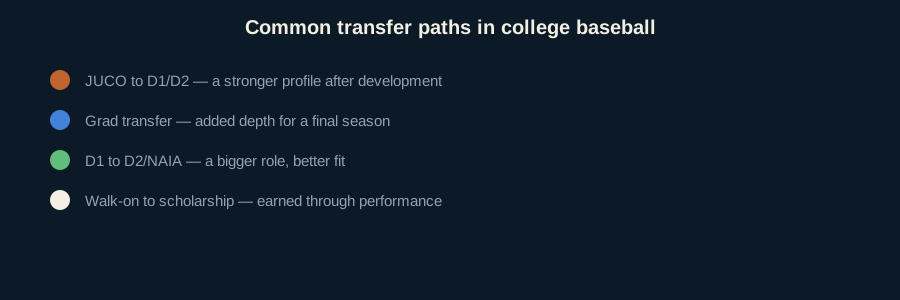
JUCO-to-D1 transfers
One of the most common and successful transfer paths in college baseball. A strong JUCO season with real stats and film often makes a player a more attractive recruit than they were out of high school.
Go deeper: the JUCO-to-D1 transfer path, in full.
Grad transfers
A player who’s completed their undergraduate degree with remaining eligibility can transfer as a grad transfer, often with immediate eligibility to compete, a path used to add experienced depth for a final season.
Go deeper: grad transfer rules for baseball.
Confirm your eligibility before you transfer
See exactly how many seasons you have left before making a move.
Walk-on to scholarship stories
Not every transfer story starts with a scholarship. Plenty of players walk on, earn a role through performance, and get scholarship money later, sometimes at the same school, sometimes after transferring to a program that noticed.
Go deeper: walk-on to scholarship: real paths that work.
Baseball transfer portal paths compared
The table below compares the three baseball transfer portal paths on fit, eligibility and timing.
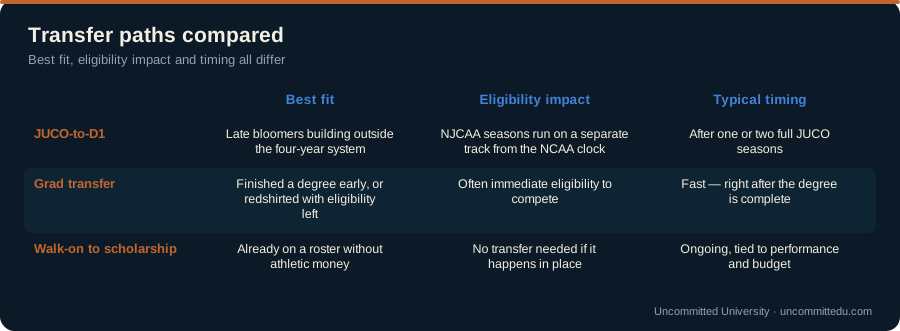
JUCO-to-D1, grad transfer, and walk-on-to-scholarship solve different problems. Here’s how the three stack up side by side.
| Path | Best fit | Eligibility impact | Typical timing | Key requirement |
|---|---|---|---|---|
| JUCO-to-D1 | Late bloomers building strength and stats outside the four-year system | NJCAA seasons run on a separate track from the NCAA clock | Usually after one or two full JUCO seasons | Consistent in-season stats and film, academic credits confirmed |
| Grad transfer | Players who finish a degree early, or banked a season under the pre-2026 rules, with time left on the five-year clock | Often immediate eligibility to compete at the new school | Fast-moving, typically right after the degree is complete | Bachelor’s degree finished, accepted into a grad program at the new school |
| Walk-on-to-scholarship | Players already on a roster without an athletic scholarship | No transfer needed if it happens in place | Ongoing | tied to performance and roster or budget openings | Sustained performance over a season or more |
None of these paths is “better” in the abstract. The right one depends on where a player actually is: physically, academically, and on the roster.
How each path actually plays out
These aren’t real players: they’re composite scenarios reflecting how each path typically works, based on patterns that show up across programs.
- JUCO-to-D1 example: A player goes unrecruited out of high school, plays two seasons at a JUCO program, adds real velocity and strength, and posts a full season of solid stats. A D1 program with a roster need at his position reaches out directly after seeing his in-season numbers.
- Grad transfer example: A player finishes a four-year degree in three and a half years. That leaves well over a year on his five-year period, so he transfers to a program that lost a starter to graduation and steps into an everyday role immediately. Under the age-based rules, finishing the degree early is what creates this move, not a year on the bench.
- Walk-on-to-scholarship example: A player walks on, doesn’t see the field much as a freshman, but keeps grinding in practice. By his sophomore year an injury opens a spot, he takes it and performs, and the program moves him onto scholarship the following year.
The common thread in all three: the player kept performing and stayed ready before the opportunity opened, rather than waiting for it to show up first.
Baseball transfer portal timing considerations that affect every path
Every timing call here sits on top of your five-year clock, and under the 2026 age-based rules that clock starts the academic year after you turn 19. The full breakdown is in our NCAA age limit guide.
Every one of these paths is sensitive to timing, even though the details differ:
- JUCO-to-D1 moves are strongest after a full, completed season of stats, not mid-season, when the sample size is too small to trust.
- Grad transfers tend to move fast once eligibility is confirmed, since programs are usually filling an immediate, specific need rather than planning years ahead.
- Walk-on-to-scholarship conversions happen on a slower, ongoing timeline, tied to a full season (or more) of proof, not a single standout outing.
Whichever path applies, the same rule holds: decisions made with a full season of real data behind them hold up better than decisions made on a hot week.
The calendar matters too, not just your own readiness. Grad transfers and walk-on conversions tend to cluster right after a season ends, when roster gaps become clear. A JUCO-to-D1 opportunity can open earlier, if an NCAA roster loses a player mid-cycle and a coach is scouting JUCO stats to fill the hole fast. Watching program news, not just your own stat line, can put you ahead of the timing.
Where NIL fits into baseball transfer portal decisions
Name, image, and likeness deals have added a real factor to transfer decisions at the highest levels, but they matter far less for most baseball transfers than headlines suggest.
For the large majority of players moving through JUCO, grad transfer, or walk-on paths, the actual value is playing time, fit, and development, not NIL money. Treat any NIL conversation as a bonus on top of a good roster fit, not the reason to pick a school. If numbers are part of the pitch, the NIL calculator puts a realistic range on them in a few seconds.
If NIL does come up, confirm any agreement in writing and understand how it connects (or doesn’t) to your athletic scholarship, since the two are handled separately under NCAA rules.
How to approach a baseball transfer portal decision
The steps below are the order to work a baseball transfer portal decision in.
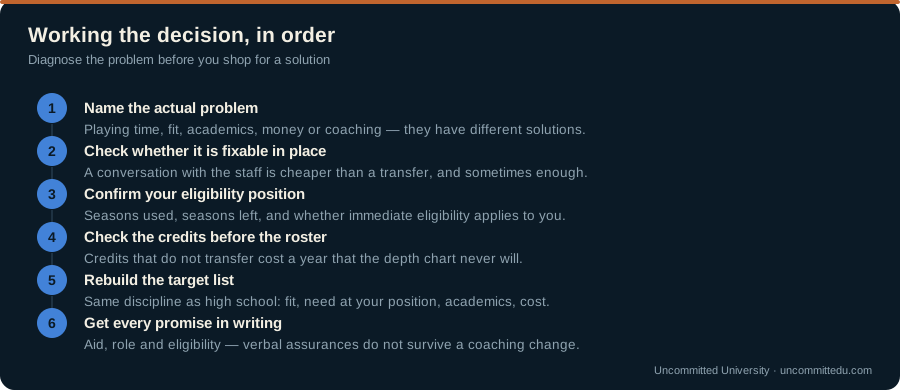
- Get honest with yourself about why you’re transferring: playing time, fit, or opportunity
- Build a target list the same way you did in high school, matched to your current level
- Reach out directly to coaches, with your current stats and film front and center
- Confirm your eligibility and academic transfer credit before committing anywhere
What to confirm before you commit
Before saying yes to a new program (through the portal or otherwise), get these confirmed in writing, not just in conversation:
- Exact remaining eligibility. Get this from your current school’s compliance office, then have the new school confirm it independently.
- Academic credit transfer. Ask specifically which credits transfer and which don’t: this affects both your eligibility clock and your actual graduation timeline.
- Scholarship terms in writing. A verbal number in a phone call is not the same as an official offer. Get the real terms before you commit publicly.
- Your actual role on the roster. Ask directly where you fit depth-chart-wise, not just whether there’s “a spot.”
- The coaching staff’s stability. A coaching change can reset the exact reasons you transferred in the first place. Ask how long the current staff has been in place.
Red flags during a baseball transfer portal decision
The checklist below covers the baseball transfer portal signals worth slowing down for.
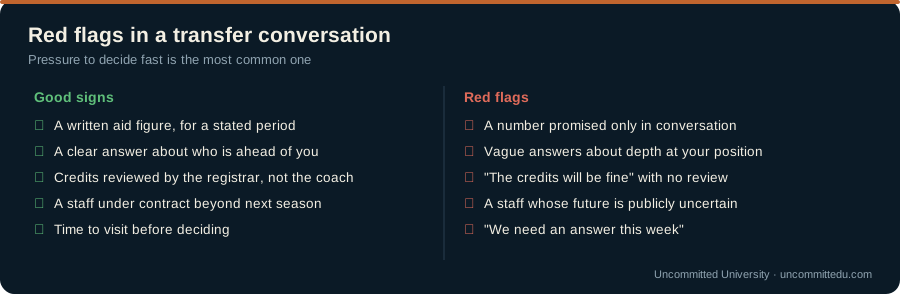
A program recruiting you as a transfer wants you to say yes fast. A few warning signs are worth slowing down for:
- Vague answers about playing time. “We’ll see how camp goes” isn’t the same as an honest depth-chart conversation. Push for specifics.
- Pressure to commit before you’ve confirmed eligibility. A program that discourages you from checking with compliance first is asking you to skip a step that protects you, not them.
- No clear answer on academic credit transfer. If the coaching staff can’t connect you with someone who can answer this, that’s a gap you’ll be stuck untangling later.
- A roster that’s already deep at your position. Interest doesn’t mean need. Ask directly how many players you’re actually competing with.
- Reluctance to put scholarship terms in writing. Any hesitation here is a reason to slow down, not speed up.
None of these automatically rule out a program. They’re just signals to ask more questions before you commit, the same discipline that served you well the first time you were recruited.
Frequently asked questions about the baseball transfer portal
How long does it take to enter the transfer portal? Two business days at most. You give your compliance office written notification of transfer, and the school must enter your name in the portal within two business days. Once your name is in, other programs may contact you. A school cannot refuse to enter you or slow it down, but it can pull your athletic aid at the end of the term, so read your aid agreement before you notify.
Can you enter the transfer portal and not transfer? Yes. Entering makes you available; it does not commit you to leaving. You can withdraw your name and stay if your current program still has a roster spot and scholarship for you, and that is the catch: the school is not required to hold either once you are in. Have the conversation with your coach before you notify, not after.
Can the public view the NCAA transfer portal? No. The portal is a compliance database that only member-school staff can search. The lists on D1Baseball, Baseball America, On3 and 64Analytics are built from schools’ reports, social media posts and players’ own announcements, so they lag the real list and never show everyone in it.
When does the college baseball transfer portal open? It runs on defined windows rather than staying open year-round, and the NCAA sets those dates by sport. They can change from year to year, so confirm the current baseball window with your compliance office before you build a timeline around a date you read somewhere.
Does your coach have to approve a transfer portal entry? No. A coach does not get a veto. Once you submit a written notification of transfer, your school is required to enter your name, the permission-to-contact era ended when the portal replaced it. What a coach can still decide is your roster spot and your athletic aid for the following year.
How many times can a baseball player use the transfer portal? Most undergraduates get one transfer with a clear path to immediate eligibility. A second undergraduate transfer is possible but typically needs a waiver. Confirm your specific case with a compliance office.
Does entering the transfer portal guarantee a scholarship? No. Entering the portal opens the door for contact. A roster spot and scholarship money still have to be earned through fit, need, and performance.
Is the JUCO-to-D1 path different from a regular transfer? Yes. JUCO players fall under NJCAA rules and a separate eligibility structure than a player transferring between two four-year schools.
Do walk-ons need to use the transfer portal to earn a scholarship? No. Walk-on-to-scholarship conversion usually happens at the same school, without transferring, though a walk-on who isn’t getting a real shot may transfer elsewhere.
Can a grad transfer play immediately? Often yes, which is one of the biggest reasons programs recruit grad transfers, but this should still be confirmed directly with both compliance offices.
What’s the biggest mistake players make in the portal? Entering without a real target list ready. Contact from a program is not the same as an offer, and a rushed decision can use up a one-time transfer exception on the wrong fit.
The short version: the baseball transfer portal rewards preparation and punishes urgency. Name the actual problem before you shop for a solution, check whether it is fixable where you are, confirm your remaining seasons, and have the registrar (not a coach) review your credits. Get aid, role and eligibility in writing before you commit, because a verbal promise in the baseball transfer portal does not survive a coaching change.
The short version
The baseball transfer portal is an administrative database, not a recruiting service. You tell your school in writing that you want to transfer, and it has two business days to enter your name. Nobody is obligated to call you after that.
Entering the baseball transfer portal does not end your eligibility and does not force you to leave, but it does let your current school stop holding your roster spot or your aid, which is the risk nobody explains up front.
Uncommitted University advises players to have at least one real conversation with an interested program before entering the baseball transfer portal, not after.
Your next step
Confirm your eligibility first, then build a target list using the D1 vs. D2 vs. D3 vs. NAIA vs. JUCO breakdown.
Build your profile before you enter the portal
A current, verified profile makes it easy for a new coach to evaluate you fast.
Written by Wayne Keeton, founder of Uncommitted University.