

NCAA Baseball Eligibility: The Complete Guide
NCAA baseball eligibility confuses almost every family at some point. The rules span academics, amateurism, and a strict eligibility clock, and they’re different again for NAIA and JUCO.
This guide covers exactly how NCAA baseball eligibility works, level by level, so you know what you actually need to do and by when.
Quick answer: NCAA baseball eligibility requires registering with the Eligibility Center, completing a set number of core courses with a qualifying GPA, and competing inside a five-year period of eligibility that starts at first full-time college enrollment, or at the academic year after your 19th birthday. That five-year period replaced the four-seasons model at Divisions I and II for 2026-27. NAIA and JUCO run separate systems with their own registration and rules.
Key takeaways
- NCAA baseball eligibility covers three separate things: academics, amateurism and a strict clock.
- NCAA baseball eligibility at D1/D2 means 16 core courses and a core GPA of 2.3 (D1) or 2.2 (D2). No test score since 2023.
- The NAIA and NJCAA run their own standards. NCAA baseball eligibility does not carry across.
- Most NCAA baseball eligibility problems are paperwork sent late, not rules that were failed.
- Register in sophomore year and NCAA baseball eligibility stops being a senior-year emergency.
- NCAA baseball eligibility at Division I and Division II now runs on a five-year age-based period rather than four seasons of competition, effective 2026-27.
- Athletics redshirt rules and medical hardship waivers were eliminated in the same change. Division III, the NAIA and the NJCAA are not covered by it.
Why NCAA baseball eligibility exists
NCAA baseball eligibility rules exist to confirm two things: that you meet academic standards to compete, and that you haven’t violated amateurism rules that would make you a professional rather than a student-athlete.
Get this wrong and a player can lose a season of eligibility (or all of it) over a paperwork issue that was entirely avoidable.
What changed in 2026: NCAA baseball eligibility went age-based
The biggest change to NCAA baseball eligibility in a generation landed in 2026. Divisions I and II replaced seasons of competition with a five-year period of eligibility triggered by age and enrollment.
Division I adopted the model in June 2026. The Division II Executive Board adopted matching emergency legislation in August 2026, on the Management Council’s July recommendation. It is effective immediately for the 2026-27 academic year.
Six rules were eliminated outright: seasons of competition, athletics redshirt rules, delayed enrollment and organized competition rules, sport-specific enrollment timelines, academic nonqualifier season limitations at Division I, and the 10 semesters / 15 quarters rule at Division II.
Five waiver categories went with them: medical hardship, extension-of-eligibility, season-of-competition, athletics activity, and delayed enrollment waivers.
Which rulebook applies to you
Nothing here is retroactive, and four groups are treated differently.
| Your situation | How your eligibility is reviewed |
|---|---|
| You used your final season under the previous rules during 2025-26 | No additional eligibility |
| You are a current student-athlete with eligibility remaining after 2025-26 | Previous rules or the age-based rule, whichever is most beneficial, run by your campus compliance staff |
| You first enrol full time at any college during 2026-27, including if you have already turned 19 | Previous rules or the age-based rule, whichever is most beneficial, run by the NCAA Eligibility Center |
| You first enrol full time in fall 2027 or later | Age-based rule only |
Two different offices run that comparison, and asking the wrong one costs you weeks on a time-sensitive NCAA baseball eligibility question. Campus compliance handles current student-athletes; the Eligibility Center handles incoming 2026-27 enrollees.
There is also a catch on choosing the old rulebook. An athlete who continues under the previous rules will not have future waiver opportunities to gain additional eligibility through the eliminated waiver categories.
The NCAA put the no-retroactivity decision plainly. Athletes who exhausted their eligibility by 2025-26 “have received the full period of eligibility permitted by NCAA bylaws”, and granting another season “would disrupt expected roster spots and playing time ahead of the upcoming seasons and alter financial aid packages for countless student-athletes.”
Scope, because it gets lost fast. This is Division I and Division II legislation. Division III is not covered by it. The NAIA and the NJCAA are separate associations that write their own eligibility rules, and neither is affected, their clocks still run exactly as they define them.
The age trigger is the part almost every write-up gets wrong, because “age 19” alone is not the rule. Our guide to the NCAA age limit works through the Sept. 1 split in detail, including what it means for a post-graduate year.
And being inside the five years is not the same as being eligible. Academic and other athletics-related rules still apply, so a student-athlete can be inside the period and still ineligible for other reasons.
How amateurism rules affect NCAA baseball eligibility
Amateurism certification confirms a player hasn’t done anything NCAA rules treat as “professional” activity before enrolling. In practice, that comes down to a short list of triggers:
- Signing with a sports agent before enrolling, even informally
- Accepting prize money above actual and necessary expenses from an open competition
- Playing for a professional team or accepting a professional contract
- Accepting benefits from an agent, financial advisor, or program based on athletic ability or potential
Most high school players clear amateurism review without any issue. The rules mainly exist to catch players who signed something without realizing what it meant, not to punish ordinary high school and travel-ball participation.
NIL (name, image, and likeness) compensation is treated separately from amateurism status under current NCAA rules. Earning NIL money as a high school or college athlete does not, by itself, affect amateurism status the way a professional contract would. Confirm current NIL-specific rules directly with the Eligibility Center, since this area continues to evolve. For what a deal is actually worth at each level, the NIL calculator prints a realistic range and every multiplier behind it.
Registering with the NCAA Eligibility Center
Every player planning to play D1 or D2 needs an account with the NCAA Eligibility Center. It’s free to register, and the earlier you start, the fewer surprises later.
- Create your account as early as sophomore year
- Have your high school send official transcripts directly
- Submit test scores if your school or conference requires them
- Confirm your amateurism questionnaire is complete before your final year
Go deeper: NCAA Eligibility Center registration, step by step.
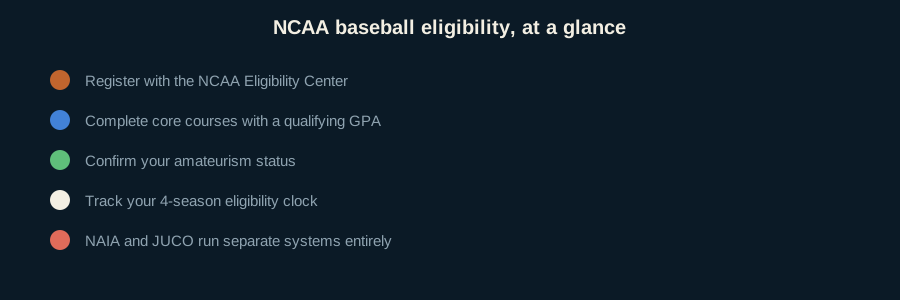
The overview below shows how the pieces of NCAA baseball eligibility fit together.
Academic eligibility: core courses and GPA
The NCAA requires a set number of approved “core courses” (English, math, science, and social studies) completed with a core course GPA of at least 2.3 at Division I or 2.2 at Division II. The old sliding scale against SAT or ACT scores ended in January 2023; no test score is required for certification now.
Miss a core course requirement, and even a strong athlete can be ruled a non-qualifier, unable to compete or receive athletic aid as a freshman.
Go deeper: academic eligibility: core courses and the GPA floors.
What happens if you’re ruled a partial qualifier or non-qualifier
Falling short of the full academic qualifier standard doesn’t automatically end a player’s college baseball career, but it does change what happens as a freshman.
- Partial qualifier: Depending on the division and the current rule in effect, a player may be able to practice and receive athletic aid as a freshman, but not compete.
- Non-qualifier: A player generally cannot practice with the team, compete, or receive athletic aid during the first year, though they can still enroll as a student.
- Academic redshirt (Division I): Under the previous rules, a player who met a minimum GPA threshold but fell short of the full sliding-scale standard could receive athletic aid and practice, but not compete, during the first year. Academic nonqualifier season limitations appear on the NCAA’s 2026 list of eliminated rules for Division I, so confirm how this is applied to your own certification rather than assuming it still works the same way.
This is exactly why an early transcript review matters more than a late one. A shortfall caught during junior year still leaves time to fix it with an extra course or a stronger senior-year push. The same shortfall caught after graduation usually doesn’t.
The NCAA baseball eligibility clock that replaced redshirt rules
Division I and Division II athletes now have a five-year period of eligibility, and redshirt rules are gone. Four seasons of competition, athletics redshirt rules and medical hardship waivers were all eliminated for 2026-27.
The period begins at the earlier of two events:
- Initial full-time college enrollment. The academic term when you first enrol full time and attend class at any college or university: domestic, international or two-year.
- The age trigger. The start of the regular academic year immediately after your 19th birthday, if you turn 19 before Sept. 1. Turn 19 on or after Sept. 1 and the period begins at the start of the subsequent academic year, unless you enrol full time earlier.
Then it runs continuously. It does not pause because you do not compete, transfer, sit out, change teams or take time away from participation, which is precisely why athletes, coaches and athletics departments no longer track redshirts.
Three exceptions can delay or pause it: pregnancy, active-duty military service and official religious missions. The NCAA Eligibility Center administers all three.
One phrase to avoid, because it is wrong. This is not a “5 for 5” rule. The NCAA rejects that description by name, since the model turns on age and initial full-time enrollment and does not guarantee five years to everyone, least of all athletes who delay enrolling.
Go deeper: how the NCAA eligibility clock starts and runs, and what happened to redshirt rules for baseball.
Check your eligibility in minutes
See how many seasons you have left under NCAA, NAIA, or JUCO rules.
JUCO eligibility rules
JUCO programs run their own eligibility system under the NJCAA, separate from the NCAA entirely. The clock, academic standards, and amateurism rules all differ.
Players sometimes assume NCAA rules carry over. They don’t. Confirm NJCAA-specific requirements directly before enrolling.
Go deeper: JUCO eligibility clock rules.
NAIA eligibility rules
The NAIA also runs its own separate eligibility system, with its own academic standards and season-of-competition rules, distinct from both the NCAA and NJCAA.
Go deeper: NAIA eligibility rules, in full.
D3 eligibility: how it’s different
Division III doesn’t use NCAA Eligibility Center certification the way D1 and D2 do. There’s no core-course GPA floor, no core-course GPA submission to a national clearinghouse, and no amateurism certification through the Eligibility Center.
Instead, D3 eligibility runs through each school’s own general admissions standards. A player gets into the school academically, the same way any other applicant would, and that admission is what determines eligibility to enroll and compete.
D3 programs still follow NCAA rules once a player is enrolled, but the front-end certification process is much lighter than D1 or D2.
One thing to be careful about in 2026-27. The age-based eligibility model was adopted by Division I and Division II. Division III is not covered by that legislation, so do not assume either the new five-year period or the old four-season model applies to you at D3: confirm current Division III provisions directly with the school’s compliance office.
NCAA baseball eligibility at a glance: D1/D2 vs. NAIA vs. JUCO
The table below sets NCAA baseball eligibility beside the NAIA and NJCAA equivalents, since registering with one body does nothing for the others.
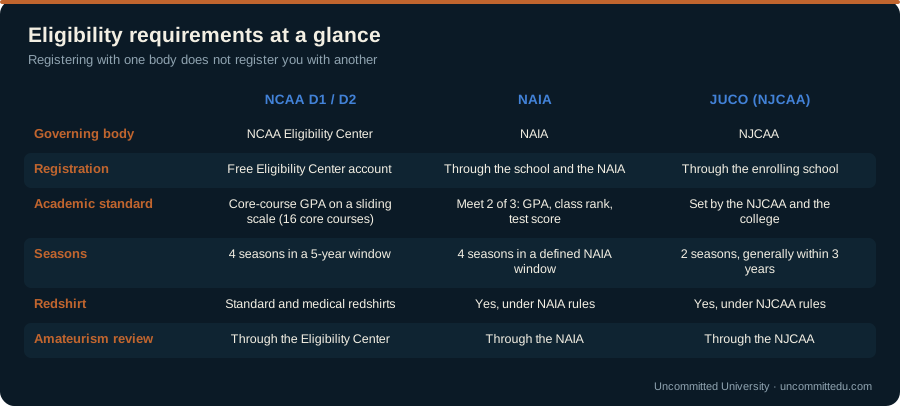
Every level runs its own system, with its own governing body and its own rules. Here’s how the structural pieces compare side by side.
| Feature | NCAA Division I / II | NAIA | JUCO (NJCAA) |
|---|---|---|---|
| Governing body | NCAA Eligibility Center | NAIA | NJCAA |
| Registration required | Yes | free Eligibility Center account | Yes | through the school and the NAIA | Yes | through the enrolling school |
| Academic standard | 16 core courses, core GPA 2.3 (D1) or 2.2 (D2), no test score | Meet at least 2 of 3: GPA, class rank, test score | Set by the NJCAA and the enrolling college |
| How eligibility is limited | A five-year period starting at first full-time enrollment or the academic year after a 19th birthday. Seasons of competition eliminated for 2026-27 | 4 seasons within a defined NAIA window | 2 seasons, generally within 3 years of first enrolling |
| Redshirt available | No | athletics redshirt rules and medical hardship waivers eliminated for 2026-27 | Yes | under NAIA-specific rules | Yes | under NJCAA-specific rules |
| Amateurism review | Required through the Eligibility Center | Required through the NAIA | Required through the NJCAA |
Exact GPA and test-score standards shift periodically. Confirm the current version directly with each governing body before making a decision based on the specifics.
Note which column of this NCAA baseball eligibility comparison moved. The Division I and Division II rows changed in 2026; the NAIA and NJCAA rows did not, because neither body is covered by NCAA legislation. Our D2 eligibility rules guide covers how Division II adopted the age-based model and what it means for a Division II recruit specifically.
Building your NCAA baseball eligibility timeline: freshman through senior year
The timeline below shows the one NCAA baseball eligibility task that belongs in each school year.
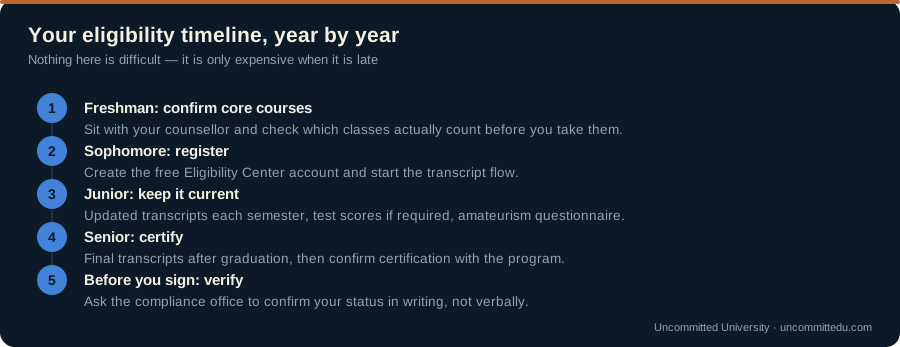
Eligibility isn’t a senior-year task. Families who stay ahead of it spread the work out over four years.
- Freshman year: Confirm which of your classes count as NCAA-approved core courses. Start a folder (physical or digital) with report cards and course lists.
- Sophomore year: Register with the Eligibility Center (and the NAIA Eligibility Center, if that path is realistic). Review your core-course progress with a counselor.
- Junior year: Send transcripts after each semester. Complete the amateurism questionnaire. Confirm your running core-course GPA, not just your overall GPA.
- Senior year: Send updated transcripts as soon as new grades post. Confirm final certification requirements with your target schools’ compliance offices before you commit.
None of this is complicated in isolation. It’s easy to miss only because nobody hands a family a checklist, so here’s one.
How NCAA baseball eligibility issues affect recruiting timing
Coaches recruit against a moving academic picture. An uncertain eligibility status changes how aggressively a program is willing to recruit a player, even one they like on the field.
- Programs often slow down or pause an offer until an amateurism or core-course question is resolved
- A cleared Eligibility Center status ahead of a visit or offer removes a real point of hesitation for a coaching staff
- Families who can answer eligibility questions immediately, without checking, come across as organized → coaches notice
Getting eligibility paperwork in order early isn’t just an administrative task. It’s part of how a recruiting profile gets taken seriously.
International and homeschool NCAA baseball eligibility
International students and homeschooled players go through the same Eligibility Center registration, but with extra steps.
International transcripts need to be evaluated for NCAA-equivalent core courses, which can take longer than a standard U.S. transcript review: start this process earlier than you think you need to.
Homeschooled players need to confirm their curriculum meets NCAA core-course requirements directly with the Eligibility Center, since homeschool documentation is reviewed under its own separate process rather than through a standard high school transcript.
Multi-sport athletes and NCAA baseball eligibility
Plenty of baseball recruits also play football, basketball, or another sport through high school, and multi-sport participation doesn’t complicate NCAA eligibility the way some families expect.
Core courses count the same regardless of which sports a player competes in. The Eligibility Center certifies a player for the sport they intend to compete in at the college level, not every sport they played growing up.
The one place multi-sport participation matters more directly is amateurism: any competition, in any sport, that involved a professional contract, agent relationship, or over-the-limit prize money can affect certification. Review your full athletic history honestly when completing the amateurism questionnaire, not just your baseball history.
NCAA baseball eligibility rules: who actually has the final say
Three different offices touch your file, and only two of them can give you an answer that counts. Knowing which is which saves families a lot of wasted worry.
- The NCAA Eligibility Center certifies academic and amateurism status for D1 and D2, and from fall 2026 it also administers and certifies the period of eligibility itself. It runs the previous-rules-versus-age-based comparison for incoming 2026-27 enrollees, and it administers the three exceptions. It is the authority on whether you are cleared to compete at all.
- Your school’s compliance office tracks what happens after you enroll: progress toward degree, transfer paperwork, and how much of your eligibility period is left. For current student-athletes it is also the office that runs the 2026 comparison between the previous rules and the age-based rule, and applies whichever is most beneficial. It is the authority on how much eligibility you have left.
- The coaching staff is neither. A coach can tell you the plan for your roster spot. A coach cannot certify you, and reassurance from a coach has no standing when the paperwork disagrees.
Get it in writing. An emailed answer from compliance is a record. A conversation after practice is not, and those two come apart at exactly the moment it matters.
One more thing about NCAA baseball eligibility rules: they change. Standards, windows and waiver processes get revised between academic years, which is why any date or threshold you read anywhere (including on this page) is worth confirming against the current NCAA rules and the Eligibility Center before you build a plan on it.
What to confirm before you commit to a program
Before signing anything, confirm these directly with the program’s compliance office, not just the coaching staff:
- Your Eligibility Center status is fully certified, not just “in progress”
- Which rulebook they will assess you under (the previous rules or the age-based model) and the exact date your five-year period of eligibility started
- Whether any credits (AP, dual-enrollment, or transfer) have been evaluated for core-course purposes
- What the development plan looks like for your position, now that holding a player out no longer preserves a season at Divisions I and II
- How the program’s academic support staff handles athletes who are close to a core-course or GPA threshold
A program that can answer these questions clearly and quickly is also telling you something about how organized its compliance operation is, which matters for the entire time you’re enrolled there, not just at signing.
The transfer portal and NCAA baseball eligibility
Transferring between four-year programs runs through the NCAA transfer portal process, which is separate from (but closely connected to) a player’s eligibility clock.
Entering the portal does not reset anything, and under the age-based model it is starker than that. The NCAA states directly that the five-year period does not pause because a student-athlete transfers, sits out or changes teams. A transfer year is a year of the five whether you play or not, and that is the single biggest NCAA baseball eligibility change for a portal athlete.
If you are in a transition group being assessed under the previous rules, the older arithmetic still applies to you: two seasons used at one school leaves two remaining after transferring, assuming no redshirt or waiver applied.
A few specific situations to confirm before entering the portal:
- Graduate transfers: additional eligibility rules apply if you’ve already completed a bachelor’s degree
- JUCO-to-four-year transfers: full-time enrollment at a junior college starts your NCAA five-year period, so the clock was already running before you arrived
- Mid-year transfers: sitting out part of a season has its own specific rules, and at Divisions I and II sitting out no longer preserves anything
None of this carries over automatically. Confirm directly with both the sending and receiving school’s compliance offices before making any assumption about remaining eligibility.
Walk-ons and NCAA baseball eligibility
Walk-on players go through the exact same Eligibility Center certification process as scholarship recruits. There’s no separate, lighter version of eligibility for players who aren’t receiving athletic aid.
The one practical difference: walk-ons sometimes have more flexibility on timing, since a program isn’t committing a scholarship to their certification status. That said, waiting to register or send transcripts still creates the same risk of a late-surfacing academic issue: don’t treat walk-on status as a reason to deprioritize the paperwork.
Preferred walk-ons (players a coaching staff has already identified before tryouts) should treat the eligibility process with the same urgency as a scholarship recruit, since a certification delay can affect whether a roster spot is still open by the time paperwork clears.
Common NCAA baseball eligibility mistakes
Almost every NCAA baseball eligibility failure traces back to something on the checklist below.
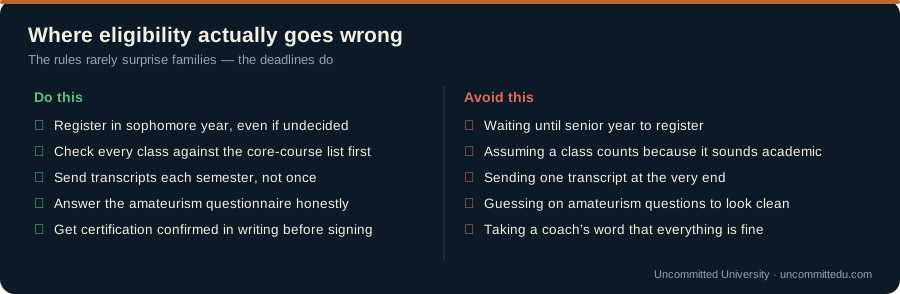
- Waiting too long to register. Start with the Eligibility Center by sophomore year, not senior year.
- Assuming one level’s rules apply to another. NCAA, NAIA, and JUCO each run separate systems.
- Missing a core course requirement that could have been caught with an early transcript review.
- Competing before confirming eligibility after a transfer, which can jeopardize an entire season.
Frequently asked questions about NCAA baseball eligibility
How does NCAA baseball eligibility work, start to finish? Three checks. Academics: 16 approved core courses and a 2.3 (D1) or 2.2 (D2) core GPA, certified by the Eligibility Center from your transcript. Amateurism: the questionnaire on the same account, answered honestly. Time: one five-year period at Divisions I and II that starts at your first full-time college enrollment or the academic year after your 19th birthday, whichever comes first. Pass all three and the school’s compliance office clears you to play.
How many years of NCAA eligibility do I have left? At Divisions I and II, five academic years from the earlier of your first full-time enrollment anywhere or the academic year after your 19th birthday, minus the years already run. Every year inside the period is usable; there are no seasons to count since 2026. The eligibility calculator returns the exact end date, and the clock guide explains the Sept. 1 split.
Do you still have four years of eligibility after JUCO? Not four seasons, and not a fresh clock. Your NCAA five-year period started with your first full-time JUCO semester, so two JUCO years leave about three. Under the age-based model those three are all usable because seasons of competition no longer count. The JUCO clock guide has the worked examples.
What are the NCAA baseball eligibility rules, in one sentence? Be certified academically and as an amateur through the NCAA Eligibility Center for D1 or D2, then compete inside the five-year period of eligibility that your first full-time enrollment (or your 19th birthday) starts. Every other requirement hangs off those two.
Does the 2026 rule change give athletes an extra year? Not retroactively. The NCAA was explicit that the change applies going forward, and athletes who exhausted their eligibility by 2025-26 receive no additional eligibility. Current athletes with eligibility remaining, and prospects first enrolling full time in 2026-27, are reviewed under the previous rules or the age-based rule, whichever is most beneficial.
Do NCAA baseball eligibility rules change every year? They are revised between academic years, and recruiting-calendar dates in particular move. Treat any specific date or threshold, from any site, as something to confirm against the current NCAA rules before you plan around it.
Does a coach have to tell you if there is an eligibility problem? Do not rely on it. Certification runs through the Eligibility Center and your school compliance office, and the reliable move is to ask them directly, in writing, once a year.
When should I register with the NCAA Eligibility Center? As early as sophomore year, so any academic issues surface while there’s still time to fix them.
Do I need to worry about eligibility if I’m going D3? D3 doesn’t use the same Eligibility Center certification as D1/D2, but core academic admission standards still apply through the school itself. Note too that the 2026 age-based eligibility model was adopted by Divisions I and II only. Division III is not covered by it, so confirm current D3 provisions directly.
Can I transfer without losing eligibility? Transferring does not cost you a season, but at Divisions I and II it does not buy you time either: the five-year period keeps running through a transfer or a sit-out year. See how the recruiting guide and transfer-specific rules interact.
The short version: NCAA baseball eligibility is administration, not difficulty. Check each class against your school’s approved core list before you take it, register with the Eligibility Center in sophomore year, send transcripts every semester, and answer the amateurism questions honestly. Confirm your NCAA baseball eligibility in writing with the compliance office before you sign anything: a verbal all-clear from a coach is not confirmation of NCAA baseball eligibility.
If it is your clock that ran out rather than your seasons, more routes stay open than most players realise. We read every rulebook and counted 11 verified extra eligibility paths across the NCAA, the NAIA and all three JUCO associations.
The short version
NCAA baseball eligibility comes down to three things: register with the Eligibility Center, pass 16 core courses, and hit the core-course GPA your division requires. Division I asks for a 2.3 core GPA with 10 of the 16 courses finished before your seventh semester. Division II asks for 2.2.
The NCAA has been test-optional since 2023, so no ACT or SAT score is required for NCAA baseball eligibility, but the core-course rules are unforgiving, and a course your high school does not have approved simply will not count.
On the clock side it is now one sentence. At Division I and Division II your NCAA baseball eligibility runs as a five-year period that starts at first full-time enrollment or the academic year after your 19th birthday, and nothing ordinary stops it.
Your next step
Check exactly how many seasons you have left, free.
Check your eligibility, free
Answer a few questions and confirm your seasons of eligibility under NCAA, NAIA, or JUCO rules.
Then register with the NCAA Eligibility Center if D1/D2 is on your list, and build your target list using the D1 vs. D2 vs. D3 vs. NAIA vs. JUCO breakdown.
Written by Wayne Keeton, founder of Uncommitted University.