
D3 Baseball Schools: All 382, By State
D3 baseball is the most misunderstood level in college baseball, and the misunderstanding costs players roster spots every single year. The myth is simple: no athletic scholarships means no money, so D3 is where you go when nobody else wants you.
That is backwards. D3 baseball is the largest division in the NCAA, it hands out real money through a different door, and for a large group of players it is the level where they will actually play.
Quick answer: D3 baseball schools cannot offer athletic scholarships. The NCAA states it plainly: “Division III schools do not offer athletics scholarships.” What they can offer is academic merit aid and need-based aid, with no cap tied to your sport. Division III is the NCAA’s biggest division at 420+ member schools and 210,878 championship-sport participants in 2024-25, which is 38% of all NCAA student-athletes. The money question is not “how big is the scholarship”, it is “what is my net price after aid”.
Updated August 2026. Every NCAA figure on this page is linked to the NCAA page it came from. Where a number is not published in a stable primary source, this page says so instead of estimating.
Jump to: What D3 baseball is | How many schools | The money, honestly | D3 vs D2, NAIA and JUCO | Who should target D3 | How to get recruited | The eligibility rule people miss | FAQ
What D3 baseball actually is
Division III is an NCAA division, not a talent tier. It is defined by a philosophy about money and time, not by how hard the players throw.
Three rules define D3 baseball schools:
- No athletic scholarships. Not reduced ones. Zero. Aid cannot be awarded on athletic ability.
- Athletes are students first, structurally. The NCAA says D3 athletes are “generally held to the same admissions standards, academic standards, housing policies and support services as the general student body.”
- Schools set their own academic bar. There is no national sliding scale to clear. “Division III schools set their own admissions and academic standards.”
That third point is the one that surprises families. At D1 and D2 there is a central academic gate. At D3 baseball schools, the admissions office is the gate, and it is a different gate at every campus.
What D3 baseball is not: a consolation level. The top of D3 is full of players who chose it over partial offers elsewhere, and the reasons are usually money, playing time, or a degree the family actually wanted.
How many D3 baseball schools are there
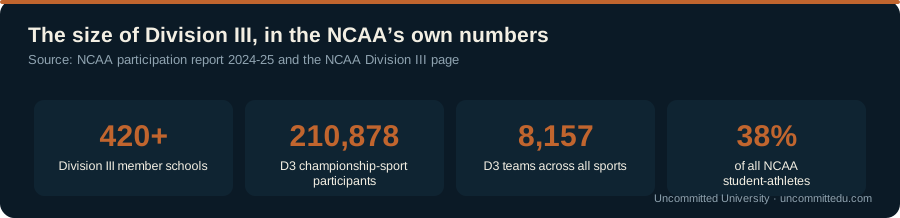
Division III is the biggest division in the NCAA, and it is not close.
| NCAA figure (2024-25) | Division III | All NCAA |
|---|---|---|
| Championship-sport participants | 210,878 | 554,298 |
| Championship-sport teams | 8,157 | 19,928 |
| Member schools | 420+ | 1,100+ |
| Share of all NCAA athletes | 38% | 100% |
Those participant and team counts come from the NCAA’s 2024-25 participation report, and the school count from the NCAA’s own Division III page.
A note on the number you came here for. The exact count of D3 baseball programs is not published as a stable figure on any NCAA page, so this page will not print one. What is published: the NCAA Division III Baseball Championship is a 64-team field, and D3 sponsors more teams across all sports than any other division.
The practical version for a recruit: there are hundreds of D3 baseball schools, they are concentrated in the Northeast, Mid-Atlantic and upper Midwest, and the list is far too long to work through school by school. That is a targeting problem, not a research problem.
382 D3 baseball schools, counted, by state
The NCAA does not publish the number, so we counted it: 382 Division III baseball programs in 34 states and the District of Columbia on the 2026 rosters we track, more than any other NCAA division and nearly a quarter of all college baseball. Pennsylvania alone has 57, more than 18 states put together. The count is from the school directory inside Uncommitted University, which carries every program at every level with its coaching staff, read 2026-09-12.
| State | D3 baseball programs | State | D3 baseball programs |
|---|---|---|---|
| Pennsylvania | 57 | Maryland, North Carolina | 8 each |
| New York | 47 | Michigan | 7 |
| Massachusetts | 32 | Georgia | 6 |
| Wisconsin | 22 | Kentucky, Oregon, New Hampshire | 5 each |
| Illinois, Ohio | 21 each | Vermont, Rhode Island, Washington | 4 each |
| Minnesota | 17 | Mississippi, Arkansas, Tennessee, Missouri | 3 each |
| Virginia | 16 | South Carolina, Louisiana, Nebraska, Alabama, West Virginia, District of Columbia | 1 each |
| Texas, New Jersey | 14 each | No D3 baseball | 16 states, including Florida, Arizona, Colorado and the Dakotas |
| California, Iowa | 10 each | ||
| Connecticut, Maine, Indiana | 9 each |
Read the geography before the rankings. Two thirds of Division III baseball sits in the Northeast and the upper Midwest, in New England, New York, Pennsylvania, Ohio, Wisconsin, Illinois and Minnesota, which is where the small private colleges are. A player in Florida or Arizona who wants D3 is looking at a flight, and a player in Pennsylvania has more D3 programs within two hours than most states have at every level combined. The full list, with each staff’s contact details, is in the directory.
D3 baseball schools give zero athletic scholarships. Players still get money.
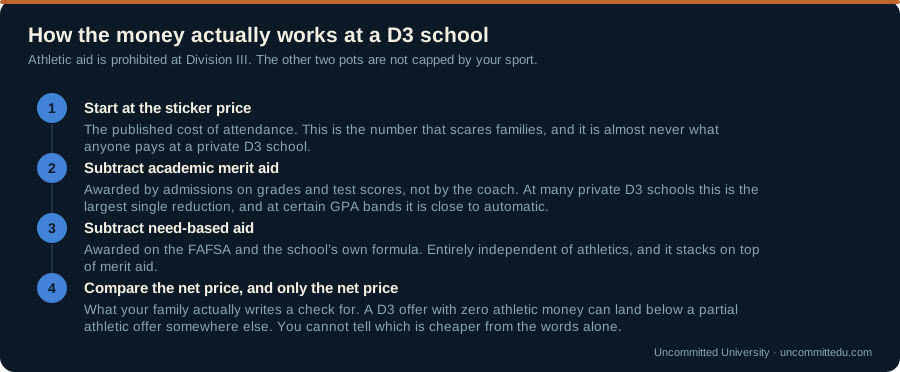
This is the section that changes decisions, so here it is without spin.
The NCAA’s rule is absolute: “Division III schools do not offer athletics scholarships.” No coach at any D3 baseball program can put athletic money in front of you. If one does, something is wrong.
The same NCAA page then says the part nobody repeats: “Many Division III student-athletes receive merit-based or need-based financial aid.”
Those are two different pots of money, and neither is capped by your sport:
- Academic merit aid. Awarded on grades and test scores by the admissions office. At many private D3 schools this is substantial and close to automatic at certain GPA bands.
- Need-based aid. Awarded on the FAFSA and the school’s own formula. Independent of athletics entirely.
Here is why that beats a partial offer more often than families expect. Baseball is an equivalency sport, which means scholarships get sliced into fractions and spread across a roster. A “baseball scholarship” at most levels is a percentage, not a free ride. Our guide to how college baseball scholarships actually work walks through the arithmetic.
So the real comparison is not scholarship versus no scholarship. It is:
| Offer | What it sounds like | What decides the cost |
|---|---|---|
| Partial athletic offer | “We can do 25%” | Sticker price minus that slice, plus any academic aid |
| D3 baseball offer | “We have no athletic money” | Sticker price minus merit aid, minus need-based aid |
The only number that matters is net price, which is what your family actually writes a check for after all aid. A D3 private with strong merit aid can land under a public school with a partial athletic offer attached. It can also land far above it. The point is that you cannot tell from the words “scholarship” and “no scholarship” which one is cheaper.
Run your own numbers before you rank your offers. Every school is required to publish a net price calculator, and our recruiting tools are built to help you compare levels honestly rather than by label.
D3 baseball vs D2, NAIA and JUCO
Most players are not choosing between D1 and D3. They are choosing between the four levels that will actually recruit them.
| Level | Athletic money | Central academic gate | Best fit when |
|---|---|---|---|
| D3 baseball | None | No, admissions decides | Grades are a real asset |
| D2 | Yes, partial | Yes, Eligibility Center | You want athletic aid and a mid-size campus |
| NAIA | Yes, partial | Yes, NAIA Eligibility Center | You want flexibility and early playing time |
| JUCO | Yes, varies by division | No NCAA gate | You need development time or a grade reset |
The honest differences, level by level, are in our guide to what actually changes from division to division. If you are still unsure where you sit, start with what college baseball level am I instead of guessing.
Who should be targeting D3 baseball schools
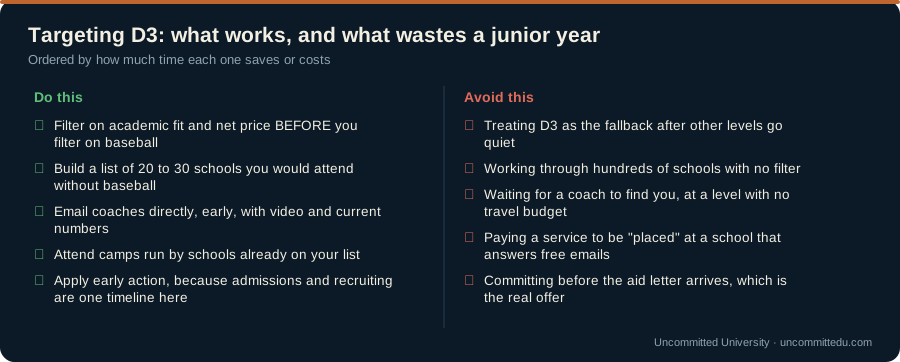
D3 baseball is the right target, not the fallback, when any of these are true:
- Your grades are a weapon. A 3.7 unlocks merit money at D3 privates that no partial athletic offer will match.
- You want to play, not redshirt. Roster spots turn over faster and the path to innings is shorter at most D3 baseball programs.
- The degree matters as much as the season. Plenty of D3 schools are academically stronger than the D1 programs recruiting you.
- You are a late bloomer physically. Four years of college strength work changes players, and D3 gives you those years on a field instead of on a bench.
- Your family needs predictability. Academic aid is locked to your GPA. Athletic aid can be reduced year to year.
And the honest counter-case. D3 baseball is the wrong target if you are chasing pro exposure above everything, or if the cost only works with athletic money. Those are real constraints and they point elsewhere.
How to get recruited by D3 baseball schools
The recruiting process at D3 looks different because the money lives in a different office.
1. Fix your academic file first. At D3 baseball schools your transcript is both the eligibility gate and the money. Improving a GPA is worth more here than at any other level.
2. Target 20 to 30 schools, not 200. Filter by academic fit, net price and region before you filter by baseball. A school that will not admit you or fund you is not a target no matter who the coach is.
3. Email coaches directly, and early. D3 staffs are small and often coach multiple roles, so a specific, short email gets read. Our coach email templates exist for exactly this.
4. Send real video with real context. Same standard as every level. Build it properly with our recruiting video guide.
5. Know your numbers before a coach asks. Velocity, exit velo, and a 60 time. Compare yours against exit velocity benchmarks by level so the conversation starts from fact.
6. Apply early action where you can. At D3 the admissions timeline and the recruiting timeline are the same timeline. A coach who wants you still needs you admitted.
What D3 baseball coaches actually look for
D3 recruiting is not D1 recruiting with lower numbers. The constraints are different, so the priorities are different.
They recruit players who will still be there in year three. With no athletic aid to hold a roster together, attrition is the enemy. A coach is reading you for fit, temperament and whether the school makes sense for you academically. An athlete who transfers out after one season is a wasted spot.
They recruit for immediate roster need, not projection. Small staffs and smaller budgets mean fewer developmental fliers. If they need a left-handed reliever and a catcher, that is what they are looking for this cycle.
They read your transcript before your video. At D3 baseball schools the admissions office has a veto, and coaches learn quickly not to fall in love with a player who will not get in. Grades move you up the board in a way that does not happen elsewhere.
They value versatility more than the label on your position. Rosters are thinner. A middle infielder who can catch, or a corner bat who can pitch, solves two problems at once.
They notice who initiated contact. D3 staffs cannot cover the showcase circuit the way funded programs do, so a large share of their recruiting class comes from players who reached out first. This is the level where a good email genuinely changes outcomes.
The D3 baseball recruiting timeline
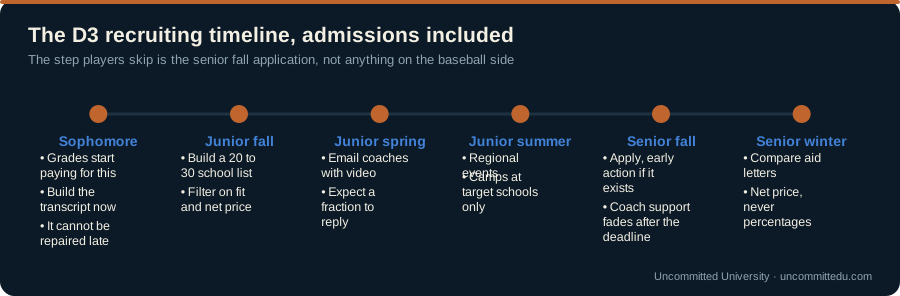
The timeline that trips families up is not the baseball one. It is the admissions one running underneath it.
- Sophomore year. Grades start counting toward the merit aid that will pay for this. Build the transcript now, because it cannot be repaired late.
- Junior fall. Build your target list of 20 to 30 D3 baseball schools. Filter on academic fit and net price first.
- Junior spring. Start emailing coaches with video and current numbers. Expect to hear back from a fraction, which is normal.
- Junior summer. Attend regional events and any camps run by schools on your actual list. A camp at a target school is worth more than a large showcase.
- Senior fall. Apply, and apply early action where it exists. This is the step players skip. A coach’s support means far less after the admissions deadline has passed.
- Senior winter. Compare aid letters on net price, not on percentages.
The broader schedule, including the contact rules that differ by level, is in our college baseball recruiting timeline.
Red flags when a D3 baseball program recruits you
Most D3 coaches are straight with players. A few things should still stop you.
- Any mention of athletic money. It does not exist at this level. If someone frames aid as a “baseball scholarship”, ask for the award letter in writing and read who issued it.
- A guaranteed roster spot before admission. No coach controls the admissions decision.
- Pressure to commit before you have an aid letter. The aid letter is the offer at D3. Committing without one is committing to an unknown price.
- A recruiting service charging you to be “placed” at a D3 school. Coaches at this level respond to direct contact from players. Paying for an introduction is paying for something free.
More of the patterns worth knowing are in our guide to baseball recruiting red flags and scams.
The D3 eligibility rule most recruits get wrong
Because D3 baseball schools have no central academic gate, families often assume the NCAA Eligibility Center is irrelevant. It is not.
The NCAA’s instruction is direct: “All incoming Division III student-athletes should register with the NCAA Eligibility Center to obtain their NCAA ID number.”
And for one group it is mandatory: “If you are an international student-athlete planning to compete at a Division III school, you must register with the NCAA Eligibility Center for athletics certification before you compete.”
Registering is free for the D3 profile, it takes minutes, and it is the same account you would need if you later transferred up a level. Our step-by-step registration guide covers it.
Your next step with D3 baseball
The players who end up happy at D3 baseball schools almost always did the same two things early.
They found their real level before they built a list. Targeting is the whole game at this division, because the list is hundreds of schools long and only a few dozen fit your grades, your budget and your bat. Guessing wastes the junior year you cannot get back.
They compared offers on net price, not on labels. A partial athletic offer that sounds better can cost more. An aid letter from a D3 private that sounds like nothing can cost less.
Both of those are measurement problems, and measurement is what our free tools do. Start with your level, get your numbers next to the benchmarks, then build a target list you can actually work through. A free profile keeps all of it in one place and gives coaches something to open when your email lands.
Frequently asked questions about D3 baseball
What GPA do you need to play D3 baseball? There is no NCAA academic floor at Division III; the Eligibility Center does not certify D3 players. The bar is admission to the college, and D3 colleges range from open admission to the most selective schools in the country, so the honest answer is the admitted-student profile of each school on your list. At the selective academic programs a 3.5 unweighted with strong test scores is the entry point, and a coach’s support helps at the margin but does not replace it. At many others a 2.5 to 3.0 gets you in. Once enrolled you keep eligibility by staying a full-time student in good standing.
What is the best D3 baseball school? Depends on what “best” means to you. On the field, the programs that reach the 64-team Division III championship year after year are the strongest, and the weekly d3baseball.com top 25 is the working list. Off the field, the best D3 program is the one at a school you would attend if baseball ended, that admits you on your transcript, and where the roster needs your position in your class. The second list matters more, because the D3 degree is the whole payoff.
Is JUCO or D3 better for baseball? Different jobs. A junior college offers athletic money, immediate playing time and a two-year reset before a four-year transfer, and NJCAA Division I plays at a level that beats most of D3. Division III offers a four-year degree from the start, no athletic money, no eligibility clock beyond ten semesters, and a much wider academic range. A player who needs development and a second look picks JUCO; a player who has the grades and wants the degree picks D3.
Do D3 schools give athletic scholarships? No. The NCAA states that “Division III schools do not offer athletics scholarships.” D3 baseball players can still receive academic merit aid and need-based aid, which are awarded by the school and are not tied to the sport.
Is D3 baseball good? The top of D3 baseball is genuinely competitive, and the championship is a 64-team national tournament. The division is wide, so the gap between the best and weakest programs is larger than at D1. Judge the program, not the letter.
How many D3 baseball schools are there? 382, in 34 states and the District of Columbia, on the 2026 rosters we track, with Pennsylvania (57), New York (47) and Massachusetts (32) holding more than a third of them. The NCAA does not publish a stable public count of D3 baseball programs; what it publishes is 420+ Division III member schools, 8,157 D3 teams across all sports, and a 64-team baseball championship field.
Is D3 baseball better than JUCO? Neither is better. JUCO offers athletic money and a development or academic reset with a two-year clock. D3 baseball offers four years, academic aid and a degree at one school. The right answer depends on your grades and your timeline.
Can you transfer from D3 baseball to D1? Yes, and it happens every year. Players who develop physically at D3 move up through the portal. That path runs through performance and academics, not through the division you started in.
Do D3 baseball coaches recruit at showcases? Yes, though budgets are smaller, so regional events and direct contact matter more than national showcases. A targeted email with video often outperforms an expensive weekend.
Sources
- NCAA Eligibility Center, Division III initial eligibility requirements, for the scholarship rule, the aid statement, the registration instruction and the admissions standards wording.
- NCAA Division III, for 420+ member schools and the 38% share of NCAA student-athletes.
- NCAA, record participation in 2024-25, for 210,878 Division III participants, 8,157 Division III teams and the 554,298 and 19,928 NCAA totals.
Written by Wayne Keeton, founder of Uncommitted University.