Baseball recruiting statistics get repeated far more often than they get checked. Most of the figures circulating in team group chats and showcase sales pitches trace back to a blog quoting a blog, and several of them describe scholarship rules that stopped existing on July 1, 2025.
This page is built to be the opposite of that. Every number below is a single sentence you can copy, followed by the primary source it came from, so a writer, a coach or a parent can check it in one click. These are the baseball recruiting statistics that survived verification against the NCAA Manuals, the NFHS survey, the NAIA, the NJCAA and Major League Baseball’s own draft data.
Quick answer: The core baseball recruiting statistics for 2026: 472,598 players competed in high school baseball in 2024-25, and NCAA baseball roster spots equal 8.8% of that population, 2.7% at Division I. Division I scholarship limits were eliminated on July 1, 2025 and replaced by a 34-player roster cap for programs that opted in to the House settlement. 77.3% of the 2026 MLB Draft came out of four-year colleges and only 20.7% came straight from high school.
Updated August 2026. Every figure in these baseball recruiting statistics was re-checked against its primary source this month. Source years are stated inside each sentence on purpose, because participation data, draft data and rulebooks are published on different cycles and any combined figure here says “more than” rather than pretending to an exact total.
The 10 baseball recruiting statistics worth citing
Every one of these baseball recruiting statistics is written as one standalone sentence with its own source, because that is the format a writer actually needs. Copy the line, keep the citation attached to it, and the claim stays checkable. That is the whole design of this set of baseball recruiting statistics.
Since July 1, 2025, Division I baseball programs that opted in to the House settlement carry a 34-player roster cap with no ceiling on how many of those players get athletic aid, while programs that stayed out remain capped at the old 11.7 scholarship equivalencies. Source: NCAA Question and Answer: Implementation of the House Settlement, plus Division I Manual Bylaw 17.2
Only 127 of the 613 players taken in the 2026 MLB Draft came straight out of high school, which is 20.7% of the draft. Source: MLB Stats API, official 2026 draft results
About 1 in every 3,700 high school baseball players is drafted straight out of high school. Computed from the MLB Stats API 2026 draft and the NFHS 2024-25 survey: 127 divided by 472,598.
Three of those ten baseball recruiting statistics are corrections rather than facts, and they are the reason this page exists. The 11.7 scholarship figure is history, not a current rule. The NJCAA baseball limit is 30, not the 24 that circulates everywhere. And the Division I recruiting calendar is now two dates, not one. Each is unpacked in full below, with the bylaw named.
How many high school baseball players actually play in college?
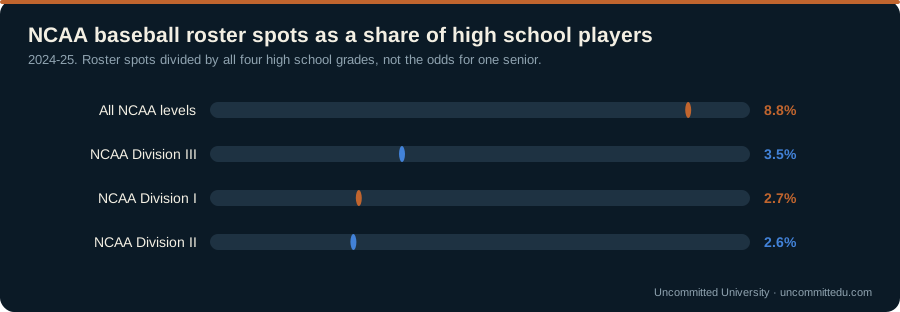
NCAA baseball roster spots equal 8.8% of the high school baseball population. That is the honest headline of any set of baseball recruiting statistics, and the wording matters more than the number.
Here is the framing caveat that most baseball recruiting statistics pages get wrong. The NCAA calculates that percentage as total NCAA participants divided by total high school participants across all four grades: 41,580 divided by 472,598. It is a ratio of roster spots to players, not the chance that a given senior signs somewhere, and baseball recruiting statistics that blur the two are answering a different question. Written as “your odds are 8.8%” it becomes a different claim, and a false one.
NCAA roster spots as a share of the high school baseball population, 2024-25. This is a ratio of spots to players across all four grades, not the chance a given senior signs. Source: NCAA Probability of Competing Beyond High School.
The division split is where the useful baseball recruiting statistics live, because the levels are nothing like equal in size.
Level
Players, 2024-25
Share of the high school population
All NCAA
41,580
8.8%
NCAA Division III
16,562
3.5%
NCAA Division I
12,649
2.7%
NCAA Division II
12,369
2.6%
NCAA Division III baseball roster spots equal 3.5% of the high school baseball population, the largest share of any division. Division III is the biggest NCAA baseball level by both players and teams, and it is the level most often skipped in a recruiting conversation. Source: NCAA Probability of Competing Beyond High School.
16,562 athletes played NCAA Division III baseball in 2024-25, more than any other division.12,649 athletes played NCAA Division I baseball in 2024-25.12,369 athletes played NCAA Division II baseball in 2024-25. Source for all three: the NCAA participation report cited above.
⚠️ One caveat that belongs on the Division I number wherever these baseball recruiting statistics are quoted. 12,649 is the 2024-25 figure, which is the last season before the 34-player roster cap took hold. It describes the level as it was, not as it is, and the next NCAA report should show a sharp Division I drop.
The NCAA is also not the whole college game, which is the single biggest gap in most baseball recruiting statistics roundups. More than 270 NAIA colleges and universities sponsor baseball. Source: the NAIA’s own baseball page, which states the figure as an approximation.
There are more than 1,200 four-year college baseball programs in the United States across the NCAA and the NAIA. That is 944 NCAA baseball teams in 2024-25 plus more than 270 NAIA programs. Junior colleges are excluded from the total because a clean NJCAA team count could not be verified from a primary source, which is exactly why the sentence says “more than” instead of naming a total.
🔴 What we deliberately did not publish: a percentage of high school players who go on to play college baseball at any level, which is the figure most baseball recruiting statistics pages simply invent. Computing it honestly requires NAIA and NJCAA participant counts, and neither body publishes one. Every all-levels percentage you have seen is an estimate built on the same missing data. The 8.8% figure is NCAA-only, and this page says so.
If you are trying to work out which level fits before you read another statistic, start with the honest self-assessment in what college baseball level am I, and the level-by-level breakdown in college baseball divisions, then come back to these baseball recruiting statistics with a shortlist in hand.
How many baseball scholarships are there by division in 2026?
The House settlement eliminated NCAA Division I sport-by-sport scholarship limits on July 1, 2025, so an opted-in program may fund every one of its 34 baseball roster spots. It is the single most important entry in the 2026 baseball recruiting statistics. Source: NCAA Question and Answer: Implementation of the House Settlement.
This is the section where most baseball recruiting statistics go stale, so here is the current mechanism stated precisely. Get this wrong and every downstream number is wrong with it.
Since July 1, 2025, Division I baseball programs that opted in to the House settlement carry a 34-player roster cap with no ceiling on how many of those players get athletic aid, while programs that stayed out remain capped at the old 11.7 scholarship equivalencies. Source: the NCAA House settlement Q&A above, plus Division I Manual Bylaw 17.2.
The precision upgrade almost nobody makes: 11.7 is no longer an NCAA bylaw. The sport-specific aid limits, including Bylaw 15.5.4.1 which held baseball’s 11.7, were struck from the Division I Manual, and a text search of the current 2026-27 Manual finds no 11.7 financial aid limit anywhere.
What 11.7 is now is a trigger line. Award athletic aid above it and the school is pulled into the settlement, roster limit and all. In practice an opted-out program operates at or below 11.7, so the familiar number still describes what those rosters look like, but the mechanism underneath it is a threshold rather than a surviving rule, and baseball recruiting statistics that skip that distinction get the next question wrong.
Before the House settlement, NCAA Division I baseball programs could divide a maximum of 11.7 scholarship equivalencies among their entire roster. That sentence is the only correct way to publish 11.7 in a set of baseball recruiting statistics in 2026: past tense, dated, and marked as history through June 30, 2025.
NCAA Division I baseball has a hard roster limit of 34 players. Bylaw 17.2 lists baseball at 34, adopted June 6, 2025 and effective July 1, 2025, binding each sport of a Division I institution that is a member of a defendant conference or opts in to the settlement. It is one of the few baseball recruiting statistics on this page with a bylaw number attached to it. Source: NCAA Division I Manual, Bylaw 17.2 Roster Limitations.
335 schools are participating in the House settlement revenue sharing model for the 2026-27 academic year. Counted directly from the settlement’s own enforcement body, which makes it one of the newest baseball recruiting statistics available anywhere. Source: College Sports Commission, Participating Schools.
Two details about that list are worth carrying. All current members of the ACC, Big Ten, Big 12, Pac-12 and SEC participate automatically, and every other Division I institution chooses to opt in or out by May 1 each year. Opt-in status is therefore an annual decision, not a one-time 2025 event, which means any set of baseball recruiting statistics naming a specific school’s status has a shelf life of one year.
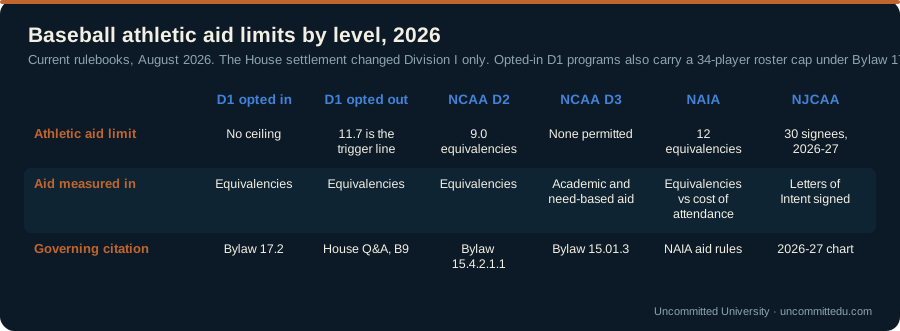
The scholarship baseball recruiting statistics: athletic aid limits for baseball by level, 2026. Division I sport-by-sport limits were eliminated on July 1, 2025; 11.7 now works as a settlement trigger rather than a bylaw.
The other four levels did not change, and their baseball recruiting statistics come straight from their own current rulebooks.
Level
Athletic aid limit for baseball
Governing citation
NCAA D1, opted in
No scholarship ceiling, 34-player roster cap
House settlement Q&A, D1 Bylaw 17.2
NCAA D1, opted out
11.7 equivalencies is the trigger line, not a bylaw
House settlement Q&A, Question B9
NCAA D2
9.0 equivalencies across the roster
D2 Bylaw 15.4.2.1.1
NCAA D3
None. No aid may be awarded on athletic ability
D3 Bylaw 15.01.3
NAIA
12 full scholarship equivalencies
NAIA financial aid rules
NJCAA
30 Letters of Intent or scholarships, 2026-27
NJCAA 2026-27 Sports Procedures Chart
NCAA Division II baseball programs may divide a maximum of 9.0 scholarship equivalencies across the roster. The House settlement changed Division I only, and the Division II equivalency table still reads 9.0, which is why Division II baseball recruiting statistics did not move at all in 2025. Source: NCAA Division II Manual, Bylaw 15.4.2.1.1.
NCAA Division III schools may not award any financial aid on the basis of athletic ability, so Division III baseball players receive academic and need-based aid instead. Those packages can still be substantial, they simply cannot be tied to baseball. Source: NCAA Division III Manual, Bylaw 15.01.3.
NAIA baseball programs may award a maximum of 12 full scholarship equivalencies. The NAIA measures an equivalency against full cost of attendance including tuition, room and board, books, fees and supplies, which is a broader base than the NCAA definition. Source: NAIA Financial Aid.
🔴 The correction most baseball recruiting statistics pages need.NJCAA baseball programs may sign a maximum of 30 Letters of Intent or scholarships for 2026-27. The widely repeated 24 is softball’s number on the same chart. Column mapping was sanity checked against three sports whose limits are independently known: football 85, basketball 15, softball 24. Two caveats stay attached: a signee counts against the maximum regardless of how much aid they actually receive, and the chart carries a publisher note that as of December 16, 2025 it is tentative pending Board of Regents meetings. Source: NJCAA 2026-2027 Sports Procedures Chart.
NJCAA Division I programs may grant full athletic scholarships, Division II programs are limited to tuition, fees and books, and Division III programs may not offer athletic scholarships at all. NJCAA divisions are declared per sport rather than per school, so one college can be Division I in baseball and Division III in something else. Source: NJCAA Divisional Structure.
Two words do most of the damage in this section. Limit is what a program is allowed to award. Budget is what a program has actually funded. Baseball recruiting statistics quoted at the limit describe the ceiling of the sport, not the offer in front of you, and funding all 34 spots is permitted rather than required. Cost is the real constraint.
The full mechanics, including how equivalency splits work and what to ask a coach, are in our guide to college baseball scholarships.
What measurable numbers do college baseball coaches actually want?
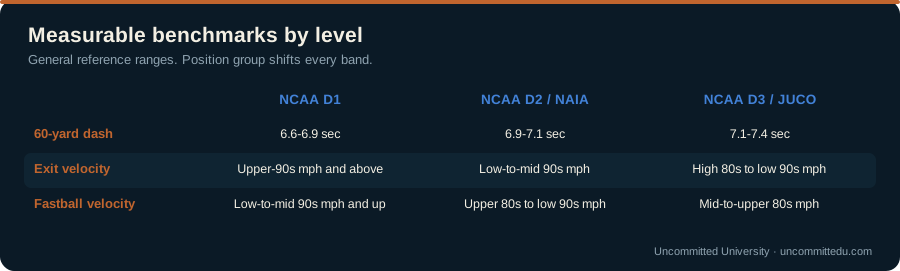
Division I baseball recruits typically run the 60-yard dash in 6.6 to 6.9 seconds. Source: our own 60-yard dash benchmarks by level, which also splits the ranges by position group. These are the benchmark baseball recruiting statistics a coach actually asks for by name.
These are the baseball recruiting statistics a player can change. Most baseball recruiting statistics describe the sport. These describe you. Roster odds and scholarship budgets are facts about the sport; a 60 time and an exit velocity are facts about you, and they move with training. That is why this section is the one worth reading twice.
Division II and NAIA baseball recruits typically run the 60-yard dash in 6.9 to 7.1 seconds.Division III and junior college baseball recruits typically run the 60-yard dash in 7.1 to 7.4 seconds.
Level
60-yard dash
Exit velocity
Fastball velocity
NCAA D1
6.6-6.9 sec
Upper-90s mph and above
Low-to-mid 90s mph and up
NCAA D2 / NAIA
6.9-7.1 sec
Low-to-mid 90s mph
Upper 80s to low 90s mph
NCAA D3 / JUCO
7.1-7.4 sec
High 80s to low 90s mph
Mid-to-upper 80s mph
General reference bands, not cutoffs. Position group moves every one of these, and testing conditions move the 60 most. Source: Uncommitted University benchmark guides, 2026.
Ranges, not cutoffs. A coach recruiting a shortstop and a coach recruiting a first baseman read the same measurables against completely different priorities, which is why every band above is tied to a position group on the source pages.
A warning that belongs beside any published table of benchmark baseball recruiting statistics: a number recorded at a showcase with electronic timing and a number recorded by a parent with a phone are not the same statistic. Coaches weight electronic times more heavily for exactly that reason, and testing conditions move a 60 time by more than most players’ entire year of training does.
When can college coaches actually contact you?
NCAA Division I baseball coaches may first call a recruit or send recruiting materials on August 1 at the beginning of the athlete’s junior year of high school. That is the first of the two timing baseball recruiting statistics that matter, and two separate bylaws set the same date: 13.1.3.1.1 for telephone calls and 13.4.1.1 for recruiting materials and electronic correspondence. Source: NCAA Division I Manual.
🔴 The correction that dates every other page.NCAA Division I baseball coaches may not make off-campus contact or host a recruit on a campus visit until September 1 at the beginning of the athlete’s junior year. Three bylaws set this second date: 13.1.1.1.1 for off-campus contacts, 13.6.2.1.2 for expense-paid official visits, and 13.7.1.2 for unofficial visits involving the athletics department. They carry revision stamps of June 2026, effective August 1, 2026, which is why so many published baseball recruiting statistics are a year out of date on this point. Source: NCAA Division I Manual.
So the Division I calendar is two dates, not one, and the sequence is what these baseball recruiting statistics are really about.
Off-campus contact, official visits, unofficial visits involving athletics
NCAA D1 baseball
NCAA Division II coaches may contact a recruit starting June 15 immediately preceding the athlete’s junior year of high school. Division II applies one date across all sports, unlike Division I which carries sport-by-sport exceptions, and it opens roughly six weeks earlier than Division I baseball, a gap worth building a plan around rather than treating as trivia. Source: NCAA Division II Manual, Bylaw 13.1.1.1.
Baseball is itself an exception inside Division I: the general Division I rule is June 15 after sophomore year, and baseball sits later than that. Athletes on a nontraditional academic calendar use the opening day of junior year classes instead of the calendar date.
What these timing baseball recruiting statistics do not say is when recruiting starts. A rule sets when a coach may reply, not when you may act. The month-by-month version of what to send and when is in the college baseball recruiting timeline, and the mechanics of the first message are in how to email a college baseball coach.
Team counts are the most stable baseball recruiting statistics on this page, and they are the ones that turn a vague search into a target list. Nothing else here converts into action as directly.
383 schools fielded an NCAA Division III baseball team in 2024-25, more than any other division.300 schools fielded an NCAA Division I baseball team in 2024-25.261 schools fielded an NCAA Division II baseball team in 2024-25. Source for all three: the NCAA participation report cited above.
A note on why you may see slightly different figures. The NCAA membership page separately projects 308 Division I, 253 Division II and 381 Division III baseball schools for 2025-26, but labels those numbers projections, so they do not belong in a set of verified baseball recruiting statistics yet. The 2024-25 counts above are the verified ones.
Now the number that changed the math. NCAA Division I baseball has a hard roster limit of 34 players, and average Division I squad size in 2024-25 was 42.2. Every opted-in program is carrying roughly eight fewer players than it did, and the Division I Baseball Oversight Committee raised the championship squad size from 27 to 34 in November 2025 to match the bylaw.
Division II and Division III are not under a roster limit and were larger to begin with: average squad size was 47.4 in Division II, the largest of the three divisions, and 43.2 in Division III.
🔴 What we deliberately did not publish here: a number for how many baseball players enter the transfer portal each year. It is the one entry that did not survive into these baseball recruiting statistics. No primary figure exists in a readable form. The NCAA publishes its transfer research as a dashboard with no static number, and the figure that circulates traces to a trade outlet with no season attached.
So this page says the effect qualitatively and stops: the roster cap pushes players who no longer fit into the portal, where they compete for spots against high school recruits who have never taken a college at-bat. That is a real pressure on a recruit’s odds, and nobody can honestly put a number on its size right now.
What are the odds of being drafted by an MLB team?
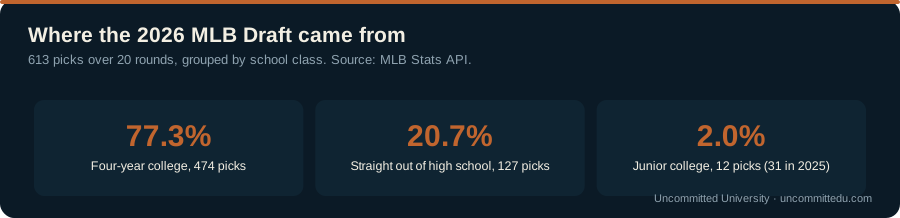
Only 127 of the 613 players taken in the 2026 MLB Draft came straight out of high school, which is 20.7% of the draft. Source: MLB Stats API, official 2026 draft results.
That single line is the strongest argument in these baseball recruiting statistics for taking the college route seriously, and it is computed from Major League Baseball’s own pick-level data rather than taken from anybody’s summary.
613 players were selected across 20 rounds of the 2026 MLB Draft. The 2025 draft was 615 players over the same 20 rounds, so the size is stable year to year and the draft baseball recruiting statistics below can be compared across seasons. Source: MLB.com press release.
474 of the 613 players taken in the 2026 MLB Draft came from four-year colleges, which is 77.3% of the draft.12 of the 613 players taken in the 2026 MLB Draft came from junior colleges, which is 2.0% of the draft. Both computed by grouping all 613 official pick records by school class.
⚠️ Attach a caveat to that junior college figure wherever these baseball recruiting statistics are quoted. The 2025 draft had 31 junior college picks, or 5.0%, so this number swings hard year to year and one season is not a trend.
Where 2026 draft picks came from
Picks
Share
Four-year colleges
474
77.3%
High school
127
20.7%
Junior college
12
2.0%
The draft baseball recruiting statistics: where the 613 picks in the 2026 MLB Draft came from. Computed from every official pick record in the MLB Stats API.
The NCAA publishes the other side of the same question, and these are the baseball recruiting statistics for the rate at which draft-eligible college players actually hear their names.
4.9% of draft-eligible NCAA baseball players were selected in the 2025 MLB Draft.15.3% of draft-eligible NCAA Division I baseball players were selected in the 2025 MLB Draft.40.8% of draft-eligible players from the ACC, Big Ten, Big 12 and SEC were selected in the 2025 MLB Draft. Source for all three: NCAA Probability of Competing Beyond High School, Figures and Methodology.
Read those three together and the shape of the sport appears. The gap between 15.3% at Division I and 40.8% in the four autonomous conferences is larger than the gap between Division I and everybody else, and the NCAA adds its own caveat that being drafted is not the same as playing professionally, let alone reaching the Major Leagues.
About 1 in every 3,700 high school baseball players is drafted straight out of high school. That is 127 high school players drafted in 2026 against 472,598 high school participants in 2024-25.
🔑 What that number assumes, stated so you can argue with it. The denominator is all four high school grades, not seniors. Assume instead that roughly a quarter of participants are seniors and the figure becomes about 1 in 930 seniors. The senior split is an estimate rather than a published NFHS figure, so the version printed here is the one carrying no assumption, which is the standard every number in these baseball recruiting statistics is held to. Cross-year comparison is deliberate: the 2025-26 NFHS survey is not out yet.
The reason the draft belongs in a page of baseball recruiting statistics at all is that it reframes the college decision. For the overwhelming majority of players, college is not the last step before professional baseball. It is the step where a degree gets finished, and these numbers say that plainly enough that it should change how a family evaluates an offer.
Baseball recruiting statistics from our own database
Uncommitted U’s recruiting vault holds 6,934 college coach records with real emails and phone numbers.The vault covers 1,649 college baseball programs, searchable by level, state and fit. Both figures are ours, both were read live from our own homepage in August 2026, and both move as the vault updates, which is why they are dated rather than presented as fixed baseball recruiting statistics.
Uncommitted U surveyed 212 college coaches from junior college through Division I to build the evaluation points in the athlete profile. That is the piece of this dataset a public survey cannot replace, and it is the rarest kind of baseball recruiting statistics: what coaches said they actually look at.
Two things worth saying plainly. The program count sits well above the 944 NCAA baseball teams because it also covers NAIA and junior college levels, which is the whole point. And a coach record means a real, named person at a real program, not a generic athletics department inbox.
The practical consequence for a recruit is a denominator that most baseball recruiting statistics never give you. The number of programs where your measurables are genuinely in range is a specific, countable list. It is usually much longer than a family expects and much shorter than a mass email blast assumes.
Sources, and how to cite this page
Every one of these baseball recruiting statistics is sourced to the body that published it. Where a number is ours, it is labelled as ours. Where a figure could not be traced to a primary source it was left off this page rather than rounded into place, and each of those omissions is named in the section it would have appeared in.
Web or blog citation: “Baseball Recruiting Statistics: The Honest Numbers for 2026,” Uncommitted University, August 2026, https://uncommittedu.com/baseball-recruiting-statistics/
Attribution line for a chart or table of baseball recruiting statistics: Source: Uncommitted University, baseball recruiting statistics, 2026.
If you are quoting a governing body’s figure that appears here, cite that body directly using the source link beside the statistic. We would rather be the page that pointed you to the NCAA than the page that stood between you and it.
Frequently asked questions about baseball recruiting statistics
What percentage of high school baseball players play in college? NCAA baseball roster spots equal 8.8% of the high school baseball population, and 2.7% at Division I. That is a ratio of NCAA roster spots to all four high school grades, not the chance a given senior signs. No honest all-levels percentage exists, because neither the NAIA nor the NJCAA publishes a participant count.
Is 11.7 still the number of D1 baseball scholarships? No. The sport-by-sport limits were struck from the Division I Manual on July 1, 2025. 11.7 now works as a trigger: a program that awards athletic aid above it is pulled into the House settlement, including the 34-player roster cap. Programs that stay under it operate much as before.
How many players are on a D1 baseball roster in 2026? A maximum of 34 at any program that opted in to the House settlement, under Division I Bylaw 17.2. Average Division I squad size in 2024-25, the last season before the cap bound, was 42.2.
How many baseball scholarships does a junior college get? NJCAA baseball programs may sign a maximum of 30 Letters of Intent or scholarships for 2026-27. The 24 figure that circulates widely is softball’s limit on the same chart.
When can D1 baseball coaches contact recruits? August 1 of junior year for phone calls, recruiting materials and electronic correspondence. September 1 of junior year for off-campus contact, official visits and unofficial visits involving the athletics department. Division II opens earlier, on June 15 before junior year.
What percentage of MLB draft picks come from college? 77.3% of the 2026 MLB Draft came from four-year colleges and 20.7% came straight out of high school, computed from all 613 official pick records.
What are the odds of being drafted out of high school? About 1 in 3,700 high school baseball players, using all four grades as the denominator. Roughly 1 in 930 if you assume a quarter of participants are seniors, though that senior split is an estimate rather than a published figure.
The short version
The baseball recruiting statistics that matter are these: 472,598 high school players, 41,580 NCAA roster spots, 8.8% of the population at all NCAA levels and 2.7% at Division I, and only 20.7% of the 2026 MLB Draft taken straight out of high school. Division III is the largest NCAA level by both players and teams, which is the fact most recruiting conversations skip.
Three corrections carry these baseball recruiting statistics. 11.7 is history and now functions only as a settlement trigger. The NJCAA baseball limit is 30, not 24. And the Division I calendar is two dates now, August 1 for the phone and the inbox, September 1 for visits and in-person contact.
Last reviewed: Aug. 12, 2026. Every figure in these baseball recruiting statistics was checked against its primary source on that date. Five claims we wanted to publish could not be traced to one, so they are not on this page at all: the annual transfer portal count, NJCAA team counts, NAIA participant totals, an all-levels college participation percentage, and the 2024-25 count of high schools sponsoring baseball.
Your next step
Baseball recruiting statistics tell you what the sport looks like. They do not tell you where you fit. That takes about two minutes and it is free.
Check your eligibility, free
Answer a few questions and see where you stand across NCAA, NAIA and JUCO before you read another statistic.
Then take the two or three baseball recruiting statistics that actually apply to you, your level and your position, and build a target list from them. That is the whole point of measuring anything.
Written by UU Recruiting Staff, part of Uncommitted University’s recruiting content team.
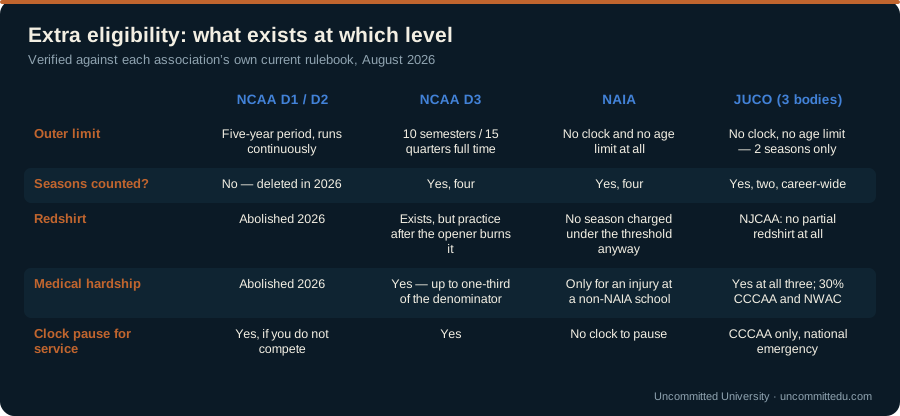
Almost every player believes the same thing: you get four seasons, five years to use them, and one redshirt if something goes wrong. That sentence was never true of every level, and as of 2026 it is not even true of the level most people mean when they say “the NCAA.”
Extra eligibility is not a loophole and it is not a favour. It is a set of written provisions in five different rulebooks, and most of them have been sitting there for years while players aged out without ever reading them.
We went through those rulebooks (the NCAA Division III Manual, the NAIA Official Handbook, and the current bylaws of all three junior college associations) and counted every extra eligibility path that can genuinely put you on a college field past year five. There are eleven that we could verify against the actual rule text.
This guide gives you all eleven extra eligibility paths, which division or association each one lives in, whether it buys you time or saves you a season, and the five myths that cost players more eligibility than any injury ever has.
Quick answer: Yes, you can play more than five years of college baseball, and there are eleven verified ways to do it. The biggest is the simplest: the NAIA has no five-year rule and no age limit at all, so a player with terms of attendance left can keep playing into their mid-twenties and beyond. The rest are clock pauses, season-recovery waivers, participation thresholds and enrollment rules that vary sharply by division: extra eligibility is real, but almost none of it works the same way at two different levels.
Key takeaways
There are 11 verified extra eligibility paths across the NCAA, NAIA and the three JUCO associations.
The NAIA has no five-year rule and no age limit by its own bylaw → that single fact outranks every waiver on this page.
Every path does one of two things: it extends your time window, or it saves a season inside it. Confusing the two is the most common mistake in extra eligibility advice.
Division I and II deleted redshirts and medical hardship waivers in 2026. Division III kept both.
If your NCAA clock expires with seasons unused, all three JUCO associations are still open to you.
Nothing here is a loophole. Every one of the 11 is written in a rulebook, and every one is division-specific.
Can you really get extra eligibility past five years?
Yes, but not by arguing with the NCAA. The reliable extra eligibility paths mostly involve playing under a different rulebook, qualifying for a written exception, or never burning the season in the first place.
The five-year figure that makes players assume extra eligibility is impossible comes from one place: the NCAA’s period of eligibility at Divisions I and II. That is one rulebook out of five that govern college baseball, and it is the strictest of them.
The NAIA does not have a five-year rule. None of the three junior college associations has one either. Division III does not run a calendar clock at all, it counts full-time semesters. So “five years” is not a law of college baseball. It is one association’s rule for two of its three divisions, and extra eligibility begins with knowing that.
D3 and NAIA (4 seasons); all three JUCO bodies (2 seasons). Deleted at D1/D2 in 2026
A pregnancy pause adds time to the window. Fall ball not counting against you saves a season. Those are different machines, and they do not stack the same way.
The reason this matters for extra eligibility is blunt: if the thing that ran out was your window, saving seasons will not help you, and vice versa. Work out which counter stopped you first, then read only the extra eligibility paths that touch it.
All 11 extra eligibility paths at a glance
#
Extra eligibility path
Where it applies
Buys time or saves a season
1
No clock, no age limit at the NAIA
NAIA
Both | there is no clock to run out
2
JUCO after your NCAA clock expires
NJCAA, CCCAA, NWAC
Time | they count seasons, not calendar
3
Military service or an official religious mission
NCAA D1, D2, D3 (CCCAA has its own version)
Time
4
Pregnancy
NCAA D1, D2, D3; NAIA
Time
5
Debilitating illness extension
NAIA
Time
6
Medical hardship, where it still exists
D3, NJCAA, CCCAA, NWAC
Season
7
Stay under the participation threshold
NAIA, NWAC
Season
8
Club baseball where there is no varsity team
D3, CCCAA
Season
9
Play through a graduate or second degree
D3, NAIA
Unlocks what you already have
10
Summer and inter-terms never burn a term
NAIA
Time
11
Part-time and reduced enrollment
NAIA, NWAC
Time
Extra eligibility by switching rulebooks
1. Play NAIA, where no clock and no age limit exist
This is the single most under-used piece of extra eligibility in college baseball, and it is one sentence in the NAIA handbook.
The NAIA states outright that for eligibility purposes it does not recognise the NCAA five-year rule or age-limitation regulations. What it counts instead is four seasons of competition inside ten semesters of attendance, and its own bylaw adds that those ten semesters need not be consecutive.
Read that carefully. A term is only charged while you are enrolled and identified at a school. A gap year charges nothing. A gap decade charges nothing. Working a job for three years charges nothing, because there is no calendar counter running in the background at all.
The practical result: a 26-year-old with four semesters of attendance left and two seasons unused has no NAIA rule standing in his way. Our NAIA eligibility rules guide covers the two-counter structure in detail, and NAIA baseball explained covers what the level actually looks like.
Here is a genuine extra eligibility consequence of the 2026 NCAA reform that almost nobody has written about: the NCAA now counts time, and the junior colleges count seasons. Those two systems can disagree, and when they do, a door opens.
None of the three JUCO associations imposes its own clock or its own age limit. Each asks one question: how many seasons of collegiate competition have you already used, anywhere? If your NCAA five-year period expired while you still have JUCO seasons left, the junior colleges have no rule that closes on you.
All three cap you at two seasons and all three count seasons played at other colleges, so this does not mint new seasons: you cannot drop down a level for a fresh start. But a player whose window closed with one or two seasons unused is a real category, and the 2026 reform created more of them.
The three associations are the NJCAA across most of the country, the CCCAA in California, and the NWAC in Washington, Oregon and Idaho. Our JUCO eligibility clock guide explains how the two systems interact, and JUCO baseball explained covers the level itself.
Extra eligibility from pausing the clock
3. Active-duty military service or an official religious mission
This extra eligibility path gets dismissed as a rumour constantly. It is not a rumour. It has been NCAA bylaw for decades, and it survived the 2026 rewrite intact.
Time spent in active-duty military service, on an official religious mission, or in a similar recognised service commitment can be excluded from the five-year period at Divisions I and II, provided you do not compete during that service. Compete, and the exception does not apply at all. Division III handles the same situations under its own unchanged rule.
Scope it carefully, because this is where extra eligibility advice usually goes wrong. At the junior colleges the same words mean much less: the NJCAA and NWAC provisions relieve academic and enrollment requirements for returning veterans but do not hand back a season. Only the CCCAA grants an outright extra season for active duty, and only when a national emergency has been declared. The NAIA has no clock to pause in the first place, so describing its military provisions as a “stop-clock” is simply the wrong frame.
4. Pregnancy
Pregnancy is the one extra eligibility provision that exists at every NCAA division and at the NAIA, and the versions differ enough to matter.
At Divisions I and II under the 2026 model, the pause runs for the actual period during which the athlete cannot compete, with medical documentation, it is open-ended rather than capped. Division III grants a fixed two-semester or three-quarter extension. The NAIA grants a one-time two-semester or three-quarter extension to its terms-of-attendance cap.
The honest gap: none of the three junior college associations names pregnancy anywhere in the bylaws we read. That is an absence in their rulebooks, not a denial, and it is the one item on this page most worth asking a compliance officer about directly.
5. NAIA’s debilitating-illness extension
Separate from pregnancy and separate from any sports injury, this NAIA extra eligibility route grants a one-time extension of two semesters or three quarters to the ten-semester cap for a debilitating illness: its bylaw names cancer, chemical dependency, and sufficiently intrusive psychological or mental illness as examples.
It requires documentation from someone licensed to diagnose and treat that specific condition, and it is not automatic: the request goes to the National Eligibility Committee as an exceptional ruling, decided case by case.
Extra eligibility from saving a season
Baseball thresholds. Any postseason appearance charges the season at the NWAC regardless of count.
6. Medical hardship, where it still exists
The medical hardship waiver is the extra eligibility path everyone has heard of, and it is also the one whose map changed most in 2026.
Divisions I and II deleted it. Medical hardship waivers appear by name on the NCAA’s own list of waiver categories eliminated by the age-based model. If you are a D1 or D2 athlete, this route no longer exists for you.
It survives everywhere else, with different thresholds:
Division III: a season-ending injury or illness before the halfway point of the season, with participation no greater than one-third of the standard denominator. Mental health conditions qualify on equal footing with physical injury as of a 2025 revision. Note the number: a lot of secondary sites still quote 20%, which is stale.
CCCAA: 30% of completed contests, and before the second half of the season.
NWAC: 30% of maximum permissible contests, which for baseball is capped at 15, with the injury in the first half of the schedule.
NJCAA: the bylaw explicitly contemplates a third season of participation once a hardship is approved. We could not confirm the current participation threshold: the pamphlet we could reach lists 20%, and njcaa.org has moved to a format that served no readable rulebook when we checked in August 2026. Treat it as somewhere in the 20–30% range and confirm with the school.
The NAIA is the odd one out and it is good news. Because of its participation threshold below, a player hurt early is never charged a season to begin with, so no waiver is needed. The one hardship provision left in the NAIA handbook covers a season-ending injury suffered at a non-NAIA school before transferring in.
7. Stay under the participation threshold
Most players assume any appearance burns a year, and give up on extra eligibility because of it. At two associations, that is flatly untrue, and the numbers are generous.
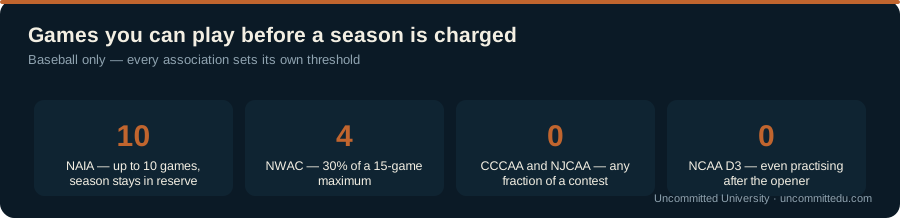
The NAIA charges a season only past 20% of the maximum allowable contests. For baseball, the published threshold is 11 contests, meaning a player can appear in up to 10 games and the season stays in reserve. Scrimmages never count at all, with no cap on how many.
The NWAC charges a season only past 30% of its maximum, which for baseball is 15 contests. Appear in four or fewer and never reach the postseason, and no NWAC season is used. Any postseason appearance charges the season regardless of percentage.
The contrast is stark and it is worth knowing before you choose a level: the CCCAA and the NJCAA charge a full season for any fraction of any contest, and the NJCAA says in its own text that it does not use a partial-season redshirt under any circumstance.
8. Club baseball where there is no varsity team
A narrow extra eligibility route, but a free one. At Division III, participation on a college club team is exempt from counting as intercollegiate competition provided the institution does not sponsor that sport at varsity level. The CCCAA has the same carve-out. Division I mirrored it before 2026.
Flip it around and the rule bites: club baseball at a school that does field a varsity team burns a season exactly as if you had played varsity. And the NJCAA charges a season for any fraction of a club season regardless of the host school’s varsity status, so this path does not exist there at all.
Extra eligibility from stretching the calendar
9. Play through a graduate or second degree
This is the most realistic extra eligibility route at Division III, and it has nothing to do with injury or hardship. Graduate early, keep your grades up, and enrol in a graduate or second bachelor’s programme: a D3 athlete may keep competing at the same or a new D3 school with eligibility remaining, provided time is left in the ten-semester window.
The NAIA has its own version: a post-baccalaureate student pursuing a second degree, a second major, or graduate work of any kind may keep competing on remaining seasons and terms. Combined with the NAIA having no clock at all, this is the mechanism behind players legitimately on rosters into their mid-twenties.
The transfer side of this is its own subject: see our grad transfer rules guide.
10. Summer sessions and inter-terms never burn an NAIA term
The NAIA defines a term of attendance as any quarter, semester or trimester excluding summer sessions. Inter-terms (the short sessions between two regular terms) are separately defined as not being terms of attendance at all.
That means you can take a full summer load, earn real credit toward your degree, and spend none of your ten terms doing it. Stack that across three summers and you have effectively bought yourself an extra year of campus time without touching the counter that limits you. It is the quietest extra eligibility gain on this page.
11. Part-time and reduced enrollment
Two different extra eligibility rules here, both real.
At the NAIA, a term only counts once you are “identified”, which means enrolling in 12 or more credit hours, or competing in a contest. Enrol below that line and do not compete, and the term is not charged. It is narrow by design: play in one game and you are identified regardless of hours, so this only helps a term you were sitting out anyway.
At the NWAC, there is an explicit reduced-enrollment path for athletes who have banked 90-plus credits or an associate degree: they may enrol less than full-time and still compete, provided they stay in at least one degree-seeking class. The bylaw itself flags the trade-off: doing this may cost you a term or year of participation at the four-year level even though the NWAC does not charge it that way.
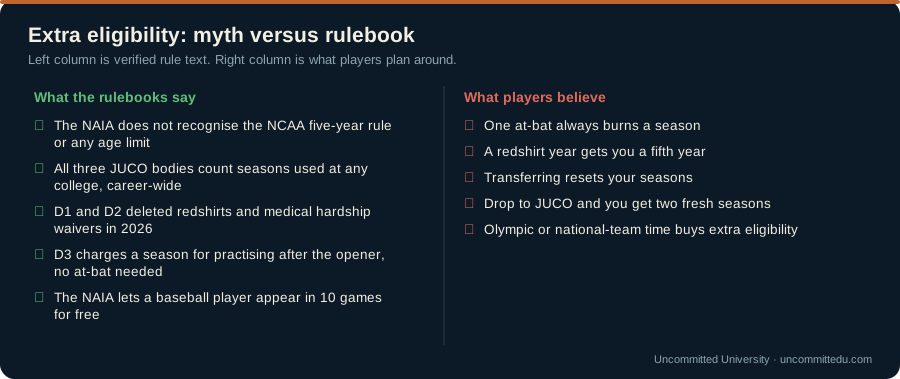
Five extra eligibility myths that cost players seasons
Each myth is wrong at the level most players care about, not wrong everywhere.
These come up in every conversation about extra eligibility, and each one is either wrong or wrong at the level the player cares about.
The myth
What the rulebooks say
“One at-bat burns a season”
Was exactly right at D1/D2 before 2026: the bylaw said any competition, regardless of time. Now moot there, since seasons of competition were deleted. Understates D3, where merely practising after the opener burns it. Wrong at the NAIA and NWAC, which have thresholds
“A redshirt gets you a fifth year”
Athletics redshirt rules were eliminated at D1 and D2 in 2026. D3 still permits one, but only if you avoid practice as well as games, and its own bylaw lists a redshirt year as a circumstance within your control that earns no extra time
“Transferring resets your seasons”
False everywhere we looked. The NAIA counts seasons charged by other associations at face value; all three JUCO bodies count seasons used at any post-secondary institution
“Drop to JUCO for two fresh seasons”
False. All three JUCO associations count prior collegiate seasons career-wide. Path 2 above works because your clock expired, not because seasons reset
“Olympic or national-team time buys eligibility”
It did before 2026, through a one-time athletics activity waiver capped at one year. That waiver category is named on the NCAA’s own eliminated list, so the clock-extension version of this looks gone at D1/D2, though the NCAA has not addressed Olympians by name
The redshirt myth is the most expensive extra eligibility mistake, because players still plan around it. Our NCAA redshirt rules guide covers what replaced it, and the NCAA age limit guide explains the model that deleted it.
What we could not verify
Publishing what we could not confirm is part of honest extra eligibility reporting, because a confident answer built on a stale rulebook is worse than no answer.
The NJCAA’s current medical hardship threshold. The reachable NJCAA rules document dates from 2018-19; njcaa.org now serves a format that returned no readable rulebook in August 2026. The mechanism is clear, the exact percentage is not.
Pregnancy provisions at the junior colleges. Genuinely absent from every JUCO rulebook we read, not merely unresearched.
Study-abroad and internship clock exceptions at D1. These existed before 2026. They are not named on the NCAA’s eliminated lists, but those lists may not be exhaustive. Status unknown.
Whether club baseball still means anything at D1/D2. The season-of-competition concept those rules were built on no longer exists there.
One more caveat that applies to every NCAA line on this page: parts of the 2026 age-based model are under active litigation. A July 2026 preliminary injunction restored fifth-season eligibility for some athletes and the NCAA is appealing. The rules described here are the rules in force as of August 2026. If you are inside a season that depends on the outcome, check the current position before you commit.
How to work out your own extra eligibility
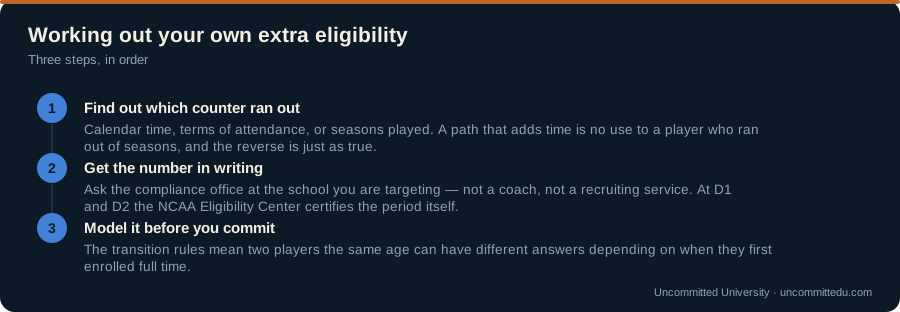
Do these in order. Step one decides which of the eleven paths can even apply to you.
Three steps, in this order, and they apply to every extra eligibility path above.
First, find out which counter ran out. Was it calendar time, terms of attendance, or seasons played? The answer decides which of the eleven extra eligibility paths above can even apply to you.
Second, get the number in writing. Ask the compliance office at the school you are targeting (not your coach, not a recruiting service) how many seasons and how much window they believe you have. At Divisions I and II the NCAA Eligibility Center certifies the period itself.
Third, model it before you decide anything. Most of these paths interact, and the transition rules at D1 and D2 mean two players the same age can have different answers depending on when they first enrolled.
Check your eligibility, free
Answer a few questions and see how many seasons you have left across NCAA D1, D2 and D3, the NAIA and all three JUCO associations.
Frequently asked questions about extra eligibility
How many ways are there to get extra eligibility in college baseball? Eleven that can be verified against the actual rule text of the NCAA, NAIA and the three junior college associations. They divide into paths that extend your time window, paths that save a season inside it, and one path (the NAIA) where no clock exists to run out.
Can you play college baseball after your NCAA five-year clock expires? Yes. The NAIA does not recognise the NCAA five-year rule or any age limit, and none of the three JUCO associations runs its own clock. If your NCAA window closed with seasons unused, those levels have no rule that closes on you for that reason alone.
Is there still a medical hardship waiver for extra eligibility? Not at Division I or Division II: it was eliminated by name in the 2026 age-based reform. It survives at Division III and at all three JUCO associations, with different participation thresholds at each.
Does a religious mission really pause your eligibility clock? At the NCAA, yes. Time on an official religious mission can be excluded from the five-year period provided you do not compete during it. At the junior colleges it does not add a season: the CCCAA explicitly limits its extra-season provision to military service.
How many games can you play without using a season? It depends entirely on the association. The NAIA allows up to 10 baseball games before a season is charged, and the NWAC allows up to four. The CCCAA and NJCAA charge a full season for any appearance at all, and Division III charges one for merely practising after the opener.
Does the NAIA have an age limit for baseball? No. The NAIA states in its own handbook that it does not recognise NCAA age-limitation regulations, and it counts terms of attendance rather than calendar years. Its ten semesters need not be consecutive, so time away from school costs nothing.
The short version
Extra eligibility is real, there are eleven verified ways to get it, and the biggest one is that the NAIA has no clock and no age limit at all. Every other extra eligibility route is a written exception in a specific rulebook.
Work out which counter stopped you (your time window or your seasons) because that decides which paths are even open. Then check the level, not the sport: a rule that is true at Division III may be deleted at Division I and irrelevant at the NAIA.
And treat the 2026 changes as the dividing line. Redshirts and medical hardship waivers are gone at Divisions I and II. Division III kept both. The NAIA and the junior colleges were never part of that legislation and did not change at all.
Your next step
Find out what extra eligibility you actually have before you plan around what you think you have.
Check your eligibility, free
See how many seasons and how much window you have left across every level: NCAA, NAIA and JUCO.
Then go to the source. The NCAA’s Division II announcement covers the 2026 model, and each association publishes its own rulebook. If an extra eligibility path on this page matters to your season, read the bylaw and then ask compliance, in writing.
For the division-by-division picture, our D2 eligibility rules guide covers the newest ruleset in the group.
Written by Recruiting Coordinator, part of Uncommitted University’s recruiting content team.
The NCAA age limit question comes up the moment a player considers a gap year, a post-grad season, or a junior college detour, and almost every answer still online was written for a rulebook that no longer exists.
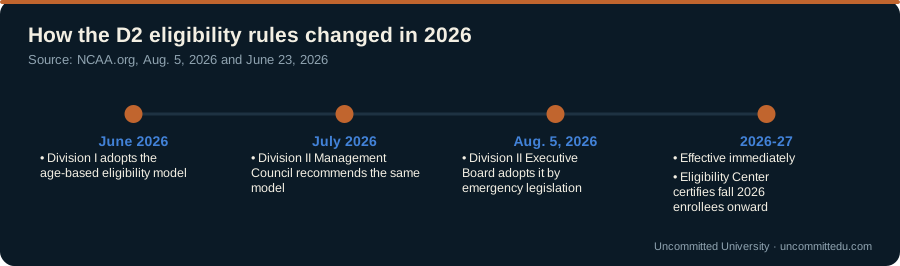
Division I adopted an age-based eligibility model in June 2026. Division II followed on August 5, 2026. Together they replaced four seasons of competition with one continuous five-year period, and that rewrote what the NCAA age limit means for every recruit on a nontraditional path.
Here’s the deal: the honest answer is not a number of years old. It’s a date.
This guide covers how the NCAA age limit works under the 2026 rules: what starts your clock, the Sept. 1 birthday split most write-ups miss, the three exceptions that can pause it, the waiver categories that were deleted outright, and what all of it means for a baseball player.
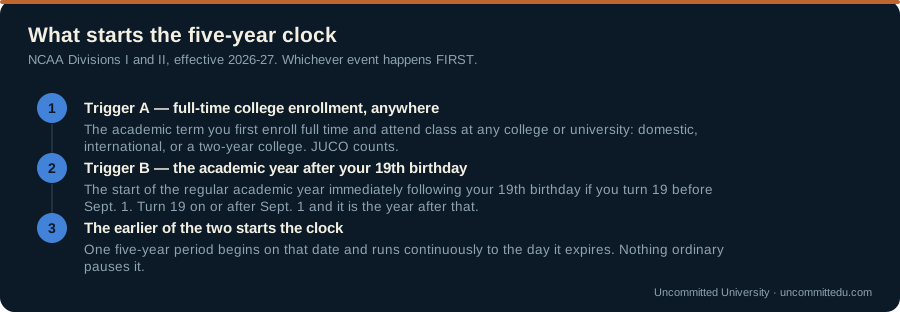
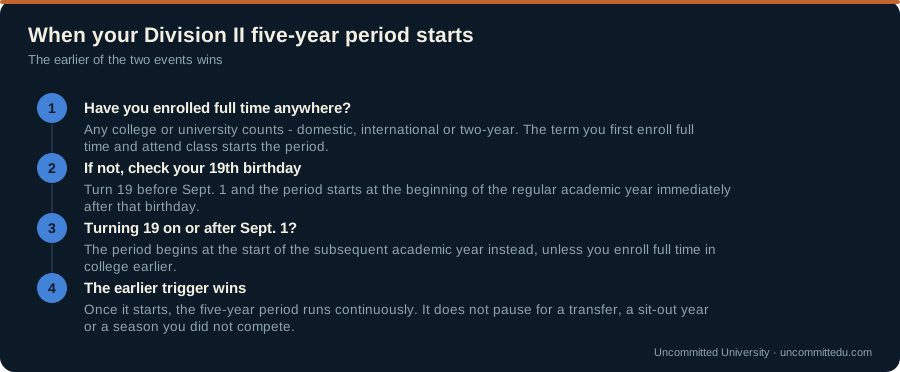
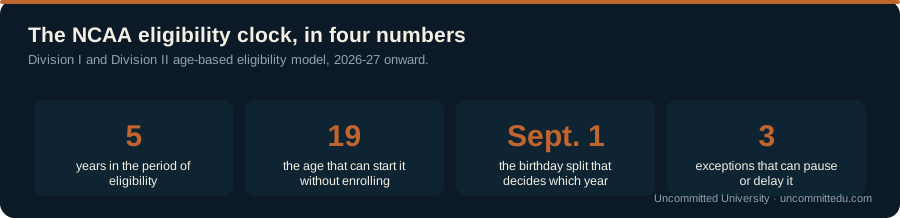
Quick answer: There is no hard NCAA age limit. Under the age-based eligibility model adopted by Divisions I and II in 2026, your five-year period of eligibility begins at the start of the academic year after you turn 19, or at your first full-time college enrollment at any college anywhere, whichever comes first. It then runs continuously until it expires.
Key takeaways
There is no hard NCAA age limit: there is a five-year clock, and a birthday can start it.
The NCAA age limit clock starts at the earlier of full-time college enrollment anywhere or the academic year after your 19th birthday.
Turn 19 on or after Sept. 1 and the age trigger waits a full extra year.
The clock runs continuously: transfers, sit-out years and injuries do not pause it.
Athletics redshirts and medical hardship waivers were deleted, not modified.
The NCAA age limit rules cover Divisions I and II only. D3, NAIA and NJCAA are not part of this legislation.
Is there an NCAA age limit?
There is no hard NCAA age limit, but under the 2026 rules your five-year clock starts at the academic year after you turn 19, or at full-time college enrollment anywhere, whichever comes first.
That distinction is the whole article. No NCAA bylaw bars a 24-year-old from a Division I roster.
What the age-based rules do is start a countdown on a birthday. Being older is only a problem because the countdown has been running the entire time.
The old system asked how many seasons you had used. The NCAA age limit system asks what date your clock started and whether today is still inside five years of it.
“The NCAA Division II age-based eligibility rules mirror the legislation adopted by Division I and establish a five-year period of eligibility. Under this model, a student-athlete’s period of eligibility begins at the earlier of these two events: full-time enrollment at any college or university, domestic or international, including junior colleges; or the beginning of the regular academic year immediately after the student’s 19th birthday.”
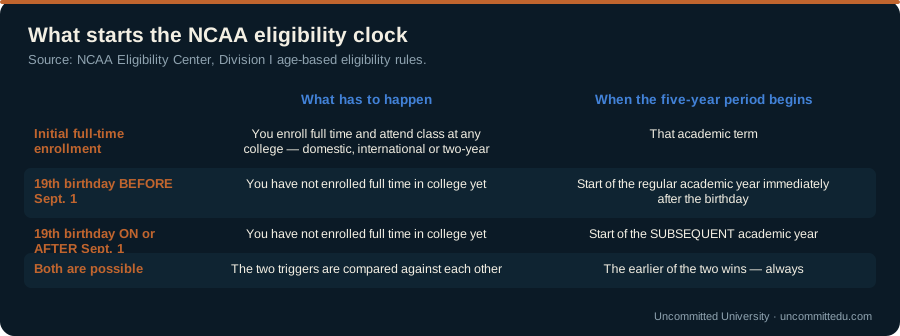
The diagram below shows how the two NCAA age limit triggers race each other.
The NCAA age limit rules start one five-year clock at whichever trigger fires first, a birthday or a full-time enrollment.
Initial full-time college enrollment: “The academic term when the student-athlete first enrolls full time and attends class at any college or university, including a domestic institution, international institution or two-year college.”
Age-based trigger: “The start of the regular academic year immediately following the student-athlete’s 19th birthday, if the student-athlete turns 19 before Sept. 1.”
Read the enrollment trigger twice. Any college, anywhere, including a two-year college, a junior college semester is a full-time enrollment, and it starts the NCAA age limit clock exactly the way a four-year enrollment does.
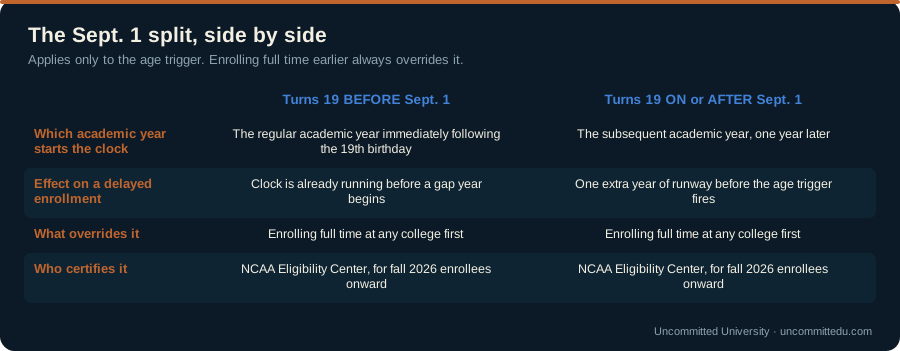
What is the Sept. 1 birthday split in the NCAA age limit rules?
A player who turns 19 on or after Sept. 1 does not start the clock that academic year, the age trigger waits until the following one, which is worth a full extra year of eligibility.
Here is the Eligibility Center’s exact wording, and it is the sentence most NCAA age limit explainers leave out:
“For an individual who turns 19 on or after Sept. 1, the period of eligibility begins at the start of the subsequent academic year, unless the individual enrolls full time in college earlier.”
The Sept. 1 birthday split is the detail most NCAA age limit write-ups leave out, and it is worth a full extra year of eligibility.
Two players, born eight weeks apart, get different answers:
An August 19th birthday. He turns 19 before Sept. 1, so the age trigger fires at the start of that same academic year. If he sits out to play travel ball instead of enrolling, the NCAA age limit clock is already burning.
An October 19th birthday. He turns 19 after Sept. 1, so the age trigger waits until the start of the next academic year. A gap year costs him nothing, provided he does not enroll full time anywhere in the meantime.
Now: the birthday only ever delays the age trigger. It never delays the enrollment trigger. Enrolling full time in college always overrides the split and starts the clock immediately.
Does the NCAA five-year rule clock ever pause?
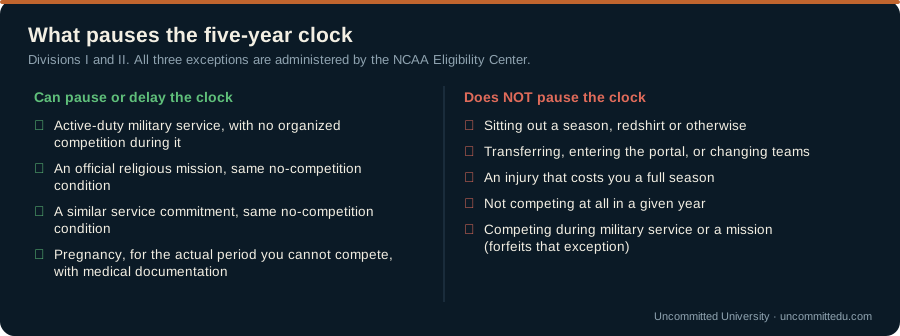
No, under the NCAA five-year rule the period runs continuously from the day it starts, and nothing about your participation stops it.
The Eligibility Center is unambiguous about this:
“Once the five-year period starts, it runs continuously. It does not pause because a student-athlete does not compete, transfers, sits out, changes teams or takes time away from participation, meaning student-athletes, coaches and athletics departments no longer have to track athletic ‘redshirts.'”
That single sentence deletes four familiar assumptions at once:
A transfer does not pause it. Entering the portal, sitting a year, and re-enrolling somewhere else spends clock the entire time.
A redshirt year does not preserve anything. There is no season count left to preserve.
An injury does not pause it. A lost season under the NCAA five-year rule is simply a lost year.
Not competing does not pause it. The clock measures elapsed time, not games played.
What’s the bottom line? The NCAA age limit rules trade flexibility for predictability. The Eligibility Center says so itself: “The new age-based rules are more predictable but less flexible.”
The NCAA explicitly rejects “5 for 5” because the age-based model does not guarantee five seasons to everybody, and a delayed enrollee can end up with fewer.
The Eligibility Center names and dismisses the phrase directly:
“While some have referred to this as the NCAA ‘5 for 5’ rule, that is not accurate. The age-based rules actually centers on a student-athlete’s age and when the student initially enrolls full time in college, and it does not guarantee five years for all student-athletes, particularly those who delay enrollment.”
The arithmetic is simple. If your NCAA age limit clock started at 19 and you did not enroll until you were 21, two of your five years are already gone.
Five years of clock is not the same thing as five years of college baseball. That gap is exactly where families get surprised.
Who gets a choice between the old rules and the NCAA age limit?
Whether you get the old rules, the new NCAA age limit rules, or the more favorable of the two depends entirely on when you first enrolled full time in college.
The rule change is effective immediately for the 2026-27 academic year. Four groups are treated differently:
Your situation
How your eligibility is reviewed
Used your final season of competition under the previous rules during 2025-26
No additional eligibility. The change is not retroactive.
Current student-athlete with eligibility remaining after 2025-26
Previous rules or the age-based rule, whichever is most beneficial
Prospect first enrolling full time at any college during 2026-27, including those who have already turned 19
Previous rules or the age-based rule, whichever is most beneficial
Prospect first enrolling full time in fall 2027 or later
Age-based rule only
Two different offices run that comparison, and this trips people up. Campus compliance staff do it for current student-athletes. The NCAA Eligibility Center does it for incoming 2026-27 enrollees.
There is also a cost to staying on the old rules that is easy to miss:
“However, student-athletes who continue under the previous rules will not have future waiver opportunities to gain additional eligibility through eliminated waiver categories.”
On why nobody whose eligibility already expired gets a season back, the Division II Executive Board and Management Council said this jointly:
“Giving student-athletes another season would disrupt expected roster spots and playing time ahead of the upcoming seasons and alter financial aid packages for countless student-athletes, including incoming freshmen who are beginning (or have begun) their college athletics experience.”
What are the three exceptions to the NCAA age limit clock?
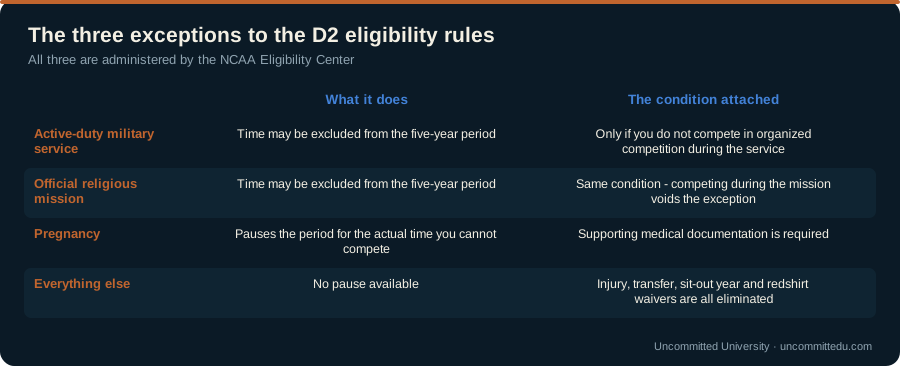
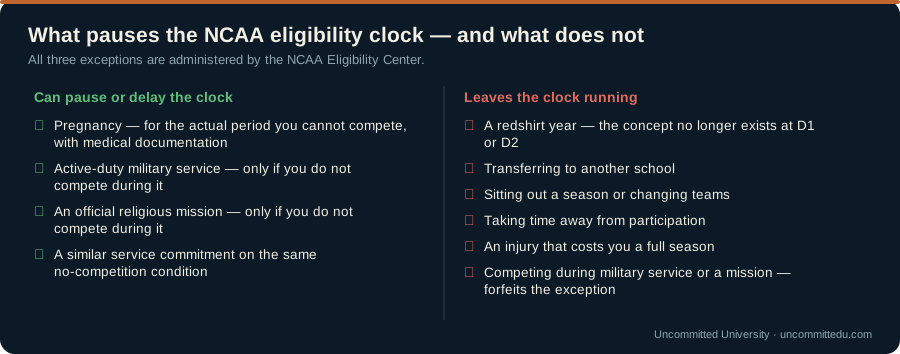
Three things can delay or pause the five-year period: pregnancy, active-duty military service and official religious missions, and all three are administered by the NCAA Eligibility Center.
Only three things pause the NCAA age limit clock, and every familiar workaround from the old rulebook is on the right-hand side.
The conditions on each one matter more than the categories:
Military service, religious missions and similar service commitments. That time “may be excluded from the five-year period if the student-athlete does not participate in organized competition during that service.” Compete during the service period and, in the Eligibility Center’s words, “the exception does not apply.”
Pregnancy. A pregnant student-athlete “may pause the eligibility period for the duration of the actual period during which the individual cannot compete.” Supporting medical documentation is required.
Notice the asymmetry. The service exception is forfeited by competing; the pregnancy exception is bounded by the actual period of inability to compete. They are not the same shape of relief, and neither is a general-purpose pause button on the NCAA age limit clock.
What the NCAA age limit model deleted
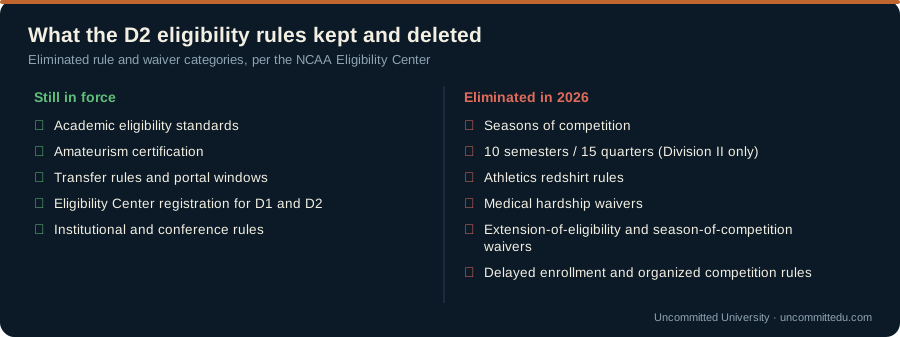
The age-based model did not modify redshirt rules, medical hardship waivers or the 10-semester rule: it deleted them.
These rules were eliminated outright:
Seasons of competition: the count itself is gone
Athletics redshirt rules
Delayed enrollment and organized competition rules
Sport-specific enrollment timelines
Academic nonqualifier season limitations (Division I only)
10 semesters / 15 quarters of full-time eligibility (Division II only)
And these waiver categories were eliminated with them:
Medical hardship waivers
Extension-of-eligibility waivers
Season-of-competition waivers
Athletics activity waivers
Delayed enrollment and organized competition waivers
Here’s the kicker: the medical redshirt was the safety net families relied on most, and under the NCAA age limit rules there is nothing behind it. A season lost to a torn UCL is a year of clock, and no waiver exists to buy it back.
There is no NCAA age limit baseball rule separate from the general one, baseball players simply run into the clock more often, because the sport’s normal development paths involve delay.
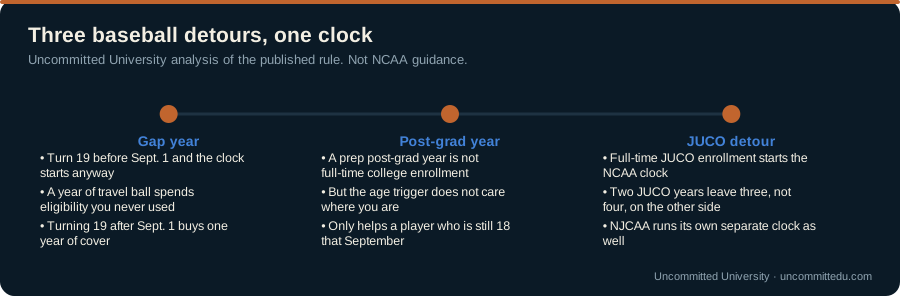
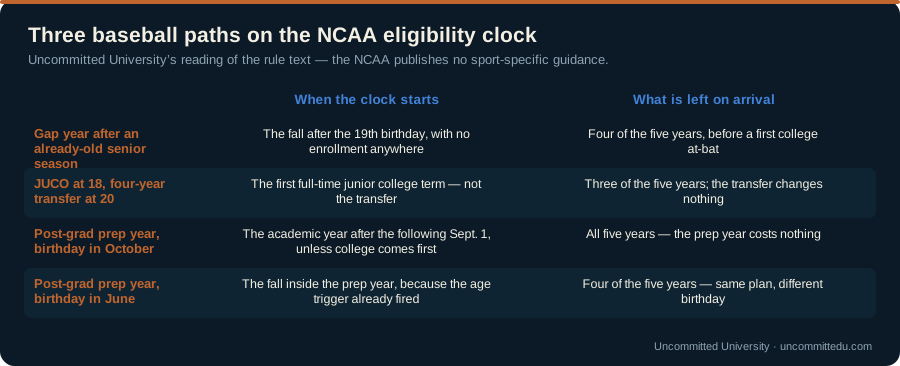
A note on sourcing: the NCAA has published no baseball-specific guidance on the age-based model. Everything in this section is Uncommitted University’s analysis of the published rule, not NCAA instruction.
Our reading of the NCAA age limit rules applied to three common baseball detours, the NCAA has published no baseball-specific guidance.
Three baseball detours read differently now:
The gap year. A year of travel ball or independent training after high school does not enroll you anywhere, but it does not stop the age trigger either. For a player who turned 19 before Sept. 1, that year is spent clock with no season to show for it.
The post-grad year. A prep post-grad season is not full-time college enrollment, so the enrollment trigger stays dormant. It only preserves anything for a player who is still 18 that September.
The JUCO detour. Full-time junior college enrollment starts the NCAA clock. Two JUCO years leave three on the other side, not four, and the NJCAA still runs its own separate clock alongside it.
Our read, stated as an opinion rather than a rule: the NCAA age limit baseball consequence is that late bloomers pay for their patience. The player who needed an extra year to add velocity now spends eligibility to buy it.
The NCAA Division 2 age limit works identically to Division I’s, because the Division II Executive Board adopted emergency legislation on August 5, 2026 that mirrors the Division I model.
The NCAA’s own wording is that the Division II rules “mirror the legislation adopted by Division I.” Same two triggers, same five-year period, same three exceptions, same Eligibility Center administration.
One thing genuinely differs, and it is what was replaced. Division I dropped four seasons within five years. Division II dropped four seasons of competition within 10 semesters or 15 quarters, a rule that had no Division I equivalent.
The age-based legislation covers Divisions I and II only, so a player evaluating other levels is looking at different rulebooks entirely.
Division III. Both NCAA sources describe this model as a Divisions I and II change. No D3 age-based model has been announced, and nothing here should be read as describing D3 eligibility.
The NAIA. This is NCAA bylaw, so it does not reach the NAIA. NAIA eligibility continues to run on the NAIA’s own standards and its own season-of-competition rules.
The NJCAA. Junior college eligibility is likewise governed by the NJCAA’s own clock. Full-time JUCO enrollment starts your NCAA clock, but the NJCAA’s rules for JUCO competition are unchanged by this legislation.
The practical version: registering or competing under one governing body’s rules tells you nothing about another’s. A player weighing a JUCO or NAIA route is now managing two clocks, not one.
Inside the five years is not the same as eligible
Being inside your five-year period does not make you eligible to compete. It only means the clock has not expired.
The Eligibility Center is explicit about it:
“Other eligibility rules – including academic and other athletics-related rules – will still apply, meaning a student-athlete may be inside the five-year eligibility period and still be ineligible for other reasons.”
Core courses, GPA, progress toward degree and amateurism all still stand. The NCAA age limit clock is one gate of several, and it is the only one this legislation touched.
The NCAA age limit is now a date-arithmetic problem, and four steps settle it for almost everybody.
Find your trigger date. Write down your 19th birthday and your first full-time college enrollment term, whether that was a four-year school, a junior college, or an institution outside the United States.
Apply the Sept. 1 split. Before Sept. 1, the age trigger fires that academic year. On or after Sept. 1, it waits for the next one.
Add five years to the earlier date. That is your expiry, and it is the whole NCAA age limit answer for you.
Confirm it in writing. The Eligibility Center certifies the period for students initially enrolling in fall 2026 and beyond, and planned to surface this information in student accounts in early August 2026. Current student-athletes should ask campus compliance for the most-beneficial comparison in an email, not after practice.
The clock question is now a birthday question
Uncommitted University’s eligibility calculator takes your birthday and your first full-time enrollment term and returns the date your five-year period expires.
Frequently asked questions about the NCAA age limit
Is there an NCAA age limit for playing college sports? No. There is no maximum age in NCAA bylaws. What exists is a five-year period of eligibility that starts at the earlier of full-time college enrollment or the academic year after your 19th birthday, and expires five years later regardless of how much you competed.
When exactly does the NCAA age limit clock start if I turn 19 in October? At the start of the academic year after the next one. Turning 19 on or after Sept. 1 pushes the age trigger to the subsequent academic year, unless you enroll full time in college before then, which starts the clock immediately.
Does a redshirt year still protect a season under the NCAA age limit rules? No. Athletics redshirt rules were eliminated in Divisions I and II, along with medical hardship, extension-of-eligibility, season-of-competition, athletics activity, and delayed enrollment waivers. The five-year period runs continuously whether you compete or not.
Does junior college enrollment start the NCAA five-year rule clock? Yes. The rule names two-year colleges explicitly. Full-time enrollment at any college or university, domestic, international or junior college, starts the period.
What is the NCAA Division 2 age limit compared with Division I? They are the same. Division II adopted emergency legislation on August 5, 2026 that mirrors the Division I model, with the same two triggers, the same five-year period and the same three exceptions.
Do the NCAA age limit rules apply to Division III, NAIA or JUCO? No. The age-based model was adopted by Divisions I and II. Division III is not part of this legislation, and the NAIA and NJCAA govern their own eligibility under their own rules.
An expired clock is not always the end of it. Our guide to extra eligibility lists the 11 verified ways players still get on a field past year five, including the levels this rule never touched.
The short version
The NCAA age limit is not an age at all: it is a five-year period that starts at the earlier of your first full-time college enrollment anywhere or the academic year after your 19th birthday. Turn 19 on or after Sept. 1 and that second trigger waits a year.
Once it starts it does not stop. Transfers, sit-outs, injuries and unused seasons all spend clock, and the redshirt and medical hardship waivers that used to fix that are gone.
Only pregnancy, active-duty military service and official religious missions can pause it, and the service exceptions are forfeited by competing. Divisions I and II only. D3, the NAIA and the NJCAA are not part of this rule.
Your next step
Work out your own expiry date before you make a decision that depends on it.
Check your eligibility, free
Answer a few questions and see the exact date your five-year NCAA period expires.
D2 eligibility rules changed on Aug. 5, 2026, and the version most recruiting sites still describe is the old one. Division II threw out four seasons of competition inside 10 semesters and replaced it with a single five-year period of eligibility.
Here’s the deal: the new D2 eligibility rules are far easier to explain and far less forgiving of a slow start. This guide covers what the NCAA Division II Executive Board actually adopted, exactly when your clock starts, what got deleted, and who gets to choose between the old and new D2 eligibility rules.
Quick answer: The D2 eligibility rules now give you one five-year period of eligibility that starts at the earlier of two events: the term you first enroll full time at any college, or the academic year immediately after your 19th birthday. The clock then runs continuously. Seasons of competition, redshirts and medical hardship waivers no longer exist in Division II.
Key takeaways
The D2 eligibility rules were rewritten by emergency legislation on Aug. 5, 2026, effective for 2026-27.
NCAA 5 year eligibility in Division 2 is a period, not a count of seasons: the clock runs whether you play or not.
The old 10 semesters / 15 quarters limit was a D2-only rule, and the D2 eligibility rules deleted it outright.
Athletics redshirts and medical hardship waivers are gone under the new D2 eligibility rules.
Nobody who finished their eligibility by 2025-26 gets a season back: the D2 eligibility rules are not retroactive.
What changed in the D2 eligibility rules on Aug. 5, 2026?
On Aug. 5, 2026, the NCAA Division II Executive Board adopted emergency legislation replacing the seasons-of-competition system with an age-based five-year period of eligibility. The NCAA’s own announcement states it plainly:
“The NCAA Division II Executive Board adopted emergency legislation to establish an age-based eligibility model as recommended by the Management Council in July.”
Three details matter in that sentence. It was emergency legislation, not a normal proposal cycle. It came from the Management Council’s July 2026 recommendation. And it was adopted by the Executive Board, which is why the D2 eligibility rules moved in weeks rather than a legislative year.
Division I got there first. The Division I membership adopted the same model in June 2026, and the Division II version explicitly mirrors it.
The D2 eligibility rules moved from a Management Council recommendation to adopted legislation in about five weeks.
The rule change is effective immediately for the 2026-27 academic year. There is no phase-in period and no pilot. If you are competing in Division II in 2026-27, the new D2 eligibility rules are already the governing framework.
The same shift is what drives the broader NCAA age limit question, and the honest answer there has changed too.
How many years of eligibility do you get in NCAA Division 2?
Five years, but it is a five-year window, not five seasons you can spend whenever you like. That distinction is the whole rule, and it is where most explanations of the D2 eligibility rules go wrong.
Under the old system, a Division II athlete had four seasons of competition to use inside 10 semesters or 15 quarters of full-time enrollment. Under the new D2 eligibility rules, you get a period. What you do inside it is up to you and your program.
Here is the before-and-after, side by side.
Element
Previous D2 eligibility rules
D2 eligibility rules from 2026-27
Core limit
Four seasons of competition
One five-year period of eligibility
Enrollment cap
10 semesters / 15 quarters full time (Division II only)
Deleted
What starts it
Full-time enrollment
Full-time enrollment anywhere, or the academic year after your 19th birthday, whichever is earlier
Redshirt tracking
Required, by the athlete and the athletics department
Not required: athletics redshirt rules are eliminated
Medical hardship
Waiver available
Waiver category eliminated
Administered by
Campus compliance, with waivers through the NCAA
NCAA Eligibility Center certifies the period for fall 2026 enrollees onward
One warning the NCAA issues itself: this is not a “5 for 5” rule. The Eligibility Center names that phrase and rejects it, because the model “does not guarantee five years for all student-athletes, particularly those who delay enrollment.”
Being inside the window is also not the same as being cleared to play. Academic standards, amateurism and institutional rules all still apply, so a player can sit comfortably inside the five years and still be ineligible for another reason entirely.
When does the NCAA Division 2 eligibility clock start?
Your NCAA Division 2 eligibility clock starts at the earlier of two events: your first full-time college enrollment anywhere, or the academic year that follows your 19th birthday. The NCAA Eligibility Center defines the first trigger this way:
“Initial full-time college enrollment: The academic term when the student-athlete first enrolls full time and attends class at any college or university, including a domestic institution, international institution or two-year college.”
Read “two-year college” carefully. Full-time enrollment at a junior college starts your NCAA five-year period, even though you are not yet an NCAA athlete. So does a full-time term at an international university. So does a semester at a school where you never played a game.
Whichever trigger happens first is the one that starts the five-year period under the D2 eligibility rules.
That single line rewrites how JUCO routes should be planned under the D2 eligibility rules. Two years of junior college now spends two years of a five-year period before a player ever sets foot on a Division II campus.
For a fuller walk-through of how the window behaves once it opens, see our guide to the NCAA eligibility clock.
The Sept. 1 split almost every write-up misses
The age trigger is not simply “age 19”: it turns on whether your 19th birthday falls before or after Sept. 1. Here is the Eligibility Center’s exact wording:
“Age-based trigger: The start of the regular academic year immediately following the student-athlete’s 19th birthday, if the student-athlete turns 19 before Sept. 1. For an individual who turns 19 on or after Sept. 1, the period of eligibility begins at the start of the subsequent academic year, unless the individual enrolls full time in college earlier.”
In plain terms: a summer birthday and an autumn birthday can be a full academic year apart in how the D2 eligibility rules treat them.
Now: that is a real planning variable for anyone considering a gap year, a post-graduate year or a delayed enrollment. The NCAA’s own advice is blunt about it: “delaying college enrollment beyond age 19 may reduce the amount of eligibility available in Divisions I and II.”
No: outside three narrow exceptions, the five-year period runs continuously from the day it starts. The Eligibility Center states it without qualification:
“Once the five-year period starts, it runs continuously. It does not pause because a student-athlete does not compete, transfers, sits out, changes teams or takes time away from participation, meaning student-athletes, coaches and athletics departments no longer have to track athletic ‘redshirts.'”
Every item in that list used to be a reason to protect a season. Under the D2 eligibility rules, none of them buy you time any more.
Not competing: the year still burns.
Transferring: the clock follows you; it does not restart at the new school.
Sitting out a season: no longer preserves anything, because there is nothing left to preserve.
An injury year: the medical hardship waiver that used to cover this is an eliminated category.
What’s the bottom line? Time is now the only currency in the D2 eligibility rules, and there is no way to bank it.
What the D2 eligibility rules deleted: redshirts, waivers and the 10-semester cap
Six rule categories and five waiver categories were eliminated, and two of them were Division II’s alone. The Eligibility Center publishes the list.
The D2 eligibility rules deleted an entire waiver menu, including the medical hardship waiver families relied on after an injury year.
Rules eliminated: seasons of competition; athletics redshirt rules; delayed enrollment and organized competition rules; sport-specific enrollment timelines; academic nonqualifier season limitations (Division I only); and 10 semesters / 15 quarters of full-time eligibility, which was Division II only.
Waiver categories eliminated: medical hardship waivers; extension-of-eligibility waivers; season-of-competition waivers; athletics activity waivers; and delayed enrollment / organized competition waivers.
That second list is the one families feel. A medical hardship waiver was how a lost season came back after a serious injury, and under the new D2 eligibility rules there is no such application to file.
If you arrived here looking for how a redshirt year works, our breakdown of NCAA redshirt rules covers what the term used to mean and what still applies at levels the NCAA change does not touch.
But here’s the kicker: “no redshirts” is not the same as “no sitting out.” A player can still take a developmental year. It just costs a year of the period instead of costing nothing, which is a completely different decision.
Old rules or new rules: who chooses, and who decides
Whether you can pick between the previous system and the new D2 eligibility rules depends entirely on when you first enrolled full time. There are four groups, and two different offices run the comparison.
Your situation
How eligibility is reviewed
Who runs the review
Used your final season of competition under the previous rules during 2025-26
No additional eligibility
Not reviewed: the change does not reach backwards
Current student-athlete with eligibility remaining after 2025-26
Previous rules or the age-based rule, whichever is most beneficial
Campus compliance staff
First full-time enrollment at any college during 2026-27, including those who have already turned 19
Previous rules or the age-based rule, whichever is most beneficial
NCAA Eligibility Center
First full-time enrollment in fall 2027 or later
Age-based rule only
NCAA Eligibility Center
Do not assume one office speaks for the other. If you are already on a Division II roster, your campus compliance office runs the most-beneficial comparison. If you are enrolling for the first time in 2026-27, the NCAA Eligibility Center does it.
There is also a cost to staying on the old system that is easy to miss. Athletes who continue under the previous rules “will not have future waiver opportunities to gain additional eligibility through eliminated waiver categories.” Choosing the old D2 eligibility rules means choosing them without the safety net that used to sit underneath them.
The Eligibility Center now certifies the period of eligibility for students initially enrolling in fall 2026 and beyond, on top of the academic and amateurism certifications it already handled. Schools still report discrepancies, advise current athletes and certify eligibility alongside it.
Do the new D2 eligibility rules apply retroactively?
No. Athletes whose eligibility was completed before the change do not get another season. The Division II Executive Board and Management Council issued a joint statement saying so directly:
“As Division II has continued to determine a path forward for a Division II eligibility model, it has been clear that any rule change should apply going forward, and not retroactively to student-athletes whose eligibility has been completed prior to the adoption of the change. Student-athletes who exhausted their eligibility by 2025-26 have received the full period of eligibility permitted by NCAA bylaws and the life-changing benefits college sports provides. Giving student-athletes another season would disrupt expected roster spots and playing time ahead of the upcoming seasons and alter financial aid packages for countless student-athletes, including incoming freshmen who are beginning (or have begun) their college athletics experience.”
Note the reasoning. The argument against retroactivity is not about the merits of the D2 eligibility rules themselves: it is about roster spots and financial aid packages that were already committed for the upcoming season.
The three exceptions that can pause the five-year period
Only pregnancy, active-duty military service and official religious missions can delay or pause the D2 eligibility rules clock, and the NCAA Eligibility Center administers all three.
Three exceptions can pause the five-year period, and the service exceptions are forfeited by competing during the service.
The conditions are not identical, and the difference is worth understanding before anyone plans around them.
Military service and official religious missions. Time spent in active-duty service or on an official mission may be excluded from the five-year period, but only if the athlete “does not participate in organized competition during that service.” Compete during the service period and the exception does not apply at all.
Pregnancy. The period may be paused “for the duration of the actual period during which the individual cannot compete,” and supporting medical documentation is required.
The asymmetry is deliberate. The service exceptions are forfeited by competing; the pregnancy exception is bounded by the actual time an athlete cannot compete. Neither is a general-purpose pause button, and nothing else on the old waiver menu survived into the D2 eligibility rules.
What the D2 eligibility rules mean for baseball recruits
This section is Uncommitted University’s analysis, not NCAA guidance. The NCAA has published no baseball-specific interpretation of the D2 eligibility rules, so everything below is reasoning from the rule text above. Confirm any individual case with the Eligibility Center or a compliance office.
With that said, five consequences look unavoidable for Division II baseball.
The JUCO route now costs clock time up front. Two full-time years at a junior college start and spend two years of a five-year period. Under the previous D2 eligibility rules, a JUCO player arrived counting seasons; now they arrive counting years already gone.
A developmental freshman year is a real expense. Baseball rosters have long used a quiet first year to add weight, velocity or at-bats. That year used to be protectable. It is now simply one of five.
Injury risk sits entirely on the athlete. Arm injuries in particular cost full seasons, and the medical hardship waiver that used to answer for them is gone under the new D2 eligibility rules.
A post-graduate year needs the Sept. 1 test run first. Anyone weighing an extra year before college should check their birthday against the Sept. 1 line before assuming the clock has not already started.
Fifth-year plans need re-checking, not re-assuming. The arithmetic behind a fifth year changes when the limit is a period rather than a season count.
None of that makes Division II a worse destination. It makes the planning window earlier and the margin for a wasted year thinner. Our full guide to NCAA baseball eligibility covers the academic and amateurism side that sits alongside these D2 eligibility rules.
How D2 eligibility rules compare with NAIA and NJCAA
The 2026 change is NCAA bylaw only. The NAIA and the NJCAA are not affected by it. Their eligibility systems continue to run on their own rules and their own registration processes.
That creates a genuine contrast for the first time. The NCAA no longer counts seasons of competition in Divisions I and II; the NAIA and NJCAA still operate their own frameworks, which means a player comparing levels is now comparing two different kinds of limit rather than two versions of the same one.
The practical consequence: do not carry an assumption from one governing body to another. A season that behaves one way under NJCAA rules does not automatically behave the same way once the D2 eligibility rules take over.
Frequently asked questions about D2 eligibility rules
How many years of eligibility do you get in NCAA Division 2? One five-year period of eligibility, which starts at the earlier of your first full-time college enrollment anywhere or the academic year after your 19th birthday. It is a window of time rather than a count of seasons.
When did the NCAA 5 year eligibility rule change in Division 2 take effect? The Division II Executive Board adopted it by emergency legislation on Aug. 5, 2026, and it is effective immediately for the 2026-27 academic year.
Does junior college enrollment start the NCAA Division 2 eligibility clock? Yes. Full-time enrollment at any college or university starts the period, and the NCAA names two-year colleges, domestic institutions and international institutions explicitly.
Are redshirts still allowed under the D2 eligibility rules? Athletics redshirt rules were eliminated. A player can still sit out a year, but the year counts against the five-year period rather than being preserved.
Can I still apply for a medical hardship waiver in Division II? No. Medical hardship waivers are on the NCAA’s list of eliminated waiver categories, along with extension-of-eligibility, season-of-competition, athletics activity, and delayed enrollment waivers.
Do the D2 eligibility rules give a season back to athletes who already finished? No. The Division II Executive Board and Management Council stated the change applies going forward and not retroactively to athletes whose eligibility was completed before adoption.
If the D2 five-year period runs out with seasons still unused, the NAIA and the junior colleges do not run the same clock. The 11 extra eligibility paths cover what stays open to you.
The short version
The D2 eligibility rules are now one five-year period, started by whichever comes first: full-time college enrollment anywhere, or the academic year after your 19th birthday. The clock runs continuously after that, and only pregnancy, active-duty military service and official religious missions can pause it.
Seasons of competition, the 10 semesters / 15 quarters cap, athletics redshirts and medical hardship waivers are all gone. Current Division II athletes and 2026-27 enrollees get whichever set of rules is most beneficial; anyone first enrolling in fall 2027 or later gets the age-based D2 eligibility rules and nothing else.
Last reviewed: Aug. 6, 2026, against the NCAA’s Aug. 5, 2026 Division II announcement and the NCAA Eligibility Center’s age-based rules page.
Your next step
Find out how much of your five-year period is actually left, free.
Check your eligibility, free
Answer a few questions and see where you stand under the D2 eligibility rules, plus NAIA and JUCO.
Then confirm your own dates in writing with your campus compliance office or the NCAA Eligibility Center, because a five-year period that started earlier than you thought is the one mistake the D2 eligibility rules give you no way to undo.
Written by Recruiting Coordinator, part of Uncommitted University’s recruiting content team.
The NCAA eligibility clock is the one rule that decides how much college baseball you actually get, and almost no family can say when theirs started.
Here’s the problem: under the age-based model Division I adopted in June 2026 and Division II adopted in August 2026, the NCAA eligibility clock can start while you are still in high school, still in a gap year, or still deciding. It does not wait for you to put on a uniform.
This guide covers exactly when the NCAA eligibility clock starts, the Sept. 1 birthday split almost every other write-up skips, the three exceptions that can pause it, and the three myths that quietly cost players a full year.
Quick answer: The NCAA eligibility clock is a five-year period of eligibility that begins at the earlier of two events: your first full-time enrollment at any college, or the start of the regular academic year after your 19th birthday. It then runs continuously. Only pregnancy, active-duty military service and official religious missions can pause it, and all three are administered by the NCAA Eligibility Center.
Key takeaways
The NCAA eligibility clock runs for five years and starts at whichever trigger arrives first.
A 19th birthday can start the NCAA eligibility clock with no college enrollment anywhere.
Birthdays on or after Sept. 1 push the NCAA eligibility clock back a full academic year.
A redshirt, a transfer or a sit-out year does not stop the NCAA eligibility clock.
Three exceptions (pregnancy, military service and religious missions) can pause the NCAA eligibility clock.
Being inside the NCAA eligibility clock is not the same thing as being eligible to play.
The NCAA eligibility clock in four numbers, and the Sept. 1 date is the one almost every other guide leaves out.
What the NCAA eligibility clock actually is
The NCAA eligibility clock is the five-year period of eligibility created by the age-based model Division I adopted in June 2026 and the Division II Executive Board adopted by emergency legislation in August 2026.
It replaced a system built on counting seasons. Division I used to allow four seasons of competition inside a five-year window; Division II used 10 semesters or 15 quarters. Both are gone.
Now there is one window, and your job is to know when it opened. Everything else (how many seasons you play, whether you sit a year, whether you transfer) happens inside that window rather than extending it.
Here’s why that matters more than it sounds. The NCAA eligibility clock is now tied to your age and your enrollment date, two things that happen to you whether or not a coach ever recruits you. The old system only started counting once you arrived on campus.
The NCAA eligibility clock starts at the earlier of two events: the academic term you first enroll full time at any college, or the start of the regular academic year immediately after your 19th birthday. Whichever comes first is the one that counts.
The NCAA Eligibility Center states the first trigger this way:
“Initial full-time college enrollment: The academic term when the student-athlete first enrolls full time and attends class at any college or university, including a domestic institution, international institution or two-year college.”
Read that list again. Any college. A junior college counts. A university abroad counts. A local community college where you never touch a baseball counts, as long as the enrollment is full time and you attend class.
The second trigger is the age one, and it is where the detail lives:
“Age-based trigger: The start of the regular academic year immediately following the student-athlete’s 19th birthday, if the student-athlete turns 19 before Sept. 1. For an individual who turns 19 on or after Sept. 1, the period of eligibility begins at the start of the subsequent academic year, unless the individual enrolls full time in college earlier.”
Read the table below before you assume you know which trigger applies to you.
Two triggers start the NCAA eligibility clock, and whichever one arrives first is the one that counts.
The Sept. 1 birthday split most guides get wrong
“Your NCAA eligibility clock starts at 19” is the version you will read almost everywhere. It is not the rule.
The rule has a hinge date, and the hinge is Sept. 1:
Turn 19 before Sept. 1: the NCAA eligibility clock starts at the beginning of the academic year that immediately follows. A birthday in March or June starts your clock that same fall.
Turn 19 on or after Sept. 1: that academic year has already begun, so the clock starts at the beginning of the subsequent academic year instead. An October birthday buys you nearly a full extra year.
Two players born four months apart, following the exact same plan, can arrive on campus with a different number of years left. That is not a loophole. It is the rule as written, and it is the single most useful thing to know about the NCAA eligibility clock.
One caveat that cancels the whole benefit: the later start applies unless the individual enrolls full time in college earlier. Enroll, and enrollment wins.
Myth 1: a redshirt or a transfer stops the NCAA eligibility clock
It does not. Once the five-year period starts, nothing about your playing status slows it down. The NCAA Eligibility Center is unusually blunt about this:
“Once the five-year period starts, it runs continuously. It does not pause because a student-athlete does not compete, transfers, sits out, changes teams or takes time away from participation, meaning student-athletes, coaches and athletics departments no longer have to track athletic ‘redshirts.’”
Count what is on that list: not competing, transferring, sitting out, changing teams, stepping away. All of it leaves the NCAA eligibility clock running.
Athletics redshirt rules were not weakened. They were deleted, along with medical hardship waivers, season-of-competition waivers, extension-of-eligibility waivers and the delayed-enrollment rules. There is no longer a mechanism to give a year back at Division I or Division II.
Now: this changes how a transfer decision should be made. A season spent in the portal is a season off your five years whether you play or not, so the calendar cost of a move is real even when the transfer itself is free. See how the mechanics work when entering the transfer portal.
Myth 2: the NCAA five-year rule guarantees everyone five years
It does not, and the NCAA says so by name. The nickname circulating for the NCAA five-year rule is “5 for 5”: five seasons in five years for everybody. The Eligibility Center rejects it directly:
“While some have referred to this as the NCAA ‘5 for 5’ rule, that is not accurate. The age-based rules actually centers on a student-athlete’s age and when the student initially enrolls full time in college, and it does not guarantee five years for all student-athletes, particularly those who delay enrollment.”
Here is the mechanism behind that sentence. The NCAA eligibility clock can start before you enroll anywhere. Every month between the age trigger and your first day of college is a month burning off a five-year window you have not begun to use.
The NCAA’s own advice to prospects is worth quoting because it is the practical version of the same point:
“Prospective student-athletes should pay close attention to both age and enrollment timing. Delaying college enrollment beyond age 19 may reduce the amount of eligibility available in Divisions I and II.”
What’s the bottom line? Five years is a ceiling, not a promise. The NCAA five-year rule measures a window, and how much of that window you can actually use depends on how early you enroll.
Myth 3: inside the five years means you are eligible
Being inside the NCAA eligibility clock is a necessary condition, not a sufficient one. The Eligibility Center says it plainly:
“Other eligibility rules – including academic and other athletics-related rules – will still apply, meaning a student-athlete may be inside the five-year eligibility period and still be ineligible for other reasons.”
Core-course requirements, GPA standards, progress-toward-degree rules and amateurism certification all survived this rule change untouched. The NCAA eligibility clock answers one question, how long is the window, and nothing else.
A player can be in year two of five and still be sitting out for an academic reason. The two systems are independent, and the clock keeps running while the academic problem gets fixed.
NCAA eligibility clock exceptions: the three that can pause it
Three exceptions can delay or pause the five-year period, and there are no others. The NCAA states the list without hedging:
“There are three exceptions available to student-athletes under this rule that may delay or pause the five-year period of eligibility: pregnancy, active-duty military service and official religious missions. All three exceptions will be administered by the Eligibility Center.”
The NCAA eligibility clock exceptions are not waivers you argue for after the fact. They are defined conditions, and each one has a test you either meet or you don’t.
Only three things pause the NCAA eligibility clock. Everything on the right-hand side leaves it running.
Pregnancy
The pregnancy exception pauses the period for a measured stretch of time, not for a whole academic year by default. The rule text:
“Pregnancy Exception: A pregnant student-athlete may pause the eligibility period for the duration of the actual period during which the individual cannot compete. Supporting medical documentation is required.”
Two things are load-bearing there. The pause is bounded by the actual period of inability to compete, so the length is a medical question rather than a calendar one. And supporting medical documentation is required: without it, there is nothing for the Eligibility Center to certify.
Active-duty military service
Military service is handled under a broader heading that also covers missions and comparable commitments:
“Military Service, Religious Missions and Similar Service Commitments: Time spent in active-duty military service, on an official religious mission or in a similar service commitment may be excluded from the five-year period if the student-athlete does not participate in organized competition during that service. If the student-athlete competes during the service period, the exception does not apply.”
Notice the word: time is excluded, not paused. Service time comes out of the five-year period entirely, provided the condition holds.
Official religious missions
An official religious mission runs on the same condition and the same trap. Compete during the service, and the exception does not apply. Not reduced → does not apply.
That is a genuinely dangerous line for a baseball player. A mission or a deployment where you play in an organized league to stay sharp is exactly the choice that forfeits the exclusion, and it is a choice that feels harmless at the time.
All three of the NCAA eligibility clock exceptions run through the NCAA Eligibility Center, not through your school and not through your coach. Document as you go, because the certification happens later.
Three baseball paths, read against the NCAA eligibility clock
The NCAA publishes no baseball-specific guidance on the age-based model, so what follows is our reading of the rule text rather than anything the NCAA has said about the sport. Confirm your own situation with the Eligibility Center and a compliance office before planning around it.
Three common baseball paths, read against the NCAA eligibility clock. This is our analysis of the rule, not NCAA guidance.
The gap-year player
A player who was already old for his graduating class turns 19 in March of his senior spring, then takes a training year instead of enrolling.
His birthday landed before Sept. 1, so the age trigger fires that fall. He is not enrolled anywhere, and the NCAA eligibility clock starts anyway. When he arrives on campus the following autumn, roughly four of his five years remain and he has not had a college at-bat.
Reading it the other way is just as useful: a gap year is close to free for a player whose 19th birthday has not yet arrived, and expensive for one whose birthday has passed.
The 20-year-old JUCO transfer
A player enrolls full time at a junior college at 18, plays two seasons, and moves to a four-year program at 20.
His NCAA eligibility clock started at that first full-time junior college term (two-year colleges are named in the rule), not on the day he transferred. Two of the five years are behind him on arrival, and the transfer itself neither reset nor paused anything.
The NJCAA runs its own separate clock on its own rules, and this NCAA change does not touch it. The two systems have to be tracked side by side: how the JUCO eligibility clock works.
The post-grad year
Two players do identical post-grad prep years. One was born in October, one in June.
The October player turns 19 after Sept. 1, so his age trigger points at the following academic year. A prep-school post-grad year is not full-time college enrollment, so nothing fires early. He reaches campus with the full five years intact.
The June player turns 19 before Sept. 1. His clock starts that fall, in the middle of the post-grad year, and he arrives with four years left. Same plan, same prep school, different birth month.
And one variation flips the answer for both of them: a post-grad year taken as full-time enrollment at a junior college is initial full-time college enrollment. That starts the NCAA eligibility clock immediately, regardless of birthday.
Who the new NCAA eligibility clock applies to
The age-based model took effect for the 2026-27 academic year, and it does not land on everyone the same way.
Your situation
How eligibility gets reviewed
Used your final season under the previous rules during 2025-26
No additional eligibility
Current student-athlete with eligibility remaining after 2025-26
Previous rules or the age-based rule, whichever is most beneficial
First enrolling full time at any college during 2026-27
Previous rules or the age-based rule, whichever is most beneficial
First enrolling full time in fall 2027 or later
The age-based NCAA eligibility clock only
Two different offices run that comparison. Campus compliance staff handle it for athletes already enrolled; the NCAA Eligibility Center handles it for prospects first enrolling in 2026-27.
There is a catch on choosing the old rules, and it is permanent: an athlete who stays under the previous system will not have future waiver opportunities through the eliminated waiver categories. The safety net comes off either way.
Division II adopted the model in its own vote and the mechanics mirror Division I, but the surrounding D2 rules are not identical, and the detail is here: Division II eligibility rules explained.
What the NCAA eligibility clock does not cover
This is Division I and Division II rule text. It is narrower than most coverage of it suggests.
Division III is not part of the age-based model. Neither NCAA source extends it past Divisions I and II, so do not assume a D3 program is running this clock.
The NAIA is a separate association with its own eligibility system, unaffected by NCAA legislation.
The NJCAA runs its own clock for junior college athletes, also unaffected, while simultaneously starting your NCAA eligibility clock the moment you enroll full time.
That last one is the combination that catches families out. One enrollment date, two governing bodies, two clocks running on different rules.
Find out where your clock actually stands
Uncommitted University’s eligibility calculator checks your birthday and enrollment dates against the NCAA eligibility clock, and against NAIA and JUCO rules.
Frequently asked questions about the NCAA eligibility clock
When does the NCAA eligibility clock start? It starts at the earlier of two events: the academic term you first enroll full time and attend class at any college, or the start of the regular academic year after your 19th birthday. If you turn 19 on or after Sept. 1, it starts at the beginning of the subsequent academic year instead, unless you enroll full time before then.
Does a redshirt year stop the NCAA eligibility clock? No. Athletics redshirt rules were eliminated at Division I and Division II, and the five-year period runs continuously whether or not you compete. Not competing, sitting out and changing teams all leave the clock running.
What are the NCAA eligibility clock exceptions? Pregnancy, active-duty military service and official religious missions. Pregnancy pauses the period for the actual time the athlete cannot compete, with medical documentation. Service time is excluded only if the athlete does not compete during it. All three are administered by the NCAA Eligibility Center.
Does the NCAA five-year rule give every athlete five years? No. The NCAA states directly that the model “does not guarantee five years for all student-athletes, particularly those who delay enrollment.” The window is five years long; how much of it you can use depends on when you enroll.
Does junior college enrollment start the NCAA eligibility clock? Yes. The rule names two-year colleges alongside domestic and international institutions, so full-time enrollment at a junior college starts the five-year period even though the NJCAA runs a separate clock of its own.
Can I be inside the five years and still be ineligible? Yes. Academic and other athletics-related rules still apply, so an athlete can be well inside the NCAA eligibility clock and unable to compete for a completely separate reason.
When the clock does expire, the real question is which rulebook you play under next. We mapped every route in our guide to extra eligibility.
The short version
The NCAA eligibility clock is five years long, it starts at the earlier of full-time college enrollment or the academic year after your 19th birthday, and it runs continuously once it starts. A birthday on or after Sept. 1 pushes the start back a year. A redshirt, a transfer or a sit-out year does not push it back at all.
Three exceptions (pregnancy, active-duty military service and official religious missions) can pause or exclude time, and the Eligibility Center administers every one of them. Everything else leaves the NCAA eligibility clock running.
Work out your own start date before anyone else does it for you. It takes two facts: your date of birth, and the first academic term you enrolled full time anywhere.
Check your eligibility, free
Answer a few questions and see how many years you have left under NCAA, NAIA or JUCO rules.
Walk-on to scholarship is a real, common path in college baseball, not a rare exception. Programs regularly convert walk-ons who earn it through performance.
Quick answer: Walk-ons earn scholarships by outperforming expectations in practice and games, filling a roster need that opens up, and proving over a season or more that they belong on scholarship. It’s a proven, realistic path, not a long shot reserved for rare exceptions.
Key takeaways
Walk-on to scholarship is a common path in college baseball, not a rare exception.
How you arrive shapes how fast walk-on to scholarship can happen.
A preferred walk-on already has the relationship, so walk-on to scholarship moves fastest there.
Money frees up as players graduate, transfer or get injured.
Walk-on to scholarship is usually a two-year plan, decided in year one.
Why programs carry walk-ons, and how walk-on to scholarship works
Rosters are almost always bigger than the number of available scholarships, especially at D1 and D2, where baseball’s equivalency structure limits total scholarship dollars. Walk-ons fill out depth, push starters in practice, and sometimes outperform scholarship players entirely.
The math behind this is simple: baseball’s scholarship equivalency system spreads a limited pool of scholarship money across a much bigger roster. That gap is exactly where walk-ons live.
Walk-on to scholarship paths compared
The table below compares how walk-on to scholarship works from each starting point.
Not every walk-on starts from the same place, and walk-on to scholarship moves at very different speeds depending on which one you are.
Not every walk-on situation looks the same. Here’s how the common paths differ.
Path
Best fit
Speed of conversion
Key requirement
Preferred walk-on
Recruited players offered a roster spot without scholarship money upfront
Often the fastest: a role and reputation are already established with the staff
Recruited relationship with the coaching staff before enrolling
Open tryout walk-on
Players who earn a spot without being recruited at all
Slower: has to prove roster value from a standing start
Standout tryout performance, then sustained practice production
Walk-on after transferring
Players who transfer without a scholarship, aiming to earn one at the new school
Similar timeline to a fresh walk-on, resets on arrival
Consistent performance across a full season at the new program
How walk-on to scholarship actually happens
Outperforming in practice. Coaches notice players who compete hard and produce, regardless of how they arrived on the roster.
Filling a real need. An injury, a transfer out, or graduating seniors can open scholarship money mid-career.
Proving it over time. A single strong scrimmage rarely converts a scholarship: sustained performance across a season does.
Being ready when the opportunity comes. Staying prepared and available matters as much as raw talent.
A few specific moments tend to open the door faster than a normal season would:
An injury to a scholarship player at your position. Being ready to step in immediately, without hesitation, gets noticed.
A player transferring out. Departures open both a roster spot and, sometimes, scholarship money that has to go somewhere.
A coaching staff reallocating aid at year-end. Scholarship money is often redistributed after a season based on who actually earned it that year.
The diagram below traces the walk-on to scholarship path from roster spot to award.
What makes a walk-on to scholarship situation realistic
Not every walk-on spot is equal. Before committing as a walk-on, look for signals that conversion is genuinely possible:
A program with a track record of actually converting walk-ons to scholarship
A realistic roster spot at your position, not one already deep with scholarship players
A coaching staff willing to talk openly about the path and what it takes
A year-by-year look at how walk-on to scholarship typically happens
This isn’t a real player: it’s a composite scenario reflecting a common pattern across programs.
Year one: A walk-on sees limited game action, but stands out in practice and scout-team work. Coaches notice effort and consistency more than stats at this stage.
Year two: A specific opportunity opens (an injury, a transfer, a graduating senior), and the walk-on is ready to take real innings or at-bats.
Mid-to-late year two or year three: After a full season of proof at the level, the program moves him onto partial or full scholarship, often timed to the next financial aid cycle.
The timeline varies by program and position, but the pattern holds: readiness before the opportunity, then sustained performance after it, not a single standout moment.
How walk-on to scholarship money actually gets allocated
Scholarship decisions aren’t made in a vacuum. A few realities shape when and how a walk-on gets money:
Budgets are typically set annually, meaning a mid-season promise is often really a commitment for the following year’s aid cycle.
Coaches balance the whole roster, not just one player’s case: a strong walk-on competes against other roster needs for the same limited dollars.
Partial scholarships are common before a full ride. Conversion is often gradual, not a single jump from zero to fully funded.
Build a profile that keeps proving your case
Keep your metrics and video current, walk-on or not, it’s how coaches track real progress.
What if the walk-on to scholarship move never comes
It’s worth being honest about this upfront: not every walk-on earns a scholarship, and that doesn’t automatically mean the experience wasn’t worth it.
Roster spot and development still have real value. Playing college baseball at all, developing physically, and being part of a program are outcomes independent of scholarship money.
Playing time can matter more than the scholarship label. A walk-on getting real innings is often better positioned than a scholarship player buried on the bench.
A walk-on year can still lead somewhere else. Strong film and stats as a walk-on can support a transfer to a program that offers scholarship money directly.
Go in with a realistic view: pursue the scholarship, but don’t measure the whole experience against it.
Some of the most successful college baseball careers include a walk-on year that never converted to a scholarship at all: the player still got everyday at-bats or innings, developed into a legitimate professional or college coaching prospect, and used the experience as a real credential. Scholarship money is one measure of success here, not the only one.
Preferred walk-on vs. open tryout: what actually differs
These two paths onto a roster look similar from the outside, but the starting position is different.
A preferred walk-on is recruited, has a relationship with the coaching staff before enrolling, and usually has a clearer sense of his role going in.
An open tryout walk-on earns his spot cold, often with less certainty about role or long-term outlook, and has to build the coaching relationship from scratch.
Both paths can lead to a scholarship. The preferred route tends to move faster since trust is already established, but performance is still what ultimately earns the money in either case.
Whichever route got you on the roster, the standard for earning a scholarship afterward is the same: sustained performance, evaluated over a full season, not the story of how you arrived.
Questions to ask about walk-on to scholarship before accepting an offer
How many walk-ons have earned scholarships here in recent years?
What does the path to scholarship actually look like: is it performance-based or budget-dependent?
What’s the realistic playing time outlook, separate from the scholarship question?
A coach willing to answer these honestly is showing you exactly how seriously the program treats walk-ons.
What to do in your first year as a walk-on
The steps below are what a walk-on to scholarship first year should actually look like.
The walk-on to scholarship conversion is decided by what happens in the first year, long before any money is discussed.
The first year sets the tone for everything that follows. A few habits matter more than raw talent at this stage:
Show up early and stay late, consistently, not just when it’s convenient. Coaches notice who’s actually putting in the extra work.
Compete in every drill like it’s being scored, because in a real sense, it is: scout-team and practice reps are your audition.
Build a real relationship with the coaching staff, not just your position coach. Head coaches make the scholarship calls.
Keep your academics and eligibility clean. A scholarship offer disappears fast if academic or conduct issues put your eligibility at risk.
Track your own development honestly. Know specifically what you’ve improved and what still needs work: it makes conversations with coaches more productive.
None of this guarantees a scholarship in year one, or ever. But it’s the version of a walk-on year that gives a program every reason to convert you when the opportunity comes.
Common walk-on to scholarship mistakes
The checklist below covers the habits that end a walk-on to scholarship plan in year one.
A walk-on to scholarship move is a two-year plan for most players, and these are the habits that end it in year one.
Assuming a scholarship is guaranteed eventually. It has to be earned: nothing is automatic.
Choosing a walk-on spot at a program with no track record of converting them. Ask directly before committing.
Losing motivation without a scholarship attached. Consistency is exactly what gets noticed.
Comparing yourself to scholarship teammates instead of your own progress. The path is different: measure your own development, not someone else’s starting point.
Never directly asking the coaching staff where you stand. A specific, honest conversation once or twice a year beats guessing at your own status.
Paying for school as a walk-on
Without an athletic scholarship, the financial side of a walk-on year deserves its own plan:
Academic scholarships and financial aid still apply, independent of athletics: file the FAFSA and check institutional academic aid regardless of your roster status.
Some athletic departments offer partial aid packages below a full scholarship, worth asking about directly even before full conversion happens.
Budget as if the scholarship might not come, at least for the first year or two. Treat any athletic aid as a bonus on top of a plan that already works without it.
Ask about work-study and campus jobs. Some walk-ons offset costs with on-campus work that fits around a practice and travel schedule: ask your academic advisor what’s realistic.
How roster caps changed the walk-on to scholarship route
This route has genuinely changed since 2025, and advice written before then is now misleading at the Division I level.
Under the old system a Division I programme had 11.7 scholarships and no cap on roster size. Carrying extra unfunded players cost nothing, so rosters ran to 40 or more and the walk-on to scholarship story had somewhere to start.
The House settlement replaced that at schools which opted in. Those programmes now work to a hard 34-player roster cap, and they can fund every one of those spots.
The consequence is blunt. When every roster spot can be paid, an unfunded developmental spot is a spot the programme is choosing to waste. The traditional walk-on to scholarship path has narrowed sharply at opted-in schools.
It has not closed everywhere. Programmes that opted out kept the old model: 11.7 equivalencies and no roster cap, which means unfunded roster spots still exist and still make sense for them.
And nothing changed below Division I. Division II, the NAIA and junior colleges all still carry larger rosters with room to earn your way up.
So the first question is no longer whether you can walk on. It is which system this specific programme is operating under, and you have to ask.
It is also worth being precise about what walking on means, because three different things share the name. A recruited walk-on was actively pursued and offered a place without money. A preferred walk-on has a guaranteed roster spot but no aid. A true walk-on makes the team through open tryouts, and that is rare and getting rarer.
Where the walk-on to scholarship move still happens, the mechanics are unchanged. Athletic aid is awarded year to year, so a player who contributes can be funded the following year as the budget frees up.
What actually earns it: being genuinely useful rather than merely present, filling a role the roster needs, and being the player the staff would have to replace.
Ask directly in recruiting. Have players moved from walk-on to scholarship here in the last three years, and how many? A programme that does it will name them. A programme that does not will talk about opportunity in general terms.
Frequently asked questions about walk-on to scholarship
How long does it typically take a walk-on to earn a scholarship? It varies widely by program and position, but conversion commonly happens after a full season or more of proven, consistent performance, rarely in year one.
Do all walk-ons eventually get a scholarship? No. Conversion has to be earned through performance and a real roster or budget opening, it’s a realistic path, not a guarantee.
What’s the difference between a preferred walk-on and a regular walk-on? A preferred walk-on is recruited and offered a roster spot before enrolling, without scholarship money attached. A regular (or open-tryout) walk-on earns a roster spot without being recruited at all.
Can a walk-on get a partial scholarship instead of a full one? Yes, and it’s common. Conversion is often gradual: from no scholarship, to partial aid, to a larger award over time as performance and budget allow.
Should I choose a walk-on offer over a small scholarship elsewhere? It depends on fit, playing time outlook, and the program’s actual track record of converting walk-ons. Compare honestly rather than assuming the scholarship offer is automatically the better option.
What’s the biggest mistake walk-ons make? Assuming a scholarship is inevitable if they just wait it out. It has to be earned through sustained, visible performance, not assumed as a reward for patience alone.
The short version: walk-on to scholarship is decided long before money is discussed. Ask the person who decides exactly what would earn a spot, become indispensable in one clear role, protect your academics, and know when scholarship budgets are actually set. Accepting a vague “work hard and we will see” is the most common way a walk-on to scholarship plan quietly dies.
The short version
The walk-on to scholarship path narrowed at Division I schools that opted into the House settlement, because a 34-man roster cap with every spot fundable leaves little reason to carry unfunded players.
It remains realistic at opted-out Division I programmes, and throughout Division II, the NAIA and junior college, where rosters are larger and aid is awarded year to year.
Uncommitted University tells walk-ons to ask one question before committing: how many players here have gone from walk-on to scholarship in the last three years, and what were their names.
Get the roster number and the opt-in answer in the same conversation. A programme carrying 34 funded players has a very different walk-on to scholarship picture from one carrying 42 with 11.7 to spread across them.