The college baseball recruiting timeline confuses most families the first time through. It doesn’t work like a school calendar with a fixed start date.
What actually changes, year by year, is what coaches are allowed to do, what you should be doing, and how many spots are still open.
This breaks the process down by grad year. For the full picture, start with the college baseball recruiting guide. This post goes deep on the timeline.
Quick answer: The college baseball recruiting timeline runs freshman year (build a profile), sophomore year (start a target list, attend camps), junior year (the busiest year: email coaches, get evaluated), to senior year (visits and closing a decision, or expanding to NAIA/JUCO if D1/D2 rosters have filled).
Key takeaways
The college baseball recruiting timeline gives each grad year one main job: skipping one is what puts players behind.
Junior year is where the college baseball recruiting timeline peaks, because direct coach contact opens up.
A college baseball recruiting timeline runs on your outreach, not on coaches finding you.
The college baseball recruiting timeline shifts by level: D3 offers commonly land latest of the NCAA levels.
Being behind the college baseball recruiting timeline is recoverable; not knowing where you stand is not.
The college baseball recruiting timeline at a glance
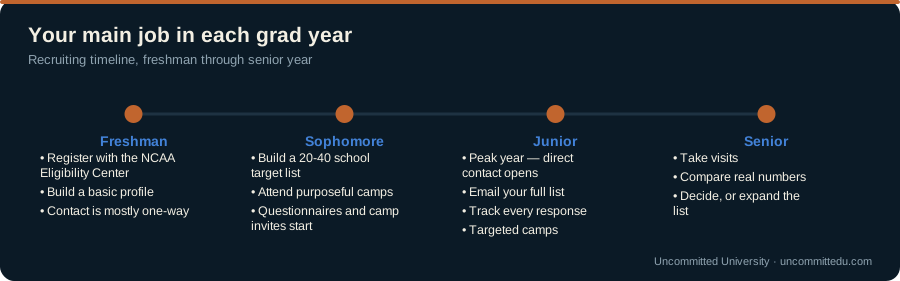
The chart below reduces the college baseball recruiting timeline to one job per grad year, if you only take one thing from this page, take this.
The college baseball recruiting timeline year by year: each grad year has one main job, and skipping one is what puts players behind.
Grad year
Coach contact
Your main job
Red flag if missing
Freshman
Mostly one-way: you reach out, coaches rarely reply directly yet
Register with the NCAA Eligibility Center, build a basic profile
No online profile at all by end of year
Sophomore
Occasional camp invites, general questionnaires
Build a 20-40 school target list, attend purposeful camps
Still no target list by summer
Junior
Direct contact opens up: this is the peak year
Email full list, track every response, attend targeted camps
Sent fewer than 15-20 emails by spring
Senior
Visits, offers, and closing conversations
Take visits, compare real numbers, decide or expand list
No visits scheduled by October of senior fall
Freshman year: build the foundation
Freshman year isn’t too early to start. Three things matter:
Register with the NCAA Eligibility Center if D1 or D2 is on the table. It’s free, and confirms your core courses are on track early.
Build a simple online profile. A name, grad year, position, basic stats, and one usable video clip is enough: create one free and update it as your numbers improve.
Play as much as you can, everywhere you can. Freshman year is about development. Coaches evaluate trajectory, not just a single number.
Sophomore year: start showing up on lists
Sophomore year is when a player should start building a real target list, not waiting to be noticed.
Attend camps with a purpose. Check who’s coaching before you pay. The biggest-name event isn’t right if none of your target schools send coaches there.
Update your video and metrics regularly. A stale video undersells a player who’s since improved.
Junior year: the busiest recruiting year
For most players, junior year is when the college baseball recruiting timeline peaks. Coaches can begin certain direct contact, and rosters start filling.
Attend camps at schools showing real interest. A camp invite from a specific program beats a generic showcase.
Track every conversation. School, contact, date, response, next step. A spreadsheet turns a chaotic process into a manageable one.
Senior year: closing the process
Senior year is about converting interest into a decision, or expanding the list if you don’t have one yet.
Take visits. Unofficial early, official once a program has real interest. Ask about roster fit, scholarship numbers, and depth chart timing.
Don’t panic if D1/D2 offers haven’t come by fall. NAIA and JUCO rosters commonly fill later, and both are legitimate paths.
Decide with real numbers in front of you. Compare actual scholarship dollars against total cost, not just prestige.
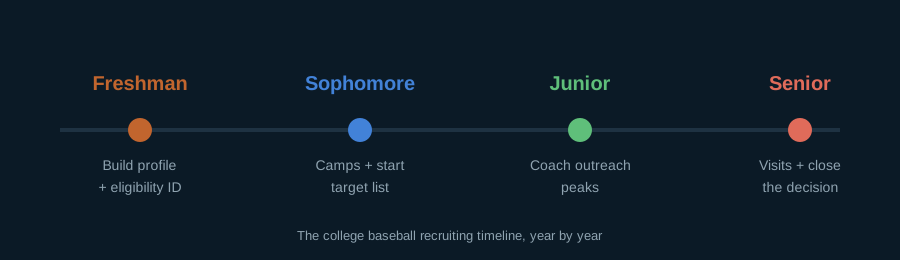
The diagram below lays out the college baseball recruiting timeline end to end, so you can see where you sit today before reading the year-by-year detail.
How coaches manage recruiting on their end
Coaches build a running “board” for each grad year, ranked by position need and fit. Early contact (camp invites, follow-up emails, questionnaires) keeps a wide net of names warm without commitment.
As signing periods get closer, staffs narrow toward players who’ve stayed responsive and kept them updated. That’s why steady communication beats any single email.
The NCAA’s recruiting calendar defines contact, evaluation, and quiet periods. Worth knowing, so you’re not surprised when an eager coach suddenly goes quiet.
How the timeline shifts depending on the level you’re targeting
The four-year outline above describes the average case, but the calendar doesn’t move at the same speed for every level. Knowing the difference keeps you from panicking over a quiet fall that’s actually normal for the level you’re chasing.
D1: Moves earliest and fastest. Top-tier D1 programs often have a strong sense of their next two recruiting classes before junior year even starts. If D1 is the goal, freshman and sophomore year outreach matters more than at any other level.
D2: Runs roughly a year behind D1. Many D2 staffs are still building their board seriously through junior year and into senior fall, which means a slow sophomore year isn’t fatal.
D3: No athletic scholarships changes the pressure entirely. D3 coaches often can’t extend a real offer until admissions has weighed in, so D3 timelines commonly run latest of all the NCAA levels, sometimes into senior spring.
NAIA: Rosters can move quickly once a coach sees what he needs, but total roster turnover tends to happen later in the calendar year, which is why NAIA is often the right home for a strong senior fall push.
JUCO: The most flexible calendar of all. JUCO coaches fill needs close to the season and are comfortable adding a player just weeks before fall semester. It’s the level most forgiving of a late start.
The practical takeaway: a player with mostly D1/D2 targets should treat sophomore year as urgent. A player leaning D3/NAIA/JUCO has real room to make up ground senior year: see the full level-by-level comparison for how each level evaluates players differently, not just when.
Building a recruiting tracking system that actually works
“Track every conversation” sounds obvious until you’re managing 30 schools at once. Here’s a simple structure that holds up:
One row per school. Columns for school name, level, coach name and email, date of first contact, date of last contact, and current status (no response / interested / camp invite / offer / dead).
A “next action” column. Every school should always have a clear next step: a follow-up date, a camp to attend, or a question to ask. A school with no next action is a school you’ve quietly stopped recruiting.
A notes column for specifics. What the coach said, what he asked for, and anything unusual about the program’s timeline. Six months later you won’t remember the details.
Review it weekly, not daily. Checking it obsessively creates anxiety without adding information. A weekly review is enough to catch schools that have gone quiet and need a nudge.
This doesn’t need to be complicated software. A shared spreadsheet that you and your parents can both see works fine, and it turns a stressful, foggy process into a manageable list of concrete tasks.
Checkpoint questions to ask yourself before advancing a grad year
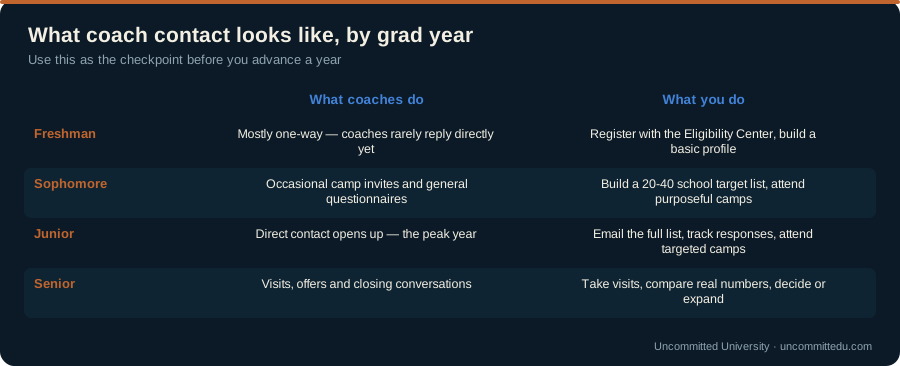
Coach contact changes shape at every stage of the college baseball recruiting timeline, and the table below is the checkpoint to run before advancing a year.
What coach contact actually looks like at each stage of the college baseball recruiting timeline.
At the end of each school year, a few honest questions tell you whether you’re on pace or need to adjust:
Do I have an accurate, current video clip, not one from over a year ago?
Is my target list still realistic given my current metrics, or does it need more D2/D3/NAIA/JUCO options?
Have I actually emailed every school on my list, or just the top few?
Am I tracking responses somewhere, or trying to remember them?
Have I asked my high school or travel coach to make any calls on my behalf?
If I’m behind pace, what’s the one action I can take this month to catch up?
A player who can answer all six honestly is almost always ahead of a player with better raw tools but no process behind them.
College baseball recruiting timeline mistakes that cost players real offers
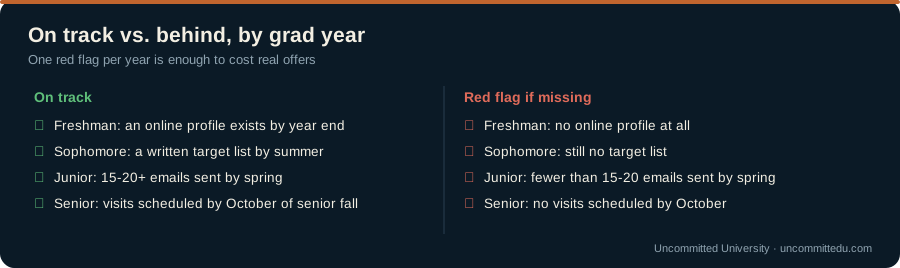
Each grad year has one warning sign, and the checklist below is the fastest way to tell whether your college baseball recruiting timeline is genuinely on track.
The recruiting timeline red flag for each grad year: if one of these describes you, the fix is the item on the left.
Waiting for an offer before reaching out. Most offers follow outreach, not the other way around.
Only targeting one level. Ten D1 programs and nothing else can mean zero realistic offers, even for a good player.
Letting metrics go stale. Update your profile and video at least once a season.
Going quiet after the first email. One unanswered email isn’t a “no.” A respectful follow-up with a new data point often reopens the conversation.
What a real college baseball recruiting timeline actually feels like
It’s rarely a straight line. Expect stretches of silence between real signals. A typical path looks like this:
Freshman/sophomore: mostly quiet, building metrics and a basic profile
Early junior year: first replies start trickling in, mixed with silence
Late junior year: camp invites and real conversations pick up
Senior fall: visits, and for some, a decision
Senior winter/spring: a second wave, if D1/D2 doesn’t come through first
Don’t measure your progress against one classmate’s faster timeline. Measure it against your own metrics, your own list, and whether you’re actually doing the outreach.
What if you’re behind the typical timeline?
Plenty of players get real offers outside this schedule: grad transfers, late bloomers, players who started late. This college baseball recruiting timeline is a guide, not a hard deadline.
What matters most at any point: accurate metrics, a working target list, and consistent outreach.
A sample month-by-month plan for junior year
Junior year carries the most weight. Here’s how to break it down further:
Fall: Finalize your 20-40 school list, send your first round of emails, lock in a fall showcase schedule.
Winter: Follow up with schools that haven’t responded. Update your profile with offseason gains. Research academic requirements.
Spring: In-season data matters most now: coaches watch current form, not last year’s numbers. Keep metrics and video current.
Summer: Attend camps at schools showing real interest, take unofficial visits during tournament travel, and narrow your list.
What changes if you’re a transfer or grad transfer
The college baseball recruiting timeline above is written for a high school player. If you’re already in college and transferring, the calendar is different:
Enter the transfer portal as soon as you know you’re leaving: timing windows are strict
Your college stats and film matter more than high school numbers now
Coaches want to talk to your current coach, so a clean exit matters
JUCO-to-D1/D2 transfers often move faster than the high school timeline, since coaches already have a full season of data on you
How the NCAA recruiting calendar shapes the college baseball recruiting timeline
Here is something most families never get told: the college baseball recruiting timeline is not one continuous stretch. The NCAA cuts the year into four kinds of period, and what a coach is allowed to do changes with each one.
Contact periods are the open windows. A coach may watch you play, talk to you in person off campus, and host you on campus.
Evaluation periods let a coach watch you compete and assess you academically, but not have off-campus contact with you or your parents.
Quiet periods allow contact only on the coach’s own campus. No watching you play, no off-campus meetings.
Dead periods shut all of it down. No in-person contact anywhere, on or off campus, though calls, emails and texts still work.
Why this matters to your college baseball recruiting timeline: a coach who goes quiet for three weeks in the middle of your season may simply be in a dead period. Players read that silence as rejection constantly, and act on it by giving up on a school that was still interested.
The practical move is to check the current NCAA Division I baseball recruiting calendar before you panic about any silence. It is published every year, and it explains most of the gaps in a college baseball recruiting timeline that otherwise look personal.
There is a second calendar running underneath it, and it belongs to the coach rather than the NCAA. Staffs recruit in waves: they close their top targets first, then work down the board as those answers come in.
That is why a school that was lukewarm in October can become urgent in January. Nothing about you changed. Someone above you on their list committed somewhere else.
So treat a late call as a real opportunity rather than an insult, and keep every school you would genuinely attend on the list until it formally closes. The college baseball recruiting timeline rewards players who stay reachable far more than it rewards players who commit early.
Frequently asked questions
These are the questions families ask most often about the college baseball recruiting timeline.
What grad year should a player start recruiting? Freshman year isn’t too early to build a basic profile and register with the NCAA Eligibility Center, but junior year is when direct coach contact and outreach typically peak.
Does the college baseball recruiting timeline move at the same speed for every level? No. D1 tends to move earliest, D2 roughly a year behind, D3 often latest of the NCAA levels since scholarship rules differ, and JUCO is the most flexible, sometimes filling roster spots just weeks before the season.
Is it too late to start recruiting as a junior? No. Junior year is actually the busiest and most common year for players to start seriously, especially for D2, D3, NAIA, and JUCO programs.
What if I don’t have any offers by senior fall? That’s common and not a sign the process has failed. NAIA and JUCO rosters frequently fill later in the calendar, and a strong senior fall push regularly turns into real offers.
How often should I update my recruiting profile and video? At least once a season. A stale video or outdated stats undersell a player who has since improved, and coaches notice when a profile hasn’t changed in a year.
Does the college baseball recruiting timeline change for transfer or grad transfer players? Yes. Transfer timing runs on transfer portal windows rather than the high school grad-year calendar, and current college stats and film matter more than high school numbers.
The short version: the college baseball recruiting timeline rewards players who do each year’s one job on time rather than sprinting late. Register early, build the target list by sophomore summer, email the full list as a junior, and take visits as a senior: that is the whole college baseball recruiting timeline in four moves.
The short version
The college baseball recruiting timeline runs on two clocks at once: your development clock and the NCAA calendar. Your job is to be ready before the window opens, because the window does not wait for you to be ready.
Uncommitted University tells players to work the college baseball recruiting timeline backwards from the date coaches can first respond, not forwards from whenever they happen to start.
If you are already behind that schedule, the answer is not to panic and it is not to quit. It is to get verified numbers, current video and a short target list into coaches hands this month, because a late start compresses the college baseball recruiting timeline but does not end it.
Your next step
Wherever you are on this college baseball recruiting timeline, the fastest way forward is knowing exactly where you fit today.
Don’t wait for the “right” year to start
Create your free profile now, then check where you actually stand.
Every year, a few players get recruited the easy way. A scout already knows their name. The offers show up before they’ve asked.
This guide isn’t for them.
It’s for the player who’s good enough to play in college but isn’t on anyone’s list yet. The one who has to build his own college baseball recruiting process, one email, one camp, one clip at a time. That’s most players. It’s also exactly what “uncommitted” means: not unrecruitable, just not found yet.
This guide walks through the entire college baseball recruiting process. The timeline. The levels. How to get in front of a coach. What a real offer looks like. And the mistakes that quietly end a college baseball recruiting process before it starts.
Quick answer: College baseball recruiting means building a target list across D1, D2, D3, NAIA, and JUCO, reaching out to coaches with verified metrics and video, and converting interest into an offer. Most players build this process themselves. Most start seriously by junior year. And most end up committed at D2, D3, NAIA, or JUCO, not D1.
Key takeaways
College baseball recruiting is a player and a programme gradually deciding whether he fits the roster.
College baseball recruiting runs across five levels: D1, D2, D3, NAIA and JUCO, with different rules at each.
Nobody finds you: college baseball recruiting is driven by your outreach, your metrics and your video.
Assistants and recruiting coordinators, not head coaches, run college baseball recruiting day to day.
The college baseball recruiting timeline gives each grad year one job: junior year is the peak.
Most college baseball recruiting failures are process failures, not talent failures.
What college baseball recruiting actually is
College baseball recruiting is a player and a program deciding, gradually, whether he fits their roster. It’s rarely a single event. And it almost never starts with an offer.
For most players, it starts with something the player does. Playing in front of a coach. Emailing him. Showing up in a database he actually checks.
Coaches recruit a need. A position, a grad year, a scholarship budget. A player who understands that, and can say clearly who he is and what he’s proven, already beats most of the field.
One more thing: head coaches rarely run college baseball recruiting day to day. Most programs assign an assistant or recruiting coordinator to manage the list and answer emails. Address your outreach to that person. You’ll get a faster response than emailing the head coach cold.
The college baseball recruiting timeline, year by year
Recruiting doesn’t open on one date. The NCAA’s recruiting rules set when coaches can contact you first. Nothing stops you from reaching out earlier.
Freshman year: Start your NCAA Eligibility Center account if D1/D2 is on the table. Build a simple profile: basic stats and one usable video clip is enough for now.
Sophomore year: Start a real target list of 20-40 schools across levels. Attend camps that the right coaches actually attend, not just the biggest-name event.
Junior year: This is the busiest year. Coaches can begin certain direct contact. Email your list, update your metrics, and narrow toward schools that respond.
Senior year: Close the process. Take visits, talk roster spots and scholarship numbers, and expand to NAIA/JUCO if D1/D2 rosters have filled.
The timeline below maps college baseball recruiting across all four high school years.
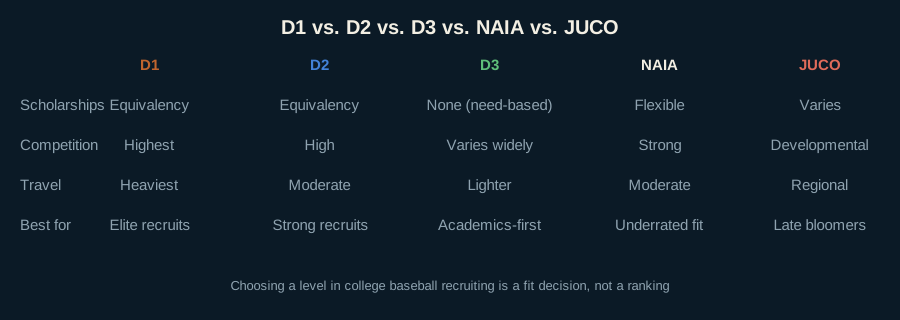
D1 vs. D2 vs. D3 vs. NAIA vs. JUCO: what actually changes
Players and parents tend to rank these levels like a ladder, D1 at the top, everything else “below” it. That’s the wrong way to think about it. These are different environments with different tradeoffs.
NCAA D1: Highest competition, heaviest travel. Scholarships are real but split across a roster. Full rides are rare.
NCAA D2: Still highly competitive. Lighter travel than D1, same scholarship structure, smaller budget.
NCAA D3: No athletic scholarships. Financial aid is academic or need-based only. Competition varies widely.
NAIA: Often more scholarship flexibility than D2/D3, since NAIA isn’t NCAA-limited. Frequently overlooked.
JUCO (NJCAA): A two-year path. Many players use JUCO to develop, then transfer up with a much stronger profile.
How this changes your approach: Build your list across levels, not just at the top. A 30-school list, some reach, some fit, some safety, beats a 10-school list of D1 programs only.
The comparison below shows how college baseball recruiting differs at D1, D2, D3, NAIA and JUCO.
Level
Scholarships
Competition
Best for
NCAA D1
Up to 34 funded roster spots at House-settlement schools; 11.7 equivalency at those that opted out
Highest
Elite recruits who can handle heavy travel
NCAA D2
Equivalency, smaller total budget
High
Strong recruits, often underrated
NCAA D3
None (academic/need-based only)
Varies widely
Academics-first players
NAIA
Flexible, not NCAA-limited
Strong at top programs
Underrated fit, often overlooked
JUCO (NJCAA)
Varies
Developmental
Late bloomers, transfer path to D1/D2
How to get discovered if nobody’s watching yet
Being “uncommitted” late almost never means a player isn’t good enough. It usually means his information never reached the right desk. Three things fix that:
A profile that reads like a scouting report. Coaches skim. Verified metrics, a clean bio, and one strong clip up top gets a real look. A wall of text doesn’t.
Camps the right coaches attend. Check who’s coaching before you pay for an event. The wrong showcase for your level is a common, expensive mistake.
Direct outreach, not just waiting. Coaches build their board from players who reach out, not only players they scout in person.
That is the quiet truth about college baseball scouting: outside the biggest programs, almost nobody is driving to games hoping to spot a hidden gem. Scouting now runs on video, verified numbers, and searchable profiles a coach can read from his office, so players who package their information well get scouted, and players who wait to be seen usually don’t.
A good recruiting email is short, specific, and easy to act on. Coaches get dozens of these a week. The ones that get a reply respect that.
Include: your name, grad year, position, one or two verified numbers, a video link, and one reason you’re reaching out to that program.
Template:
Subject: [Grad Year] [Position] – [Your Name]
Coach [Last Name],
My name is [Name], a [grad year] [position] at [high school/travel team]. I’m currently running a [X] mph exit velo / [X] mph fastball and a [X] 60-yard time, with a [GPA] GPA. I’ve been following [Program]’s season and think my [specific skill] would fit how you play.
Here’s my video and profile: [link]. Would you be open to me attending one of your upcoming camps, or is there anything specific you’d want to see from me first?
Thanks for your time, [Name] | [phone] | [email]
How this changes your approach: Send this to your full list, not just your top choices. Track every email in a spreadsheet: date sent, who replied, what’s next. Recruiting is a numbers game before it’s a relationship.
Building a college baseball recruiting video coaches actually watch
Coaches watch the first 15-20 seconds. Then they decide whether to keep watching. Two formats matter:
A skills video: a few reps at game speed with a measured number on screen: velocity, exit velo, a stopwatch time. Quality beats quantity.
Game video: at least one full game, or a real set of uncut at-bats or innings. Shows approach, not just highlights.
How this changes your approach: Put your best clip first, always. A coach who isn’t hooked in 15 seconds won’t scroll to find the good part later. Re-cut the video every time you hit a new personal best.
Once it’s cut, attach it to a free recruiting profile. One link, not five different platforms.
This is the most misunderstood part of recruiting. NCAA baseball is an “equivalency” sport. A program gets a scholarship budget and splits it across the roster however the coach wants. Until 1 July 2025 that budget was 11.7 scholarships at every D1 school.
The House v. NCAA settlement changed that. D1 programs that opted in now fund up to 34 roster spots outright, while programs that opted out still split 11.7. College baseball recruiting now runs on two different scholarship systems at the same time, so ask a coach which one applies before comparing any two offers.
Nothing else in college baseball recruiting changed below D1: D2 has 9 equivalencies, the NAIA has 12, the NJCAA allows up to 30 baseball signees for 2026-27, and D3 offers no athletic aid at all. A true full ride is rare. Most offers are partial.
How this changes your approach: Don’t judge an offer by “full” vs. “partial.” Compare the actual dollar amount to the school’s total cost. Stack it against academic scholarships too, they’re separate, and often larger. Ask the coach directly what percentage is athletic money.
Unofficial visits: any time, your own expense, no limit. A low-pressure way to see a campus before things get serious.
Official visits: partly paid by the school, limited by NCAA rules, usually later once a program has real interest. Expect a campus tour and a real conversation about fit.
How this changes your approach: Take unofficial visits early and often. Bring specific questions: who else is being recruited at your position, what the depth chart looks like, how the staff communicates during the season.
College baseball recruiting red flags and scams to avoid
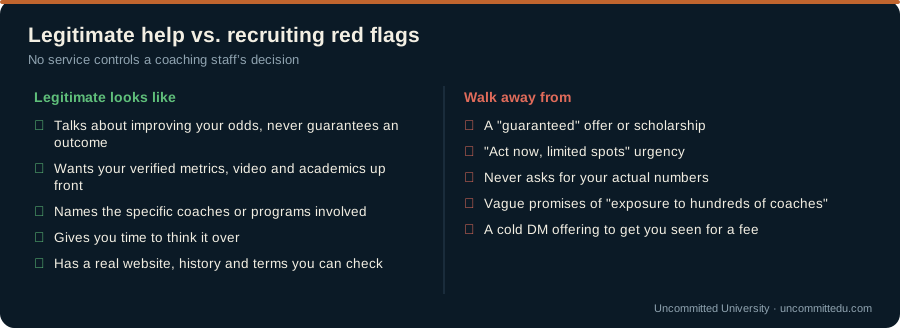
The checklist below separates legitimate college baseball recruiting help from the pitches to walk away from.
What legitimate college baseball recruiting help looks like next to the pitches families should walk away from.
The recruiting process attracts services that profit from anxious families. Watch for:
Guaranteed offers for a fee. No legitimate service can guarantee a scholarship offer. That decision belongs to the coach.
Pressure to pay fast for a “spot.” Legitimate camps don’t need fake urgency.
Services that never ask your real numbers. If they’ll “get you recruited” without discussing your actual metrics, they’re selling a mailing list.
How this changes your approach: Use a paid service as a tool for faster outreach, never as a replacement for your own metrics, video, and direct coach contact.
Every position gets judged on a different checklist. Know yours before you write an email.
Pitchers: velocity gets the first look, but command and a usable second pitch matter just as much.
Catchers: pop time and blocking ability often matter more than exit velo, below D1.
Middle infielders: range, hands, and arm strength come first. Offense is judged separately.
Corner infielders and outfielders: mostly offense-first: exit velo, bat speed, power projection.
How this changes your approach: Lead your profile and emails with the number that actually matters for your position.
What belongs on your college baseball recruiting profile
A strong profile is short, verified, and easy for a coach to skim in under a minute. It should include:
Name, grad year, position, height, weight, and GPA
Verified metrics: velocity, exit velocity, 60 time, pop time for catchers
One best clip up top, with the rest of your video linked below it
Your high school and travel team, with your coaches’ contact info
Academic info: test scores if you have them, intended major if you know it
A clear way to contact you directly
Update it every time a number changes. A stale profile is worse than no profile. It actively undersells you.
Building your target list, step by step
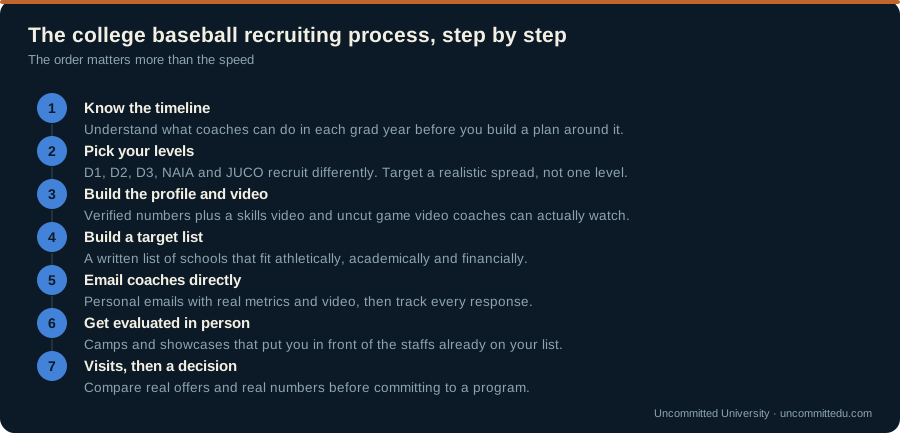
The six steps below are the college baseball recruiting process in the order it actually works.
The college baseball recruiting process in six steps, most families lose ground by starting at step four instead of step one.
A target list is the backbone of the whole process. Build it like this:
Start wide. 30-40 schools across every level, not just your dream schools.
Sort by fit, not prestige. Use your real metrics against typical benchmarks at each level.
Research each program. Roster needs, conference, academic fit, distance from home.
Rank them. Reach, likely fit, and safety, in roughly equal numbers.
Email all of them. Not just the top five. Replies from every tier matter.
Revisit the list every few months. Schools move up and down as coaches respond, offers come in, and your own numbers improve.
How many players actually get recruited
Worth sizing up the field honestly. Most high school players who go on to play in college land at D3, NAIA, or JUCO, not D1. D1 rosters are a small fraction of all college baseball spots.
The verified numbers back that up. NCAA baseball roster spots equal 8.8% of the high school baseball population and 2.7% at Division I, and Division III is the largest NCAA level by both players and teams. Every figure, with the primary source beside it, is in our baseball recruiting statistics page.
That’s not discouraging. It’s why a multi-level target list beats a D1-only wish list. Plenty of players end up thrilled with their college experience at a “lower” level than they once assumed was the goal.
Questions to ask a coach before you commit
A verbal offer isn’t a signed offer. Before you say yes, ask:
What percentage of my scholarship is guaranteed for all four years?
Who else is being recruited at my position and grad year?
What does the depth chart look like the year I’d arrive?
What happens to my scholarship if I get hurt?
How does the coaching staff communicate with players during the season?
A coach who answers these directly, without dodging, is showing you exactly how the program treats its players.
What a real offer actually looks like
An offer isn’t always a phone call with a number attached. It can start small:
An invite to an “prospect camp” built for recruits, not a general showcase
A request for a transcript or test scores
A direct question about your other visits or offers
An invite to an official visit
Each of these is a real signal. Treat them like one, and follow up fast.
Frequently asked questions about college baseball recruiting
These are the questions families ask most often once college baseball recruiting is actually underway.
When does college baseball recruiting actually start? There’s no single start date. Building a profile and target list as early as freshman year is common; the busiest window of direct coach contact tends to be junior year.
Do I need to attend a showcase to get recruited? No, some players get recruited purely through video and email outreach, but a well-chosen showcase in front of the right coaches accelerates the process.
Can I still get recruited as a senior with no offers yet? Yes. Rosters at D2, D3, NAIA, and JUCO programs often fill later than D1, and direct outreach in the fall and winter of senior year regularly produces real offers.
What if my numbers aren’t D1-level? Most players aren’t D1-level. A strong D2, NAIA, or JUCO fit beats an unrealistic D1 reach that never responds.
Do I need a recruiting service to get recruited? No. Plenty of players build a real recruiting process themselves with a profile, a target list, direct emails, and video. A service can save time but can’t replace your own metrics and outreach.
What’s the biggest mistake players make? Waiting to be found instead of reaching out. Most offers follow outreach; very few start with a coach discovering a player cold.
The role of your high school and travel coaches in college baseball recruiting
Your coaches are a resource most players underuse. College coaches trust other coaches’ evaluations, especially ones they already know.
Ask your coach to make a call or send an email to a program he has a relationship with. A coach-to-coach introduction carries real weight.
Keep your coach updated on your target list, so he’s not caught off guard by a call from a program you’ve been talking to.
Use your coach as a reference in emails: “my coach can speak to my work ethic and role on the team” is a credible line, if it’s true.
A coach who vouches for you is more valuable than almost anything you can say about yourself.
The short version: college baseball recruiting rewards the players who run a process instead of waiting for one. Know the timeline, target a realistic spread of levels, build verified numbers and video, email coaches personally, and get evaluated in front of the staffs already on your list. Every part of college baseball recruiting that actually moves the needle is something you control, and none of it requires paying anyone to do college baseball recruiting for you.
Your next step
The fastest way to move from “uncommitted” to “on somebody’s list” is knowing exactly where you fit today.
Start your recruiting process right now
Create your free profile, then use these two free tools to know exactly where you stand.
From there: build your profile, start your target list, and work the process. One email, one camp, one clip at a time.
None of this requires a big-name travel team or a scout who already knows your name. Every year, players build their own recruiting process from nothing and end up committed somewhere they’re excited about. The process rewards players who work it consistently, not players who wait to be found. Start today, keep your numbers current, and treat every email as one more shot at getting noticed.
Written by Recruiting Coordinator, part of Uncommitted University’s recruiting content team.