NCAA academic eligibility trips up more players than a lack of talent ever does. Core courses and the GPA sliding scale sound complicated. They’re actually pretty simple once you break them down.
Quick answer: The NCAA requires a set number of approved core courses across English, math, science, and social studies, completed with a qualifying GPA on a sliding scale tied to test scores. Fall short, and a player can be ruled a non-qualifier as a freshman.
Key takeaways
NCAA academic eligibility needs 16 core courses at both D1 and D2: the subject split differs, not the total.
Your core GPA is not your report-card GPA, and NCAA academic eligibility only counts the core.
Only courses on your school’s approved list count toward NCAA academic eligibility.
NCAA academic eligibility runs on a sliding scale, pairing core GPA against test scores.
Ten of the sixteen should be finished before senior year starts.
What counts as a core course for NCAA academic eligibility
Core courses are specific, NCAA-approved classes in four main areas:
English
Mathematics
Natural or physical science
Social science
Not every class automatically counts. Your high school submits an official list of approved core courses to the Eligibility Center. Check that list directly rather than assuming.
NCAA academic eligibility core courses: Division I vs. Division II
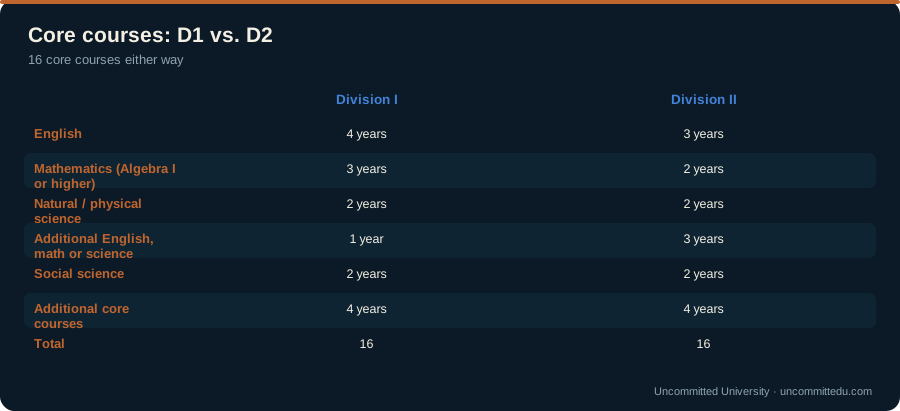
The table below breaks the 16 core courses for NCAA academic eligibility across D1 and D2.
NCAA academic eligibility needs 16 core courses at both D1 and D2: the subjects, not the total, are what differ.
Both divisions require 16 total core courses, but the required split by subject area differs slightly.
Subject area
Division I
Division II
English
4 years
3 years
Mathematics (Algebra I or higher)
3 years
2 years
Natural / physical science
2 years
2 years
Additional English, math, or science
1 year
3 years
Social science
2 years
2 years
Additional core courses (any area above, or foreign language, comparative religion, philosophy)
4 years
4 years
Total core courses
16
16
This breakdown reflects the standard structure both divisions have used for years. Confirm current requirements directly with the Eligibility Center, since specific rules are reviewed periodically and can change.
How the NCAA academic eligibility GPA sliding scale works
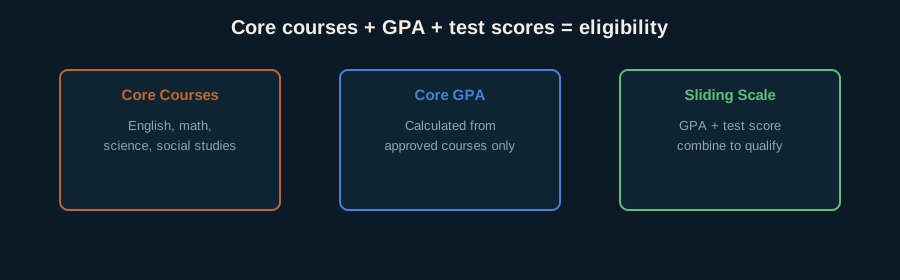
The NCAA uses a sliding scale that pairs your core-course GPA with your test scores where required. A higher GPA can offset a lower test score, and vice versa, up to a point.
The exact numbers on the sliding scale are published directly by the NCAA Eligibility Center and updated periodically. Always check the current version rather than relying on an old chart.
The chart below shows how the sliding scale pairs core GPA with test scores for NCAA academic eligibility.
How your core-course GPA is actually calculated
Core-course GPA isn’t the same number as the GPA that shows up on a standard report card, which is exactly why it catches families off guard.
Only approved core courses count: electives, PE, and non-approved classes are excluded entirely, even if they raise your overall GPA.
The scale is generally unweighted for core-course GPA purposes, regardless of how your high school weights honors or AP classes on its own transcript.
Repeated courses are typically handled under specific rules about which attempt counts. Confirm directly rather than assuming the better grade automatically applies.
Grades from every core course that counts toward the 16-course requirement factor in, not just your most recent semester.
Because of these differences, a player’s core-course GPA and overall GPA can genuinely diverge, sometimes significantly. Track the core-course number specifically, not just the number that shows up on report cards.
How AP, honors and dual-enrollment courses count toward NCAA academic eligibility
Advanced classes generally do count as core courses, as long as they’re on your high school’s approved core-course list submitted to the Eligibility Center: the advanced label alone doesn’t automatically qualify a class.
A few specifics to confirm directly with your counselor:
Dual-enrollment and community-college courses taken while still in high school sometimes need separate documentation to count as core credit
Online courses and credit-recovery programs often need separate approval, even if they cover the same material as an in-person class
A class that qualifies as a core course at one high school isn’t automatically approved if you transfer to a different school
None of this is complicated to resolve, it just requires asking directly instead of assuming a class counts because it looks like it should.
Why NCAA academic eligibility catches families off guard
A class doesn’t count because it wasn’t on the approved core course list, even though it looked academic.
Grades from 9th grade don’t count at all levels. Confirm exactly which years factor in.
A transfer between high schools complicates which courses transfer as core credit.
Online or credit-recovery courses sometimes need separate approval.
Check your full eligibility picture
Confirm your seasons and academic standing together.
Register with the Eligibility Center by sophomore year
Review your school’s approved core course list with a counselor early
Send transcripts after every semester with new core courses
Ask your counselor directly if you’re on track, don’t assume
What happens if you fall short of NCAA academic eligibility
A player ruled a partial qualifier or non-qualifier can still enroll and often still practice, but the academic standard decides whether you can compete or receive first-year athletic aid.
What falling short costs has changed in Division I. The 2026 age-based eligibility model eliminated seasons of competition, and with them the academic non-qualifier season limitations that used to apply in Division I. There is no longer a season to lose. What you lose now is time: the five-year period of eligibility starts at your first full-time college enrollment and runs continuously whether or not you are cleared to play.
That is the trap worth naming. The NCAA says plainly that a student-athlete can be inside the five-year period and still be ineligible for other reasons, and NCAA academic eligibility is the most common of those reasons. The clock does not wait while you fix a transcript. This is exactly why catching issues early matters. There’s often still time to fix a shortfall before senior year.
What to do if you’re behind on core courses
Finding out midway through high school that you’re behind on a core-course requirement isn’t unusual, and it’s rarely unfixable if it’s caught with enough time left.
Summer school can add core-course credit outside the regular school year, if the specific course is on your school’s approved list.
Retaking a course to replace a low grade is often possible, under rules about which attempt counts toward your core-course GPA.
Adjusting your senior-year schedule to add a needed core course is usually the most direct fix if the shortfall is caught early enough.
The earlier a shortfall is caught, the more of these options are realistically available. A gap discovered in the first semester of senior year has far fewer paths than one caught sophomore or junior year.
Core-course requirements for NAIA and JUCO-bound players
If NAIA or JUCO is realistically part of your plan, it’s worth knowing the academic picture looks different there too.
NAIA academic eligibility is generally based on a combination of GPA, class rank, and test scores, evaluated under the NAIA’s own standards rather than an NCAA-style core-course list. See the NAIA eligibility rules guide for the specifics.
JUCO academic standards are set by the NJCAA and the enrolling college directly, rather than through core-course certification. See the JUCO eligibility clock rules guide for how that system works.
Keeping every path open (NCAA, NAIA, and JUCO) usually means keeping your core-course GPA as strong as possible regardless of which level ends up being the best fit.
It also means not assuming a shortfall at one level rules out every level. A player who falls short of a Division I sliding-scale standard can often still qualify for Division II, NAIA, or JUCO, the systems aren’t stacked in strict difficulty order, they’re simply different.
Building a semester-by-semester NCAA academic eligibility plan
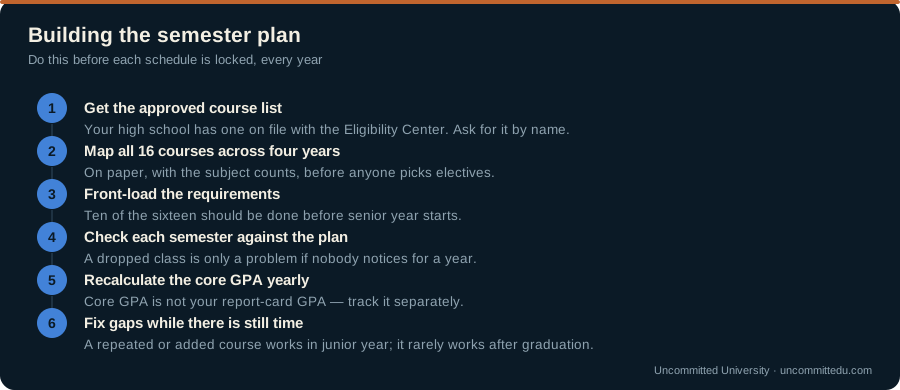
The steps below turn NCAA academic eligibility into a plan you build once and check each semester.
NCAA academic eligibility is won in the schedule-building meeting, not in senior year.
Don’t leave core courses to chance. Map them out early:
List every required core course area and how many credits you still need
Plan your schedule each semester with a counselor, confirming each class counts
Track your running core GPA, not just your overall GPA, they can differ
Revisit the plan every semester, especially after any schedule change
A clear plan two years out is worth far more than scrambling senior year.
What if you switch high schools mid-year
Transferring high schools complicates core-course tracking more than families expect, mainly because the new school needs to confirm which previously completed courses transfer as approved core credit.
Steps worth taking as soon as a transfer happens:
Request an official transcript from the previous school immediately. Don’t wait until the new school asks
Ask the new school’s counselor to review the transcript specifically for core-course equivalency, not just general credit
Confirm any GPA recalculation directly: a switch in grading scale between schools can shift your core-course GPA
Update your Eligibility Center account with the new school’s information right away
A mid-year transfer isn’t a problem by itself. An unconfirmed one, discovered senior year, can be.
The same logic applies to any gap in your academic record: a missed semester, a schedule change, an incomplete grade. Flag it with your counselor and the Eligibility Center as soon as it happens, rather than hoping it resolves itself by graduation.
Why strong students still fail NCAA academic eligibility
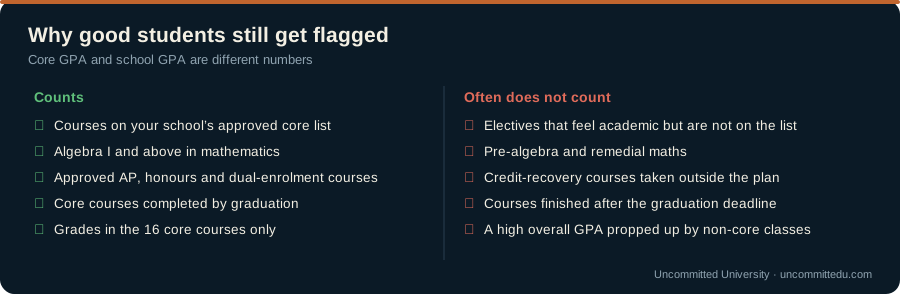
The checklist below shows why a high GPA and an NCAA academic eligibility problem are entirely compatible.
A 3.8 report-card GPA and an NCAA academic eligibility problem are entirely compatible: these are the usual reasons.
It’s a common surprise: a player with a strong overall GPA and a full course load still gets flagged for a core-course shortfall. That usually comes down to one of a few specific gaps.
A required subject area (often social science or an additional core course) got overlooked while focusing on other classes
A class assumed to be core-approved wasn’t actually on the school’s submitted list
Credits earned before core-course tracking started weren’t properly accounted for
None of these are academic failures. They’re tracking gaps, which is exactly why a semester-by-semester plan, reviewed with a counselor, matters more than raw GPA alone.
Questions to ask your counselor about NCAA academic eligibility
A short, direct conversation with your counselor once a year avoids most core-course surprises. Worth asking specifically:
Which of my current classes are on the school’s NCAA-approved core-course list?
Am I on pace to complete all required core courses by graduation?
What’s my current core-course GPA, calculated the way the Eligibility Center calculates it?
Has our school’s approved core-course list changed recently?
Counselors review these questions constantly for other students. Asking directly, with specific questions, gets a far more useful answer than a general “am I on track?”
The deadline inside NCAA academic eligibility that closes early
Most families think of eligibility as something settled in senior year. For Division I it is largely settled before senior year starts, and that surprises people every single spring.
The rule is this: of the 16 required core courses, 10 must be completed before your seventh semester of high school (in practice, before the start of senior year). Seven of those 10 must be in English, maths or natural/physical science.
Here is the part that does the damage. Those 10 courses lock. Once your seventh semester begins, you cannot retake them to raise your core GPA for Division I purposes.
So a player who plans to fix a weak transcript with a strong senior year is, for NCAA academic eligibility purposes, often too late. The senior year can still add the remaining courses. It cannot repair the locked ones.
Division II does not apply that lock, which is one of several reasons a player can be short for D1 and comfortable at D2.
The second thing to understand is that your core GPA is not your school GPA. Only NCAA-approved core courses count, and electives your high school weights heavily may contribute nothing.
Every high school has a published list of NCAA-approved courses. Check your schedule against your own school’s list every single year, because a course that looks academic and is not approved is wasted time for NCAA academic eligibility.
On testing: the NCAA has been test-optional since 2023, so no ACT or SAT score is required. That removes a lever players used to use, and puts all the weight on core-course GPA.
The division standards themselves are straightforward. Division I asks for a 2.3 core GPA. Division II asks for 2.2. Division III sets no national academic standard and defers to each institution.
The practical routine is simple and almost nobody does it: meet your counsellor once a year with the approved-course list in hand, and confirm both the count and the GPA. NCAA academic eligibility problems are nearly always discovered late and fixable early.
Frequently asked questions about NCAA academic eligibility
How many core courses does the NCAA require? 16 total core courses for both Division I and Division II, split across English, math, science, social science, and additional academic areas.
Does my overall GPA matter for NCAA eligibility? Not directly. Only your core-course GPA counts toward the sliding scale, though a strong overall GPA usually correlates with a strong core-course GPA.
Do AP and honors classes count differently than standard classes? Not automatically: they count as core courses if they’re on your school’s approved list, generally evaluated on an unweighted scale for eligibility purposes.
What happens to core courses if I switch high schools? Your new school needs to confirm which previous courses transfer as approved core credit. Request transcripts immediately and don’t assume it happens automatically.
Are online or credit-recovery courses accepted as core courses? Sometimes, but they often require separate approval. Confirm directly with the Eligibility Center rather than assuming.
Can I retake a class to improve my core-course GPA? Generally yes, but specific rules govern which attempt counts toward your core-course GPA. Confirm directly rather than assuming the higher grade automatically applies.
The short version: NCAA academic eligibility is decided in the room where next year’s schedule gets built. Ask for your school’s approved core-course list by name, map all sixteen across four years on paper, and recalculate your core GPA yearly. A strong student can still fail NCAA academic eligibility on a technicality, and the fix is almost always available a year earlier than it is needed.
The short version
NCAA academic eligibility at Division I needs 16 core courses and a 2.3 core GPA, with 10 courses finished (and locked) before senior year begins. Division II needs 2.2 and does not lock them. Division III sets its own standards.
Only NCAA-approved core courses count, and the NCAA has been test-optional since 2023.
Uncommitted University tells every sophomore the same thing: audit your NCAA academic eligibility now, because the most important deadline in it passes before your senior year starts.
If you are already past that point and short, do not assume the whole thing is over. Division II, the NAIA and junior college all run different standards, and a transcript that fails one of them frequently clears another.
The players who lose years are the ones who find out in July. The ones who adapt are the ones who checked in sophomore year and adjusted the plan while there was still a plan to adjust.
Your next step
Register with the NCAA Eligibility Center if you haven’t already, and review your redshirt options in the redshirt rules guide: the 2026 age-based model changed what redshirting means in Divisions I and II.
Written by UU Recruiting Staff, part of Uncommitted University’s recruiting content team.
NCAA Eligibility Center registration is the first real paperwork step in the recruiting process. Miss it, or wait too long, and it can hold up a scholarship offer even for a talented player.
Quick answer: Create a free account at the NCAA Eligibility Center as early as sophomore year, have your school send official transcripts, submit test scores if required, and complete the amateurism questionnaire before your final year of high school.
Key takeaways
NCAA Eligibility Center registration is five steps, and the free account is the easy one.
Transcripts must come from the school directly: a copy you upload does not count.
Start NCAA Eligibility Center registration in sophomore year, before you know your level.
NCAA Eligibility Center registration is tied to one sport and one high school on file.
Spreading NCAA Eligibility Center registration across four years is what prevents a senior-year scramble.
What you need before NCAA Eligibility Center registration
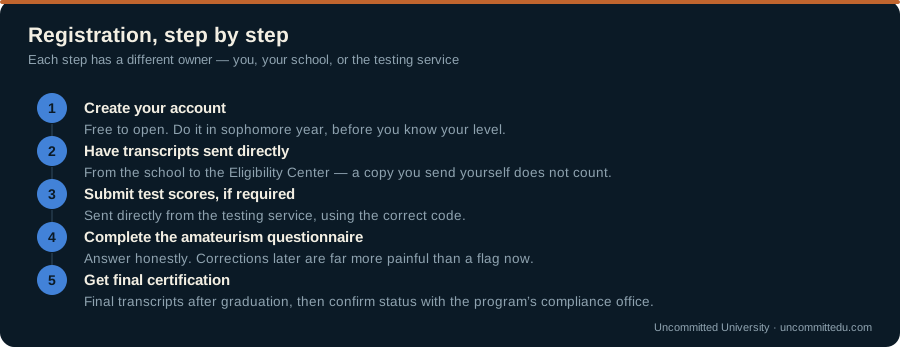
The five steps below are the whole of NCAA Eligibility Center registration, in the order they have to happen.
NCAA Eligibility Center registration is five steps: the account is the easy one, the transcripts are where families stall.
NCAA Eligibility Center registration itself is quick, but having the right information ready first makes it faster and avoids logging back in mid-process to look something up.
Full legal name, exactly as it appears on official records
Date of birth and current contact information
Your high school’s exact name and location
Your expected graduation year and the sport you plan to compete in
A parent or guardian’s information if you’re not yet 13, since a separate account setup applies
None of this is complicated: it just goes faster with a few minutes of prep instead of stopping mid-registration.
Step 1: Create your account
Go to the NCAA Eligibility Center and register for a free account. You’ll need basic personal information and your high school details.
Do this as early as sophomore year: it costs nothing and starts the process of tracking your core courses officially.
Step 2: Have your transcripts sent directly
Your high school counselor needs to send official transcripts directly to the Eligibility Center, not a copy you submit yourself. Ask your counselor early, and confirm it’s actually been sent.
Do this after every semester that adds new core courses, not just once at the end.
Coordinating with your high school counselor
Your counselor is the one person who can actually get transcripts moving, confirm your core-course list, and flag problems early. A short conversation early in the process saves real time later.
Ask directly whether your school has a designated NCAA liaison or if it’s handled through general counseling
Confirm your school’s approved core-course list matches what you’re actually enrolled in
Set a standing reminder to check in each semester, rather than waiting for a problem to surface
Counselors handle dozens of these requests every year. Being specific and organized when you ask makes it far more likely things move quickly.
Step 3: Submit test scores, if required
Some conferences and situations still require standardized test scores as part of the certification. Check current requirements directly with the Eligibility Center, since these policies have shifted in recent years.
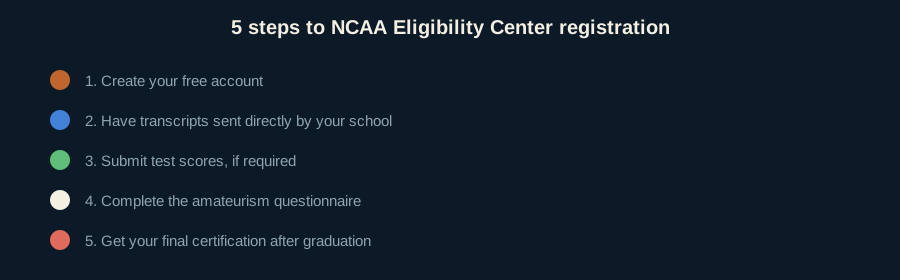
The diagram below walks through NCAA Eligibility Center registration from account to certification.
Step 4: Complete the amateurism questionnaire
This confirms you haven’t violated NCAA amateurism rules: things like accepting prize money or signing with an agent. Most high school players clear this easily, but it still needs to be completed, typically junior year.
How the amateurism questionnaire actually works, in more detail
The amateurism questionnaire asks about your athletic history in detail: organized teams you played for, any prize money received, and any contact with agents or professional teams.
A few specifics worth knowing:
Answer based on your actual history, not what you think the “right” answer is: inconsistencies get flagged and take longer to resolve than an honest disclosure would have.
Travel ball, showcase events, and typical high school competition don’t trigger amateurism concerns on their own.
If you’re unsure whether something needs to be disclosed (a camp, an award, a signed form from years ago), disclose it. Eligibility Center staff can evaluate it; you can’t undo leaving it out.
Most players complete this questionnaire in under fifteen minutes. It only becomes complicated when someone tries to guess what to leave out.
What if you switch sports or schools mid-process
NCAA Eligibility Center registration is tied to a specific sport and a specific high school on file: both need to be updated if either changes.
Switching the sport you’re being certified for is usually a simple account update, but do it as soon as the change is real, not after a coach has already started recruiting you for the new sport.
Switching high schools mid-process means the new school needs to pick up sending transcripts, and any core courses already completed need to transfer over correctly. Confirm this directly with both schools’ counseling offices. Don’t assume it happens automatically.
Step 5: Get your final certification
Once your core courses, GPA, and amateurism status are all confirmed, the Eligibility Center issues your final certification, usually after graduation, once your final transcript is in.
This certification is what allows you to practice, compete, and receive athletic aid as a college freshman.
Since 2026 there is a second thing the Eligibility Center certifies: your period of eligibility. NCAA Divisions I and II replaced seasons of competition with an age-based five-year model (Division I in June 2026, Division II in August), and the Eligibility Center administers and certifies that period for anyone first enrolling full time in fall 2026 or later. It sits alongside the academic and amateurism certifications, not instead of them.
Two jobs in particular now belong to the Eligibility Center rather than a campus compliance office. It administers the three exceptions that can delay or pause a five-year period: pregnancy, active-duty military service and official religious missions. And for a prospect first enrolling in 2026-27, it runs the comparison between the previous rules and the age-based rule and applies whichever is more beneficial.
The distinction is worth holding onto, because two different offices do the same arithmetic for two different people. A current student-athlete with eligibility left after 2025-26 gets that comparison from campus compliance staff. An incoming enrollee gets it from the Eligibility Center, which is one more reason NCAA Eligibility Center registration is not a formality you finish and forget.
NCAA Eligibility Center registration fees and fee waivers
Creating a basic Eligibility Center account is free. There’s a separate one-time registration fee once you move into the certification process, with a higher fee for international students.
Fee waivers are available for students who qualify for a reduced-price or free school lunch program, or who received an SAT/ACT testing fee waiver. Ask your counselor whether you qualify before assuming you need to pay out of pocket.
Confirm the current fee amount and waiver requirements directly on the Eligibility Center site. Both are updated periodically.
Check your eligibility timeline
See how many seasons you have left and confirm you’re on track.
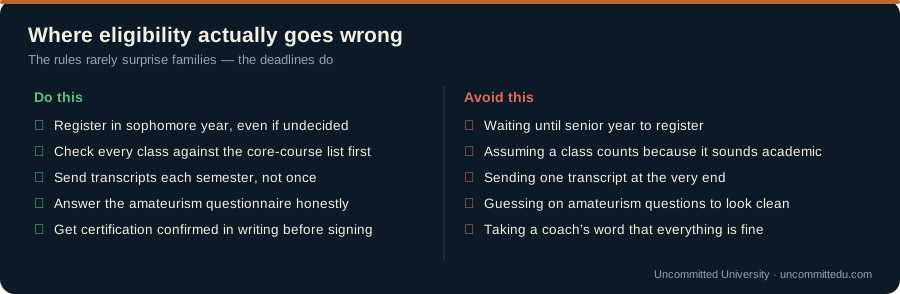
Common NCAA Eligibility Center registration mistakes
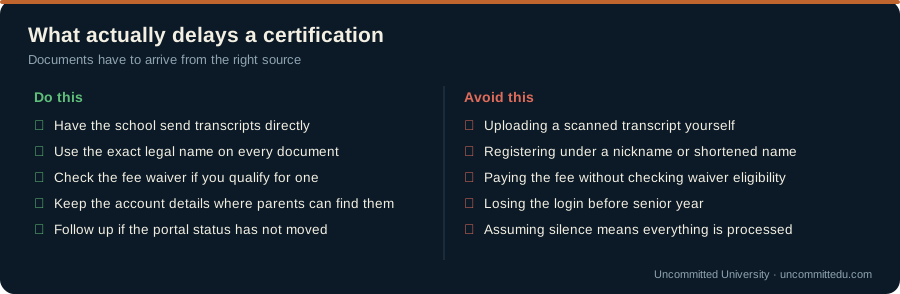
The checklist below covers what actually delays NCAA Eligibility Center registration, and it is almost always process rather than eligibility.
Most NCAA Eligibility Center registration delays come from paperwork sent the wrong way, not from a player who failed a rule.
Waiting until senior year to register. This leaves no time to fix an academic issue if one surfaces.
Assuming your counselor sent transcripts automatically. Always confirm directly.
Forgetting to update your account after transferring schools or retaking a course.
Skipping the amateurism questionnaire until the deadline is already close.
Not updating the account after a mid-high-school change in primary sport, which can leave the wrong certification in progress.
What happens if something gets flagged
Sometimes the Eligibility Center flags a discrepancy: a missing transcript, a course that doesn’t match the approved list, or a gap in academic records.
Respond to any request for information quickly: delays here can hold up your certification
Loop in your high school counselor immediately if a course or transcript issue comes up
Keep copies of everything you submit, in case something needs to be resent
Most flags are simple paperwork issues, not disqualifying problems, but they need to be resolved promptly.
NCAA Eligibility Center registration timeline by grade year
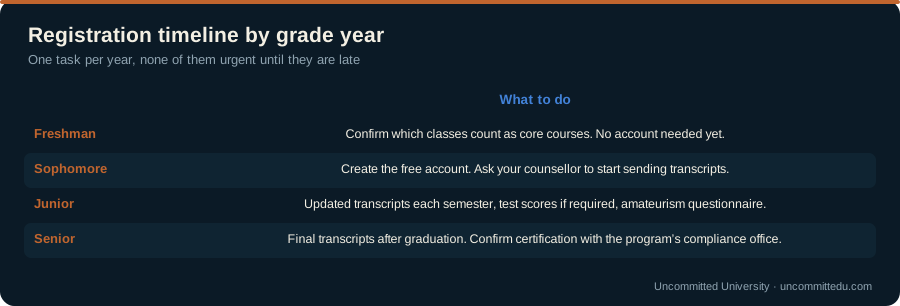
The table below shows what NCAA Eligibility Center registration asks of you in each grade year.
What NCAA Eligibility Center registration asks of you in each grade year.
Spreading NCAA Eligibility Center registration steps across four years, instead of cramming them into senior year, is the single biggest difference between families who breeze through certification and families who scramble.
Grade
What to do
Freshman year
Confirm which classes count as core courses with your counselor. No Eligibility Center account needed yet.
Sophomore year
Create your free Eligibility Center account. Ask your counselor to start sending transcripts.
Junior year
Send updated transcripts each semester. Submit test scores if required. Complete the amateurism questionnaire.
Senior year
Send final transcripts after graduation. Confirm final certification with your target program’s compliance office.
Homeschool, transfer and international NCAA Eligibility Center registration
Most of the NCAA Eligibility Center registration process above applies the same way to every player, but three situations add extra steps:
Homeschooled players go through a separate review process to confirm their curriculum meets NCAA core-course standards, since there’s no standard high school transcript to submit.
Students who transferred high schools need to confirm which courses transferred as approved core credit: this sometimes requires extra documentation from the previous school.
International students need their transcripts evaluated for NCAA-equivalent core courses, which typically takes longer than a standard domestic review.
If any of these apply to you, start the NCAA Eligibility Center registration and transcript process earlier than the standard timeline above: the extra review step takes real time.
Reach out to the Eligibility Center directly if you’re not sure which category applies to you, a quick question early is much easier to resolve than a certification delay discovered senior year.
Confirming your certification status before you commit
Before signing with any program, confirm your actual certification status directly on your Eligibility Center account, don’t rely on a coach’s assumption or an old status check.
Log in and check your status directly rather than asking someone else to confirm it for you
Confirm all required transcripts show as received, not just submitted
Confirm your amateurism questionnaire shows as complete, not pending
If anything shows as outstanding, resolve it before your signing date, not after
A clean status check takes minutes and removes any doubt heading into a commitment that matters.
Why registering early matters even if you’re undecided on your level
Some players hold off on registering because they don’t yet know if they’ll end up D1, D2, NAIA, or JUCO. That hesitation costs time for no real benefit.
A basic Eligibility Center account doesn’t commit you to anything. It simply starts the transcript-tracking process that every D1 or D2 path eventually requires anyway. If you end up choosing NAIA or JUCO instead, you’ve lost nothing by having registered early, but if you end up needing D1 or D2 certification and haven’t started, you’re behind.
Register as if D1/D2 is on the table, even if you’re not sure yet. It costs nothing and keeps every option open.
Certification Account or Profile Page: choosing the right NCAA Eligibility Center registration
There are two different accounts, they cost different amounts, and picking the wrong one is the most common NCAA Eligibility Center registration mistake.
The Certification Account is the paid one, and it is the only one that produces an actual eligibility decision. If there is any chance you will compete at Division I or Division II, this is the account you need.
The Profile Page is free. It gets you into the system and lets Division III programs and coaches find you, but it does not certify anything.
The rule of thumb is simple: if D1 or D2 is realistically on your list, open a Certification Account. You can upgrade a Profile Page later, but doing it late is how players end up ineligible in August.
What happens after your NCAA Eligibility Center registration is where families get surprised, because the account alone finishes nothing.
Your high school has to send an official transcript directly: a copy you upload yourself does not count. Most schools send it after your sixth semester, and then a final one after graduation.
You complete the amateurism questionnaire, which asks about pro contracts, agents, prize money, benefits and playing with professionals. Answer it honestly; the NCAA verifies, and an inconsistency is far worse than an awkward true answer.
Then amateurism certification opens on a fixed date depending on when you enrol, and you request final certification. Nothing is final until a school on your list requests your information and the Eligibility Center places you on its institutional request list.
That last step catches people out. Completing NCAA Eligibility Center registration does not mean you have been certified → it means you are ready to be.
Two practical notes. Use a permanent email address, not a school one that gets shut off at graduation. And check your account after every semester, because a course your school lists differently from the NCAA-approved list is a problem you want to find early.
Frequently asked questions about NCAA Eligibility Center registration
How much does it cost to register with the NCAA Eligibility Center? Creating a basic account is free. A separate one-time certification fee applies later, with waivers available for students who qualify for a reduced-price lunch program or an SAT/ACT fee waiver.
When should I create my Eligibility Center account? As early as sophomore year, so transcripts and core-course tracking start well before any certification deadline.
Do I need to resend transcripts every time I take a new class? Send updated transcripts after every semester that adds a new core course, not just once at the end of high school.
What happens if my school doesn’t send transcripts directly? The Eligibility Center generally requires transcripts sent directly from your school, not submitted by the student: confirm with your counselor that this has actually happened.
Is the amateurism questionnaire required for every sport? Yes. It’s required regardless of which sport you’re being certified for, though the specific situations it flags can vary.
Can I still register if I already graduated high school? The process is designed to happen while you’re still enrolled, so your school can send transcripts directly. If you’ve already graduated, contact the Eligibility Center directly to find out what’s still possible for your situation.
Does the Eligibility Center decide my five-year eligibility period now? Yes, if you first enroll full time in fall 2026 or later. Divisions I and II moved to an age-based model in 2026, and the Eligibility Center administers and certifies the five-year period as well as your academic and amateurism status. It also administers the only three exceptions that can pause it: pregnancy, active-duty military service and official religious missions.
The short version: NCAA Eligibility Center registration is free to begin and costs nothing but time until certification. Open the account, get your counsellor sending transcripts each semester, use your exact legal name everywhere, and check whether you qualify for a fee waiver. Then confirm your certification status with the program’s compliance office before signing anything.
The short version
NCAA Eligibility Center registration needs a paid Certification Account for Division I or II; the free Profile Page only serves Division III and general interest. Register early, send official transcripts through your school, and complete the amateurism questionnaire honestly.
Uncommitted University advises completing NCAA Eligibility Center registration in your sophomore year. It costs nothing to be early, and every problem it uncovers takes months to fix.
There is a fee waiver available if you already qualify for a testing or lunch fee waiver at school. Ask your counsellor rather than assuming: it is routinely unclaimed.
Keep your own copy of everything you submit, and note the date you submitted it. Disputes about missing transcripts are far easier to settle when you can point at a date.
If you change high schools at any point, every school you attended has to send a transcript. A missing transcript from a single semester at a previous school is one of the most common reasons certification stalls.
NCAA redshirt rules have been abolished at Division I and Division II. The NCAA’s own list of eliminated rules names athletics redshirt rules outright, and the replacement took effect for the 2026-27 academic year.
This explains exactly how NCAA redshirt rules work for baseball. For the full picture, see the NCAA baseball eligibility guide.
Quick answer: NCAA redshirt rules no longer exist at Division I or Division II. Seasons of competition, athletics redshirt rules and medical hardship waivers were all eliminated for 2026-27 and replaced by a five-year period of eligibility that starts at first full-time college enrollment, or the academic year after your 19th birthday, and then runs continuously.
Key takeaways
NCAA redshirt rules were eliminated at Division I and Division II for the 2026-27 academic year.
What replaced them is a five-year period of eligibility, starting at first full-time college enrollment or the academic year after your 19th birthday, whichever comes first.
The clock runs continuously, which is why the NCAA says athletes, coaches and athletics departments no longer have to track athletic redshirts.
Medical hardship waivers were eliminated too, so a medical redshirt is no longer a route at Division I or Division II.
Only three exceptions can delay or pause the clock: pregnancy, active-duty military service and official religious missions.
Some current athletes are still assessed under the previous rules, which is why the NCAA redshirt rules detail below still matters.
Do NCAA redshirt rules still exist?
No, not at Division I or Division II. The NCAA eliminated athletics redshirt rules along with seasons of competition, and the change took effect immediately for the 2026-27 academic year.
A five-year period of eligibility. It begins at the earlier of two events: full-time enrollment at any college or university, domestic or international, including a junior college; or the start of the regular academic year immediately after your 19th birthday.
A date most write-ups miss. The age trigger applies if you turn 19 before Sept. 1. Turn 19 on or after Sept. 1 and the period begins at the start of the subsequent academic year instead, unless you enrol full time sooner. That single boundary is why the NCAA age limit question finally has a concrete answer.
No more counting seasons. Seasons of competition are gone as a concept at Division I and Division II, which is what makes NCAA redshirt rules unnecessary rather than merely relaxed.
A period that does not pause. The NCAA is explicit that it does not stop because an athlete fails to compete, transfers, sits out, changes teams or takes time away from participation. That single sentence is what made NCAA redshirt rules redundant.
One caution. Being inside the five years is not the same as being eligible. Academic and other athletics-related rules still apply, so an athlete can be inside the five-year period and still ineligible for other reasons. That was as true under NCAA redshirt rules as it is now.
The abolition of NCAA redshirt rules is Division I and Division II legislation. Division III is not covered by it, and neither the NAIA nor the NJCAA is affected: both write their own eligibility rules and still run their own clocks.
What NCAA redshirt rules used to do
Under the previous model, athletes got four seasons of competition to use within an eligibility window: five years at Division I, ten semesters or fifteen quarters at Division II. A redshirt year preserved one of those seasons by having a player sit out actual games while still practicing, training, and being part of the team.
It was never a punishment or a sign a player was not good enough. It was a development tool, and the development logic has not gone anywhere.
What has gone is the accounting. With no seasons of competition left to preserve, there is nothing for NCAA redshirt rules to protect.
Why coaches used redshirts under the old NCAA redshirt rules
Three reasons drove almost every redshirt decision, and all three still drive the choice to hold a young player out. What changed is that the choice no longer carries an eligibility price.
Physical development. An extra year of strength and conditioning before facing college-level competition.
Roster management. Staggering when players are eligible to compete helps balance a roster year to year.
Academic adjustment. Extra time to acclimate to college coursework without also facing full competition pressure.
What a year without competition looks like day to day
A year without competition is not a year on the sideline, and the rule change did not alter that. In most programs, a player being held out:
Practices with the team on the same schedule as competing teammates
Travels with the team for some or all road games, depending on the program’s roster and travel-squad policies
Gets extra reps in practice and in intrasquad scrimmages that don’t count as official contests
Works individually with position coaches and strength staff on specific development goals for the year
The main difference is simply not appearing in official box scores. Everything else about being part of the program continues.
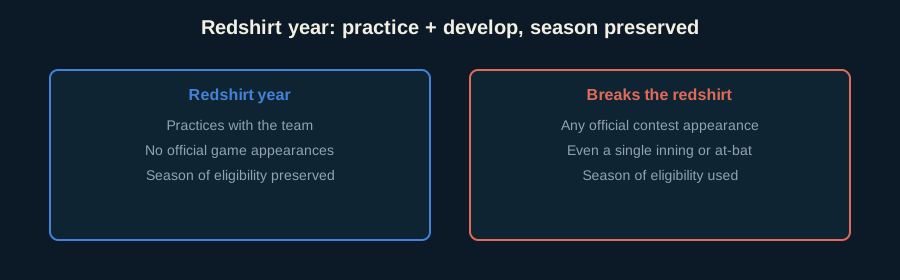
The diagram below shows how NCAA redshirt rules applied across a college baseball season under the previous model, still worth reading if you are one of the athletes being assessed under it.
What used to break a redshirt under NCAA redshirt rules
Appearing in any official contest (even for a single inning or at-bat) typically used that season of eligibility and ended the redshirt for that year. Coaches and compliance staff tracked it carefully.
Practice, scrimmages against your own team, and off-season competition generally did not affect it. Official games did.
Under the age-based model that replaced NCAA redshirt rules, none of that arithmetic exists. A single at-bat costs nothing, because there is no season to spend: only the calendar, which was already running.
Medical redshirts and NCAA redshirt rules: the hardship waiver is gone too
Medical hardship waivers were eliminated alongside the athletics redshirt rules. They appear by name on the NCAA’s list of deleted waiver categories, together with extension-of-eligibility waivers, season-of-competition waivers, athletics activity waivers and delayed enrollment waivers.
Under the previous system a season-ending injury early in the year could be waived back to you, provided you had played only a limited share of the season. That route no longer exists at Division I or Division II.
The reason is structural rather than unsympathetic. A waiver restored a season of competition, and seasons of competition no longer exist. There is nothing left for it to give back.
Injury is not one of the three exceptions. Only pregnancy, active-duty military service and official religious missions can delay or pause the five-year period, and the NCAA Eligibility Center administers all three.
Military service, religious missions and similar service commitments. That time may be excluded from the five years if the athlete does not take part in organized competition during the service. Compete during it and the exception does not apply at all.
Pregnancy. The period may be paused for the actual span during which the individual cannot compete, with supporting medical documentation.
The asymmetry decides real cases: the service exception is forfeited by competing, while the pregnancy exception is bounded by the actual period of inability to compete.
One more catch if you are weighing the two rulebooks. An athlete who stays under the previous NCAA redshirt rules keeps the old arithmetic but permanently gives up the eliminated waiver categories.
Types of redshirts under the old NCAA redshirt rules, compared
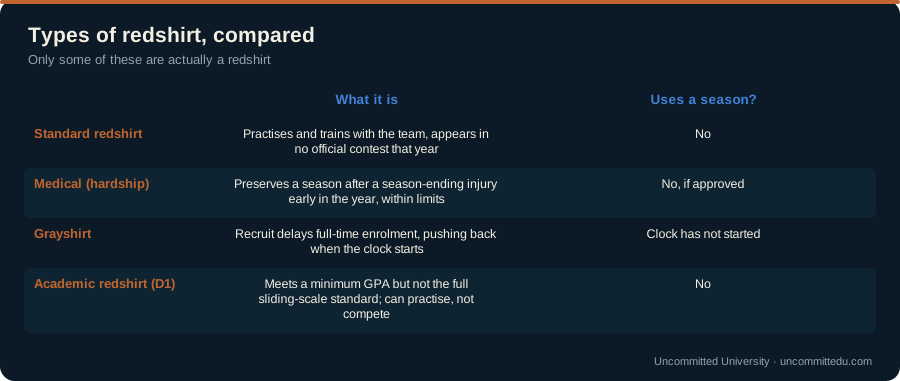
Four different things get called a redshirt, and the table below shows how NCAA redshirt rules treated each one. This is the previous model, kept because athletes in the transition groups are still assessed against it.
Four things get called a redshirt, and NCAA redshirt rules treat each of them differently.
“Redshirt” gets used loosely to describe several different situations. They’re not interchangeable, and mixing them up leads to confusion with coaches and compliance staff.
Type
What it is
Uses a season of eligibility?
Standard redshirt
Practices and trains with the team, doesn’t appear in any official contest for the year
No
Medical (hardship) redshirt
Preserves a season after a season-ending injury early in the year, under specific limits
No, if approved
Grayshirt
Recruit delays full-time enrollment, often by a semester, pushing back when the eligibility clock starts
N/A | clock hasn’t started yet
Academic redshirt (D1)
Player meets a minimum GPA but not the full sliding-scale standard; can practice and receive aid, not compete
No
Here is where each of those four stands now at Division I and Division II. Standard and medical redshirts are gone, because the seasons they protected are gone. Academic nonqualifier season limitations were eliminated in Division I, so the academic-redshirt row needs checking against your own certification rather than assumed. The grayshirt has been inverted: delaying full-time enrollment no longer postpones the clock, because the academic year after your 19th birthday starts it anyway.
Confirm which category applies to your own situation with a program’s compliance office, because the transition rules decide whether the old column or the new one governs you. The NCAA redshirt rules in that table are history at Division I and Division II either way.
What if an injury happens partway through a season now
Under the age-based model an in-season injury does not cost you a season, because there is no season to lose. NCAA redshirt rules were the mechanism for protecting one, and that mechanism is gone. It costs calendar time, and the calendar was already running before the injury.
That is a real gain for some athletes and a real loss for others. A player hurt in April keeps everything except the games. A player who loses two full years to injury has no waiver route to recover them, because injury is not one of the three exceptions.
Under the previous NCAA redshirt rules a medical hardship waiver generally required the injury to happen early in the season, with the player having competed in only a limited number of contests or a limited percentage of the season beforehand. If you are in a transition group being assessed under those rules, those deadlines still apply to you.
Either way, tell the compliance office the day the injury happens. Documentation gathered in the moment is worth more than documentation reconstructed in June, and that held true under both rulebooks.
Confirm your own eligibility timeline
See exactly how many seasons you have left, including redshirt scenarios.
NCAA redshirt rules: how to tell where you actually stand
There was never a form a player signed to become a redshirt. It was a status that showed up in the paperwork, which is why players sometimes found out after the fact.
The NCAA redshirt rules question has changed shape rather than disappeared. Instead of was I redshirted, it is now which rulebook am I assessed under, and when does my five-year period end.
Three things to check:
Which transition group you are in. Athletes who used their final season under the previous rules in 2025-26 get no additional eligibility. Athletes with eligibility remaining after 2025-26, and prospects first enrolling full time in 2026-27, are reviewed under the previous rules or the age-based rule, whichever is most beneficial. Anyone first enrolling full time in fall 2027 or later is on the age-based rule only.
Who runs that comparison for you. Campus compliance staff run it for current student-athletes. The NCAA Eligibility Center runs it for incoming 2026-27 enrollees. Two different offices, and asking the wrong one wastes a month.
Your actual start date. The five-year period that replaced NCAA redshirt rules begins at the term you first enrolled full time anywhere (including a junior college, including an international institution) or the academic year after your 19th birthday, whichever came first. Our guide to the NCAA eligibility clock walks through both triggers.
Ask in writing, once a year. A short email to compliance asking which rules you are assessed under and when your eligibility period ends gives you a record. Verbal reassurance from a coach is not that record, and the two do come apart.
A note on spelling, since it splits the search results: you will see this written as “redshirt” and as “red shirt.” They mean the same thing, and the one-word version is the NCAA’s own usage.
NCAA redshirt rules and transfers
This is where the change bites hardest. The five-year period does not pause because you transfer, sit out, change teams or take time away from participation. The NCAA states that directly.
A JUCO transfer meets the same fact in a different form: full-time enrollment at a two-year college starts the NCAA period, so arriving at a four-year school starts nothing fresh.
Confirm your exact status with a new program’s compliance office before committing, and read the JUCO eligibility clock rules if that is your route.
NCAA redshirt rules by position: what it typically looked like
Development patterns are not identical across every position, and none of this was ever a hard rule. With NCAA redshirt rules abolished these are now purely coaching decisions rather than eligibility decisions, which if anything makes them easier to discuss honestly.
Pitchers are redshirted often, partly for arm health and long-term development, and partly because pitching depth means a roster can absorb one more year of a young arm not yet in the rotation.
Position players are more likely to see early playing time if a roster has an immediate need, but still redshirt regularly when a program is deep at that position.
Catchers often redshirt for the same defensive-development reasons pitchers do, the position rewards experience that’s hard to simulate in practice alone.
None of this should be read as a guarantee. Ask a program directly how it’s handled specific positions in recent recruiting classes rather than assuming a pattern applies to you.
NCAA redshirt rules compared with NAIA and JUCO
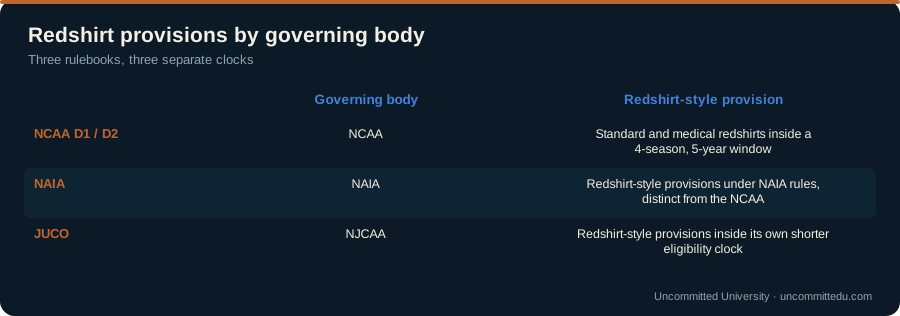
NCAA redshirt rules never carried across to the NAIA or the NJCAA, and neither body is affected by the NCAA’s 2026 change: the table below shows where each one now stands.
NCAA redshirt rules do not carry across to the NAIA or the NJCAA: each body runs its own clock and its own provisions.
Redshirt-style provisions still exist outside NCAA Division I and Division II, and the specifics are set by each level’s own governing body.
Level
Governing body
Redshirt-style provision
NCAA D1 / D2
NCAA
None | redshirt rules and medical hardship waivers eliminated for 2026-27, replaced by a continuous five-year eligibility period
NCAA D3
NCAA
Not covered by the Division I and Division II age-based legislation | confirm current Division III provisions directly
NAIA
NAIA
Redshirt-style provisions under NAIA-specific rules, distinct from the NCAA
JUCO
NJCAA
Redshirt-style provisions under NJCAA rules, within its own shorter eligibility clock
Never assume a redshirt rule from one level carries over to another. Confirm directly with the specific governing body and program compliance office.
How a redshirt year affects MLB draft timing
Baseball’s draft eligibility rules interact with redshirt status in a way other sports don’t deal with. MLB draft eligibility for college players is generally tied to class standing (being a junior) or turning 21, not directly to how many seasons of NCAA eligibility remain.
A non-competing year can shift when a player reaches junior academic standing relative to their draft class, which in turn shifts the earliest year they become draft-eligible. That interaction survives the rule change untouched, because MLB sets its own draft rules. What changed is the other side of the trade: a development year now costs five-year clock time and nothing else, so the calculation is simpler than it was under NCAA redshirt rules. This is our reading of how the two rulebooks meet, not NCAA guidance.
This is a planning conversation, not a rule to memorize. Talk it through with a coach who has helped players navigate it before.
Redshirting as a walk-on vs. a scholarship player
Redshirt decisions apply the same way to walk-ons as to scholarship players, there’s no separate eligibility rule based on scholarship status.
The practical difference is usually about roster math rather than rules: walk-ons sometimes redshirt more readily simply because a program has less financial pressure riding on their immediate playing time. That’s a program-culture pattern, not an NCAA requirement, so it’s still worth asking about directly rather than assuming.
Common misconceptions about NCAA redshirt rules
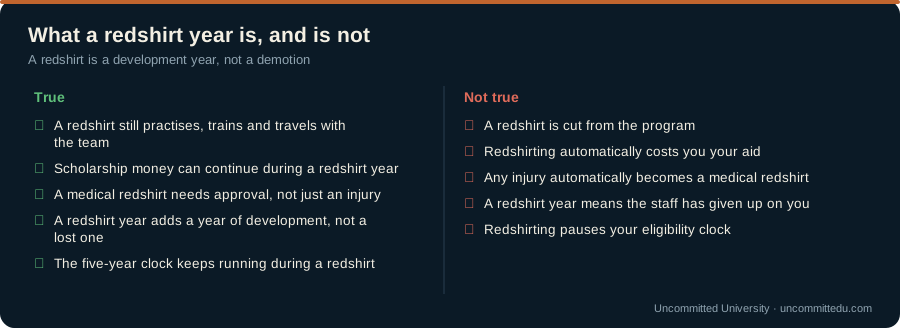
The checklist below separates what NCAA redshirt rules actually said from what families usually assumed, plus one new misconception the 2026 change has already created.
What NCAA redshirt rules actually say, next to what families usually assume they say.
“Redshirting means you’re not good enough.” Plenty of redshirted freshmen become key starters within a year or two.
“You can redshirt more than once.” Under the old NCAA redshirt rules a standard redshirt was a one-time tool. At Division I and Division II the question is moot: there is no redshirt left to use once or twice.
“Practice time doesn’t count against anything.” It never used eligibility and it still does not, but it is governed by NCAA practice-time rules either way.
“The new clock is a 5-for-5 rule.” The NCAA rejects that phrase by name. The model centres on age and initial full-time enrollment, and it does not guarantee five years to everyone, least of all athletes who delay enrolling.
How to talk to a coach about NCAA redshirt rules now
Don’t wait for a coach to bring it up. The questions have changed, so ask directly:
Do you plan to have me compete as a freshman, or develop for a year first?
Which rulebook does your compliance office think I fall under: the previous rules or the age-based model?
What does a development year look like here in terms of practice reps and specific goals?
How have players at my position developed into contributors after a year of not competing?
A coach’s answer here tells you a lot about whether the program actually develops players or just recruits and hopes.
Questions to ask before accepting a redshirt-heavy recruiting offer
If a coach signals early that redshirting is likely, that’s useful information, not a red flag by itself. Get specific before deciding what it means for you.
Is this based on roster depth at my position, or on a specific development plan for me?
What would it take to compete for playing time earlier than planned?
How has the program used a redshirt year for players at my position in the past, and where are they now?
Does redshirt status affect my scholarship percentage or renewal in any way?
A program that’s transparent about this is usually a program that’s thought it through, which is a good sign regardless of the specific answer.
What redshirting means for scholarship money
A redshirt year doesn’t automatically affect scholarship money: a player can be redshirted and still receive the same athletic aid as a competing teammate, depending on the program’s scholarship structure and NCAA division.
What can change is the conversation around scholarship renewal. NCAA rules require scholarships to be renewed or non-renewed annually, and a redshirt year is exactly the kind of year where a family should confirm renewal expectations directly, rather than assuming a redshirt year signals anything about a coach’s confidence in the player.
Ask directly, every year: is this scholarship guaranteed for the length of the original offer, and does redshirt status change anything about that conversation.
The clock replaced NCAA redshirt rules entirely
Here is the thing that reframes all of this: a redshirt was never something you applied for. There was no redshirt form. The word described what happened, not a status you were granted, which is exactly why it could be deleted without anything taking its place.
What used to exist was a clock and a count. NCAA redshirt rules at Division I and Division II gave you four seasons of competition inside an eligibility window. What exists now is only the clock: a five-year period that starts at first full-time enrollment anywhere, or the academic year after your 19th birthday, and then runs without pausing.
A redshirt year was simply a year inside that window where you were enrolled, practised with the team, and did not compete. The season went unused. The clock still ran.
Only the second half of that sentence survives. The NCAA puts it plainly: athletes, coaches and athletics departments no longer have to track athletic redshirts.
That distinction was the whole of it, and the new model resolved it in one direction. Time always moves. Nothing else is being counted any more.
The ordinary redshirt used to be a freshman decision. A player who needed a year in the weight room, or who sat behind an established starter, banked the season and got a more useful fifth year later. The banking is gone. The weight-room year is not.
The medical hardship waiver was the part of NCAA redshirt rules that got misdescribed most often, and it is now eliminated by name at Division I and Division II. There is no season to restore, so there is nothing to apply for.
The three exceptions that remain are narrower, and none of them is injury: pregnancy, active-duty military service and official religious missions, all administered by the NCAA Eligibility Center. Medical documentation still matters for the pregnancy exception, which is why athletic training staff should be involved early rather than at the end of a year.
A few things the five-year period does not do. It does not make you eligible on its own: academic and other athletics rules still apply, so an athlete can be inside the five years and ineligible for other reasons. It does not stop you practising, travelling or being on scholarship. And it does not reach Division III, the NAIA or the NJCAA, none of which are covered by this legislation.
JUCO is the case that changed most. NJCAA baseball still runs its own two-year window under its own rules, but full-time enrollment at a junior college now starts your NCAA five-year period: the NCAA names two-year colleges explicitly.
The practical advice has flipped. Under the old NCAA redshirt rules the thing to protect was the season; under the new clock it is the calendar. Enrol on time, and if a gap year is on the table, price it in years of eligibility before you take it.
What baseball families should do now that NCAA redshirt rules are gone
None of this section is NCAA guidance. The NCAA has published no baseball-specific direction on the age-based model, so what follows is our reading of what the end of NCAA redshirt rules means for a baseball timeline.
Treat a post-graduate year as a purchase, not a free option. If you turn 19 before Sept. 1 of that year, the period starts anyway. A PG year that once cost nothing can now cost a year of the five.
Reprice the JUCO route. Two years at a junior college are two years of the same five, because full-time enrollment at a two-year college starts the NCAA period. The route still works. It just no longer buys time.
Stop planning around a redshirt freshman year. There is nothing left to bank. If a program pitches a redshirt year plus five years of eligibility, ask which rulebook it thinks applies to you.
In-season appearances are now free. Fall ball and scrimmages always were. Under the old NCAA redshirt rules a March weekend could cost a season; now it cannot, so a coach has no eligibility reason to hold a healthy freshman out.
Put the draft conversation and the clock conversation in one meeting. MLB draft eligibility runs on class standing and age rather than NCAA seasons, so the two timelines now move independently.
The NCAA advice to prospects is blunt: plan your college enrollment timeline carefully, especially if you are considering a gap year, delayed enrollment or another nontraditional path after high school. Delaying enrollment beyond age 19 may reduce the eligibility available to you in Divisions I and II.
Frequently asked questions about redshirt rules
Do NCAA redshirt rules still exist in 2026-27? Not at Division I or Division II. Athletics redshirt rules and seasons of competition were eliminated for 2026-27 and replaced by a continuous five-year eligibility period. Division III is not covered by that legislation, and the NAIA and NJCAA are unaffected by it.
Are medical redshirts still allowed under NCAA redshirt rules? No. Medical hardship waivers appear by name on the NCAA list of eliminated waiver categories for Divisions I and II. Injury is not one of the three exceptions that can pause the five-year period: only pregnancy, active-duty military service and official religious missions can.
Does a redshirt year count against a scholarship? Not automatically. A player can be redshirted and still receive athletic aid, though scholarships are renewed annually and should be discussed directly each year.
Can a player redshirt more than once? Under the previous rules a standard redshirt was a one-time tool, with medical hardship as a separate provision. At Division I and Division II the question no longer applies, because both were eliminated for 2026-27.
What is a grayshirt, and is it the same as a redshirt? No. A grayshirt delays a recruit’s full-time enrollment, pushing back when the eligibility clock starts. A redshirt happens after enrollment and uses a year of development without using a season of competition.
Does practicing during a non-competing year count against eligibility? No. Practising never used a season of competition, and with seasons eliminated at Division I and Division II there is nothing left for it to use. NCAA practice-time rules still apply.
Can a transfer redshirt at their new school? Often yes, depending on transfer rules and how many seasons were already used. Confirm directly with the new program’s compliance office.
Who decides which eligibility rules apply to you? Playing time is still the coaching staff call. The rulebook is not: campus compliance staff run the comparison for current student-athletes, and the NCAA Eligibility Center runs it for incoming 2026-27 enrollees.
The short version: NCAA redshirt rules no longer exist at Division I or Division II, so a year of development costs calendar time and nothing else. Before accepting a development-heavy offer, ask what the plan is, what happens to your aid, and which rulebook the compliance office says you fall under.
The short version
NCAA redshirt rules were eliminated at Division I and Division II for 2026-27, along with seasons of competition and medical hardship waivers. What is left is a five-year period of eligibility that starts at first full-time enrollment or the academic year after your 19th birthday, and then runs whether you play or not.
Injury no longer buys a season back. The only three exceptions are pregnancy, active-duty military service and official religious missions, and the NCAA Eligibility Center administers all three.
Uncommitted University advises settling one question with the compliance office before opening weekend: which rulebook governs you, the previous rules or the age-based model, and when your five-year period ends.
Get the answer in writing if you can, even informally by email. Coaching staffs change, and a verbal understanding from a coach who leaves in June is worth very little in February.
Your next step
Work out your own dates first. Read how the NCAA eligibility clock starts and runs, and check the NCAA age limit rules if your 19th birthday falls near a Sept. 1 boundary. Both explain the system that replaced NCAA redshirt rules.
Check your own eligibility clock, and if you’re coming from JUCO, review the JUCO eligibility clock rules specifically.
Written by Recruiting Coordinator, part of Uncommitted University’s recruiting content team.
NCAA baseball eligibility confuses almost every family at some point. The rules span academics, amateurism, and a strict eligibility clock, and they’re different again for NAIA and JUCO.
This guide covers exactly how NCAA baseball eligibility works, level by level, so you know what you actually need to do and by when.
Quick answer: NCAA baseball eligibility requires registering with the Eligibility Center, completing a set number of core courses with a qualifying GPA, and competing inside a five-year period of eligibility that starts at first full-time college enrollment, or at the academic year after your 19th birthday. That five-year period replaced the four-seasons model at Divisions I and II for 2026-27. NAIA and JUCO run separate systems with their own registration and rules.
Key takeaways
NCAA baseball eligibility covers three separate things: academics, amateurism and a strict clock.
NCAA baseball eligibility at D1/D2 means 16 core courses on a GPA sliding scale.
The NAIA and NJCAA run their own standards. NCAA baseball eligibility does not carry across.
Most NCAA baseball eligibility problems are paperwork sent late, not rules that were failed.
Register in sophomore year and NCAA baseball eligibility stops being a senior-year emergency.
NCAA baseball eligibility at Division I and Division II now runs on a five-year age-based period rather than four seasons of competition, effective 2026-27.
Athletics redshirt rules and medical hardship waivers were eliminated in the same change. Division III, the NAIA and the NJCAA are not covered by it.
Why NCAA baseball eligibility exists
NCAA baseball eligibility rules exist to confirm two things: that you meet academic standards to compete, and that you haven’t violated amateurism rules that would make you a professional rather than a student-athlete.
Get this wrong and a player can lose a season of eligibility (or all of it) over a paperwork issue that was entirely avoidable.
What changed in 2026: NCAA baseball eligibility went age-based
The biggest change to NCAA baseball eligibility in a generation landed in 2026. Divisions I and II replaced seasons of competition with a five-year period of eligibility triggered by age and enrollment.
Six rules were eliminated outright: seasons of competition, athletics redshirt rules, delayed enrollment and organized competition rules, sport-specific enrollment timelines, academic nonqualifier season limitations at Division I, and the 10 semesters / 15 quarters rule at Division II.
Five waiver categories went with them: medical hardship, extension-of-eligibility, season-of-competition, athletics activity, and delayed enrollment waivers.
Which rulebook applies to you
Nothing here is retroactive, and four groups are treated differently.
Your situation
How your eligibility is reviewed
You used your final season under the previous rules during 2025-26
No additional eligibility
You are a current student-athlete with eligibility remaining after 2025-26
Previous rules or the age-based rule, whichever is most beneficial, run by your campus compliance staff
You first enrol full time at any college during 2026-27, including if you have already turned 19
Previous rules or the age-based rule, whichever is most beneficial, run by the NCAA Eligibility Center
You first enrol full time in fall 2027 or later
Age-based rule only
Two different offices run that comparison, and asking the wrong one costs you weeks on a time-sensitive NCAA baseball eligibility question. Campus compliance handles current student-athletes; the Eligibility Center handles incoming 2026-27 enrollees.
There is also a catch on choosing the old rulebook. An athlete who continues under the previous rules will not have future waiver opportunities to gain additional eligibility through the eliminated waiver categories.
The NCAA put the no-retroactivity decision plainly. Athletes who exhausted their eligibility by 2025-26 “have received the full period of eligibility permitted by NCAA bylaws”, and granting another season “would disrupt expected roster spots and playing time ahead of the upcoming seasons and alter financial aid packages for countless student-athletes.”
Scope, because it gets lost fast. This is Division I and Division II legislation. Division III is not covered by it. The NAIA and the NJCAA are separate associations that write their own eligibility rules, and neither is affected, their clocks still run exactly as they define them.
The age trigger is the part almost every write-up gets wrong, because “age 19” alone is not the rule. Our guide to the NCAA age limit works through the Sept. 1 split in detail, including what it means for a post-graduate year.
And being inside the five years is not the same as being eligible. Academic and other athletics-related rules still apply, so a student-athlete can be inside the period and still ineligible for other reasons.
How amateurism rules affect NCAA baseball eligibility
Amateurism certification confirms a player hasn’t done anything NCAA rules treat as “professional” activity before enrolling. In practice, that comes down to a short list of triggers:
Signing with a sports agent before enrolling, even informally
Accepting prize money above actual and necessary expenses from an open competition
Playing for a professional team or accepting a professional contract
Accepting benefits from an agent, financial advisor, or program based on athletic ability or potential
Most high school players clear amateurism review without any issue. The rules mainly exist to catch players who signed something without realizing what it meant, not to punish ordinary high school and travel-ball participation.
NIL (name, image, and likeness) compensation is treated separately from amateurism status under current NCAA rules. Earning NIL money as a high school or college athlete does not, by itself, affect amateurism status the way a professional contract would. Confirm current NIL-specific rules directly with the Eligibility Center, since this area continues to evolve.
Registering with the NCAA Eligibility Center
Every player planning to play D1 or D2 needs an account with the NCAA Eligibility Center. It’s free to register, and the earlier you start, the fewer surprises later.
Create your account as early as sophomore year
Have your high school send official transcripts directly
Submit test scores if your school or conference requires them
Confirm your amateurism questionnaire is complete before your final year
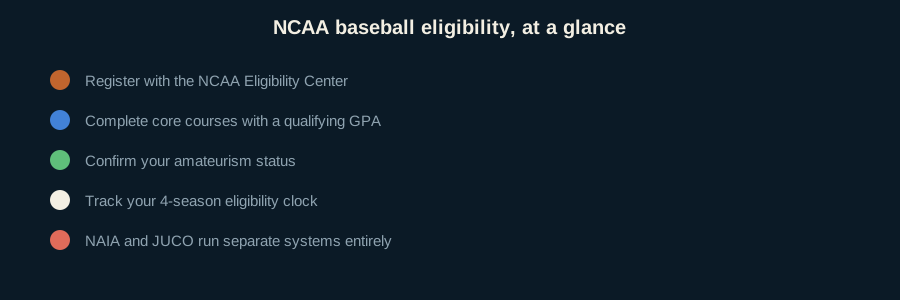
The overview below shows how the pieces of NCAA baseball eligibility fit together.
Academic eligibility: core courses and GPA
The NCAA requires a set number of approved “core courses” (English, math, science, and social studies) completed with a qualifying GPA on a sliding scale against your test scores.
Miss a core course requirement, and even a strong athlete can be ruled a non-qualifier, unable to compete or receive athletic aid as a freshman.
What happens if you’re ruled a partial qualifier or non-qualifier
Falling short of the full academic qualifier standard doesn’t automatically end a player’s college baseball career, but it does change what happens as a freshman.
Partial qualifier: Depending on the division and the current rule in effect, a player may be able to practice and receive athletic aid as a freshman, but not compete.
Non-qualifier: A player generally cannot practice with the team, compete, or receive athletic aid during the first year, though they can still enroll as a student.
Academic redshirt (Division I): Under the previous rules, a player who met a minimum GPA threshold but fell short of the full sliding-scale standard could receive athletic aid and practice, but not compete, during the first year. Academic nonqualifier season limitations appear on the NCAA’s 2026 list of eliminated rules for Division I, so confirm how this is applied to your own certification rather than assuming it still works the same way.
This is exactly why an early transcript review matters more than a late one. A shortfall caught during junior year still leaves time to fix it with an extra course or a stronger senior-year push. The same shortfall caught after graduation usually doesn’t.
The NCAA baseball eligibility clock that replaced redshirt rules
Division I and Division II athletes now have a five-year period of eligibility, and redshirt rules are gone. Four seasons of competition, athletics redshirt rules and medical hardship waivers were all eliminated for 2026-27.
The period begins at the earlier of two events:
Initial full-time college enrollment. The academic term when you first enrol full time and attend class at any college or university: domestic, international or two-year.
The age trigger. The start of the regular academic year immediately after your 19th birthday, if you turn 19 before Sept. 1. Turn 19 on or after Sept. 1 and the period begins at the start of the subsequent academic year, unless you enrol full time earlier.
Then it runs continuously. It does not pause because you do not compete, transfer, sit out, change teams or take time away from participation, which is precisely why athletes, coaches and athletics departments no longer track redshirts.
Three exceptions can delay or pause it: pregnancy, active-duty military service and official religious missions. The NCAA Eligibility Center administers all three.
One phrase to avoid, because it is wrong. This is not a “5 for 5” rule. The NCAA rejects that description by name, since the model turns on age and initial full-time enrollment and does not guarantee five years to everyone, least of all athletes who delay enrolling.
JUCO programs run their own eligibility system under the NJCAA, separate from the NCAA entirely. The clock, academic standards, and amateurism rules all differ.
Players sometimes assume NCAA rules carry over. They don’t. Confirm NJCAA-specific requirements directly before enrolling.
The NAIA also runs its own separate eligibility system, with its own academic standards and season-of-competition rules, distinct from both the NCAA and NJCAA.
Division III doesn’t use NCAA Eligibility Center certification the way D1 and D2 do. There’s no sliding scale, no core-course GPA submission to a national clearinghouse, and no amateurism certification through the Eligibility Center.
Instead, D3 eligibility runs through each school’s own general admissions standards. A player gets into the school academically, the same way any other applicant would, and that admission is what determines eligibility to enroll and compete.
D3 programs still follow NCAA rules once a player is enrolled, but the front-end certification process is much lighter than D1 or D2.
One thing to be careful about in 2026-27. The age-based eligibility model was adopted by Division I and Division II. Division III is not covered by that legislation, so do not assume either the new five-year period or the old four-season model applies to you at D3: confirm current Division III provisions directly with the school’s compliance office.
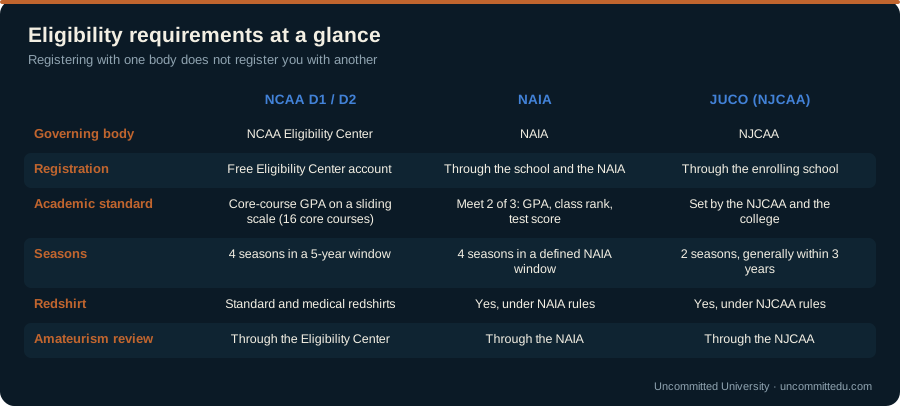
NCAA baseball eligibility at a glance: D1/D2 vs. NAIA vs. JUCO
The table below sets NCAA baseball eligibility beside the NAIA and NJCAA equivalents, since registering with one body does nothing for the others.
NCAA baseball eligibility, NAIA and JUCO rules side by side → three governing bodies, three separate rulebooks.
Every level runs its own system, with its own governing body and its own rules. Here’s how the structural pieces compare side by side.
Feature
NCAA Division I / II
NAIA
JUCO (NJCAA)
Governing body
NCAA Eligibility Center
NAIA
NJCAA
Registration required
Yes | free Eligibility Center account
Yes | through the school and the NAIA
Yes | through the enrolling school
Academic standard
Core-course GPA on a sliding scale (16 core courses)
Meet at least 2 of 3: GPA, class rank, test score
Set by the NJCAA and the enrolling college
How eligibility is limited
A five-year period starting at first full-time enrollment or the academic year after a 19th birthday. Seasons of competition eliminated for 2026-27
4 seasons within a defined NAIA window
2 seasons, generally within 3 years of first enrolling
Redshirt available
No | athletics redshirt rules and medical hardship waivers eliminated for 2026-27
Yes | under NAIA-specific rules
Yes | under NJCAA-specific rules
Amateurism review
Required through the Eligibility Center
Required through the NAIA
Required through the NJCAA
Exact GPA and test-score standards shift periodically. Confirm the current version directly with each governing body before making a decision based on the specifics.
Note which column of this NCAA baseball eligibility comparison moved. The Division I and Division II rows changed in 2026; the NAIA and NJCAA rows did not, because neither body is covered by NCAA legislation. Our D2 eligibility rules guide covers how Division II adopted the age-based model and what it means for a Division II recruit specifically.
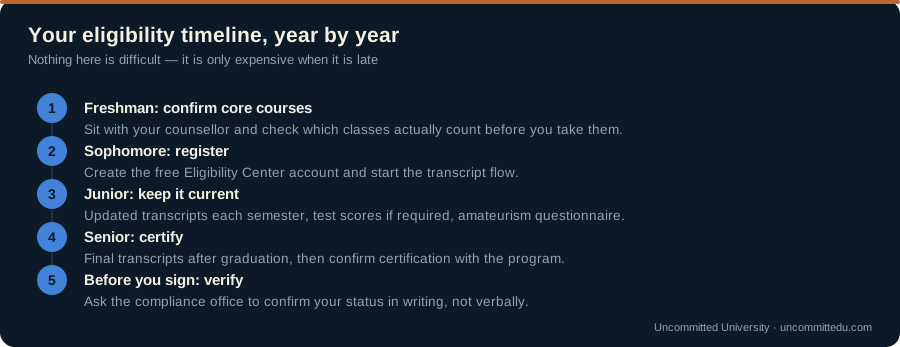
Building your NCAA baseball eligibility timeline: freshman through senior year
The timeline below shows the one NCAA baseball eligibility task that belongs in each school year.
NCAA baseball eligibility is a four-year paperwork trail, and every year has one thing that cannot be done late.
Eligibility isn’t a senior-year task. Families who stay ahead of it spread the work out over four years.
Freshman year: Confirm which of your classes count as NCAA-approved core courses. Start a folder (physical or digital) with report cards and course lists.
Sophomore year: Register with the Eligibility Center (and the NAIA Eligibility Center, if that path is realistic). Review your core-course progress with a counselor.
Junior year: Send transcripts after each semester. Complete the amateurism questionnaire. Confirm your running core-course GPA, not just your overall GPA.
Senior year: Send updated transcripts as soon as new grades post. Confirm final certification requirements with your target schools’ compliance offices before you commit.
None of this is complicated in isolation. It’s easy to miss only because nobody hands a family a checklist, so here’s one.
How NCAA baseball eligibility issues affect recruiting timing
Coaches recruit against a moving academic picture. An uncertain eligibility status changes how aggressively a program is willing to recruit a player, even one they like on the field.
Programs often slow down or pause an offer until an amateurism or core-course question is resolved
A cleared Eligibility Center status ahead of a visit or offer removes a real point of hesitation for a coaching staff
Families who can answer eligibility questions immediately, without checking, come across as organized → coaches notice
Getting eligibility paperwork in order early isn’t just an administrative task. It’s part of how a recruiting profile gets taken seriously.
International and homeschool NCAA baseball eligibility
International students and homeschooled players go through the same Eligibility Center registration, but with extra steps.
International transcripts need to be evaluated for NCAA-equivalent core courses, which can take longer than a standard U.S. transcript review: start this process earlier than you think you need to.
Homeschooled players need to confirm their curriculum meets NCAA core-course requirements directly with the Eligibility Center, since homeschool documentation is reviewed under its own separate process rather than through a standard high school transcript.
Multi-sport athletes and NCAA baseball eligibility
Plenty of baseball recruits also play football, basketball, or another sport through high school, and multi-sport participation doesn’t complicate NCAA eligibility the way some families expect.
Core courses count the same regardless of which sports a player competes in. The Eligibility Center certifies a player for the sport they intend to compete in at the college level, not every sport they played growing up.
The one place multi-sport participation matters more directly is amateurism: any competition, in any sport, that involved a professional contract, agent relationship, or over-the-limit prize money can affect certification. Review your full athletic history honestly when completing the amateurism questionnaire, not just your baseball history.
NCAA baseball eligibility rules: who actually has the final say
Three different offices touch your file, and only two of them can give you an answer that counts. Knowing which is which saves families a lot of wasted worry.
The NCAA Eligibility Center certifies academic and amateurism status for D1 and D2, and from fall 2026 it also administers and certifies the period of eligibility itself. It runs the previous-rules-versus-age-based comparison for incoming 2026-27 enrollees, and it administers the three exceptions. It is the authority on whether you are cleared to compete at all.
Your school’s compliance office tracks what happens after you enroll: progress toward degree, transfer paperwork, and how much of your eligibility period is left. For current student-athletes it is also the office that runs the 2026 comparison between the previous rules and the age-based rule, and applies whichever is most beneficial. It is the authority on how much eligibility you have left.
The coaching staff is neither. A coach can tell you the plan for your roster spot. A coach cannot certify you, and reassurance from a coach has no standing when the paperwork disagrees.
Get it in writing. An emailed answer from compliance is a record. A conversation after practice is not, and those two come apart at exactly the moment it matters.
One more thing about NCAA baseball eligibility rules: they change. Standards, windows and waiver processes get revised between academic years, which is why any date or threshold you read anywhere (including on this page) is worth confirming against the current NCAA rules and the Eligibility Center before you build a plan on it.
What to confirm before you commit to a program
Before signing anything, confirm these directly with the program’s compliance office, not just the coaching staff:
Your Eligibility Center status is fully certified, not just “in progress”
Which rulebook they will assess you under (the previous rules or the age-based model) and the exact date your five-year period of eligibility started
Whether any credits (AP, dual-enrollment, or transfer) have been evaluated for core-course purposes
What the development plan looks like for your position, now that holding a player out no longer preserves a season at Divisions I and II
How the program’s academic support staff handles athletes who are close to a core-course or GPA threshold
A program that can answer these questions clearly and quickly is also telling you something about how organized its compliance operation is, which matters for the entire time you’re enrolled there, not just at signing.
The transfer portal and NCAA baseball eligibility
Transferring between four-year programs runs through the NCAA transfer portal process, which is separate from (but closely connected to) a player’s eligibility clock.
Entering the portal does not reset anything, and under the age-based model it is starker than that. The NCAA states directly that the five-year period does not pause because a student-athlete transfers, sits out or changes teams. A transfer year is a year of the five whether you play or not, and that is the single biggest NCAA baseball eligibility change for a portal athlete.
If you are in a transition group being assessed under the previous rules, the older arithmetic still applies to you: two seasons used at one school leaves two remaining after transferring, assuming no redshirt or waiver applied.
A few specific situations to confirm before entering the portal:
Graduate transfers: additional eligibility rules apply if you’ve already completed a bachelor’s degree
JUCO-to-four-year transfers: full-time enrollment at a junior college starts your NCAA five-year period, so the clock was already running before you arrived
Mid-year transfers: sitting out part of a season has its own specific rules, and at Divisions I and II sitting out no longer preserves anything
None of this carries over automatically. Confirm directly with both the sending and receiving school’s compliance offices before making any assumption about remaining eligibility.
Walk-ons and NCAA baseball eligibility
Walk-on players go through the exact same Eligibility Center certification process as scholarship recruits. There’s no separate, lighter version of eligibility for players who aren’t receiving athletic aid.
The one practical difference: walk-ons sometimes have more flexibility on timing, since a program isn’t committing a scholarship to their certification status. That said, waiting to register or send transcripts still creates the same risk of a late-surfacing academic issue: don’t treat walk-on status as a reason to deprioritize the paperwork.
Preferred walk-ons (players a coaching staff has already identified before tryouts) should treat the eligibility process with the same urgency as a scholarship recruit, since a certification delay can affect whether a roster spot is still open by the time paperwork clears.
Common NCAA baseball eligibility mistakes
Almost every NCAA baseball eligibility failure traces back to something on the checklist below.
Almost every NCAA baseball eligibility problem traces back to one of these, and almost all of them are fixable a year earlier.
Waiting too long to register. Start with the Eligibility Center by sophomore year, not senior year.
Assuming one level’s rules apply to another. NCAA, NAIA, and JUCO each run separate systems.
Missing a core course requirement that could have been caught with an early transcript review.
Competing before confirming eligibility after a transfer, which can jeopardize an entire season.
Frequently asked questions about NCAA baseball eligibility
What are the NCAA baseball eligibility rules, in one sentence? Be certified academically and as an amateur through the NCAA Eligibility Center for D1 or D2, then compete inside the five-year period of eligibility that your first full-time enrollment (or your 19th birthday) starts. Every other requirement hangs off those two.
Does the 2026 rule change give athletes an extra year? Not retroactively. The NCAA was explicit that the change applies going forward, and athletes who exhausted their eligibility by 2025-26 receive no additional eligibility. Current athletes with eligibility remaining, and prospects first enrolling full time in 2026-27, are reviewed under the previous rules or the age-based rule, whichever is most beneficial.
Do NCAA baseball eligibility rules change every year? They are revised between academic years, and recruiting-calendar dates in particular move. Treat any specific date or threshold, from any site, as something to confirm against the current NCAA rules before you plan around it.
Does a coach have to tell you if there is an eligibility problem? Do not rely on it. Certification runs through the Eligibility Center and your school compliance office, and the reliable move is to ask them directly, in writing, once a year.
When should I register with the NCAA Eligibility Center? As early as sophomore year, so any academic issues surface while there’s still time to fix them.
Do I need to worry about eligibility if I’m going D3? D3 doesn’t use the same Eligibility Center certification as D1/D2, but core academic admission standards still apply through the school itself. Note too that the 2026 age-based eligibility model was adopted by Divisions I and II only. Division III is not covered by it, so confirm current D3 provisions directly.
Can I transfer without losing eligibility? Transferring does not cost you a season, but at Divisions I and II it does not buy you time either: the five-year period keeps running through a transfer or a sit-out year. See how the recruiting guide and transfer-specific rules interact.
The short version: NCAA baseball eligibility is administration, not difficulty. Check each class against your school’s approved core list before you take it, register with the Eligibility Center in sophomore year, send transcripts every semester, and answer the amateurism questions honestly. Confirm your NCAA baseball eligibility in writing with the compliance office before you sign anything: a verbal all-clear from a coach is not confirmation of NCAA baseball eligibility.
If it is your clock that ran out rather than your seasons, more routes stay open than most players realise. We read every rulebook and counted 11 verified extra eligibility paths across the NCAA, the NAIA and all three JUCO associations.
The short version
NCAA baseball eligibility comes down to three things: register with the Eligibility Center, pass 16 core courses, and hit the core-course GPA your division requires. Division I asks for a 2.3 core GPA with 10 of the 16 courses finished before your seventh semester. Division II asks for 2.2.
The NCAA has been test-optional since 2023, so no ACT or SAT score is required for NCAA baseball eligibility, but the core-course rules are unforgiving, and a course your high school does not have approved simply will not count.
On the clock side it is now one sentence. At Division I and Division II your NCAA baseball eligibility runs as a five-year period that starts at first full-time enrollment or the academic year after your 19th birthday, and nothing ordinary stops it.
Your next step
Check exactly how many seasons you have left, free.
Check your eligibility, free
Answer a few questions and confirm your seasons of eligibility under NCAA, NAIA, or JUCO rules.
NAIA baseball gets overlooked constantly, mostly because families are less familiar with it than the NCAA divisions. That’s a mistake for a lot of players.
This explains exactly how NAIA works and where it fits. For the full picture, see the college baseball level guide.
Quick answer: NAIA schools follow their own rules, separate from the NCAA, and typically offer more scholarship flexibility than D2 or D3 since NAIA isn’t bound by NCAA equivalency limits. Competition at the top NAIA baseball programs rivals D2.
Key takeaways
NAIA baseball is governed by the NAIA, not the NCAA, with its own rulebook throughout.
NAIA baseball scholarships are not bound by NCAA equivalency caps, so they vary school to school.
NAIA baseball recruiting contact is generally earlier and more direct than the NCAA allows.
Competition at the top of NAIA baseball rivals NCAA D2.
NAIA baseball schools are typically smaller and often private, so judge cost after aid, not on sticker price.
NAIA baseball explained: what it actually is
The NAIA is a separate governing body from the NCAA, with its own rules on scholarships, eligibility, and recruiting contact. NAIA schools are typically smaller, often private institutions.
NAIA vs. NCAA divisions at a glance
The table below sets NAIA baseball against its closest NCAA comparison, D2.
NAIA baseball explained against its closest NCAA comparison: the scholarship rules and contact rules are the real differences.
Feature
NAIA
NCAA D2 (for comparison)
Scholarship limits
Not bound by NCAA equivalency caps; more school-to-school variation
Fixed equivalency limit per sport, split across the roster
Recruiting contact timing
Generally allows earlier and more direct contact
Governed by NCAA contact period rules
School size/type
Typically smaller, often private institutions
Wide range of sizes, public and private
Governing body
NAIA
NCAA
This isn’t a ranking of one over the other: it’s a different rulebook entirely, and that difference is exactly why NAIA programs can sometimes move faster and offer more flexible aid than a comparable NCAA D2 or D3 program.
Why NAIA baseball scholarships are often more flexible
NCAA D1 and D2 programs are capped by strict equivalency limits: a fixed scholarship budget split across the roster. NAIA isn’t bound by those same limits.
That flexibility means NAIA programs can sometimes offer more total scholarship money, spread more generously, than an NCAA D2 or D3 program with similar competition level.
The overview below covers how NAIA baseball is structured and where it sits against the NCAA divisions.
NAIA eligibility rules
NAIA eligibility runs on its own set of rules, separate from the NCAA’s structure. Broadly, NAIA student-athletes generally have four seasons of competition to use within a defined period of full-time enrollment, governed entirely by NAIA rules.
That used to resemble the NCAA. As of 2026 it does not. NCAA Divisions I and II adopted an age-based eligibility model (Division I in June 2026, Division II in August), which deleted seasons of competition, athletics redshirt rules and medical hardship waivers, and replaced them with one five-year period that runs continuously. NAIA baseball was not part of that legislation, and neither was NCAA Division III.
So the two systems now answer the same question differently. The NAIA still asks what you have played and attended. D1 and D2 ask only when your clock started. Carrying an answer from one to the other is how NAIA baseball recruits end up planning around a rule that does not apply to them.
Transfer rules, redshirt provisions, and international student eligibility all have their own NAIA-specific requirements. A program’s compliance office, not general assumptions carried over from NCAA rules, is the reliable source for a player’s exact eligibility picture.
This distinction trips up plenty of families mid-recruiting process, especially when a player is weighing an NAIA offer alongside an NCAA one. Assuming the two systems work identically, or that an NCAA rule automatically applies at an NAIA school, is one of the more common and avoidable mistakes in the process: always confirm directly with the specific school rather than carrying over an assumption from a different governing body.
How NAIA baseball recruiting contact differs from the NCAA
One practical advantage families often miss: NAIA recruiting contact rules tend to be less restrictive than the NCAA’s contact-period system. Coaches at NAIA programs can often start direct conversations with recruits earlier and more consistently than NCAA D1 or D2 coaches, who operate under strict NCAA-defined contact windows.
In practice, this means a player interested in NAIA programs can often expect earlier, more direct communication with coaching staffs than the same player would experience navigating NCAA recruiting rules.
Is NAIA baseball D1, D2 or something else?
Neither. NAIA baseball is not an NCAA division at all. The NAIA is a separate governing body with its own rulebook, its own eligibility standards and its own national championship, so labelling a program “D1” or “D2” is a category error rather than a ranking.
The comparison that actually helps is scholarship structure and fit, level by level.
Level
Governing body
Athletic scholarships
Who it fits
NCAA D1
NCAA
Funded roster spots at schools that opted into the House settlement; equivalency limits elsewhere
Elite recruits who can handle heavy travel
NCAA D2
NCAA
9 equivalencies, split across the roster
Strong recruits, often underrated
NCAA D3
NCAA
None: academic and need-based aid only
Academics-first players
NAIA
NAIA
12 equivalencies, set by the NAIA rather than the NCAA
Players who want real scholarship money and earlier coach contact
JUCO
NJCAA
Varies by school and NJCAA division
Late bloomers and players building a transfer path
Read that table sideways, not top to bottom. NAIA baseball sits alongside the NCAA levels rather than underneath them, and the top of the NAIA competes with solid D2 while the bottom of any level looks much like the bottom of any other.
Competition level: what to actually expect
NAIA competition varies, same as any level. Top NAIA programs rival D2 talent and sometimes produce professional players. Others are more developmental.
Research a specific program’s conference and recent results rather than assuming based on the NAIA label alone.
Why NAIA baseball gets overlooked
Name recognition. Families know the NCAA divisions; NAIA is less familiar.
Fewer televised games and less general media coverage than NCAA programs.
Assumptions about quality that don’t hold up once you look at actual rosters and results.
That gap in awareness is exactly why NAIA can be a strong, less-competitive-to-land recruiting opportunity for the right player.
See if NAIA fits your numbers
Check your real stats against every level, NAIA included.
What day-to-day life looks like on an NAIA baseball roster
Because many NAIA schools are smaller, the athletic experience often feels different from a large NCAA program, in ways that can cut both directions:
Roster sizes tend to be smaller, which can mean more realistic playing time for a player who might sit deep on the depth chart at a bigger program.
Coaching staffs are often smaller too, which can mean more direct, personal coaching attention but fewer dedicated position-specific coaches than a large D1 program.
Facilities vary widely. Some NAIA programs have invested heavily in modern training facilities; others are more modest. This is worth evaluating in person rather than assuming from the level alone.
Travel and scheduling can be lighter than a power-conference NCAA program, which matters for a player balancing academics and athletics closely.
NAIA baseball as an option for two-sport athletes
NAIA programs are often more accommodating of multi-sport athletes than NCAA D1 programs, where the demands of a single sport frequently make a second sport impractical. A player weighing whether to keep playing two sports into college may find NAIA programs more willing to work around a shared schedule, though this still varies significantly by school and coaching staff.
Cost of attendance at NAIA schools
Cost at NAIA schools varies as widely as the schools themselves, since many are private institutions with higher sticker-price tuition than public NCAA D2 or D3 options. That headline number can be misleading on its own:
The scholarship flexibility described above often narrows the real gap between a private NAIA school’s sticker price and a public NCAA school’s in-state tuition
Academic scholarships frequently stack with athletic aid at NAIA schools in ways that can make the final cost competitive with, or lower than, a state school
A direct conversation with the financial aid office, not just the coaching staff, is the only reliable way to know a real number for a specific family’s situation
Comparing offers purely on the headline scholarship percentage, without asking what that percentage applies to after other aid is factored in, is one of the more common ways families misjudge the real cost difference between an NAIA offer and an NCAA one.
How to research NAIA baseball programs
The steps below turn a general interest in NAIA baseball into a real target list.
Researching a programme properly is where NAIA baseball explained turns into an actual target list.
Check the school’s conference and recent standings, not just its name
Look at roster size and typical playing time for your position
Ask directly about scholarship structure: it varies more school to school than in the NCAA
Visit if possible: academics and campus fit matter as much as baseball here
Questions to ask when researching an NAIA baseball program
What conference does the program compete in, and how competitive is that conference nationally?
What does the total cost look like after both athletic and academic aid are applied?
How does the coaching staff’s contact and recruiting timeline typically work?
What percentage of roster spots at my position are currently filled by underclassmen versus upperclassmen?
Common mistakes families make evaluating NAIA baseball programs
The checklist below covers the mistakes families make when judging NAIA baseball programmes.
NAIA baseball explained without the myths: most families misjudge it on cost and competition level, in both directions.
Ranking every NAIA program below every NCAA program by default. Competition level should be judged program by program, not by governing body alone: a strong NAIA program can outcompete a weak D2 or D3 roster.
Assuming the sticker price is the real price. NAIA scholarship flexibility means the actual cost after aid can look very different from the published tuition figure.
Skipping NAIA schools in a search entirely simply because they’re less familiar, which removes real options, including some with strong athletic and academic combinations, before ever evaluating them directly.
Not asking directly about roster depth at a specific position. A program’s overall reputation says little about whether there’s realistic playing time at one specific spot.
Common misconceptions about NAIA baseball
“NAIA is a lower level than D3.” There’s no strict hierarchy: the governing bodies are simply separate, and competition level depends entirely on the specific program, not the letters in front of it.
“NAIA schools don’t offer real athletic scholarships.” Many offer more scholarship flexibility than NCAA D2 or D3 programs, not less.
“Pro scouts don’t look at NAIA rosters.” Top NAIA programs have a track record of producing drafted and professional players, and scouts cover them accordingly.
Academics at NAIA schools
Many NAIA schools are smaller, private institutions with a strong academic focus alongside athletics. That combination can be a real advantage.
Smaller class sizes and more individual attention than large NCAA programs
Academic scholarships that stack with athletic aid, often generously
A campus culture where athletes are known personally by faculty, not just coaches
NAIA baseball runs on its own rulebook, not the NCAA one
This is the most common and most expensive misunderstanding about NAIA baseball: families apply NCAA rules to it and get the answers wrong.
The NAIA is a separate governing body. It has its own eligibility centre, its own academic standards, its own transfer rules and its own scholarship limits. Registering with the NCAA Eligibility Center does nothing for NAIA baseball eligibility.
You register with the NAIA Eligibility Center instead, and it is a different account, a different fee and a different process.
The academic entry standards are generally more flexible than the NCAA equivalents, which matters enormously to late-blooming students and to players whose high school did not have many NCAA-approved core courses.
Eligibility is counted differently too. The NAIA works in semesters of attendance rather than a five-year clock, which gives many players more usable time than the NCAA model does.
Transfer rules are the other big divergence, and they are the reason NAIA baseball absorbs so many NCAA transfers. Moving into the NAIA is typically far less restrictive than moving between NCAA institutions.
On money: NAIA baseball programs work with 12 equivalencies, more than NCAA Division II, and the NAIA does not restrict stacking athletic aid with academic and institutional money the way some NCAA rules do. Well-run NAIA programs use that combination aggressively.
What about the standard of play? At the top it is strong. Leading NAIA baseball programs compete with, and beat, mid-tier NCAA Division II teams, and the NAIA World Series is a serious tournament.
The spread is wide, though. There is more distance between the best and worst NAIA baseball programs than in most NCAA divisions, so evaluate the specific program rather than the letters.
The honest summary: NAIA baseball is the most consistently underrated route in the sport, largely because families never learn it operates as a genuine parallel system.
Frequently asked questions about NAIA baseball
Does NAIA baseball have its own national championship? Yes. The NAIA runs its own postseason and crowns its own national champion: NAIA programs do not feed into the NCAA tournament. That is the clearest sign NAIA baseball is a parallel system rather than a lower rung of the NCAA ladder.
Can you play NAIA baseball after JUCO? Yes, and it is a well-worn route. A JUCO player moving to an NAIA program follows NAIA transfer and eligibility rules rather than NCAA ones, so confirm the season count with the NAIA school directly before committing to the move.
Is NAIA baseball considered a step down from NCAA D2 or D3? Not accurately. NAIA is a separate governing body, not a lower rung on the NCAA ladder, and the best NAIA programs compete at a level comparable to solid D2 competition.
Do NAIA baseball players get drafted into professional baseball? Yes. NAIA programs have a real, ongoing track record of producing drafted and professional players, particularly from their top conferences.
Can international students play NAIA baseball? Yes, though eligibility requirements for international students have their own specific NAIA rules, separate from NCAA international eligibility requirements.
Is NAIA recruiting contact easier to navigate than NCAA contact? Generally, yes. NAIA doesn’t operate under the same strict contact-period system as the NCAA, which often means earlier and more direct conversations with coaching staffs.
How do I know if an NAIA program is a good academic fit, not just an athletic one? Treat the school search the same as any college decision: research the specific academic programs, visit if possible, and talk to current students, not just the coaching staff.
Can a player transfer between an NAIA school and an NCAA school? Yes, transfers happen in both directions, though each governing body has its own transfer and eligibility rules to navigate, so a compliance office conversation on both ends is the reliable way to confirm specifics before committing to a move.
The short version: NAIA baseball gets written off for two reasons that are both wrong: that the competition is a step down everywhere, and that a private school is automatically expensive. Judge each programme on who it actually schedules and beats, and on cost after aid. For a lot of players NAIA baseball delivers a bigger role, more scholarship flexibility and an earlier conversation than the NCAA route.
The short version
NAIA baseball is a separate association with its own eligibility centre, its own academic rules and 12 scholarship equivalencies that can be stacked with academic aid. It is not a lower tier of the NCAA and it does not follow NCAA rules.
If your NCAA core-course situation is difficult, or you need eligibility counted in semesters rather than a five-year clock, NAIA baseball is often the better structural fit rather than the fallback.
Uncommitted University advises registering with the NAIA Eligibility Center separately and early, because it is the step families forget entirely.
A practical warning about scale. NAIA schools are typically small, often between one and three thousand students, and that shapes the experience as much as the baseball does.
For some players that is the appeal: smaller classes, professors who know your name, a coach who has real influence across campus. For others it is claustrophobic after a large public high school.
Visit before deciding, and visit on an ordinary weekday rather than a showcase weekend. The version of a small campus you see on a recruiting visit is not the version you live in during February.
Also check the conference travel map. Some NAIA baseball conferences are geographically tight and forgiving; others send teams on long bus trips that eat far more of the academic week than the brochure suggests.
Finally, look at roster size before you commit. Without an NCAA-style cap, some NAIA baseball programs carry very large rosters, and a large roster at a small school means the competition for innings is fiercer than the level suggests.
Ask directly how many players are on the roster, how many are at your position, and how many of last year’s group are returning. Those three numbers predict your freshman year better than any facility tour.
Your next step
Add NAIA programs to your target list: see the < href="https://uncommittedu.com/college-baseball-divisions/">D1 vs. D2 vs. D3 vs. NAIA vs. JUCO breakdown for how to build a realistic, multi-level list.
Written by UU Recruiting Staff, part of Uncommitted University’s recruiting content team.
JUCO baseball gets treated as a fallback option. It shouldn’t be. It’s a real, legitimate path, and often the smartest one for a player who needs more development time.
This explains exactly how it works and why it’s not “lesser.” For the full picture, see the college baseball level guide.
Quick answer: JUCO (NJCAA) baseball is a two-year path many players use to add strength, refine mechanics, and raise their academic standing, then transfer to a D1 or D2 program with a far stronger recruiting profile than they had out of high school.
Key takeaways
JUCO baseball runs under the NJCAA across three divisions with very different scholarship rules.
JUCO baseball gives you at-bats and innings a four-year bench does not.
The JUCO baseball clock is two seasons, generally within three years of first enrolling.
Enrolling full time at a JUCO now starts your NCAA D1/D2 five-year eligibility clock.
Transferable credits, not talent, are where most JUCO baseball plans fail.
Four-year staffs recruit JUCO baseball players a full year before they arrive.
What is JUCO baseball, exactly?
JUCO baseball is college baseball played at two-year junior colleges, governed by the NJCAA rather than the NCAA. Players compete for two seasons, then transfer to a four-year program or finish an associate degree and move on. JUCO is simply short for junior college.
That is the mechanical answer. Here is what it means in practice.
Two years, not four. A JUCO baseball roster turns over fast, which is why playing time arrives sooner than it does on a four-year bench.
Its own governing body. The NJCAA writes the eligibility, recruiting and scholarship rules for JUCO baseball. NCAA rules do not carry over.
Three divisions, three different scholarship pictures. NJCAA Division I, II and III are not interchangeable, and the table further down spells out the gap.
A transfer route by design. Four-year staffs recruit JUCO baseball players deliberately, because those players arrive with recent in-season numbers against college pitching.
Put plainly: JUCO baseball is a two-year development level inside the college system, with its own rulebook and a well-worn exit ramp to D1 and D2.
JUCO programs fall under the NJCAA, with their own divisions, eligibility clock, and rules, separate from the NCAA entirely.
Two-year colleges field competitive baseball programs, some at a very high level, with a direct pipeline to four-year transfers.
NJCAA divisions at a glance
The table below compares the three NJCAA divisions, because JUCO baseball is not one uniform level.
JUCO baseball explained starts with the divisions: the NJCAA is three very different competitive tiers, not one.
NJCAA division
General scholarship structure
Typical competitive level
NJCAA Division I
Full athletic scholarships permitted
Highest level of JUCO competition, deepest D1/D2 transfer pipeline
NJCAA Division II
Partial athletic scholarships permitted
Strong competition, regular four-year transfers
NJCAA Division III
No athletic scholarships (need-based aid only)
Still competitive, more academically-focused programs
This structure runs parallel to, and separate from, the NCAA’s own D1/D2/D3 system covered elsewhere on this site, a common source of confusion for families new to the process.
Why JUCO baseball is underrated as a developmental path
More development time. Extra strength, mechanics work, and physical maturity before a four-year commitment.
A real season of college-level stats and film. Coaches trust current college performance more than high school numbers.
A path to raise your academic standing. Struggling grades in high school don’t have to close doors permanently.
Often a lighter financial commitment while you build your recruiting profile further.
The diagram below traces the JUCO baseball development and transfer path end to end.
How the JUCO eligibility clock works
The JUCO clock only makes sense next to the NCAA one, and the NCAA clock now runs on age: it starts the academic year after you turn 19. Our NCAA age limit guide walks through exactly when it starts and what pauses it.
JUCO eligibility generally runs on its own two-year clock, set by the NJCAA. In practical terms, that means a player typically has two seasons of JUCO competition available before needing to transfer or exhaust eligibility at that level.
What changed in 2026 is the second clock running alongside it, and it is now the most important thing for a JUCO baseball player to understand. NCAA Divisions I and II adopted an age-based eligibility model (Division I in June 2026, Division II in August) under which a five-year period of eligibility begins at your first full-time enrollment at any college. The NCAA names junior colleges explicitly. So the day you enroll full time at a JUCO, the NCAA clock starts, whether or not you ever play an NCAA game.
Two years at a JUCO therefore spends two of those five calendar years, leaving three at the four-year school, if you enroll straight out of high school and stay enrolled. The clock does not pause because you did not compete, transferred, sat out or stepped away from the sport. The other trigger matters to anyone taking a gap year: if you turn 19 before Sept. 1, the period starts at the beginning of the next regular academic year even if you have not enrolled anywhere. Our JUCO eligibility clock guide works through the timing case by case.
NJCAA redshirt rules, medical hardship provisions and transfer timing all interact with the JUCO clock in ways that vary by situation. Do not carry any of them across to the NCAA side. Divisions I and II eliminated athletics redshirt rules and medical hardship waivers outright in 2026, and only pregnancy, active-duty military service and official religious missions can now pause a five-year period.
A compliance office at the JUCO program is the reliable source for a player’s specific eligibility picture, not a general assumption carried over from high school or another level, and for the NCAA side of it, ask the four-year school you are transferring into.
Cost and financial aid in JUCO baseball
One of the most underrated parts of JUCO baseball is cost. Many JUCO programs, especially at the NJCAA D1 level, offer meaningful athletic scholarship money, and tuition at a two-year public college is frequently a fraction of a four-year private or out-of-state program.
A player can use two lower-cost years to build a stronger recruiting profile before committing to a more expensive four-year program
Academic scholarships and need-based aid often stack with athletic aid in ways that aren’t always possible at the four-year level
A strong JUCO transfer with two years of eligibility left is frequently a more attractive scholarship target for a four-year program than an unproven freshman
See if JUCO fits your numbers
Check your real stats against every level, JUCO baseball included.
D2 deserves a hard look on this path, and its eligibility math has its own rules. The D2 eligibility rules guide covers what transfers in and what does not.
The steps below are the JUCO baseball transfer path in sequence, with the credit check where it belongs.
The JUCO transfer path in sequence: JUCO baseball explained as a two-year plan with a deadline, not an open-ended stop.
Coaches at four-year programs actively recruit JUCO players, especially ones performing well in-season. A strong JUCO season is often a stronger recruiting asset than a high school profile alone.
Track your stats and film throughout your JUCO season, and treat outreach to four-year programs the same way you would as a high schooler: build a target list, email coaches directly, and follow up.
Communication between JUCO and four-year coaching staffs happens more often than families expect. Many four-year coaches have working relationships with specific JUCO programs and check in on rosters regularly, which is another reason a strong, well-documented JUCO season tends to travel further than players assume.
How to choose the right JUCO baseball program
Look at recent transfer history. A program with a strong, recent track record of sending players to D1 or D2 programs has a proven pipeline, not just a claim.
Ask about the coaching staff’s role in transfer recruiting. Some JUCO coaches actively market their players to four-year staffs; others leave it entirely to the player.
Check the academic support available. If academics were part of what brought a player to JUCO, the support system there matters as much as the baseball program.
Understand the roster and playing time picture honestly. Development requires actual innings and at-bats: a crowded roster with limited playing time defeats the purpose of the JUCO path.
Weigh geography and cost of living, not just tuition. Two JUCO programs with similar baseball reputations can differ significantly in total cost once housing, travel, and living expenses are factored in.
Talk to current or recent players, not just the coaching staff. A player who’s lived the day-to-day experience can offer a perspective on culture and development that a recruiting pitch won’t.
What actually changes for a player in JUCO baseball
The day-to-day experience surprises a lot of families who assume JUCO is simply a smaller version of a four-year program:
Class sizes and campus life are often closer to a large high school than a traditional four-year college experience, since many JUCO campuses are commuter-focused.
Practice and competition schedules are frequently just as demanding as a four-year program, since coaching staffs are actively building players toward a transfer.
The roster turns over faster. With players cycling through in one or two years toward transfers, a JUCO locker room looks different year to year than a four-year program’s does.
Living situations vary widely: some JUCO programs have dorms and a full athletic department, others expect players to find their own housing near campus.
None of this makes JUCO harder or easier than a four-year program. It’s simply a different structure, and knowing what to expect ahead of time avoids an unpleasant surprise in year one.
JUCO baseball compared to going directly to a four-year program
For a player sitting right on the edge between a JUCO offer and a four-year offer, a few honest questions help clarify the decision:
Would the four-year offer mean a bench role for two years, or real early playing time? Real innings at JUCO often develop a player faster than a bench role at a four-year program.
Is the academic situation a genuine concern? If grades or test scores are marginal, JUCO buys real time to fix that before it becomes a bigger problem later.
Does the four-year program’s cost make sense right now, or would two lower-cost JUCO years followed by a stronger scholarship offer make more financial sense overall?
There’s no universally correct answer: the right call depends on playing time, academics, and cost, weighed together rather than any one factor alone.
It’s also worth remembering that this isn’t always a binary choice made once. Plenty of players commit to a four-year program, struggle for playing time or academic footing, and later transfer down to a JUCO program to reset and rebuild: the path runs in both directions, not just JUCO-to-four-year.
Questions to ask a JUCO baseball coaching staff
How many players have transferred to D1 or D2 programs in the last two or three years, and to which schools?
What does a realistic path to significant playing time look like at this position?
What academic support is available, and how do credits typically transfer to four-year programs?
What does housing and campus life actually look like day to day?
How does the coaching staff communicate with four-year programs about players ready to transfer?
Who JUCO baseball is a realistic fit for
Players who need more physical development before a four-year commitment
Players whose academics need improvement before qualifying elsewhere
Players managing a lighter recruiting or financial budget early on
Late bloomers whose metrics are still climbing
Common mistakes players make when considering JUCO baseball
The checklist below covers what makes JUCO baseball work, next to what quietly wastes the two years.
JUCO baseball explained honestly: the path works, but only for players who treat the academics as seriously as the innings.
Treating it as a one-year holding pattern instead of a real commitment. Players who show up without buying into the program rarely get the development or the transfer opportunity they were hoping for.
Assuming transfers happen automatically. A strong JUCO season creates opportunity, but the player and coaching staff still need to actively market that season to four-year programs.
Ignoring the academic side. Falling behind academically at JUCO can create the same eligibility problems that may have contributed to needing the JUCO path in the first place.
Picking a program based on baseball alone, without checking academic transfer credit policies: some credits don’t transfer cleanly to a four-year program, which can cost a player time and eligibility.
Common misconceptions about JUCO baseball
“JUCO means you weren’t good enough.” Plenty of JUCO players end up at D1 programs. It’s a path, not a ceiling.
“JUCO doesn’t count for eligibility.” It does: see the recruiting guide for how eligibility works across levels.
“No one recruits out of JUCO.” Four-year coaches actively scout JUCO rosters, especially in-season.
The JUCO baseball draft rule almost nobody explains
Here is the single biggest structural advantage of the JUCO baseball route, and it has nothing to do with development.
Junior college players are eligible for the MLB draft every year. Players at four-year colleges are not: they generally have to complete their junior year or turn 21 first.
Read that again, because it changes the whole calculation. A player who goes the JUCO baseball route can be drafted after his first year, after his second year, and again after transferring.
A player who signs with a Division I program out of high school and does not sign a pro contract is effectively locked in for three years before the draft is an option again.
That is why you see advisers steer certain high-school players toward JUCO baseball deliberately, rather than as a fallback. It preserves optionality that a four-year commitment removes.
It also explains why JUCO baseball rosters get scouted far more heavily than their level of play alone would justify.
The other half of the structure is the NJCAA itself, which runs three divisions rather than one. NJCAA Division I programs may offer full athletic scholarships including tuition, books, fees and housing. Division II is more limited. Division III offers no athletic aid at all.
So JUCO baseball is not one thing, and comparing an NJCAA Division I offer to an NJCAA Division III offer is a mistake families make constantly.
Now: the trade-offs are real. Two years at a junior college means transferring, which means new coaches, a new campus and credits that have to actually carry across. Academic planning is not optional on this path: it is the path.
Talk to the four-year programs you eventually want while you are still in your first JUCO baseball year, not your last. The schools recruiting sophomores have usually been watching since the previous spring.
Frequently asked questions about JUCO baseball
What does JUCO stand for? Junior college. In baseball it is shorthand for a two-year college program playing under the NJCAA, and it describes a level rather than any single school or conference.
Is JUCO baseball the same as community college baseball? In everyday use, yes. Most NJCAA member schools are community or junior colleges, and players use the two terms interchangeably. What decides your eligibility is the governing body (the NJCAA), not the word on the sign.
Is JUCO baseball considered NCAA or a separate organization? JUCO baseball operates under the NJCAA, a completely separate governing body from the NCAA, with its own divisions, rules, and eligibility structure.
How many years of eligibility does a JUCO player have? JUCO eligibility generally runs on a separate two-year clock from four-year eligibility, though specifics can vary by circumstance. A compliance office at the school is the authoritative source.
Do JUCO programs offer athletic scholarships? It depends on the division. NJCAA Division I programs can offer full athletic scholarships, Division II offers partial scholarships, and Division III relies on need-based aid rather than athletic scholarships.
Can a player go straight from JUCO to a D1 program? Yes, this is one of the most common and well-established transfer paths in college baseball, especially for players who perform well over their JUCO seasons.
Is JUCO a good option for a player with strong high school grades? It can be, particularly for physical development or cost reasons, but players with strong grades and metrics may have more direct four-year options worth exploring first.
Do MLB scouts pay attention to JUCO players? Yes. JUCO programs, especially at the NJCAA Division I level, have a long track record of producing MLB draft picks, and scouts regularly cover top JUCO programs alongside four-year schools.
The short version: JUCO baseball is a development path with a deadline, not a fallback. Pick the programme for its actual transfer record, keep every credit on a four-year degree track, and restart your recruiting in year one rather than year two. Played that way, JUCO baseball puts a proven college performer in front of four-year staffs with eligibility still on the clock.
The short version
JUCO baseball is a two-year window built for development, playing time and a second look, not a consolation prize. NJCAA Division I can fund a full ride, players are draft-eligible every year, and the level at the top is genuinely good.
The cost is a transfer you have to plan for from day one, with credits that transfer and a degree path that survives the move.
Uncommitted University tells players to choose a JUCO baseball program on the strength of where its players went next, not on its win-loss record.
Ask any junior college staff for a list of where their last three recruiting classes ended up. A program that moves players on will have the answer ready and will be proud of it. A program that does not will change the subject to facilities.
Ask about the academic side with the same directness: who advises on transfer credits, how many players finished an associate degree on time, and which four-year schools they have existing relationships with.
Those two answers tell you more about a JUCO baseball program than any campus visit will.
One financial point worth raising early. Junior college tuition is generally a fraction of four-year tuition, so even a partial award can leave a family paying very little for two years.
For players whose realistic four-year options were expensive and low on aid, that arithmetic alone can justify the route before anyone discusses development or the draft at all.